5 min read

The Orphan Who Named Her Guardian as Father

Before the marriage scribe, an orphan freezes when asked her father's name, then points to the guardian who raised her, not the man who only begot her.

Curated by Arthur · Told by Maggid ·
Table of Contents
  1. The Name That Would Not Fit the Line
  2. When Trouble Remembers the Word Father
  3. Sons Lined Without a Ladder
  4. The Contract Ink Dries

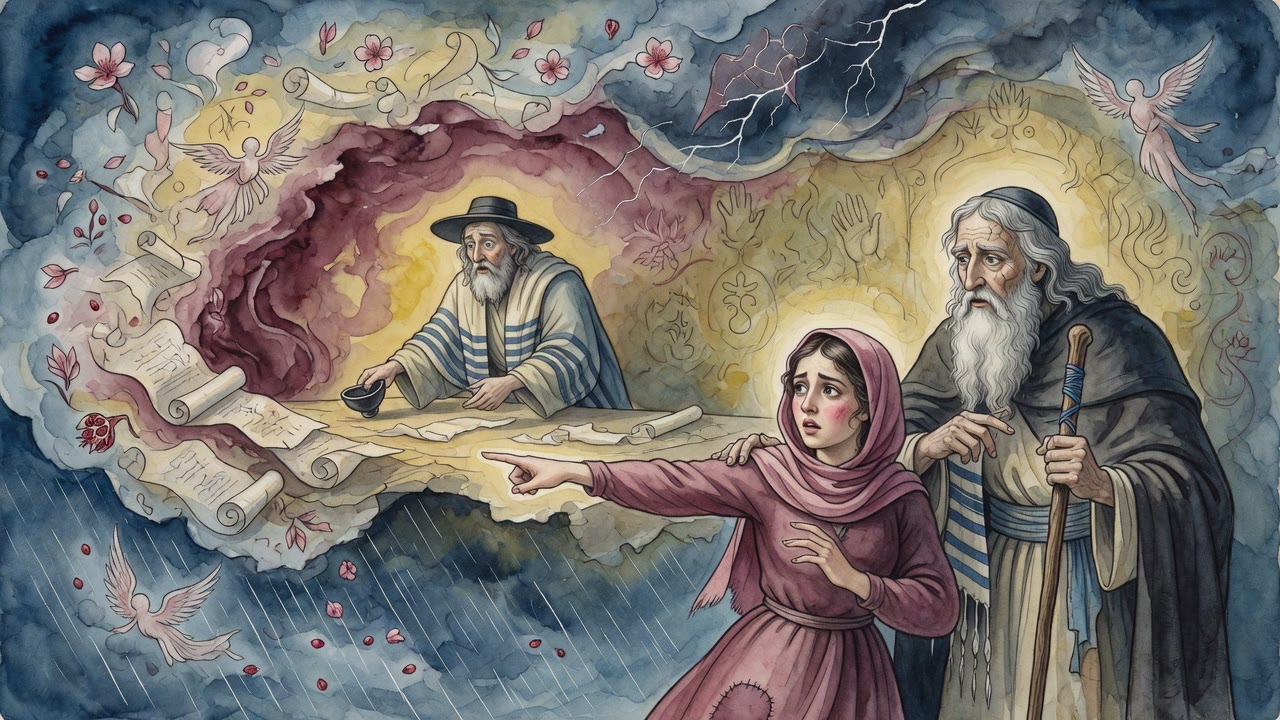
The scribe dipped his reed and waited. The ketubah needed a father's name. Across the small table, an orphan girl pressed her palms flat on the wood so no one would see them shake. Her guardian stood behind her chair, kind-faced, travel-dust still on his sleeves from the errands of arranging the match.
The Orphan Who Named Her Guardian as Father Click for full size

"The father's name," the scribe said again, gentler.

She opened her mouth. Nothing came. The room held the ordinary sounds of a courtyard beyond the door: a goat bell, two women arguing over water, a child singing half a verse. Inside, the silence thickened until the guardian touched her shoulder.

"Why won't you answer?"

She turned enough to see him and not the reed. "Because I do not know any father other than you. The one who raises is called father, not the one who only begets."

The Name That Would Not Fit the Line

The scribe looked from face to face. Law wanted a lineage. The girl offered a life. Ink hung ready and useless. In the end the contract took the guardian's name because that was the only fatherhood present in the room with weight enough to stand under a marriage.

She did not smile when it was done. She only breathed out, as if she had set down a jar too heavy for her arms. The guardian's eyes shone and he looked away toward the courtyard light.

That domestic scene is how Israel answers when heaven presses a harder question.

When Trouble Remembers the Word Father

Isaiah cries, "But now, Lord, You are our Father" (Isaiah 64:7). The plea arrives after absence, after a confession that no one was calling the Name, after the complaint that the face of God had been hidden (Isaiah 64:6). Trouble sharpens memory. A people who wandered from the daily work of the will suddenly want the intimacy of family speech.

God does not rush to accept the title like a flattered official. The challenge comes back sharp: Where were you before the crisis? Do you call Me Father only when the walls shake? I show Myself as Father and Maker to the one who does My will. Everyone called by My name is formed for My glory (Isaiah 43:7).

Then a second thrust: Have you forsaken Abraham, Isaac, and Jacob, that you call Me Father? Look to Abraham your father (Isaiah 51:2). The patriarchs stand in the record as begetters of the nation. Why leap over them?

Israel answers with the orphan's logic. The one who raises is father. Exile has been a long raising. Bread in strange cities, Torah carried in packs, festivals kept under foreign calendars, the stubborn refusal to dissolve. Abraham begot. God raised.

Sons Lined Without a Ladder

The same insistence on equal belonging shows in how the tribes are named. The lists do not always march Reuben, Simeon, Levi, Judah in a frozen rank. Orders shift. Leah's sons and Rachel's sons do not permanently tower over the sons of Bilhah and Zilpah on the page. The rearrangements block the easy sneer that some brothers were roof-beams and others only scraps.

Rabbi Yehoshua of Sikhnin, in the name of Rabbi Levi, saw the tribes as the tikra, the ceiling of the world: thick beam set beside thinner, strength from joinery rather than from a single board's boast. Isaiah's language of the one God called (mekora'i) leans toward that ceiling word (Isaiah 48:12). A roof fails if only the "best" planks are allowed to touch.

So when Israel claims God as Father, it is not a grab for status over the patriarchs. It is the orphan's accuracy. The household that kept them alive through empires is the household they name at the table.

The Contract Ink Dries

Back in the small room, the guardian walked the girl to the courtyard after the signing. Neighbors would still ask whose child she had been. She would still feel the missing biological line like a pulled thread. But the ketubah held a name that had packed her food, hired her teachers, stood between her and the street.

Israel walks out of the argument with Isaiah under a similar sky. Abraham remains father in the blood of the story. God remains Father in the daily raising. The crisis that made the people cry "Our Father" does not get to be the only hour of the relationship, or the title turns into flattery. The will has to follow the word, the way the girl had already lived the fatherhood she finally spoke.

Night came down on both houses, the small one and the national one. In each, a name spoken under pressure stayed spoken.


← All myths
From the tradition

Sources

2 sources

The texts behind this telling. Some cards carry a translation of the source; others are our own retelling of it, and each card says which. Every card links out to the original.

Shemot Rabbah 46:5Shemot Rabbah

Retold in our words. Read the original at the link below.The Sefaria Midrash Rabbah, 2022 · CC-BY

The prophet Isaiah cries out, "But now, Lord, You are our Father" (Isaiah 64:7). But God, it seems, isn't so quick to embrace this sudden familial affection. He essentially asks, "Where were you before? Just a moment ago, Isaiah was lamenting, 'There is no one calling Your name..because You concealed Your face from us' (Isaiah 64:6). Now that you're in trouble, you suddenly remember I'm your Father?"

Do we only seek connection when

God doesn't stop there. He continues, "I wish to show Myself as Father and Maker only to one who performs My will." This idea is echoed in (Isaiah 43:7): "Everyone who is called by My name, whom I have created for My glory, I have formed him and I have made him." According to the Rabbis in Shemot Rabbah, this verse means that God sees Himself as the Maker of those who fulfill His commands and His will.

So, what's going on here? Is God being harsh? Is He setting an impossibly high bar for connection?

The text continues, exploring this idea of fatherhood. God asks the people, "Have you forsaken your patriarchs Abraham, Isaac, and Jacob, that you call Me Father?" It's almost as if He's saying, "Don't you have other fathers you can turn to?"

The people's response is fascinating. They essentially say, "We acknowledge You as our Father." To illustrate this, Shemot Rabbah tells a story:

He cares for her, protects her, and seeks to find her a husband. When the scribe comes to write the marriage contract and asks for the father's name, she falls silent. Her guardian asks why, and she replies, "Because I do not know any father other than you, for it is the one who raises who is called father and not the one who begets."

This is a powerful analogy. The Jewish people, the "orphans," are being raised by God, their "good and trustworthy guardian." So they cry out, "Our Father!" But God challenges them again, referencing Abraham: "Look to Abraham your father" (Isaiah 51:2).

And here's where it gets really interesting. The people respond, "Master of the universe, the one who raises is the father, not the one who begets, as it is stated: 'For You are our Father; for Abraham does not know us'" (Isaiah 63:16).

Think about the weight of that statement. They are acknowledging God as the one who has nurtured and sustained them, even if their physical lineage traces back to Abraham. Abraham may be their ancestor, but God is the one who has truly parented them.

What does this all mean? It seems to me that Shemot Rabbah is confronting the complex nature of our relationship with God. It's not just about biological connection or historical lineage. It's about recognizing the source of our sustenance and guidance.

It is about performing God's will, of course, but as the story of the orphan girl shows, it is also about acknowledging the Divine presence that is actively involved in raising us as children in this world.

Full source
Shemot Rabbah 1:6Shemot Rabbah

Retold in our words. Read the original at the link below.The Sefaria Midrash Rabbah, 2022 · CC-BY

It’s not a typo, and it’s definitely not random! There’s a beautiful lesson tucked away in that apparent inconsistency.

Rabbi Yehoshua of Sikhnin, quoting Rabbi Levi, offered a powerful explanation, one that really resonates even today. Why does the lineup change?

The answer, according to them, is to prevent any of us from thinking that the sons born to Jacob’s wives, like Leah and Rachel, were somehow superior to the sons born to the handmaidens, Bilhah and Zilpah. We shouldn't assume that some tribes were inherently "better" or "more important" than others. The Torah is actively teaching us that each tribe, each son, was equal in the eyes of God. In a world obsessed with hierarchy and status, this is a radical idea.

There's more! Rabbi Yehoshua and Rabbi Levi offer another, equally compelling, reason. They say the tribes are like the tikra, the "ceiling" or "roof," of the world. Imagine building a roof. You wouldn’t just use planks of all the same size. You’d carefully interlock different pieces to create a strong, stable structure. So too, with the tribes.

Each one brings a unique strength, a unique perspective, and a unique contribution. By varying their order, we're reminded that their strength comes from their complementarity, not from some inherent superiority. "One who installs a ceiling properly places the thickness of this ceiling beam alongside one that is not its equal," they said.

But where does this idea of the tribes being the "ceiling" of the world come from? Well, Rabbi Yehoshua and Rabbi Levi point us to the prophet Isaiah. In (Isaiah 48:12), God says, "Heed Me, Jacob and Israel, whom I called [mekora’i]." The word mekora’i, "whom I called," shares a root with the word tikra, "ceiling." It's a subtle but powerful connection, suggesting that Israel, in its entirety, forms a protective covering over the world.: the tribes, in their diversity and equality, represent the very foundation upon which the world is sustained. Each one, vital. Each one, essential.

So, the next time you encounter those shifting names in the Torah, remember Rabbi Yehoshua and Rabbi Levi's wisdom. It's a reminder that true strength lies not in hierarchy, but in recognizing the inherent worth and equal importance of every single member of our community. What kind of roof are we building?

Full source