Jacob's Staff Holds the Jordan Open for Israel
Centuries after Jacob crossed with only a staff, the Jordan flees for his children, and Exodus still calls them by name like stars.
Table of Contents
 Click for full size
A Staff and a River
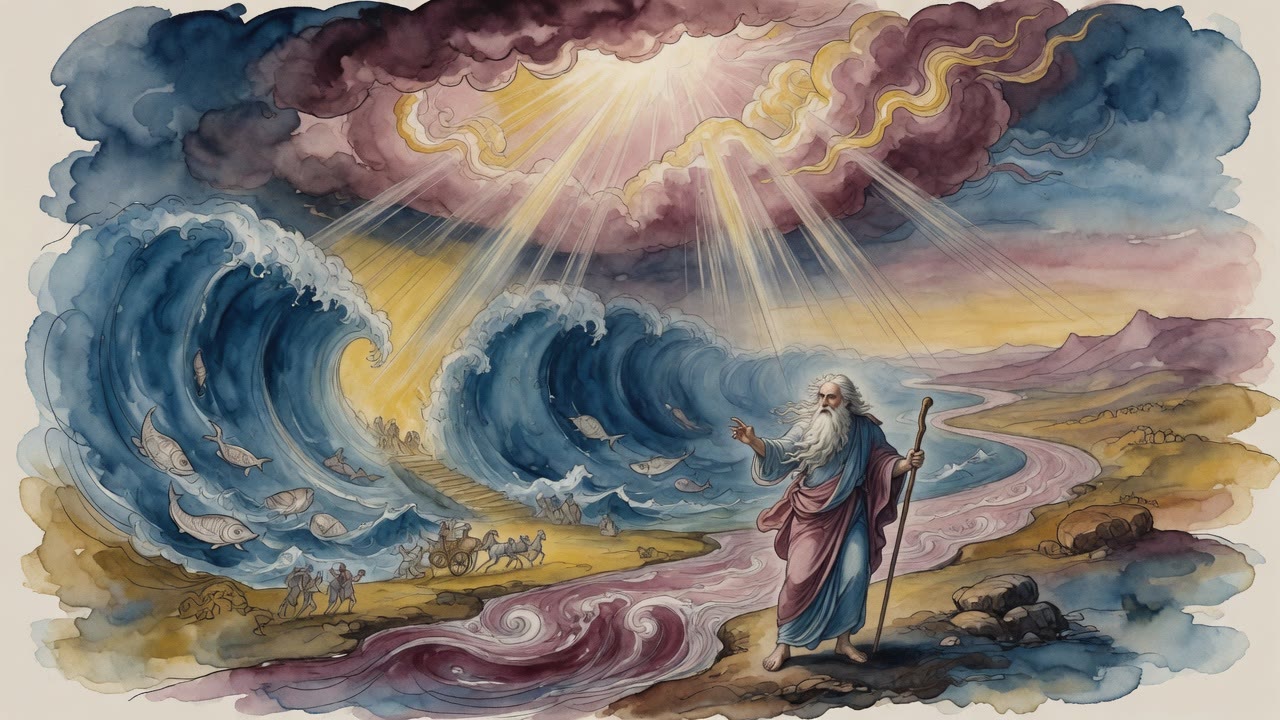
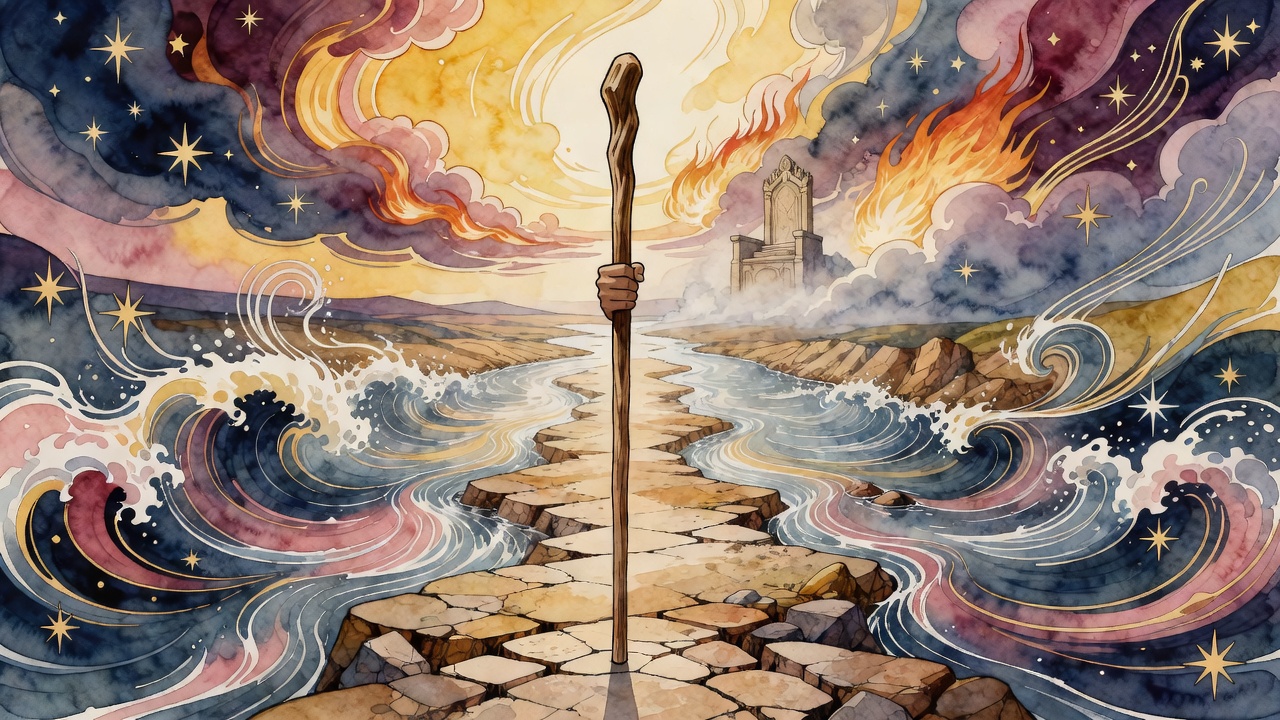
Jacob once stood at the Jordan with nothing but a staff and a history of flight. "For with my staff I crossed this Jordan," he said later, when the camps of wives and children and flocks made the old poverty hard to believe (Genesis 32:11). The river remembered the man who became Israel. Generations later, when the nation that carried his name came to the same water under Joshua, the midrash refuses to call the dry path an accident of timing alone.
Rabbi Huna heard Song of Songs and answered with Joshua's charge: tell your children that Israel crossed this Jordan on dry land (Joshua 4:22). Not "children of Israel" in that verse, but Israel, the patriarch's own name, as if the river opened for the merit of the one who crossed first with a stick and a prayer.
Priests' feet entered the water. The current stacked up. Children of the wilderness, who had not seen the Reed Sea, now saw a river behave like a door. Behind that door stood an old man with a staff, still paying forward a crossing he made alone.
Torah, Prophets, Writings
Rabbi Yudan in the name of Rabbi Yohanan said the proof runs through all three parts of Scripture. Torah: the staff verse in Genesis. Prophets: Joshua's memorial teaching. Writings: the psalm that asks the sea and the Jordan why they flee, and answers, from before the God of Jacob (Psalm 114:5-7). The water does not debate policy. It turns back from the God who bound Himself to that man's name.
Merit here is not a charm worn on a neck. It is a life that still weighs on a later day, heavy enough to part a current. Jacob wrestled, limped, schemed, blessed, and buried his dead. The river responds not to a marble statue of virtue but to a covenant history with mud still on it.
Mothers on the bank told sons to look. The sons would one day tell their own sons. The staff became invisible infrastructure, a private tool promoted to national engineering.
Names Like Stars
Exodus opens by listing the names of those who came down to Egypt, names Genesis already knew. Why say them again? Rabbi Abbahu heard the difference between eleh and ve'eleh, the second form adding praise rather than erasing what came before. The seventy souls are not a discarded preface. They are a roll of honor on the way into slavery. God counts the stars and calls them all by name (Psalm 147:4). Israel is set beside that host, each person a light heaven bothers to name before the darkness of labor begins.
The book of redemption starts with a census of love, not with a whip. Before bricks, names. Before taskmasters, a list that sounds like a family being counted for a journey. Jacob's house enters Egypt already precious in the grammar of the opening word.
When the Jordan later opens, it opens for a people whose ancestors were already star-catalogued. Anonymity was never the plan. Slavery tried to make them a mass. Scripture keeps making them a roster.
Tribes as Ceiling Beams
When the tribes are listed in changing orders, Rabbi Yehoshua of Sikhnin in the name of Rabbi Levi said they are the ceiling of the world. A builder does not lay every beam the same thickness side by side without thought. He sets strength against strength so the roof holds. The shifting order refuses a single permanent ranking. Complement is the structure. Jacob's house crosses the Jordan as one roof, not as twelve rival ladders.
Staff, names, beams. The man who crossed poor becomes the measure by which a nation crosses rich in children. The river flees. The list of names stands. The ceiling holds because the pieces are not identical. Reuben's thickness beside Judah's, Dan's place moving as the story needs balance, each shift a reminder that the roof is a team.
On the far bank, stones rose as a memorial. The midrash stacks older stones under them: a staff's print, a census of seventy, a ceiling of tribes. Israel walks into the Land on carpentry and memory as much as on dry mud.
Jacob had sent gifts across the river before he crossed to meet Esau, dividing camps, bowing seven times, still limping from the night's wound. The staff was never only wood. It was the thin line between the man who fled and the man who returned. When Joshua's generation stepped into the stacked water, they walked on that line extended to the width of a nation. Merit, in this telling, is a path worn deep enough that later feet can find it in the dark.
← All myths