5 min read

The Merit That Moved From Mount Moriah to the Red Sea

Israel stood at the sea with nowhere to go. The rabbis asked what finally moved God to split it. The answer started with a promise made centuries before.

Curated by Arthur · Told by Maggid ·
Table of Contents
  1. The Moment Before the Sea Split
  2. Why It Was Abraham's Merit and Not Israel's
  3. Great Is the Faith That Walked Into the Water
  4. God in Exile With Israel
  5. The Mercy That Came From the Ancient Covenant

The Moment Before the Sea Split

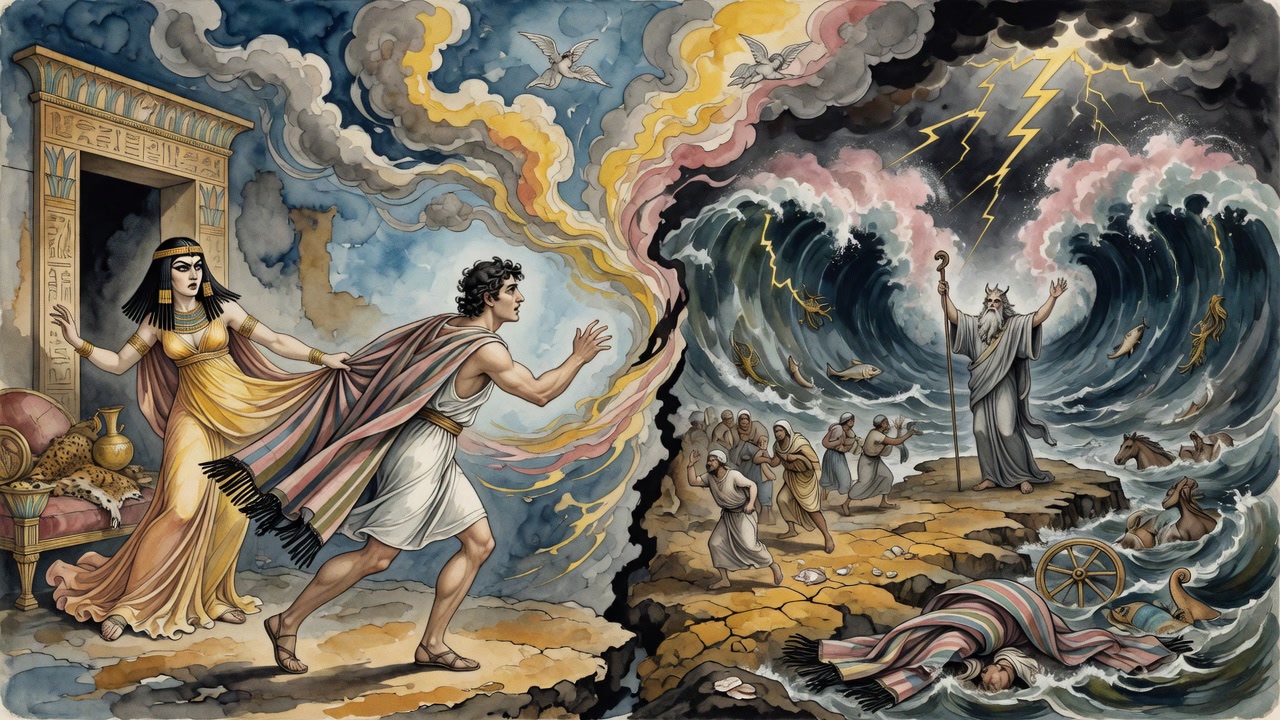
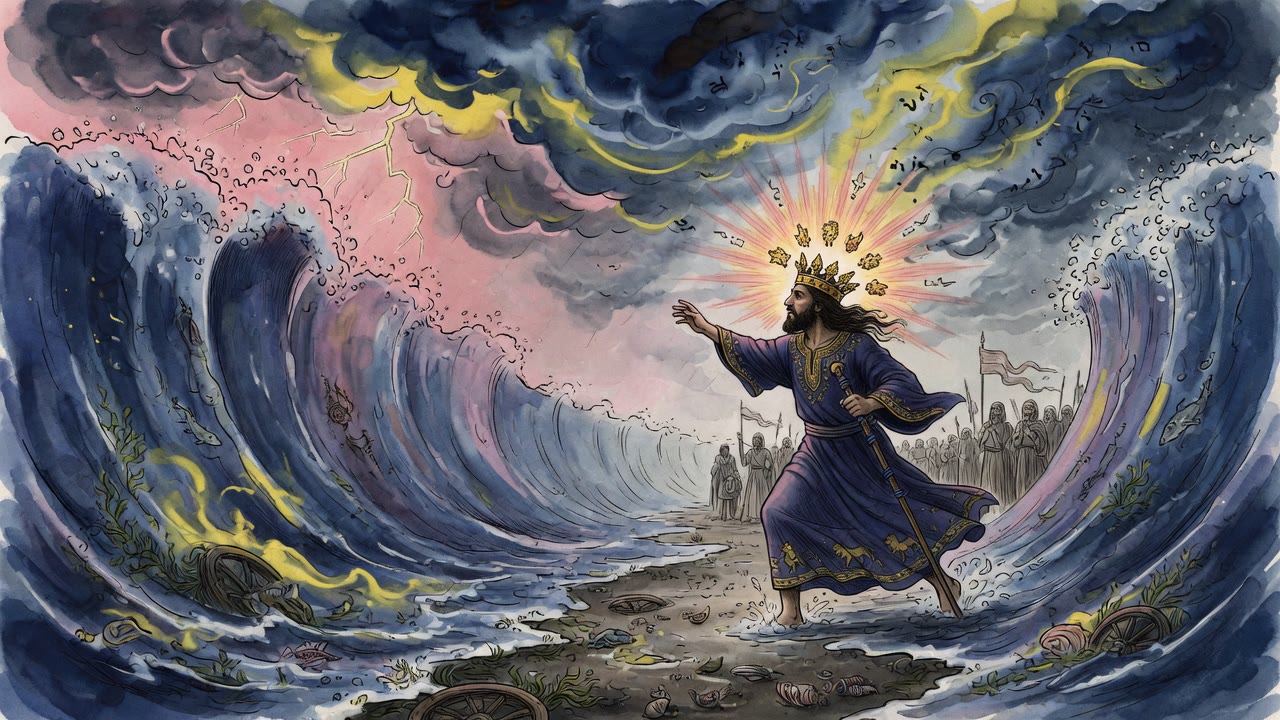
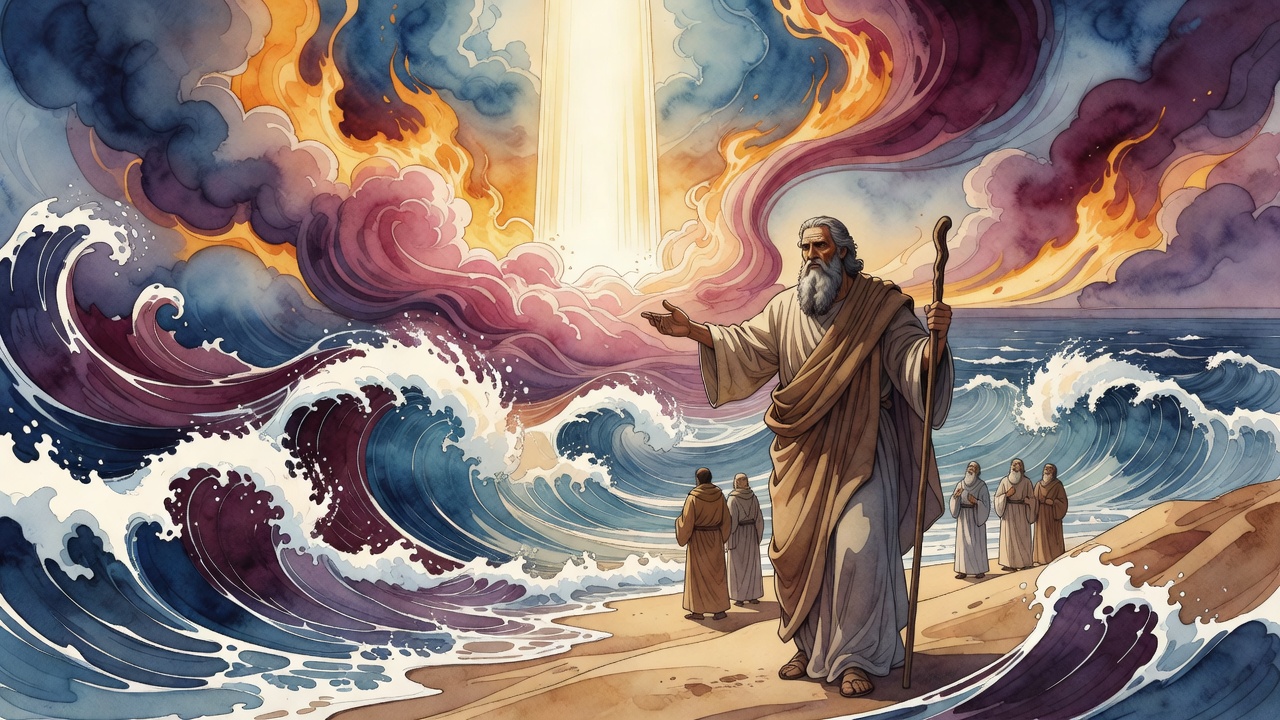
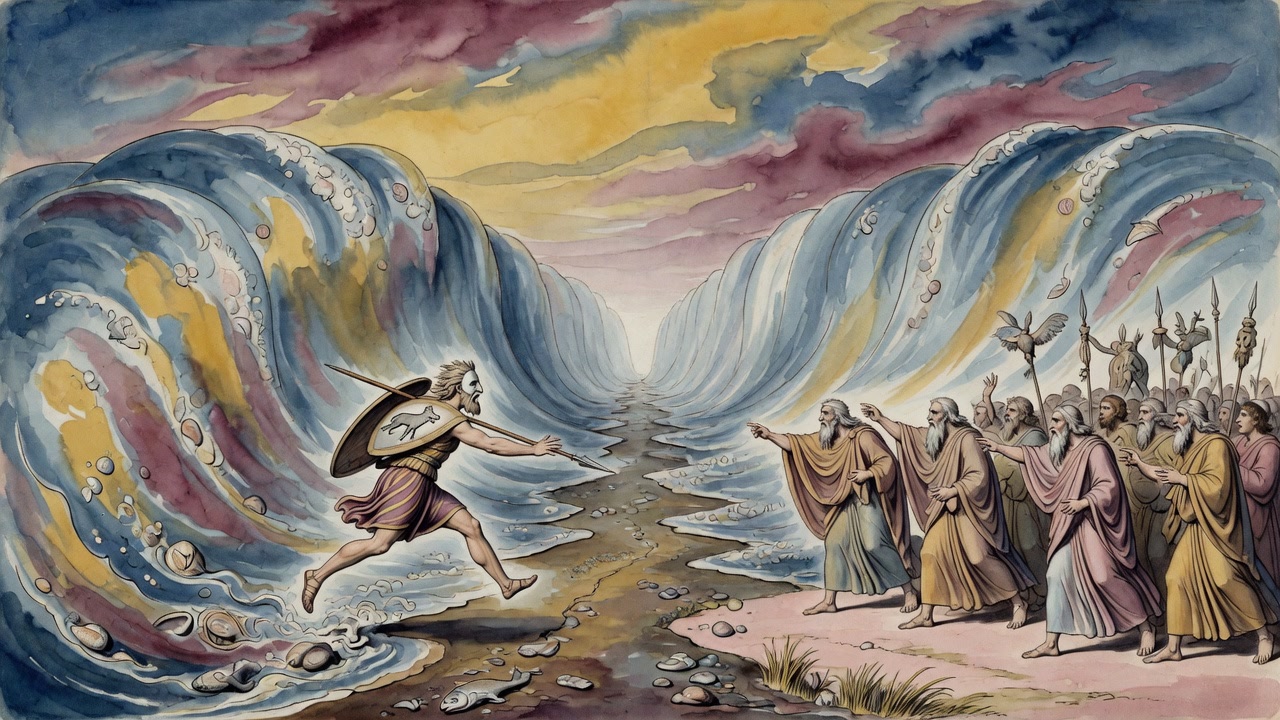
God had already told Moses to stop praying and tell the people to move forward. The army was behind them and the water was ahead of them and there was still nothing happening. Israel went into the sea. According to the Mekhilta DeRabbi Yishmael, the ancient halakhic midrash on Exodus, the water did not split when Moses stretched out his staff. It split when the water reached a man's nostrils.

Rabbi Yossi HaGlili looked at this sequence and asked what had finally made the sea move. His answer came from geometry and covenant: at the precise moment Israel stepped into the water, Mount Moriah tore itself from its place and was carried to the sea. With it came the altar Abraham had built there for the binding of Isaac. With it came the accumulated weight of that act, and all the merit attached to it, arriving at the shoreline to stand behind Israel at the moment they needed something to stand behind them.

Why It Was Abraham's Merit and Not Israel's

Rabbi Elazar ben Azaryah made an explicit statement preserved in the Mekhilta: God did not free Israel from Egypt because of anything the generation in Egypt had done. Not their prayers. Not their suffering. Not their righteousness. It was the merit of Abraham.

This was not a rebuke of the generation in Egypt. They had suffered enormously. They had cried out and God had heard them. But the hearing was conditioned on something that preceded them by centuries. Abraham had walked into a furnace for refusing to worship idols. Abraham had left his home and his country and his father's house for a destination he had not been shown. Abraham had bound his son on a mountain in silent obedience and lifted the knife. That accumulated action was what God was answering when God answered Egypt.

Great Is the Faith That Walked Into the Water

The Mekhilta also preserved a different answer, not contradicting the first but alongside it. Great is the faith by which Israel believed in the One who spoke the world into being. The reward for that faith was the sea splitting, the Song of the Sea, the moment of transformation that Israel would retell for every subsequent generation as the central act of divine rescue.

The faith the Mekhilta was describing was not the faith of the theologians. It was the faith of walking into water that had not yet parted. It was the faith of men and women who could hear the chariot wheels behind them and still moved forward because they had been told to move forward. Abraham's merit created the conditions. Israel's faith in that moment completed the act.

God in Exile With Israel

Pesikta Rabbati, a later Palestinian midrash compiled around the 7th century CE, preserved a teaching about what happened to God when the Temple was destroyed and Israel went into exile. God went with them. Not metaphorically, the divine presence withdrew from the Temple and traveled with Israel into Babylon and into every subsequent diaspora.

The rabbis read this alongside the sea splitting as part of a single through-line about how God's relationship with Israel worked. The merit at the sea was Abraham's, transferred to his descendants, made available to them in the moment they needed it most. The presence in exile was the same logic extended: the covenant did not dissolve when everything else dissolved. It compressed into the portable form that could travel wherever Israel traveled.

The Mercy That Came From the Ancient Covenant

Moses gave Israel the Torah, and the Midrash looked at that gift and said it was not separate from the mercy that had been the first principle of creation. God had declared three times: in mercy I created the world, in mercy I guide it, with mercy I will return to Jerusalem. The Torah given at Sinai was the form that mercy took in history. The sea splitting was the form that mercy took at the shoreline. Abraham's merit was the form that mercy took across generations.

The rabbis were not describing a system of divine accounting in which good deeds accumulated interest. They were describing something more like a structural commitment that had been built into the world before the world was made, and that showed up at the sea because it had been there before the sea existed.


← All myths

From the tradition

Sources

5 sources

The texts this telling draws on, in full. Open a card to read inline, or expand it for a wider, quieter read.

Mekhilta Tractate Vayehi Beshalach 4:26Mekhilta DeRabbi Yishmael

This dramatic scene from the Mekhilta DeRabbi Yishmael belongs to the section on the splitting of the Sea of Reeds, expounding the Song at the Sea. R. Yossi HaGlili imagines that at the very instant Israel stepped into the water, Mount Moriah was torn from its place and carried to the sea, and with it the entire tableau of the Akedah. The altar stood ready, the wood was arranged upon it, Isaac lay bound atop the woodpile, and Abraham reached out his hand and grasped the knife to slaughter his son, exactly as Genesis 22 describes. The merit of that supreme act of faith is summoned as a living defense for Abraham's descendants in their hour of terror.

Into this picture the midrash sets a sharp exchange. With the sea raging and the Egyptians bearing down, the L-rd says to Moses: My children are in distress, and you stand here drawing out your prayer? Moses answers, But what can I do? The reply is the command of (Exodus 14:16): "Raise your staff and stretch out your hand over the sea" and split it. There is a moment for petition and a moment for action; the rescue at the sea calls for both faith and the decisive lifting of the staff.

The teaching then turns the people toward praise, heaping up a cascade of words: exalt and praise, song and thanks, grandeur, glory, splendor, and hallel, all directed to the Master of wars who delivered them. The redemption at the sea is bound to the binding of Isaac, so that ancient merit and present salvation answer one another in song.

Full source
Mekhilta Tractate Pischa 16:36Mekhilta DeRabbi Yishmael

Rabbi Elazar ben Azaryah, one of the most prominent Tannaitic sages, made a bold claim about why God chose to liberate Israel from Egypt. It was not because of anything the enslaved generation had done. It was not their prayers, their suffering, or their righteousness. It was because of the merit of one man who had lived centuries earlier: their forefather Abraham.

The proof comes from (Psalms 105:42-43): "For He remembered His sacred word to Abraham His servant, and He took out His people in gladness, His chosen ones in song." The verse links two actions with a causal chain, remembering the promise to Abraham led directly to taking the people out of Egypt.

This concept is known in rabbinic thought as zekhut avot, the merit of the ancestors. It holds that the righteous deeds of the patriarchs create a spiritual account that their descendants can draw upon in times of need. Abraham's faith, his willingness to leave his homeland at God's command, his binding of Isaac on Mount Moriah, these acts accumulated a merit so vast that it could fund the redemption of an entire nation generations later.

The teaching carries a humbling implication. The generation that left Egypt did not earn their freedom. They inherited it. The Exodus was not a reward for the present but a fulfillment of a promise made to the past. God freed Israel because He remembered Abraham.

Full source
Mekhilta Tractate Vayehi Beshalach 7:20Mekhilta DeRabbi Yishmael

The Mekhilta exalts the power of emunah, faith, as the decisive merit that brought Israel its highest moments. Commenting on the crossing of the Sea, the sages declare: great is the faith wherein Israel believed in Him who spoke and brought the world into being. The reward for that belief was immediate and immense. Because Israel trusted in the Lord, the Shechinah, the indwelling Presence of God, came to rest upon them, and they were able to break into the Song at the Sea.

The proof comes from the very sequence of the verses. Scripture first says, "And they believed in the Lord and in Moses His servant," and only then, in the next breath, "Then Moses and the children of Israel sang." The song does not precede the faith; it flows directly out of it. The rabbis read this order as cause and effect: belief opens the mouth to praise, and the prophetic spirit needed to compose such a song is itself a gift granted to those who first trust.

The Mekhilta then reaches back to the founding figure of the nation. It teaches that our father Abraham inherited both this world and the world to come solely in the merit of his believing in the Lord, citing, "And he believed in the Lord, and it was accounted unto him as tzedakah" (Genesis 15:6). Faith, then, is not a passive sentiment but a meritorious act that secures lasting reward, binding the patriarch's trust to Israel's trust at the Sea as a single continuous virtue.

Full source
Pesikta Rabbati 30:1-2Pesikta Rabbati

"Comfort, comfort My people, says your God" (Isaiah 40:1). This is what is said by the Holy Spirit: "What shall I take to witness for you? What shall I liken to you?" (Lamentations 2:13). Concerning whom did Jeremiah speak this verse? He spoke it only concerning Jerusalem, for all the prophets sought a mate for Jerusalem and did not find one. A parable: to a man whose wife died, and his companions came in to comfort him. If they comfort him over his wife and he will not be comforted, they say to him: Is your wife more beautiful than the wife of so-and-so, who died, and he accepted comfort over her? If over his son, thus they say to him: Is your son more beautiful than the son of so-and-so? So you find that when the Holy One, blessed be He, brings calamity upon a province, He pairs it with another province to comfort it thereby. When He brought calamity upon Nineveh, He paired Alexandria of Egypt with it, as it is said: "And it shall come to pass that all they that look upon you," and so forth ("Nineveh is laid waste; whence shall I seek comforters for you? Are you better than No-Amon, that was situated among the rivers? She also went into exile," and so forth) (Nahum 3:7-9). With Alexandria He paired Nineveh to comfort it, as it is said: "Speak unto Pharaoh," and so forth ("Behold, Assyria was a cedar in Lebanon," and so forth) (Ezekiel 31:2-3); and at the end it is written: "And strangers, the terrible of the nations, cut him off" (Ezekiel 31:12). But for the Congregation of Israel He found none to pair with her, until Israel said: "Behold, as the eyes of servants look to the hand of their masters, and as the eyes of a maiden to the hand of her mistress, so our eyes look to the LORD our God, until He be gracious to us" (Psalms 123:2). Joel came and paired her, "And you children of Zion, be glad and rejoice in the LORD your God" (Joel 2:23), and it is written: "And I will rejoice in Jerusalem, and joy in My people; and the voice of weeping shall be no more heard in her, nor the voice of crying" (Isaiah 65:19).

When Israel went into exile from their land, the Holy One, blessed be He, said to them: Whom do you want? Your earliest forefathers, that I should raise him from his grave and he will go at your head? If Abraham, Isaac, and Jacob; if Moses and Aaron, I will raise him from his grave and he will go at your head; if David and Solomon you want, I will raise him from his grave and he will go at your head. Israel said to Him: Master of the universe, we do not want these, but only You, as it is said: "For You are our father, though Abraham knows us not, and Israel does not acknowledge us; You, O LORD, are our father, our redeemer; Your name is from everlasting" (Isaiah 63:16). The Holy One, blessed be He, said to them: Since you have spoken thus, I will go up with you to Babylon, as it is said: "For your sake I have sent to Babylon" (Isaiah 43:14), "and I will set My throne in Elam" (Jeremiah 49:38). A parable: to a king who married a wife, and she was with him many years and he had no children from her. He said to her: My daughter, go and marry another man; perhaps you will have children from him; but take all the precious vessels that I have in your house and go. She said to him: If it is so, let me make you a feast, and let us eat and drink, and I will part from you, so that they will not say, See, the king's wife, since he hated her, he expelled her from his house. He said to her: Yes. Immediately she made a feast; the king ate and drank and became drunk. And she commanded her servants in the middle of the night, and they arose and carried him out on the bed to her father's house. When the king awoke from his sleep, he said: In what place am I reclining? She said to him: In my father's house. He said to her: And what is the nature of my being in your father's house? She said to him: Thus you said to me, Take all the precious vessels that I have and go; I have no delight of my eyes and gladness of my soul but you. So too the Congregation of Israel: at the hour when the Holy One, blessed be He, said to them, Whom do you want, that I should raise him from his grave and he will go at your head to Babylon, they said to Him: We do not want any but You, as it is said: "For You are our father." Immediately the Holy One, blessed be He, said to them: I will be your mate, and I will bring you up, as it is said: "For your sake I have sent to Babylon" (Isaiah, ibid.).

Another interpretation: "Comfort, comfort," why twice? Only because of "she weeps sorely" (Lamentations 1:2). The Holy One, blessed be He, said: Now I will comfort you twice over: "Comfort, comfort My people." Another interpretation: The Holy One, blessed be He, said to Abraham: Go and comfort Jerusalem; perhaps she will accept comfort from you. Abraham went and said: Accept comfort from me. She said to him: How shall I accept comfort from you, when you made me into a mountain, as it is said: "In the mountain where the LORD is seen" (Genesis 22:14)? He said to Isaac: Go and comfort Jerusalem; perhaps she will accept comfort. Isaac went and said, and so forth. She said to him: How shall I accept comfort from you, from whom Esau the wicked went forth, and who made me into a field, as it is said: "And Esau went to the field" (Genesis 27:5), and whose children burned me with fire? He said to Jacob: Go and comfort Jerusalem, and so forth. She said to him: How shall I accept comfort from you, who made me as though I had never been, as it is said: "This is none other than the house of God" (Genesis 28:17)? He said to Moses: Go and comfort, and so forth. She said to him: How shall I accept comfort from you, who wrote curses and harsh decrees concerning me: "the wasting of hunger, and the devouring of the fiery bolt," and so forth (Deuteronomy 32:24)? Immediately they all returned and said to the Holy One, blessed be He: She did not accept comfort from us, as it is said: "O afflicted one, storm-tossed, not comforted" (Isaiah 54:11). Immediately the Holy One, blessed be He, said: It is incumbent upon Me to comfort Jerusalem, for thus I wrote: "He that kindles the fire shall surely make restitution" (Exodus 22:5). I kindled her with fire, as it is said: "From on high has He sent fire" (Lamentations 1:13); I will comfort her, as it is said: "For I, says the LORD, will be unto her a wall of fire round about," and so forth (Zechariah 2:9).

The Holy One, blessed be He, said: I wrote in the Torah, "You shall not deliver a servant to his master" (Deuteronomy 23:16), yet I delivered them into the hand of the nations of the world, as it is said: "Except their Rock had sold them, and the LORD had delivered them up" (Deuteronomy 32:30). I wrote, "You shall not wholly reap the corner of your field" (Leviticus 19:9), yet I made an end of My fury, as it is said: "The LORD has accomplished His fury" (Lamentations 4:11). And were it not for the iniquities for which they were delivered up, no creature could prevail against Israel. There was an incident of a certain gentile who pursued an Israelite to kill him, and he did not reach him until a serpent came and coiled around him and threw him down. He said to him: Wait until I tell you a thing. Had the Holy One, blessed be He, not delivered us into your hand, you could not prevail against us, as it is said: "Except their Rock had sold them" (Deuteronomy 32:30). And when they killed Ben Koziba, they brought his head to Hadrian. He said to them: Bring me his body. And they found a serpent coiled around his heart. He said to them: It was not we who killed him, but the Holy One, blessed be He, delivered him into our hands, for thus it is written in your Torah: "Except their Rock had sold them."

And the Holy One, blessed be He, is destined to say to Jerusalem: Accept comfort from Me, as it is said: "Open to me, my sister," and so forth (Song of Songs 5:2). She said to Him: He does not accept comfort from You until I and You speak words of reproof, as it is said: "Come, my beloved, let us go forth into the field" (Song of Songs 7:12), to a place where there is no commerce, "let us lodge in the villages" (ibid.). I will show you the nations of the world, whom You bestow goodness upon, yet they deny You. She said before Him: Master of the universe, why did You not do for me as for Joseph, as it is said: "Oh that you were as my brother" (Song of Songs 8:1)? Joseph, his brothers dealt evilly with him and sought to kill him, and when they came into his hand, he dealt kindly with them, and he himself comforted them, as it is said: "And he comforted them, and spoke to their heart" (Genesis 50:21). And even Shimei son of Gera said to David: "Behold, I am come this day the first of all the house of Joseph" (2 Samuel 19:21). He said to him: Did they ever distress you as the brothers of Joseph distressed him, and he accepted it from them? David turned back and said before Him: Master of the universe, when You gave the Torah to Israel, You took it around to all seventy nations and they did not accept it, until Israel accepted it; and now that they have accepted it, will You do thus? Immediately the Holy One, blessed be He, instructed her and said: I have regarded you, as it is said: "For I am a husband unto you" (Jeremiah 3:14). She said before Him: Master of the universe, it is fitting that You should speak between Me and Yourself; who will make known concerning me to the nations of the world that I did Your will? They will revile and reproach me and shame me and say to me: You rebelled against your God and you betrayed Him. Immediately the Holy One, blessed be He, said to her: I will make known concerning you to the nations of the world the deeds of your acts of righteousness, as it is said: "For I will declare your righteousness and your works" (Isaiah 57:12). And the Holy One, blessed be He, makes known the righteousness of Israel to the nations of the world. At that hour Michael and Jerusalem say: "The LORD has brought forth our righteousness; come, and let us declare in Zion the work of the LORD our God" (Jeremiah 51:10).


Full source
Midrash Tehillim 118:3Midrash Tehillim

It's not like God shows mercy to Israel for a year or two and then calls it quits! The Midrash (rabbinic interpretive commentary) suggests something much deeper is at play here.

Think about the Torah, for instance. Moses gave it to us, and the Midrash sees the Torah itself as an act of profound mercy. (Proverbs 31:26) says of the woman of valor, "She opens her mouth with wisdom, and on her tongue is the law of kindness." The Torah, according to this reading, isn't just a set of rules, but an expression of divine compassion. And crucially, it wasn't a temporary loan! (Deuteronomy 33:4) reminds us that "Moses commanded us a law, as an inheritance of the congregation of Jacob." It's ours, passed down through generations. All of God's mercies, the Midrash insists, are like that. They endure. (Lamentations 3:22) says it so powerfully: "Through the Lord's mercies we are not consumed, because His compassions fail not."

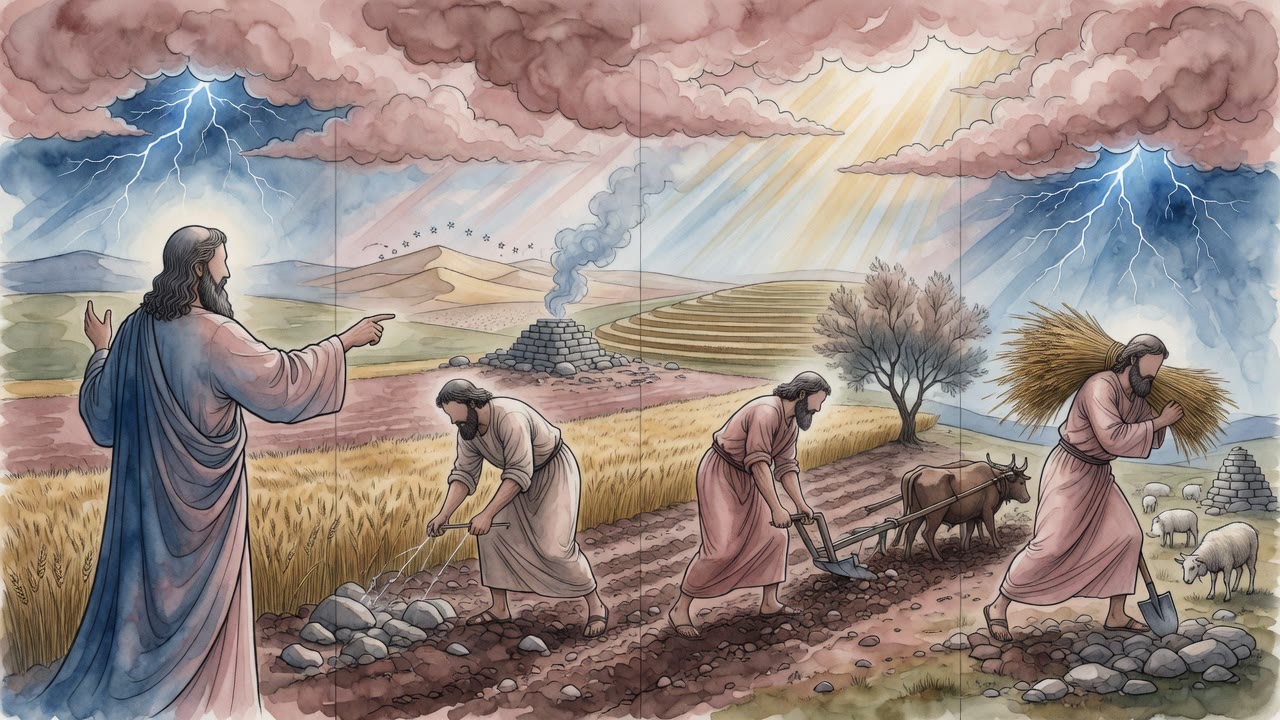
What kind of good are we talking about? The Midrash then shifts gears, offering an analogy. Imagine a homeowner who lends to everyone in town. During the rainy season, everyone sings his praises. But when the hot season rolls around, he starts asking for collateral – three rocks from each person.

Then, someone comes along and says, "I'll give you everything you need, and I only want one rock in return." People might switch their allegiance. But then another person shows up and says, "I'll give it to you for free." Well, now we're talking! It’s fitting to give thanks to the one who gives freely.

The point? God sustains us, His creatures, freely. There are no hidden costs, no collateral demanded. It is fitting to give thanks to the Lord, ki tov, "for He is good." He doesn't just offer temporary relief or a better deal; He offers unconditional and enduring support.

It makes you think, doesn't it? About the nature of gratitude. About the difference between a transaction and a gift. And ultimately, about the kind of relationship we want to have with the Divine. Are we focused on the "rocks" we might have to give up, or on the boundless, freely-given goodness that surrounds us, always?

Full source