Parshat Noach5 min read

The Ravens of Mastema and the Boy Who Cleared the Sky

In the dark years after the Flood the world forgot God, until a boy of fourteen ran at Mastema's ravens and turned the black sky back.

Curated by Arthur · Told by Maggid ·
Table of Contents
  1. The World That Forgot the Maker
  2. Serug Carved Gods in Ur
  3. The Prince Who Loosed the Spirits
  4. The Boy Who Would Not Kneel
  5. Mastema Sends the Ravens
  6. Seventy Times He Turned the Sky
The Ravens of Mastema and the Boy Who Cleared the Sky Click for full size

The World That Forgot the Maker

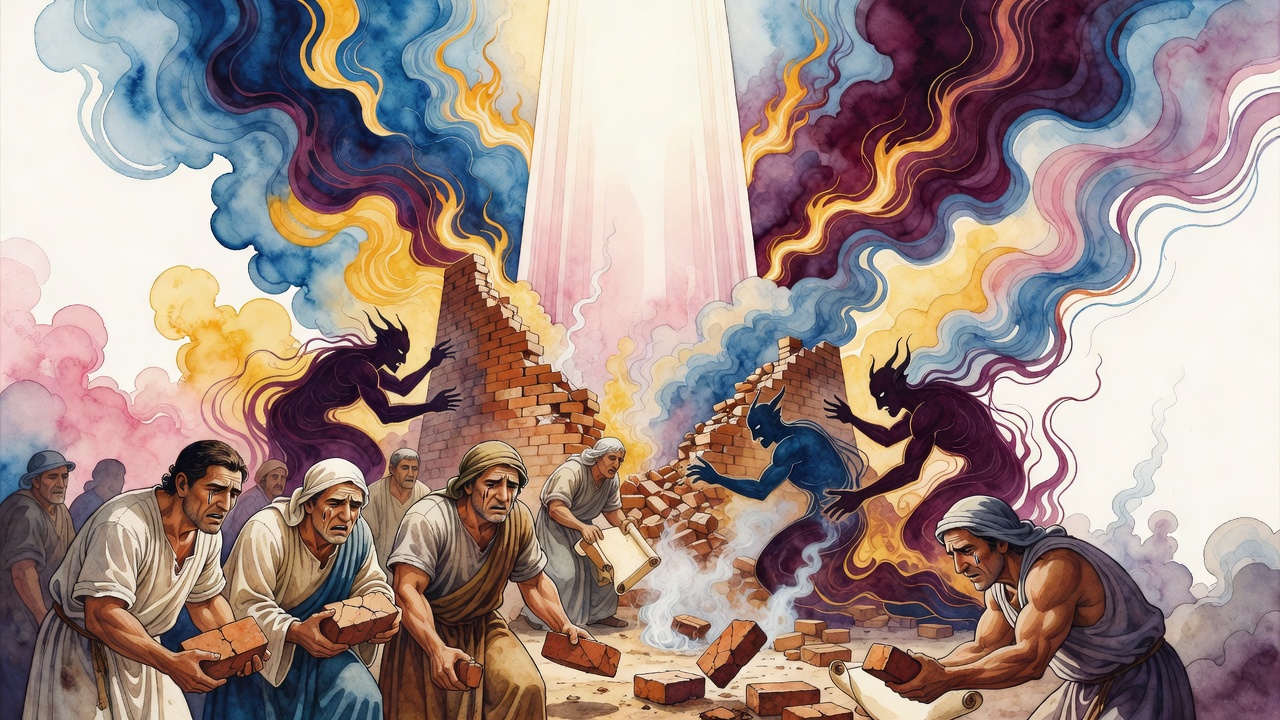
The water had barely dried from the earth when the killing started again. Men who had ridden out the Flood in the same ark now sharpened iron against one another. They built strong cities and threw up walls and raised towers, nation against nation, city against city, and they taught their sons the trade of war before they taught them anything else. In the plain they captured towns and sold men and women off like sacks of grain, and every hand learned to take what another hand had made. The world had been washed clean and rinsed itself filthy inside a few generations.

Serug Carved Gods in Ur

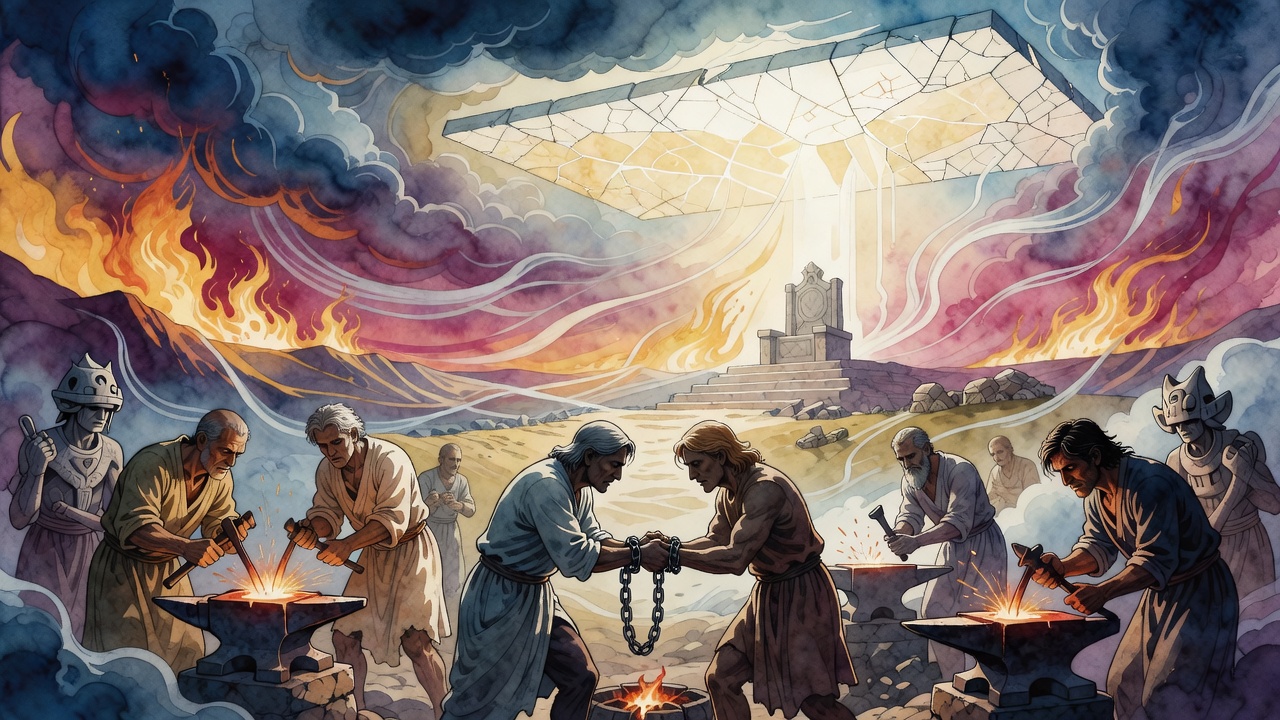
Into that age a boy was born whose name itself meant turning away. Serug grew up in Ur of the Chaldees, and there, among the kilns and the smoke, men had begun to pour metal into molds and fall down before whatever cooled in their hands. Serug worshipped idols. He married into a household that served them, took Melka the daughter of Kaber for his wife, and when she bore him Nahor, the child opened his eyes on the same shelves of graven images his father had carved. Serug taught his sons what his own hands knew. The knife that shapes a god. The smoke that feeds it. The bow of the head that costs nothing and buys nothing. Nahor stayed in Ur, and the next generation was born already kneeling.

The Prince Who Loosed the Spirits

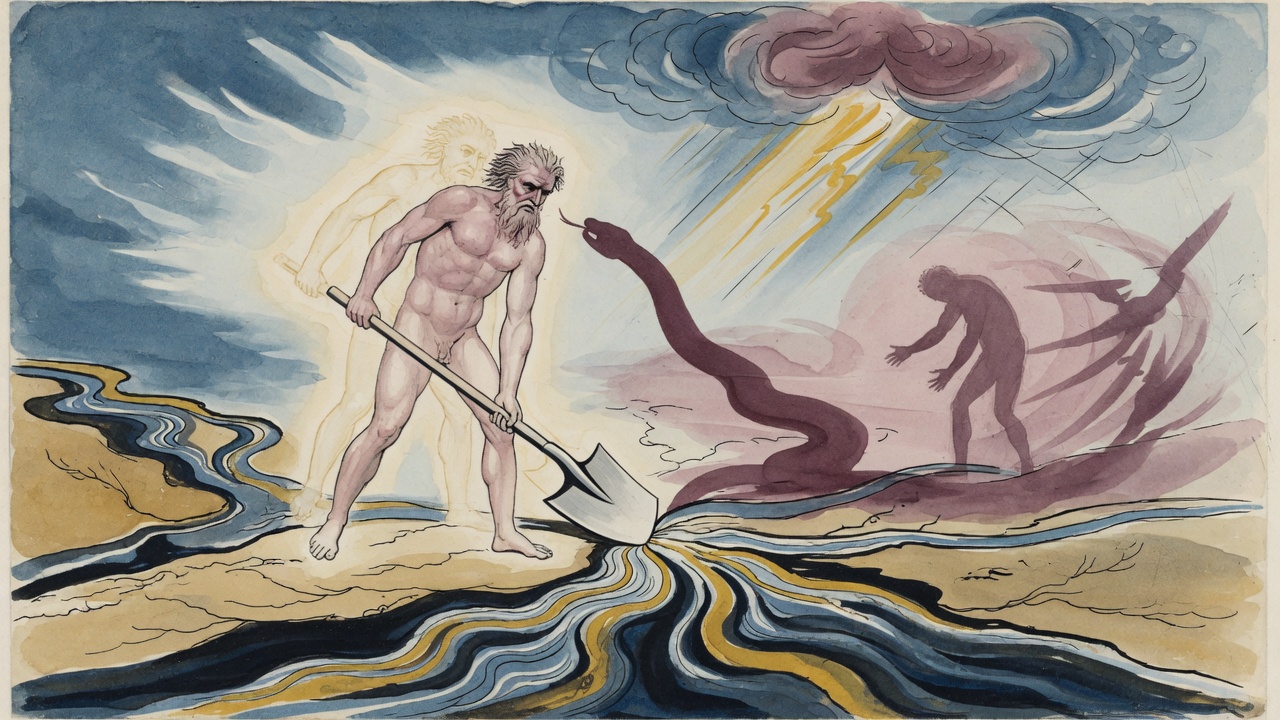
The men did not fall alone. Something pressed at their backs. Malignant spirits moved through the cities of the plain, and they did not merely tempt. They seduced, they corrupted, they drove hands toward blood. Over them stood a prince, and his name was Mastema. He exerted himself to ruin the whole earth, and he sent out the spirits under his hand to do every wrong, to shed blood, to make the ground itself unclean. The molten images multiplied. The graven shapes multiplied. And in the din of hammer and prayer, the name of the One who made the sky slipped out of the mouths of men, until almost nobody on earth remembered there had ever been a Maker at all.

The Boy Who Would Not Kneel

Almost nobody. In the house of Terah a child named Abram was watching. Terah taught him his letters, and the boy who could now read could also see. He understood the errors of the earth, that everyone had gone astray after graven images and after uncleanness, and the sight sickened him. He was two weeks of years old, fourteen, when he made his choice. He drew apart from his father so that he would not bow where his father bowed. Alone, away from the shelves of idols, he turned his face toward the Creator of all things and begged to be saved, that he not fall into the vileness that had swallowed everyone he knew. No voice answered out of the sky. The boy kept praying anyway, and the prince of the spirits was not finished with the earth.

Mastema Sends the Ravens

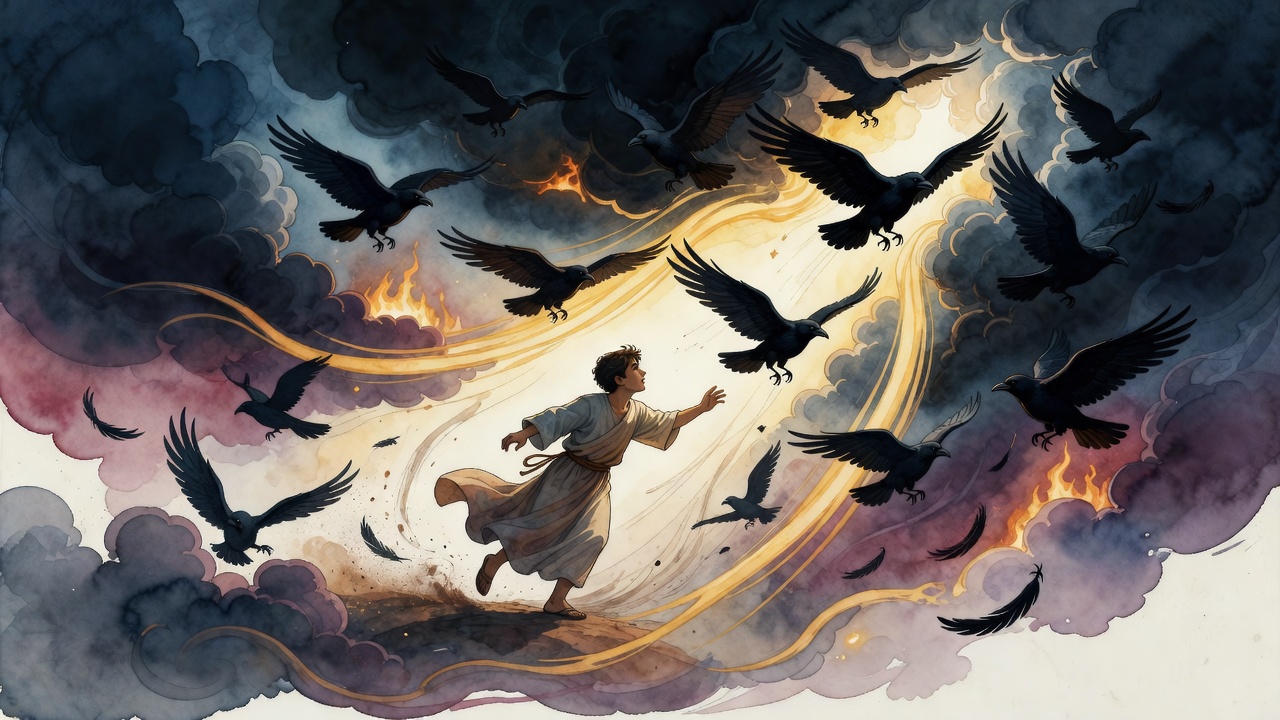
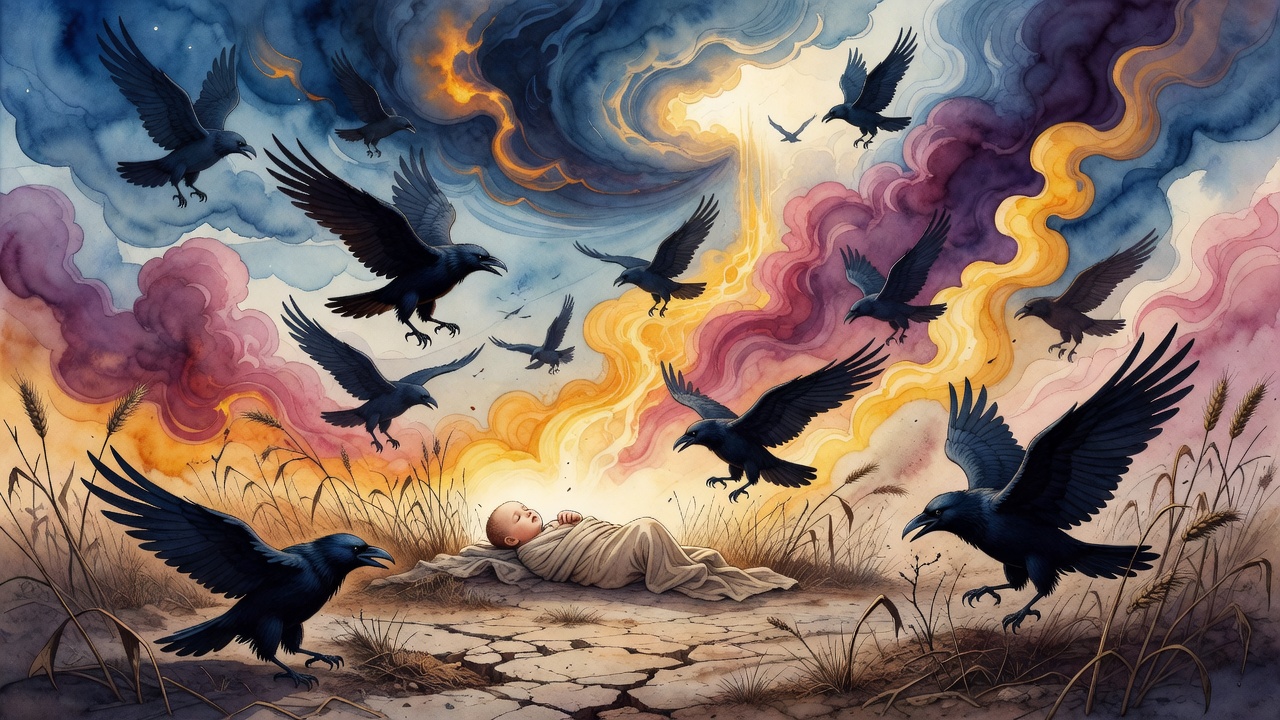
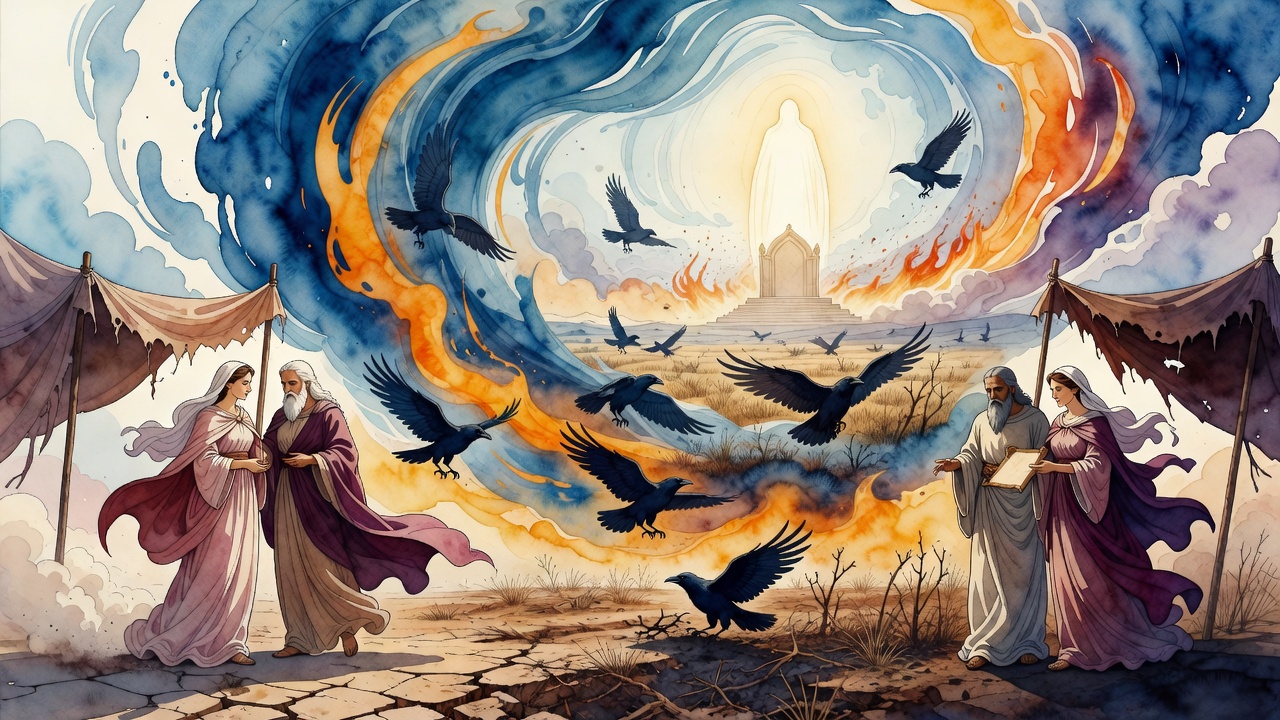
Mastema struck at the one thing the plain could not live without. When the farmers went out to sow, he loosed the ravens. They came in black clouds that blotted the light and dropped on the furrows before the plough could cover the seed, and they tore the grain from the ground kernel by kernel. Season after season the birds ate the harvest before it began. Men scattered seed and reaped nothing but hunger, and the fields that had fattened the cities of the idol-makers went bare. It was famine engineered out of the air, and no wall a king could raise stood tall enough to stop it.

Seventy Times He Turned the Sky

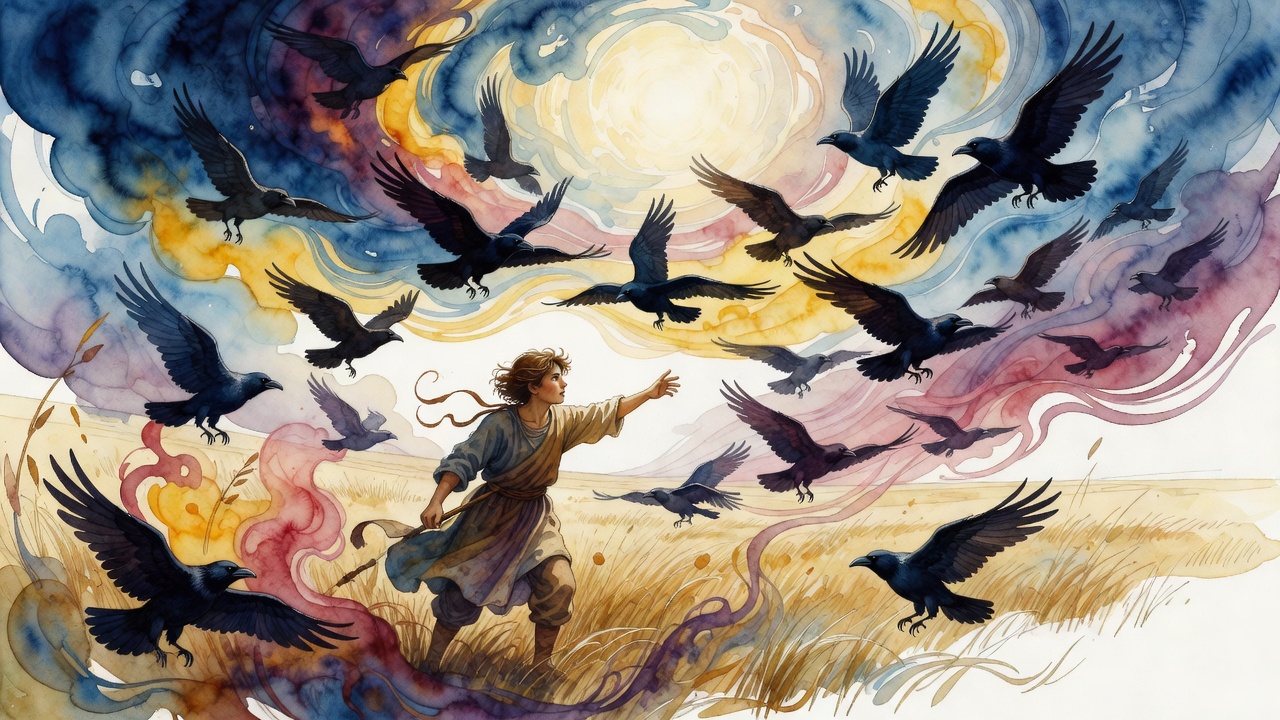
It was sowing season again when the cloud came down on the field where Abram stood. The others waved their arms and shouted and lost. Abram ran straight at the descending flock. He did not throw a stone. He lifted his voice and spoke to the birds as though they could be reasoned with. "Descend not," he cried. "Return to the place whence you came." And the ravens broke. The whole black cloud wheeled in the air and climbed back into the sky it had dropped from. Seventy times that day the flock returned, and seventy times the boy turned it away, until the sun went down on ground where not one seed had been stolen. Where Abram kept watch, the earth held its harvest. A lad of fourteen had stood in a field owned by Mastema's birds and taken it back with nothing but words, and the age that had forgotten its Maker began, one field at a time, to turn.


← All myths
From the tradition

Sources

5 sources

The texts behind this telling. Some cards carry a translation of the source; others are our own retelling of it, and each card says which. Every card links out to the original.

Book of Jubilees 11:5Book of Jubilees

Retold in our words. Read the original at the link below.Sefaria Community Translation · CC-BY

It offers a unique perspective on the early generations after the Flood.

In Jubilees 11, we learn that SÊRÔH was born to Noah's descendants in the seventh year of a particular week within a jubilee cycle. Now, a "jubilee" in this context is a period of 49 years, a significant time marker in this ancient calendar. It’s a way of framing history, of seeing patterns emerge across generations.

It's what happens after Sêrôh's birth that really grabs our attention. What follows reads like a headline ripped from today's news.

"And the sons of Noah began to war on each other, to take captive and to slay each other, and to shed the blood of men on the earth, and to eat blood..."

Whoa. Strong stuff. It paints a pretty grim picture. Instead of harmony and cooperation after the great flood, humanity almost immediately descends into infighting. The text goes on to describe how people begin building "strong cities, and walls, and towers." It's the beginning of kingdoms, of power struggles, of people exalting themselves.

According to the Book of Jubilees, this is also when they "go to war people against people, and nation against nation, and city against city, and all (began) to do evil, and to acquire arms, and to teach their sons war." The Book of Jubilees isn’t just recounting historical events, it's making a statement about human nature. It suggests that the seeds of conflict, the temptation towards violence and domination, are deeply embedded within us. The impulse to build walls, both literally and figuratively, to separate ourselves from others, seems to be a recurring theme in the human story. It’s as if humanity, given a fresh start after the Flood, almost immediately reverts to old habits. The drive to acquire arms and teach war to their sons suggests a cycle of violence passed down through generations.

Does this bleak portrayal depress you? It can. But perhaps it also serves as a warning. If we understand the patterns of the past, can we learn to break free from them? Can we choose a different path, one that leads to cooperation, understanding, and peace? Maybe the story of Sêrôh, born amidst the beginnings of conflict, is also a story of potential – the potential to learn from our mistakes and build a better future.

Full source
Book of Jubilees 11:14Book of Jubilees

Retold in our words. Read the original at the link below.Sefaria Community Translation · CC-BY

Sometimes, the story behind a name is a window into a whole era, a whole shift in how people saw the world. Take Serug, for example.

The Book of Jubilees, a text considered canonical by the Ethiopian Orthodox Church and valued by many for its unique perspective on biblical history, tells us that Serug’s name itself is a commentary. "For this reason he called the name of Sêrôḫ, Serug, for every one turned to do all manner of sin and transgression." In other words, Serug is connected to the Hebrew word for "turning away" or "deviating." It's a name that reflects a time when people were, according to Jubilees, turning away from the right path.

Serug grew up and made his home in Ur of the Chaldees. This location is key. Ur, a city in ancient Mesopotamia, was a major center of civilization – and, in many traditions, a hub of idol worship. The text specifies that he lived "near to the father of his wife's mother, and he worshipped idols." This detail isn't just geographical; it paints a picture of Serug's environment and spiritual influences. He wasn't just near idol worshippers, he was integrated into a family that practiced idol worship.

It situates events within a very particular chronological framework. We learn that Serug took a wife in the thirty-sixth jubilee, in the fifth week, in the first year thereof. Jubilees uses a system of jubilees – periods of 49 years – to mark time. His wife was Mêlkâ, the daughter of Kâbêr, who was the daughter of his father's brother. So, a cousin. Marrying cousins was common in ancient times, but what's striking here is the meticulous genealogy. The text wants you to know exactly who Serug married and how she was related to him.

And in the first year of the following week, Mêlkâ bore him Nahor. Serug's son, Nahor, continued to live in Ur of the Chaldees. The cycle continues. The next generation is born into the same environment, the same influences.

So what does this all mean? Why does the Book of Jubilees focus on these details about Serug? Perhaps it’s a cautionary tale. A reminder that names carry meaning, that environments shape us, and that the choices of one generation can influence the next. It's a snapshot of a family living in a specific time and place, confronting the temptations of their surroundings. It prompts us to consider: What names do we carry, and what stories do our lives tell?

Full source
Book of Jubilees 11:10Book of Jubilees

Retold in our words. Read the original at the link below.Sefaria Community Translation · CC-BY

Chapter 11 of Jubilees isn't exactly a feel-good story. It describes a rapid descent into moral chaos. The people, newly populating the earth, "began to capture cities, and to sell male and female slaves." Not a great start. It's a harsh reminder that rebuilding isn't just about bricks and mortar; it's about rebuilding character, too.

Then we have ’Ûr, son of Kêsêd, a name that might ring a bell. He built the city of ’Arâ of the Chaldees, and, tellingly, "called its name after his own name and the name of his father.” What does that suggest to you? A desire for legacy? A need for recognition? Or something darker… a kind of self-worship creeping in?

Because it gets worse. Much worse.

The verse reads, "And they made for themselves molten images, and they worshipped each the idol, the molten image which they had made for themselves.” They weren't just worshipping something; they were worshipping themselves, or at least, their own creations. The Book of Jubilees sees this as a pivotal moment, a turning point where humanity lost its way. It wasn't just a matter of misguided faith. It was a deep corruption setting in.

And it wasn't just about idols. They began to make “graven images and unclean simulacra.” The text makes it very clear that the images themselves were considered unclean and impure. And here's where it gets even more interesting. These acts weren't just human failings; they had supernatural assistance.

"Malignant spirits assisted and seduced (them) into committing transgression and uncleanness.”

Now, we’re not just talking about people making bad choices. We're talking about a cosmic battle, a spiritual influence actively pushing humanity towards corruption.

And who's the ringleader? None other than Mastêmâ. This is where the Book of Jubilees offers a particularly striking theological perspective. The text says, "And the prince Mastêmâ exerted himself to do all this, and he sent forth other spirits, those which were put under his hand, to do all manner of wrong and sin, and all manner of transgression, to corrupt and destroy, and to shed blood upon the earth.”

Mastêmâ, often understood as a chief of the evil spirits (similar to Satan in other traditions), is actively working to undermine humanity. He’s not just tempting them; he’s deploying a whole army of malevolent forces to corrupt and destroy. This idea of spiritual forces influencing human behavior is a recurring theme in Jewish mystical thought, as we see echoed in texts like the Zohar.

So, what are we to make of this rather bleak picture? Is it just a historical account of ancient misdeeds? Or is there something more profound at play?

Perhaps the Book of Jubilees is offering a cautionary tale. A reminder that the seeds of destruction can be sown quickly, and that the descent into moral chaos can be a slippery slope. It suggests that we need to be vigilant not only against external threats but also against the internal temptations that can lead us astray. And, maybe, just maybe, it's a reminder that we're not alone in this struggle, that there are forces at work, both good and evil, that are shaping our world and our destinies.

Full source
Book of Jubilees 11:26Book of Jubilees

Retold in our words. Read the original at the link below.Sefaria Community Translation · CC-BY

That’s kind of the vibe we get when we look at the early life of Abraham, or Avram as he was known then. to the Book of Jubilees, a fascinating ancient Jewish text that expands on the stories we find in Genesis. Jubilees fills in gaps, adds details, and sometimes offers a completely different perspective on familiar biblical tales. It's considered apocryphal by some, but it's still a treasure trove of insight into how ancient Jews understood their history.

In Jubilees 11, we learn about the birth of Avram. A way of keeping a memory alive.

Even as a young child, Avram understood something was deeply wrong with the world around him. The text says he “began to understand the errors of the earth, that all went astray after graven images and after uncleanness.” This wasn’t just youthful rebellion. This was a fundamental rejection of the prevailing culture. A recognition that something was fundamentally amiss.

His father, bless his heart, taught him to write. The text specifies that Avram was “two weeks of years old,” which, if we’re doing the math right based on the Jubilee calendar, would make him fourteen. And at that point, he makes a radical decision: he separates himself from his father so that he "might not worship idols with him."

Fourteen years old and already choosing his own path, guided by his own conscience. Incredible!

And what does he do? He prays. He turns to the “Creator of all things,” begging to be saved from the errors of humanity, from falling into "uncleanness and vileness."

A young man, standing apart from his community, seeking guidance from something higher. He's not just passively accepting the world he's born into. He's actively seeking a different way, a more meaningful existence.

This passage in Jubilees gives us a glimpse into the inner life of Avram, the man who would become Abraham, the father of monotheism. It shows us that his journey wasn’t just about following divine commands. It was about a deep, personal yearning for truth and righteousness.

What errors do we see in the world around us? What "graven images" do we chase? And what can we learn from young Avram's courage to stand apart and seek a higher truth?

Full source
Book of Jubilees 11:31Book of Jubilees

Retold in our words. Read the original at the link below.Sefaria Community Translation · CC-BY

Let me tell you a story from the Book of Jubilees, an ancient Jewish text that expands on stories from the Torah.

It’s sowing season. The time when farmers scatter seeds, entrusting their future harvest to the earth. Everyone’s out in the fields, working together, but also guarding their precious seeds. Why? Because ravens love to swoop down and snatch them up. And Abram, a mere lad of fourteen years, is right there with them.

The scene: A dark cloud descends – a swarm of ravens, hungry and ready to devour the freshly sown seeds. Disaster looms! But young Abram? He doesn't panic. He runs towards the approaching menace.

Here’s where the story takes a turn that’s pure Jewish folklore. Abram doesn't just wave his arms or shout. He speaks to the ravens. He cries out, "Descend not! Return to the place whence ye came!"

And here’s the kicker: They listen. The ravens turn back.

The Book of Jubilees tells us that Abram turned back the clouds of ravens seventy times that day. Seventy times! And not a single raven managed to steal a single seed in the land where Abram stood guard.

What does this story tell us? It's not just about a boy shooing away birds, is it?

It's a glimpse into the unique character of Abraham. Even as a young boy, he possesses an innate authority, a power of speech, a connection to the world around him that transcends the ordinary. He understands that words have power, that intention matters. That even the natural world responds to a righteous heart. We often see Abraham as the patriarch, the founder of a nation, the man who made a covenant with God. But stories like this, from texts like the Book of Jubilees, remind us that even the greatest figures start somewhere. They have moments, even as children, that hint at the extraordinary destiny that awaits them.

This small episode in the field becomes a powerful symbol. It speaks to Abraham's inherent ability to protect, to nurture, and to command respect, not through force, but through the sheer force of his will and the purity of his intention. Perhaps, in those fields long ago, he was already sowing the seeds of faith, the seeds of a legacy that would resonate for millennia.

Full source