The Sage Who Outran a Decree to Save a Stingy House
Rabbi Meir overhears a serpent dispatched from heaven to kill a stingy household, and races the creature to its door to break the decree.
Table of Contents
Rabbi Meir left the synagogue before the prayers were finished. His students watched him go. He was not a man who cut a service short, and the look on his face was not the look of a man with somewhere pleasant to be.
 Click for full size
On the road he had heard a thing no walking man is meant to hear. A serpent, low against the dust, muttering to itself like a courier rehearsing an order. "I am sent," it said, "to the house of Judah, to kill him and every soul under his roof, because he has never once opened his hand to a poor man."
Rabbi Meir did not stop to ask who had sent it. He ran.
He Conjured the River to Hold the Serpent
The serpent and the sage were both bound for the same gate, and the serpent had the head start. Between them ran a river. Rabbi Meir reached the bank first, and at the water he spoke the Name and laid a charge on the serpent that it not cross until he gave it leave. The current went on talking to itself. The serpent, when it arrived, could only coil at the edge and wait, a sealed order with nowhere to be delivered.
Then Rabbi Meir covered his face so that no one would know him, and walked the rest of the way to the house he had come to save.
The Stingy House Turned a Stranger Away
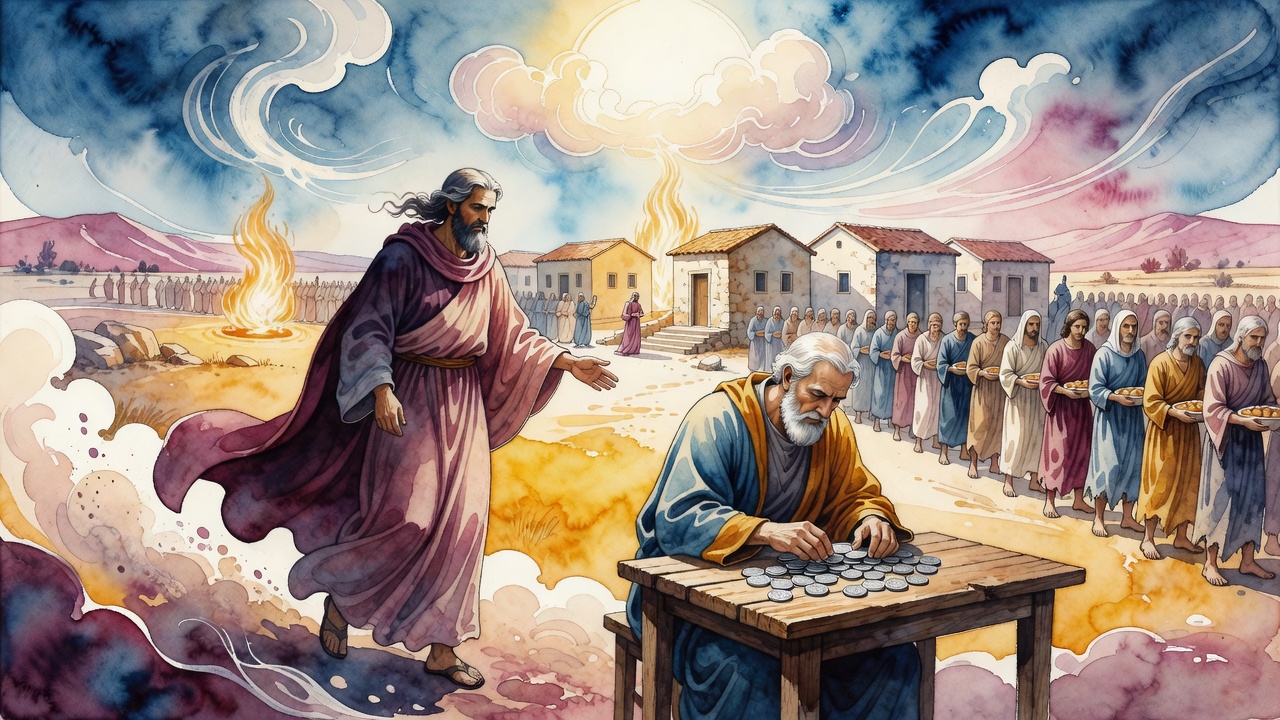
They took him for a thief. A man with his face hidden, asking for shelter at dusk, the household of Judah wanted nothing to do with him. They put him in the stable to wait. When at last they let him near the table, they ate around him and would not pass him the bread until he reached for it himself. He asked them, plainly, for a small loan as an act of charity. They answered him the way they answered every beggar who had ever stood at that gate, with a hard word and a turned back.
So this was the house under sentence. A house where a hungry stranger could sit at the table and still go hungry. The serpent at the river had not lied about them.
Rabbi Meir put out the lamp.
The Lamp Went Out and His Face Filled the Room
He uncovered his face in the dark. And the dark did not hold. His face was so bright with the Torah he carried that the whole room stood lit as if at noon, the walls, the cold supper, the frightened faces of a family that had just refused a coin to one of the great sages of Israel.
They fell on their faces. Judah begged to know what he had done. Rabbi Meir did not waste the light on a sermon. He gave orders. Send your wife to one house in the village. Send each child to a different one. Then he sat Judah down beside him and said, "Do not open this door tonight. No matter who calls. No matter whose voice it is. Not until morning."
He had eaten in this house now. Poorly, late, and unwelcome, but he had eaten. He had asked for charity and, in the end, taken it. That was the hinge the whole night turned on.
The Serpent Came and Was Refused at the Door
Two hours into the dark, Rabbi Meir gave the serpent leave to come. It crossed the river it had been forbidden, slid to the house, and rose up against Judah where he sat. Rabbi Meir stepped into its path and rebuked it. "I have been fed in this house tonight. I have taken charity from this man's hand. The decree against him is void."
The serpent did not believe a meal could undo an order from heaven. It went outside and tried the door another way. It made itself into the voice of Judah's wife, weeping at the threshold that she was freezing, let her in. The door stayed shut. It became the eldest son, crying that beasts were loose in the dark. The door stayed shut. It became all the children at once, a chorus of terror against the wood. The door did not open.
The Creature Broke Itself Against a Locked Door
There was nothing left for it to do. Its order had been canceled by a man who had simply eaten supper in the right house, and a serpent that cannot deliver its death has no second purpose. It climbed to a great height and threw itself down and died on the stones.
In the morning the family came home from their scattered hiding places. Not one of them had stood at the door in the night. Rabbi Meir walked Judah outside and showed him the broken thing on the ground, the messenger that had been sent for his whole household. Judah, who in all his years had never given a poor man so much as a crust, swore that from that day his hand would never close again.
The serpent had killed nothing. It never could have. It was only ever a courier, and the man it was sent to kill had paid off the debt that summoned it, one cold meal, one grudging loan, one night with the door held shut against every familiar voice.
← All myths