6 min read

Rabbi Akiva Meets the Man the Sea Released and Meir Races a Snake

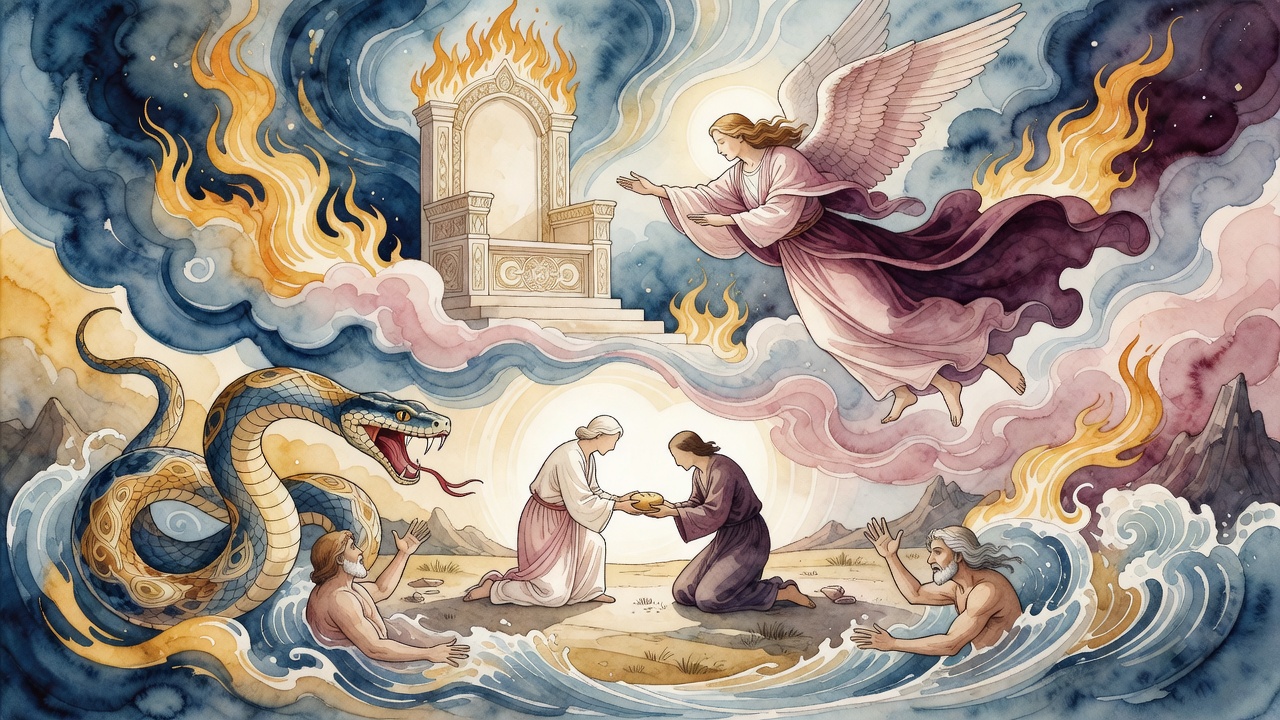
A drowned man tells Akiva about the bread he once gave away. A snake on a killing errand lets Meir run ahead and stop it.

Curated by Arthur · Told by Maggid ·
Table of Contents
  1. The Man Who Should Not Have Been There
  2. The Arithmetic of Charity
  3. The Snake With a Mission and the Rabbi Who Ran Ahead
  4. The Intervention Before the Arrival
  5. Two Witnesses to the Same Principle

The Man Who Should Not Have Been There

Rabbi Akiva was on the shore when the ship went down. He watched it break apart. He watched passengers thrown into the Mediterranean. He watched the water close over them, and among the drowning he saw one man he recognized.

Days passed, or weeks. The exemplum does not specify. Then Akiva met the same man walking on dry land, alive.

He stopped him. "How are you here. I saw you drown."

The man explained. After the ship had broken apart and he had gone under, a wave had come and set him back on the surface. He had been carried to shore. He had survived.

Akiva asked the direct question: what merit had protected him?

The man told him. Once, he had given his own loaf of bread to a hungry stranger. That loaf, the sea returned to him. The verse from Ecclesiastes came into the teaching: cast your bread upon the waters, for you will find it after many days. He had cast it once, and the waters that should have swallowed him had released him instead. Bread given away returns as a body returned.

The Arithmetic of Charity

Akiva did not offer the man philosophy about why this had happened. He named what had happened, for anyone who could hear it: if a single loaf given to a single hungry person could accomplish this much, what would consistent and sustained charity accomplish? The shore became a classroom. The man standing on it was the evidence.

The exemplum does not tell us the man's name, or the name of the stranger who received the bread, or the date of the ship's departure. The anonymity is deliberate. This is not biography. What holds is the structural law that governed his survival, the same law that would govern anyone who had ever given away food to someone who needed it. Bread given away returns. Not always visibly. Not always immediately. But on the day the water closes over you, something may come and set you back on the surface.

The Snake With a Mission and the Rabbi Who Ran Ahead

Rabbi Meir left the synagogue early one afternoon. This was unusual enough that his colleagues noticed and later asked for an explanation. When he finally gave it, the story that came out was strange even by the standards of a tradition that normalized divine intervention in daily life.

He had been walking when he overheard a snake speaking. The snake was saying: "I am sent on a mission to kill Rabbi Judah the Antoti and his whole family, because he has never given alms."

Meir ran. He reached the river before the snake did and stopped at the bank and conjured it by the Name not to cross until he gave permission. Then he covered his face and ran to the house of Rabbi Judah the Antoti.

The Intervention Before the Arrival

At the house, Meir had to persuade Rabbi Judah to give alms immediately, before the snake received permission to cross the river. The exemplum stages the urgency without making it comic. A rabbi is standing at a door explaining to another rabbi that there is a snake stopped at a river by divine Name waiting for the conversation to resolve itself, and that the conversation's resolution is literally the difference between life and death for the man in the doorway.

Rabbi Judah agreed. He gave. Meir returned to the river and released the snake, and the snake crossed, and the house of Rabbi Judah the Antoti was not touched.

The logic behind the mission is the same logic that governed the survivor on the shore. Charity bends what was decreed. The snake was not a natural predator acting on instinct. It had been sent with a specific mandate against a specific household for a specific reason: the absence of charitable giving. The mandate was negated not by argument but by the act the mandate had been issued for the lack of. The snake arrived at a house that had, in the last hour, crossed the threshold from no alms to alms given. The mission's premises no longer applied.

Two Witnesses to the Same Principle

Both stories from The Exempla of the Rabbis belong to a single argument made through illustration. A man was saved from drowning by a single historical act of charity. A family was saved from a lethal decree by a single act of charity performed under deadline. The principle is identical in both cases. The difference is the timeline: one was retroactive, the other was immediate.

Akiva and Meir function as witnesses rather than protagonists. Akiva is present to receive the testimony of the man the sea released and to name what it demonstrates. Meir is the agent who hears the decree in transit and runs ahead to create the conditions that will void it. Neither sage performs a miracle. Neither calls on divine power for his own benefit. They witness the workings of the principle and either report it afterward or position themselves to intervene within its logic.


← All myths

From the tradition

Sources

2 sources

The texts this telling draws on, in full. Open a card to read inline, or expand it for a wider, quieter read.

Gaster, Exempla No. 298 (Kohelet Rabbah 11:1)The Exempla of the Rabbis (1924)

Rabbi Akiva was standing on a shore, the Talmud places the scene at the edge of the Mediterranean, when a ship offshore broke apart in a storm. He watched passengers thrown into the waves. He watched the waters close over them.

Among the drowning, Akiva saw one particular man he recognized. The man went under. The crash came. The ship vanished.

The Reunion on Land

Days later, or weeks, the exempla is not precise. Rabbi Akiva met the same man walking on land, dry and alive. He stopped him.

"How are you here? I saw you drown."

The man explained. After the ship had gone down, he had been pulled under. He remembered nothing of how he reached shore, only that he had woken on a beach, the waves having set him down gently instead of swallowing him.

The Loaf That Paid for His Life

Rabbi Akiva pressed him. "What had you done? Why were you saved?"

The man thought. And he told the Sage a small memory, almost too small to mention. A few days before the voyage, a poor man had come to him begging. He had given the poor man his own loaf of bread, the loaf he had packed for his own meal, the only food he had with him at the time.

That loaf, Rabbi Akiva declared, was what the sea returned. The man had fulfilled the teaching of (Ecclesiastes 11:1), "Cast your bread upon the waters, for you shall find it after many days." The verse became literal. The bread given to the hungry man on land had come back as the buoyancy that lifted this man onto shore.

The Gaster exempla, drawn from Kohelet Rabbah 11:1 and Codex Gaster 184, preserves this story as rabbinic physics. Charity, the Sages insist, is not a sentimental accounting. It is a material exchange. The waves of the sea are listening to what we did with our loaves.

Full source
Gaster, Exempla No. 394 (Ben Attar)The Exempla of the Rabbis (1924)

Rabbi Meir left the synagogue one afternoon earlier than usual. His colleagues noticed. Rabbi Meir was not a man who cut services short. When he finally explained himself, the story that emerged was one of the strangest in Gaster's collection.

The Snake's Mission

Rabbi Meir had overheard a snake speaking as he walked. The snake was saying, "I am sent on a mission to kill Rabbi Judah the Antoti and his whole family, because he has never given alms."

Rabbi Meir ran. He reached the river before the snake did, and conjured it by the Name not to cross until he gave permission. Then he covered his face, made his way to Rabbi Judah's house, and asked for shelter.

Rabbi Judah's household did not recognize him. They suspected him of being a thief. He was forced to hide in the stables until dinner. When he came to the table, the family treated him coldly, refusing to let him share the meal until he insisted. He asked for a loan as an act of charity. They answered him rudely.

The Unveiling

Then Rabbi Meir put out the lamp. He uncovered his face. And his face was so luminous with Torah that the room filled with light.

The family recognized him and prostrated themselves. Rabbi Meir ordered Rabbi Judah immediately to send his wife and each of his children to different hiding places in the village. He himself remained in the house with Rabbi Judah and warned him: "Do not open the door, no matter who calls, until morning."

After two hours he gave the snake permission to come. It entered the house and threatened Rabbi Judah. Rabbi Meir stood in its path and rebuked it: "I have just been fed in this house. I have just received charity from this man. The decree against him is voided."

The Snake's Tricks

Frustrated, the snake coiled around the house outside. It pretended to be Rabbi Judah's wife, crying to be let in, she was freezing. Rabbi Meir kept the door locked. It pretended to be the eldest son, terrified of wild beasts. The door stayed locked. It pretended to be all the children at once. The door stayed locked.

Its mission frustrated, the snake threw itself down from a great height and died.

In the morning, the family returned. None of them had come to the house during the night. Rabbi Meir showed Rabbi Judah the dead snake. Rabbi Judah, who had never given a coin to a poor man, promised from that day forward to give alms profusely.

This exempla from the Ben Attar collection preserves a folk-theological truth the Sages hammered repeatedly: the world contains decrees against the stingy, and the only reliable way to cancel such decrees is the one Rabbi Judah learned the hard way.

Full source