6 min read

The Soul Demanded an Accounting and the Intellect Asked What a Lack Is

She came carrying everything she had watched go wrong and demanded an accounting. The Intellect refused to comfort her and asked about lack.

Curated by Arthur · Told by Maggid ·
Table of Contents
  1. The Ruler She Refused to Give Up
  2. The Charge She Laid on the Table
  3. The Intellect Turned the Question Around
  4. The Rules Etched Before the First Morning
  5. The Governance That Keeps Its Face Covered
  6. The Lamp She Carried Back Down

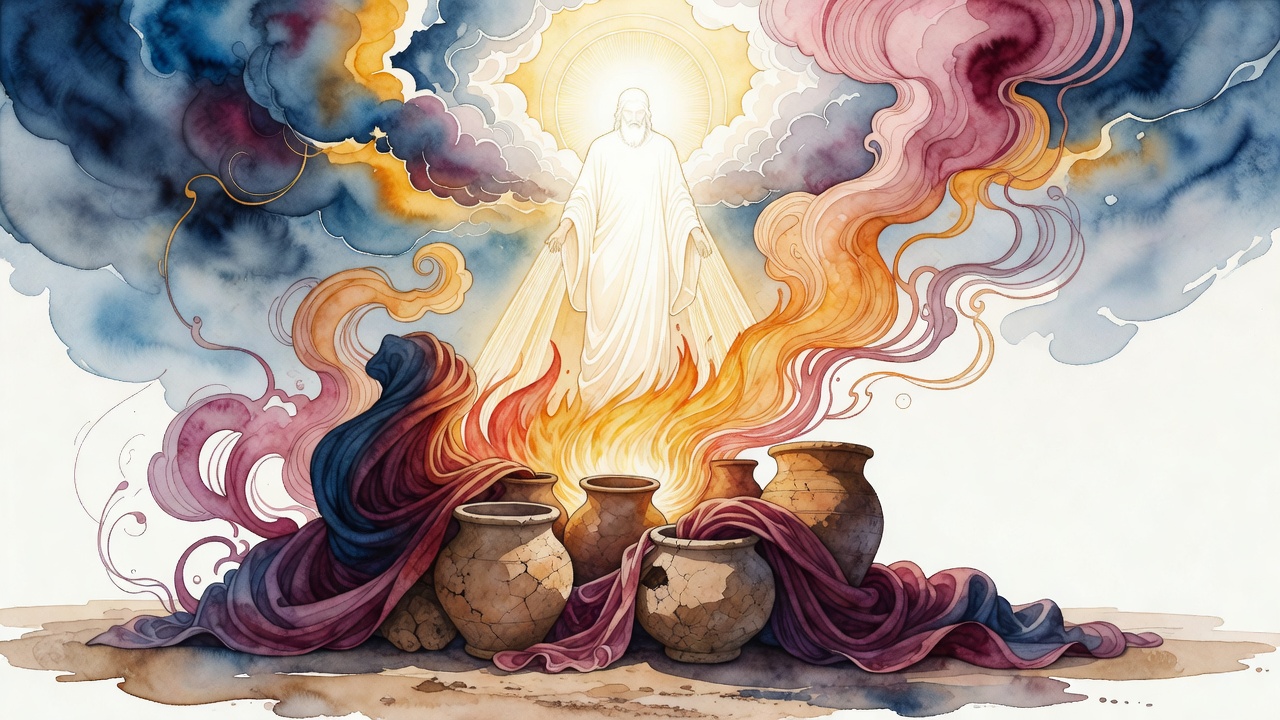
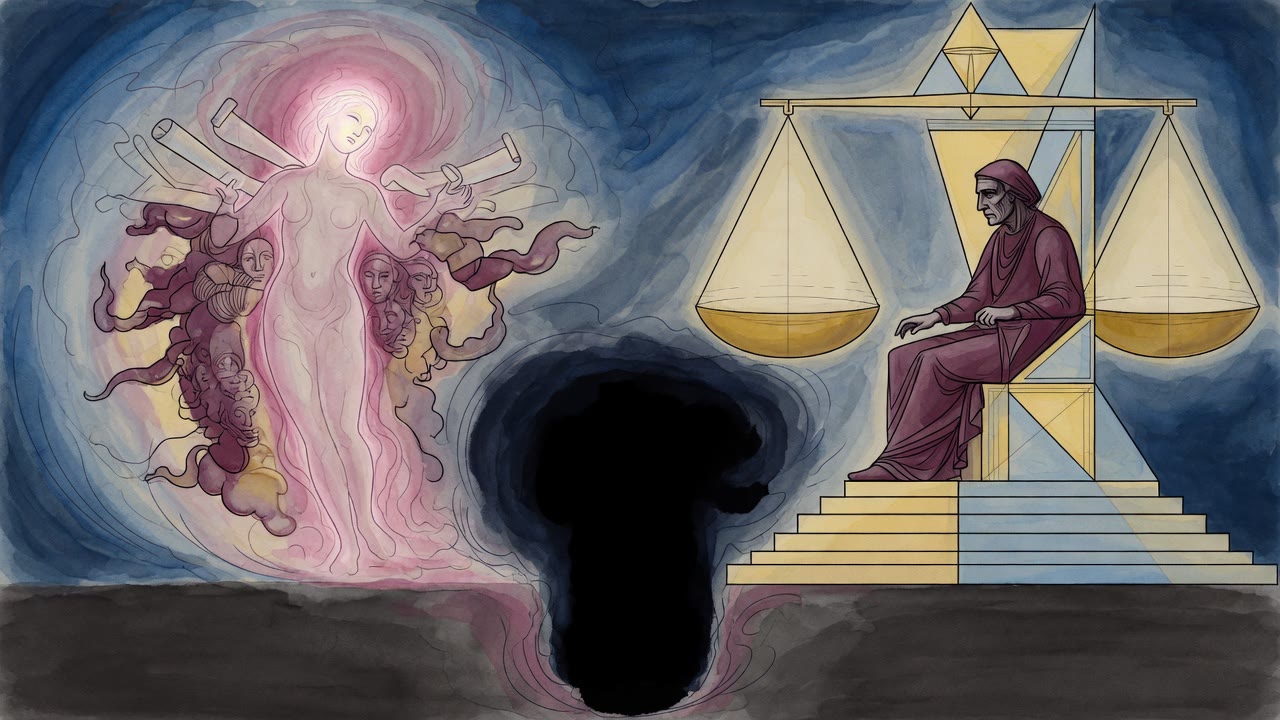
The Neshamah (the higher soul) did not sit down. She stood at the edge of the lamplight with her hands open, the way a woman stands who has come straight from a house of mourning and not yet washed. "I have heard you," she said, "and your words are settled on me." She said settled the way a man says a stone is settled on his chest.
The Soul Demanded an Accounting and the Intellect Asked What a Lack Is Click for full size

Across the table the Sekhel waited. It had spent a long time laying groundwork with her, one foundation under another. It had promised all of it would eventually hold something up. She had come to collect.

The Ruler She Refused to Give Up

She began with the one thing she would not surrender.

"Take away the supervisor over all this," she said, "and every wonder in the world turns into a puzzle with no solution. The rains. The fact that anything continues at all instead of stopping. I would drift in doubt forever and nothing would ever be answered, because nobody would be there to answer." She set two fingers flat on the table. "One who governs, all-powerful, not forced and not coerced and not pushed into His acts by matter or by any rival. Without that I cannot rest, and I will not pretend I can."

The Sekhel did not argue.

"Then what you carried in here is not a doubt about whether God is," it said. "It is a bill you want paid."

"It is."

The Charge She Laid on the Table

"You told me His acts come out of completeness," she said. "That He does not merely hold completeness, He is it. Very well. Then look at the thing He made."

She went through what she had watched from inside a body. The child buried by the parent. The prayer that goes up in full voice and comes back with nothing in its mouth.

"I do not understand the working of this straightforward completeness of His," she said. "By everything visible, that is not how completeness conducts itself. And you already told me the true completeness cannot be grasped at all. So you have handed me a rule I can neither watch working nor take apart."

Then she said the harder thing.

"Men have watched what I have watched and they counted. One power that gives the bread, another that takes the child. Two authorities up there, because they could not make one authority answer for both. That mistake did not fall out of the sky. It came out of rooms like this one, from nobody answering."

The Intellect Turned the Question Around

The Sekhel did not comfort her. It did not tell her the suffering was smaller than she thought, or that her eyes had gone bad.

"Before I account for what a complete Ruler does with a crooked world," it said, "answer me one thing. What is a lack?"

She stared at it.

"You have used the word all night. Crooked. Deficient. Missing. Out of everything the two of us laid down, a great root comes up now, and the root is this. What is chisaron, deficiency, and what is the shlemut, the completion that answers it? How did lack come to be in a made world at all? By what road is it repaired, and what follows the repair?"

She had come for consolation and been handed work.

"That is not an answer," she said.

"It is the only door into the answer."

The Rules Etched Before the First Morning

So the Sekhel gave her the arrangement.

Before anything ran, an order was set. Rules, a system, a whole organization built to deliver to creation both the good and its opposite. Not a hand reaching down each morning to decide who eats and who is buried. The consequences were etched into the fabric of the thing in advance, the way a weaver strings the warp before one colored thread crosses it, so that every figure the cloth will ever show is already permitted or forbidden by threads nobody can see. Both qualities belong to the character of the world.

The Neshamah heard it out. Then she said, "You have not removed one grave. You have filed it."

"I have told you that nobody lost track of it," said the Sekhel.

The Governance That Keeps Its Face Covered

"There is a rule running underneath the one you can see," it went on. "It works with its face covered, and it will keep working that way until the end that was fixed before you were sent down into flesh. At that end the crookedness gets shown for what it was, which is nothing that ever stood on its own, and every grave you counted tonight gets counted again in the other direction."

"When."

"Not tonight."

She laughed once, without any pleasure in it. "Then the explanation is extremely broad."

"It is. As broad as everything that has happened and everything that has not happened yet. You asked for the accounting of a Ruler with no border. Did you expect it to sit in your palm?"

The Lamp She Carried Back Down

The Neshamah stood a long while without speaking.

She had walked in to turn the world's crookedness into an accusation, and she was being handed it as material instead. The lack was not the flaw in the plan. It was the portion left unfinished on purpose and assigned to her, and the repair of it was not something she would watch from a bench.

"I want to be settled," she said. "Not soothed. Settled."

"Then take up the deficiency," said the Sekhel. "Settled comes to a soul with its hands in the work."

She picked up the lamp. The flame leaned hard, righted itself, and went on burning badly, the way a flame burns in a room with a draft nobody can find. She carried it out anyway.


← All myths
From the tradition

Sources

5 sources

The texts behind this telling. Some cards carry a translation of the source; others are our own retelling of it, and each card says which. Every card links out to the original.

Da'at Tevunot 47:1Da'at Tevunot

Retold in our words. Read the original at the link below.Sefaria Community Translation · CC-BY

It acknowledges that deep-seated yearning for meaning, that need to understand the "why" behind everything. Up until now, it says, we've been laying the groundwork, building the foundation for a truly profound discussion.

We arrive.

The Neshama, the Soul, speaks, and it speaks with a voice heavy with the weight of unanswered questions. "I heard," the Soul says, "and the words are settled upon me." The weight of it all is palpable.

What is that weight? It's the impossibility of finding peace, of truly understanding the creation and all that happens within it, without acknowledging a divine cause. A heavenly supervisor, if you will. One who is all-powerful, omnipotent, and acts without being forced or coerced. Without this fundamental understanding, the Soul argues, we are left adrift in a sea of doubt. The wonders and mysteries of the world become unsolvable puzzles, frustrating and ultimately meaningless. As Da'at (Knowledge) Tevunot suggests, so many doubts and wonders simply cannot be resolved without this core belief.

A challenge to our modern sensibilities, perhaps. But it's also an invitation. An invitation to consider the possibility of something greater, something beyond our immediate grasp, as the key to unlocking the deepest mysteries of existence.

So, what do you think? Can we truly find peace without acknowledging a divine hand in creation? Or are we doomed to wander, forever searching for answers in a world that ultimately makes no sense? The Neshama has spoken. Now, it's our turn to listen. And to reflect.

Full source
Da'at Tevunot 56:2Da'at Tevunot

Retold in our words. Read the original at the link below.Sefaria Community Translation · CC-BY

These aren't new questions. Jewish mystics have wrestled with them for centuries. And one of the most profound explorations comes from Da'at (Knowledge) Tevunot, a text that delves deep into the nature of God and creation.

What is the nature of God, anyway? According to Da'at Tevunot, God's actions are always rooted in perfection. God is perfection. So, if God is perfect, why isn't the world?

The text suggests that God established a system, a set of "rules and organization," designed to deliver both good and, yes, negative experiences to creation. Now, before you bristle, think about it this way: Imagine a painter creating a masterpiece. They choose specific colors, brushstrokes, and techniques. The final painting is a result of these choices.

Similarly, the experiences we encounter, both the joyful and the painful, are "consequences" of the divine blueprint. They are "etched and prepared" within the very fabric of creation. The text uses the Hebrew word characteristic which can also be translated to attribute or quality. These qualities of the world include both good and negative.

So, does this mean God is off the hook? Not exactly. It means that the world operates according to principles established by a perfect being, but those principles allow for a range of experiences, not just blissful ones.

Think of it like this: God is the ultimate programmer who set up the parameters. The world is the program running according to the code. It is not that God is making arbitrary decisions, but that the divine will exists within the set of rules.

This idea might feel unsettling. We yearn for a world where only good things happen. But Da'at Tevunot invites us to consider a different perspective: that even the negative experiences are part of a larger, ultimately perfect design.

Maybe the imperfections we see aren't flaws, but rather the shadows that give the light its depth. Maybe they are opportunities for growth, for resilience, and for a deeper understanding of ourselves and the world around us.

Perhaps the key isn't to ask why bad things happen, but to ask what can we learn from them? What can we create from them? What can we become?

Full source
Da'at Tevunot 51:1Da'at Tevunot

Retold in our words. Read the original at the link below.Sefaria Community Translation · CC-BY

In a fascinating passage from Da'at (Knowledge) Tevunot – which translates to "The Knowledge of Discernment," a profound work of Jewish thought – we encounter a soul confronting a particularly tricky concept: God's governance. The soul, acting as our inquisitive stand-in, voices a concern about God's “straightforward completeness.”

What does that even mean?

Basically, the soul is struggling to reconcile the idea of a perfect, complete God with the often-imperfect, incomplete world we see around us. If God is all-powerful and utterly complete, why doesn't the world reflect that?

The soul essentially asks: "I still need to be settled somewhat on the matter of this characteristic of governance that you mentioned, because I don't understand well the action of HaShem's straightforward completeness, may He be blessed, because according to that which is apparent even it isn't from his rule of completeness, for you already said that the true completeness cannot be grasped."

Deep breath. It's a mouthful, I know!

Let's unpack it. The soul is saying, "I'm having trouble understanding how God’s perfect governance works in the world." The problem? The world doesn’t always seem perfectly governed, does it? Suffering exists. Injustice persists. If God is complete, why isn't the world a mirror of that completeness?

But here’s the kicker: The text already acknowledges that "true completeness cannot be grasped." So, are we just spinning our wheels?

Not necessarily. I think what Da'at Tevunot is hinting at is that our human minds, finite and limited as they are, simply can't fully comprehend the infinite and absolute nature of God. We can glimpse aspects of it, catch reflections of divine truth, but we can never fully encompass it.

The teacup might hold a little bit of water, and that water is the ocean, but it's not the whole ocean, is it?

Maybe the point isn't to achieve a perfect, comprehensive understanding. Maybe the journey is the destination. Maybe wrestling with these questions, confronting the apparent contradictions, and striving for deeper understanding is precisely what we're meant to do.

And maybe, just maybe, the "straightforward completeness" isn't about everything being neat and tidy, but about a deeper, more profound harmony that we can only glimpse through the imperfections and uncertainties of our world. A harmony that transcends our limited capacity for understanding.

So, what do you think? Can we ever truly grasp the fullness of God’s governance? Or is the striving for understanding enough?

Full source
Da'at Tevunot 63:1Da'at Tevunot

Retold in our words. Read the original at the link below.Sefaria Community Translation · CC-BY

In Da'at Tevunot the Soul says: "If so, the explanation is extremely broad."

The Soul does not yet fill the breadth. It only marks that the answer stretches wider than a short reply.

Full source
Da'at Tevunot 20:1Da'at Tevunot

Retold in our words. Read the original at the link below.Sefaria Community Translation · CC-BY

In this particular section, the "Intellect" itself – a stand-in for divine wisdom – poses a question that cuts to the core of existence.

The question is this: What's the deal with deficiency?

It sounds simple. But stick with me. Because from this simple question blooms an entire universe of understanding.

The Intellect tells us that from the groundwork we’ve already laid, a "great root" emerges for us to contemplate. This root? It's the very essence of chisaron (deficiency) and its shlemut (completion).

See, we can't just blindly strive for perfection. We need to understand what’s lacking, the impact of that lack, and how tikkun (rectification) – that beautiful, oh-so-Jewish concept of repairing the world – actually works. How does creation become complete? What path does that rectification take? And what are the consequences of this journey?

These aren't just philosophical questions; they're the roadmap to understanding our purpose, our role in the grand cosmic drama. We are invited to explore what it means to be human. To strive. To fall short. And to rise again.

Think of it like this: a beautiful piece of pottery, marred by a crack. Do you just throw it away? Or do you see the potential for something even more beautiful, evidence of resilience and repair? That's the essence of tikkun olam, repairing the world, and it begins with acknowledging the crack, the deficiency, and then understanding how to make it whole again.

So, what is this deficiency? What are its consequences, and how do we even begin to rectify it? These are the questions we'll need to unpack, layer by layer, as we continue this journey. Because understanding deficiency isn't just about understanding what's wrong; it's about unlocking the potential for profound and meaningful wholeness.

Are you ready to dive deeper?

Full source