6 min read

The Soul That Sees Everything and Is Seen by No One

Each night the soul slips out to wander the earth and returns like a rehearsal, until the morning it rises clothed in its shroud in the Land.

Curated by Arthur · Told by Maggid ·
Table of Contents
  1. The Watcher That Casts No Shadow
  2. Each Night a Small Death
  3. The Silent Chorus in the Dark
  4. Gathered Into the Bundle of the Living
  5. Clothed in the Morning

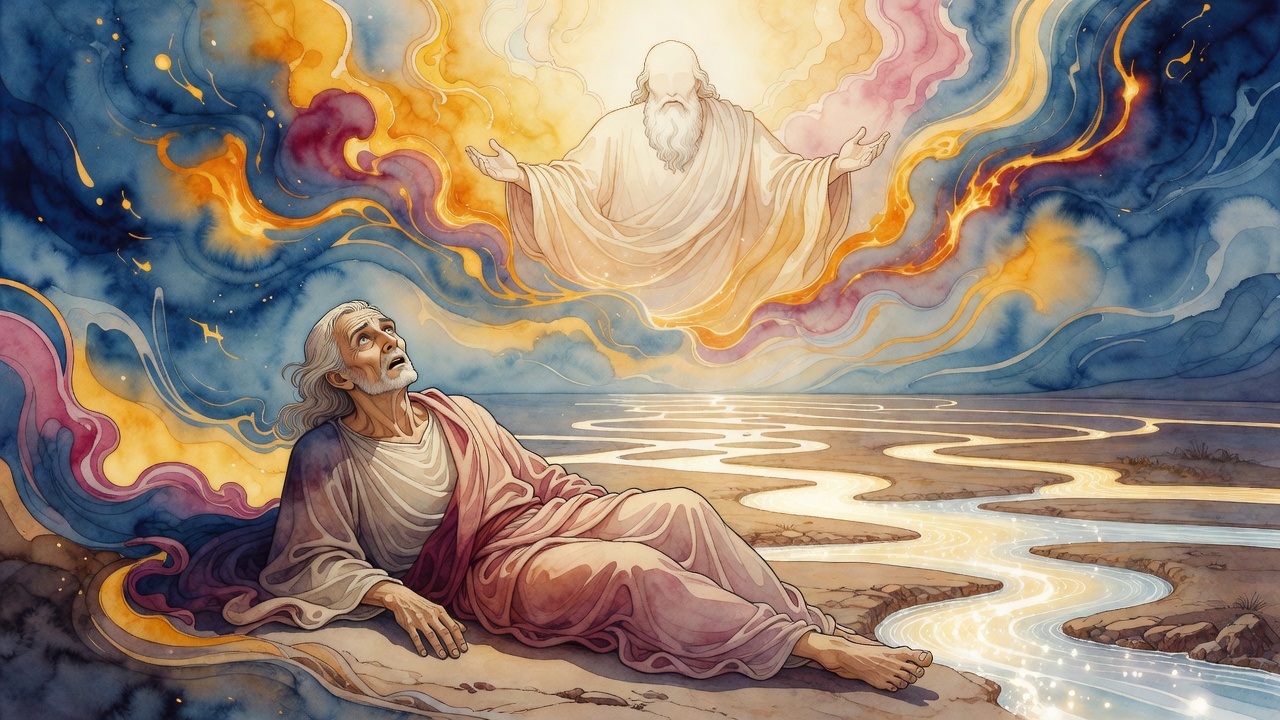
At night a man lay down on his mat and let his eyes fall shut, and something inside him did not shut with them. The breath slowed. The limbs went heavy. And the soul rose out of the sleeper the way a guest steps out of a house it means to return to before dawn. It had left him this way every night of his life. It would go on leaving him until the night it did not come back.
The Soul That Sees Everything and Is Seen by No One Click for full size

The Watcher That Casts No Shadow

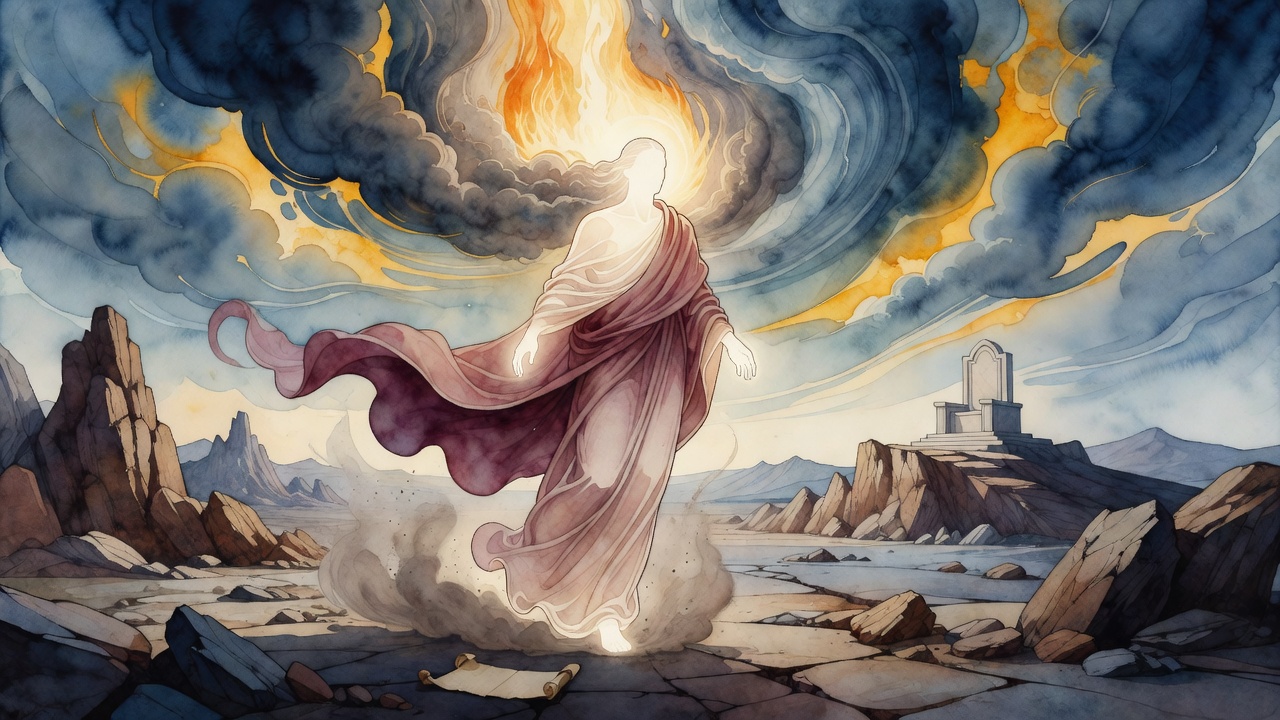
The soul moved through the dark house and saw everything. It saw the sleeper's own face slack against the reed mat, saw the walls, saw the road beyond the door. Nothing looked back at it. It sees, and it is not seen, made in the likeness of the One who fashioned it, for God also sees and is never seen.

It did not rest. The body slept, but the soul that holds the body upright does not sleep, just as the Guardian of the world neither slumbers nor closes His eyes. All night it bore the man's frame the way its Maker bears the whole earth, holding a shape that would collapse the instant it let go. "Behold, all souls are mine," God had said, and this one knew it belonged to Him and not to the man wearing it.

Each Night a Small Death

Out through the door it went, over roofs and fields and roads it had never walked by day. The spirit ranges across all the earth while the body lies still, and whatever it finds out there it carries home and pours into the sleeper as a dream. In the vision of the night, when deep sleep falls, the ear of a man is opened, and he is told what is coming. Morning would find the sleeper muttering about things he could not have known.

Sleep is this world. The waking that follows is the world to come. Every dawn the man crossed from the one into the other without understanding that he had just rehearsed his own death and his own rising, and would rehearse it again the next night, and the night after that.

The Silent Chorus in the Dark

It was not alone out there. The spirits of the dead wander the same night air, and they see what happens in the world below as clearly as the living dreamer does. But they are changed. They do not come back at dawn to chatter about where they had gone. They keep silent. And in that silence they sing, praise rising from the ones who wait for the God who will bring them to life again. "Let the righteous exult in glory," the verse says of them, let them sing upon their beds. The beds are graves, and still they sing.

Gathered Into the Bundle of the Living

Then came the morning the soul did not return, and where the body lay turned out to matter more than the man had ever guessed. He had died far from the Land. His soul did not stay stranded in foreign ground. It was drawn home, gathered in across the distance to the one soil that could hold it, bound up in the bundle of the living. Abigail had promised this to David when she told him his soul would be bound in that bundle while the souls of his enemies were flung out as a stone is flung from the hollow of a sling. What the Land drew in, it kept. What did not belong, it cast past its borders.

And there was a morning still to come, larger than any dawn. The Holy One would take hold of the four corners of the Land like the corners of a cloth and shake it hard, and everything unclean would fall out of it, the wicked shaken loose the way dust is beaten from a garment.

Clothed in the Morning

The dead lie in the ground like seed pressed naked into a furrow. But the furrow works a change on what it swallows. A bare grain goes down into the dark and comes up wrapped in husk and stalk and blade, dressed in more than it wore going in. If a naked seed rises clothed, then a body laid down already wrapped in its shroud will surely rise still wrapped.

There was proof of it. Chananiah, Mishael, and Azariah had walked into Nebuchadnezzar's furnace and walked out again with not one thread scorched, their garments whole where the fire should have eaten them first. And when the woman at Endor called Samuel up out of the earth, she did not see a naked ghost. She cried out that an old man was rising, covered in his robe. The prophet came back dressed exactly as they had buried him.

So the sleeper would wake. Not the small waking of one more morning, muttering about a dream, but the great one, upright in the Land, wrapped in the cloth they had lowered him in, standing at last among the silent singers now given back their voices. "Satisfy us in the morning with Your kindness," they had begged from their beds. The morning was the world to come, and it was answering.


← All myths
From the tradition

Sources

4 sources

The texts behind this telling. Some cards carry a translation of the source; others are our own retelling of it, and each card says which. Every card links out to the original.

Pirkei DeRabbi Eliezer 34:13Pirkei DeRabbi Eliezer

Retold in our words. Read the original at the link below.Pirke de Rabbi Eliezer, trans. Rabbi Gerald Friedlander, London (1916) · CC-BY

One of the most poetic comes from Pirkei DeRabbi Eliezer, a collection of stories and teachings that many scholars believe comes from around the 8th century.

It paints a picture of the soul that's, well, almost divine. Pirkei DeRabbi Eliezer teaches that the soul is like its Creator. Just as God sees but isn't visible, so too the soul sees but remains unseen. That within each of us resides something that mirrors the very essence of the Divine.

It goes on. Just as God never sleeps, as we say in Psalms, "Behold, He that keepeth Israel doth neither slumber nor sleep" (Psalm 121:4). So too the soul doesn't sleep. Think of it! While our bodies rest, our souls are still active, still present. What are they doing? That's a question for another time, perhaps. But the idea is captivating.

Here’s another powerful image: Just as God sustains the entire world, so the soul sustains the entire body. Wow. The soul, in this view, isn't just some ethereal afterthought. It’s the very thing that animates and holds us together. It bears us.

And where do all these souls come from? "Behold, all souls are mine," says God in the book of Ezekiel (18:4). All souls are His. It's a beautiful thought, a reminder that we are all connected, all part of something larger than ourselves.

But then, there's a shift. A somber note from Rabbi Jehudah. He connects the state of the land of Israel to the state of its people, particularly after the destruction of the Temple in Jerusalem. He says that since that tragic day, the land has been "broken down" because of the wickedness of its inhabitants.

He uses the image of a sick person, too weak to stand, to describe the land's inability to yield its fruits. The prophet Isaiah echoes this sentiment when he says, "The earth also is polluted under the inhabitants thereof" (Isaiah 24:5). It's a stark reminder that our actions have consequences, not just for ourselves, but for the world around us. That kedushah (holiness), holiness, is intrinsically connected to the land and to our behavior.

So, what do we take away from all this?

On one hand, we have this soaring vision of the soul, a divine spark within each of us, constantly active, constantly sustaining. On the other hand, we have a sobering reminder of the responsibility that comes with being human, with the potential for both great good and, sadly, great destruction.

Perhaps the connection lies in understanding that our souls, these divine sparks, are intimately connected to the world around us. How we treat each other, how we treat the earth – it all matters. It all affects the very fabric of existence.

Full source
Pirkei DeRabbi Eliezer 34:3Pirkei DeRabbi Eliezer

Retold in our words. Read the original at the link below.Pirke de Rabbi Eliezer, trans. Rabbi Gerald Friedlander, London (1916) · CC-BY

Rabbi Zechariah paints a beautiful and thought-provoking analogy: "The sleep at night is like this world, and the awakening of the morning is like the world to come." Simple. When you fall asleep, you enter a different realm. Your body rests, but your mind… well, your mind can travel anywhere. The text continues, saying that "in the sleep of the night a man lies down and sleeps, and his spirit wanders over all the earth, and tells him in a dream whatever happens." This idea echoes the verse in (Job 33:15-16), "In a dream, in a vision of the night… then he openeth the ears of men."

Pirkei DeRabbi Eliezer draws a parallel between this nightly wandering of the spirit and the state of the dead. It suggests that the spirits of those who have passed on also wander the earth, aware of what's happening in the world. But unlike us, who might chatter about our dreams the next morning, "they are silent and (yet) they give song and praise to God, who will quicken them in the future, as it is said, 'Let the righteous ones exult in glory' (Psalm 149:5)." What a beautiful image – a silent chorus of souls, praising God.

What about that awakening in the morning? That, Rabbi Zechariah says, is like the future world, Olam Ha-Ba (the World to Come). It's a fresh start, a new beginning. The text then offers a parable: just as a person wakes up from sleep, so too will the dead awaken in the future world. This is connected to the verse in (Psalm 90:14), "O satisfy us in the morning with thy loving-kindness."

So, what does all this mean?

Perhaps it's a comforting thought that even after death, there’s a connection to the world, a silent awareness. And more than that, it emphasizes the cyclical nature of life and death, comparing it to the everyday experience of sleeping and waking. The transition from night to morning becomes a powerful metaphor for the transition from this world to the next.

This passage from Pirkei DeRabbi Eliezer isn't offering a literal explanation of the afterlife, of course. Rather, it's inviting us to contemplate the mysteries of life and death through a lens of hope and faith. It suggests that even in the face of the unknown, there's a promise of renewal, a promise of awakening into something new. What does that mean for how we live our lives now?

Full source
Pirkei DeRabbi Eliezer 34:7Pirkei DeRabbi Eliezer

Retold in our words. Read the original at the link below.Pirke de Rabbi Eliezer, trans. Rabbi Gerald Friedlander, London (1916) · CC-BY

Rab Huna, a prominent Amoraic Sage of the 3rd century, has something quite striking to say about it, preserved for us in Pirkei DeRabbi Eliezer. He suggests that the location of our death profoundly impacts the journey of our souls.

Think about this: Rab Huna states that when Jews die outside of Eretz Yisrael, the Land of Israel, their souls are gathered into the Land. It's like a cosmic homecoming, a spiritual repatriation. He backs this up with a verse from the Book of Samuel (1 Sam. 25:29), where Abigail says to David, "Yet the soul of my lord shall be bound in the bundle of the living." This "bundle of the living" – tzror hachayim – is interpreted as being within the sacred boundaries of Israel.

What about non-Jews? The flip side of the coin, according to Rab Huna, is that the souls of non-Jews who die within the Land of Israel are cast out beyond its borders. Ouch. The same verse in Samuel continues, "And the souls of thine enemies, them shall he sling out, as from the hollow of a sling. A kind of spiritual expulsion.

Why this stark contrast? It's a complex question, rooted in the unique spiritual significance of the Land of Israel in Jewish thought. The Land is seen as a conduit to the Divine, a place where the connection between heaven and earth is particularly strong. Thus, for the Jewish soul, returning to the Land after death is a return to its source, a reunification with the Divine presence. For others, the connection isn't the same.

But the story doesn't end there. Pirkei DeRabbi Eliezer goes on to paint an even more dramatic picture of the future. It says that in the future world, the Holy One, blessed be He, will grasp the very corners of the Land of Israel and shake it, freeing it from all that is impure and unclean.

This idea comes from the Book of Job (38:13), "That it might take hold of the ends of the earth, and the wicked be shaken out of it." Imagine the scene: a cosmic shaking, a spiritual cleansing, where the Land is purified and the wicked are… well, shaken out.

What does this all mean for us today? Is it a literal description of the afterlife? Perhaps. But perhaps it's also a powerful metaphor for the importance of connection – to our heritage, to our spiritual home, and to the values that we hold dear. And it challenges us to consider what it truly means to be "bound in the bundle of the living."

Full source
Pirkei DeRabbi Eliezer 33:11Pirkei DeRabbi Eliezer

Retold in our words. Read the original at the link below.Pirke de Rabbi Eliezer, trans. Rabbi Gerald Friedlander, London (1916) · CC-BY

Rabbi Eliezer, in Pirkei DeRabbi Eliezer, a fascinating and somewhat enigmatic Midrashic (rabbinic interpretive commentary) text, tackles this very question. And his answer is surprisingly comforting. He suggests that when we rise again, we'll be clothed in our shrouds.

How can we be so sure? Rabbi Eliezer doesn’t just state it; he gives us a few compelling analogies. He asks us to consider the humble seed. We plant it naked in the ground. Yet, when it sprouts, it emerges covered, protected by layers of husk and stem. If seeds, bare as they are, rise from the earth clothed, surely those who descend into the earth already dressed will rise in the same way!

Rabbi Eliezer doesn't stop there. He brings forth even more compelling prooftexts. Remember Chananiah, Mishael, and Azariah? Thrown into the fiery furnace for refusing to bow down to Nebuchadnezzar's idol? As the Book of Daniel (3:27) tells us, when the satraps and officials gathered around, they saw that "the fire had no power upon their bodies… neither were their hosen changed." Their garments remained intact, untouched by the flames. If these righteous individuals emerged from such a trial unscathed, clothing and all, it strengthens the idea that clothing is not so easily discarded.

Then there's Samuel the Prophet. In (1 (Samuel 28:1)4), when Saul seeks guidance from the Witch of Endor, Samuel appears, and the witch describes him as "an old man cometh up; and he is covered with a robe." Even in his resurrected, or perhaps re-animated, state, Samuel is still clothed.

These examples, taken together, paint a vivid picture. They suggest a continuity, a respect for the form we inhabited in life.

So, what does this all mean? Perhaps it’s a reminder that even in death, there's a sense of dignity and recognition. The clothes we are buried in, in this view, are not just fabric; they are part of our story, part of our identity as we transition to whatever comes next. That even in the great mystery of resurrection, there's a familiar thread connecting us to who we were.

Full source