The Storm, the Cask, and the Angel Sewing a Gardener's Shirt
Driven into forbidden seas, two sages prove the ocean drinks its own water, then meet an angel stitching light for a gardener no one noticed.
Table of Contents
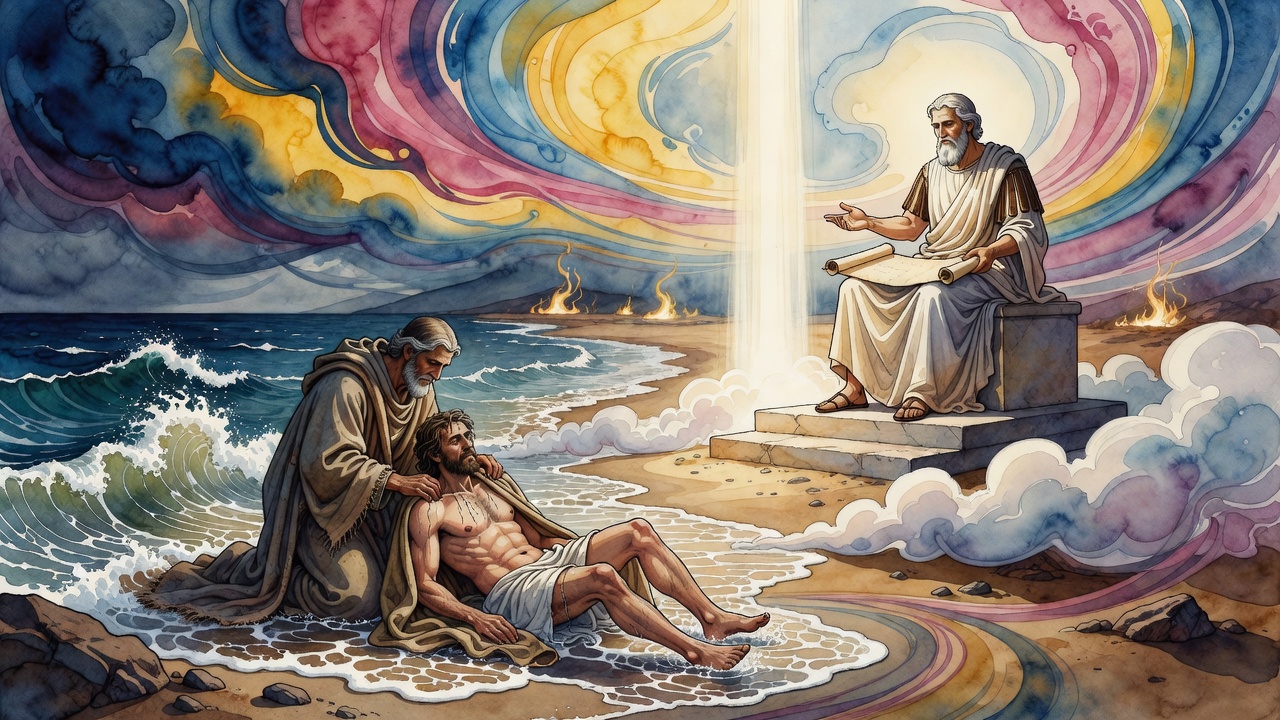
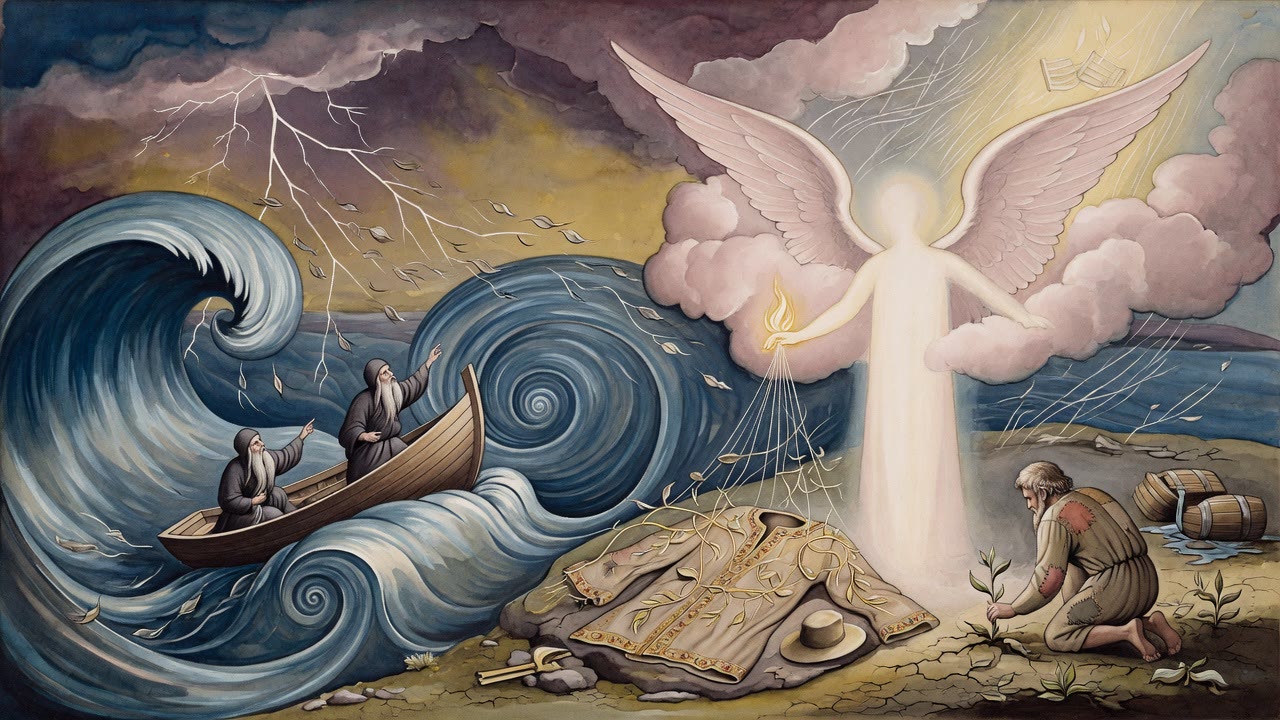
The storm took the ship the way a hand takes a leaf. Rabbi Eliezer and Rabbi Yehoshua had set out across familiar water, and now there was no shore in any direction, only a churning gray that pushed them on and on into seas no Jew had any reason to cross. The sailors gave up steering. The two sages held the rail and watched the current twist beneath them, foreign and fast, carrying them toward a place the maps did not name.
 Click for full size
Rabbi Eliezer leaned over the side and studied the water. It moved against itself, swallowing its own crests. "We were not driven here for nothing," he said. "Let us carry back proof of where we have stood."
The Cask Filled at the Edge of the World
They found an empty cask in the hold and hauled it to the rail. At the farthest point the storm flung them, where the sea looked the same as everywhere and yet was the end of everything, they dipped the cask and drew it up brimming. Rabbi Yehoshua sealed it. They held a piece of the unreachable ocean in their arms, and the wind, as if it had finished its errand, began to die.
The ship came back to known water. The cask came with it onto dry land, sloshing, ordinary, heavier than it looked. Neither sage knew yet why they had been sent to fetch it. The reason was waiting in Rome, in a question that had not yet been asked aloud.
The Emperor's Question About the Sea
The summons came from the emperor Hadrian, who liked to corner Jewish scholars and watch them squirm under the weight of the natural world. He set his riddle before the two travelers. Rivers run into the sea from every land, day after day, year after year, and the sea never rises. Where does all that water go? Why does the ocean not climb its shores and drown the earth?
Rabbi Eliezer set the cask before the emperor. He took a vessel of water and poured it in. The level did not move. He poured again, and again, more than the cask could possibly hold, and still the surface sat exactly where it had begun. The water drawn from the deep ocean was drinking everything they fed it. Whatever entered, it swallowed.
"This is why the sea does not overflow," they told him. "Its own waters drink what is poured into them." Hadrian looked at the cask that should have been spilling across his floor and was not. Whether it was a matter of nature or a small miracle, the account does not finally decide. What it decides is that a storm had carried two sages to the edge of the world for the sole purpose of answering, years later, a riddle they could not have known was coming.
An Angel Flying Low on the Road to Jerusalem
On another road, on pilgrimage toward Jerusalem, the two sages looked up and saw what almost no living eye is shown. An angel was flying low over the dust of the path, close enough to call to, and across its arms it carried a garment of pure light, a shirt woven from something brighter than any loom in any city. Rabbi Eliezer called up to it. "For whom is that garment?"
The angel did not stop its work. "For Joseph the Gardener," it answered, "who lives in Askalon." And the sages saw, as it passed, that the shirt was nearly finished and yet not finished. One seam at its edge gaped open, unsewn, as if the tailor in heaven were still waiting for a thread he did not yet have.
The Gardener Who Gave His Harvest Away
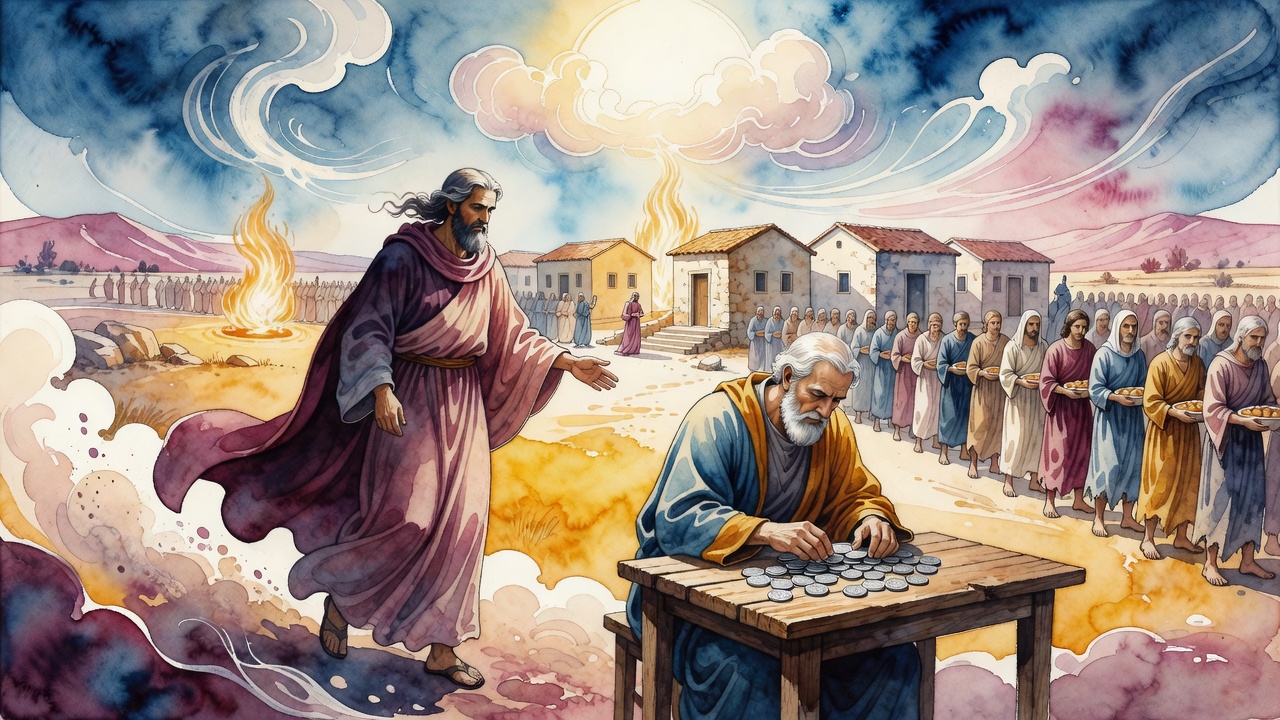
After the festival they went down to Askalon to find this Joseph. They expected a hidden sage, a secret tzaddik, someone marked. They found a man bent over a small plot of vegetables, dividing the day's harvest into two heaps, one for his house and one, the larger, for the poor of the town who came to his gate.
They told him about the angel and the shirt of light, and the one seam still open. Joseph's face fell. He had been rich once, he said, born to a wealthy father, and in his youth he had thrown the whole inheritance away on nothing. This garden was all that remained. Now he lived small and gave half of everything he grew, hoping each day's giving stitched a little more of the damage shut. "Perhaps that open seam," he said quietly, "is the part I have not yet repaired."
His wife had been listening from the doorway. She said nothing to him then. Later she came to him alone with a thing so strange he refused it twice. "Sell me," she said. "Sell me as a bondservant, and give the money away as charity, enough to finish the seam of your shirt." He would not. She insisted until he broke, agreeing only on the promise that he would buy her back when he could. He sold her to a cruel shepherd who used her hard, and he gave every coin to the poor.
The Voice That Said the Shirt Was Complete
Years passed. Joseph could not rest until he knew what his wife had become in that house of cruelty. He disguised himself as a stranger, came to her, and offered to lie with her, watching her face. She turned on him in fury and refused, not knowing the stranger was her own husband testing the one thing he had paid everything to protect. When he was certain she had held, he let the disguise fall.
A bat kol (a heavenly voice) broke over them out of heaven. "Your shirt is complete," it said. "A more beautiful one is being prepared for your wife. Go to such a place, and dig, and you will find a treasure your father buried long ago." Joseph went where the voice sent him and put his hands in the earth, and there it was, the very wealth of the father he had squandered, returned to him now in a form he was at last worthy to lift. He used it to ransom his wife from the shepherd. The two of them walked home to Askalon, back to the small plot and the two heaps of vegetables, and they fed the poor at their gate for the rest of their lives.
← All myths