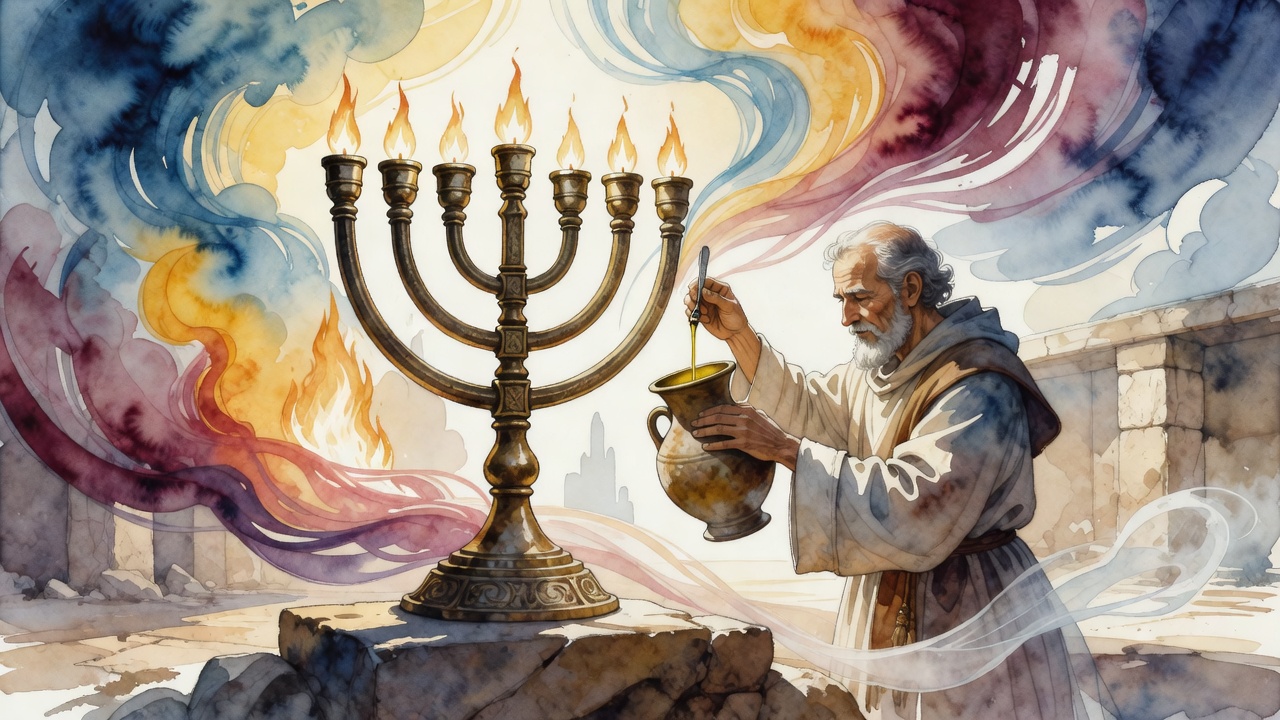
The Tabernacle Israel Carried Was Heaven Built by Human Hands
A poor man promised the king dinner, then hid the plain lamp he had made when the royal gold came through the door. The king sent his own lamp away.
Table of Contents
 Click for full size
The Lamp the Beloved Hid
A king told a man he loved that he was coming to dinner. Go and get ready for me, he said.
The man had nothing. He went home and set out what he had: a plain couch, a plain table, and a plain lamp, and he lit the lamp and stood there waiting.
Then the king arrived, and the attendants arrived with him, and they came in on both sides of him carrying gold and silver, and in front of the king they carried a golden lamp.
The man looked at his own table. Then he went around the room and hid everything he had prepared, the couch, the table, the lamp, all of it, because it was common stuff and the room was suddenly full of court.
The king sat down and saw bare floor. "Did I not tell you I was dining with you?" he said. "Why have you prepared nothing for me?"
"I saw all this grandeur that came in with you," the man said, "and I was ashamed, and I hid what I had made. They were only common vessels."
The king said, "As you live, I reject everything I brought. For love of you I will use nothing but yours."
Then he sent his gold out of the room and ate by the plain lamp.
Moses Could Not Get Into the Tent
Which is why Israel was told to build a lamp for the One who is entirely light, and to whom darkness and night shine like the day, and for whom the difference between the two is nothing at all.
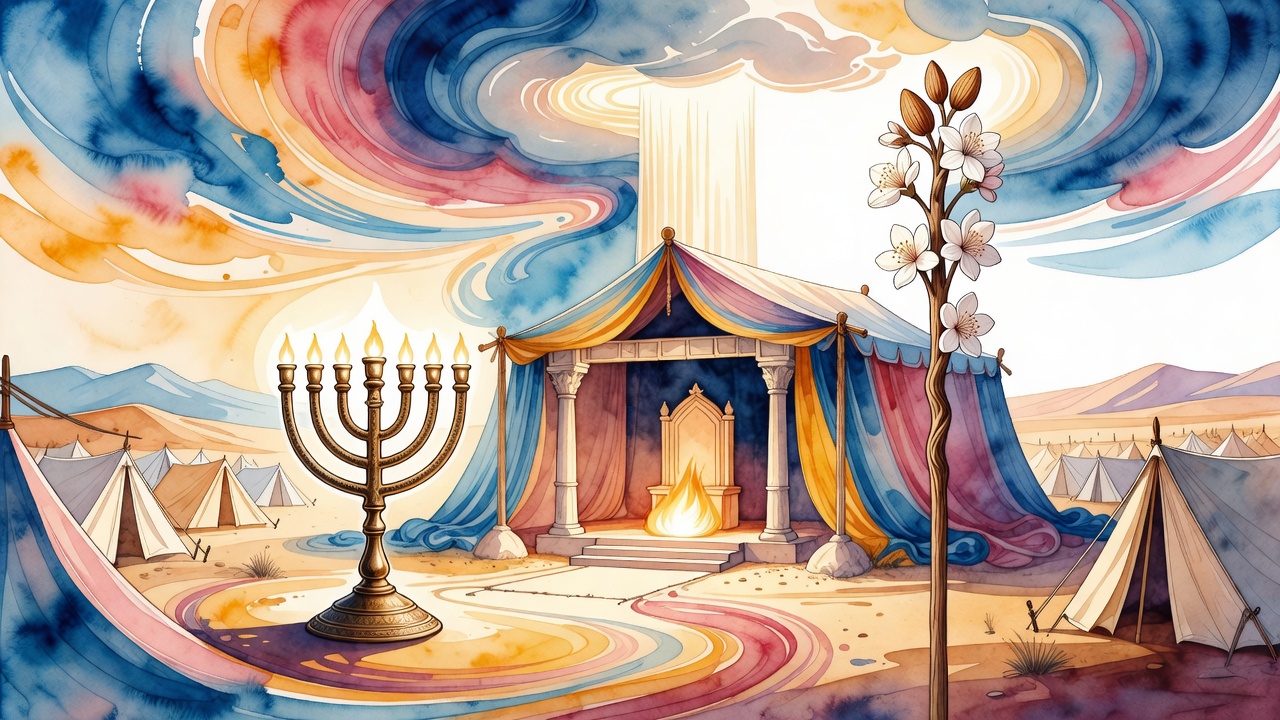
They built it. They hammered a candelabrum out of one piece of pure gold, cups and knobs and almond blossoms, and they built a tent around it out of goat hair and acacia and dyed skins, and they finished on the appointed day.
And then Moses could not go in.
The Presence had come down and filled the Tent, and the man who had supervised every cubit of it stood outside his own work and could not get through the door. He waited there. He had brought the whole plan down off a mountain and now the finished thing had shut him out.
Then a voice called him and he went in, and he heard it speaking to him, and what it said, out of all the things it could have said in that first moment, was this. When you kindle the lamps.
He Put It Up and Took It Down Twice a Day
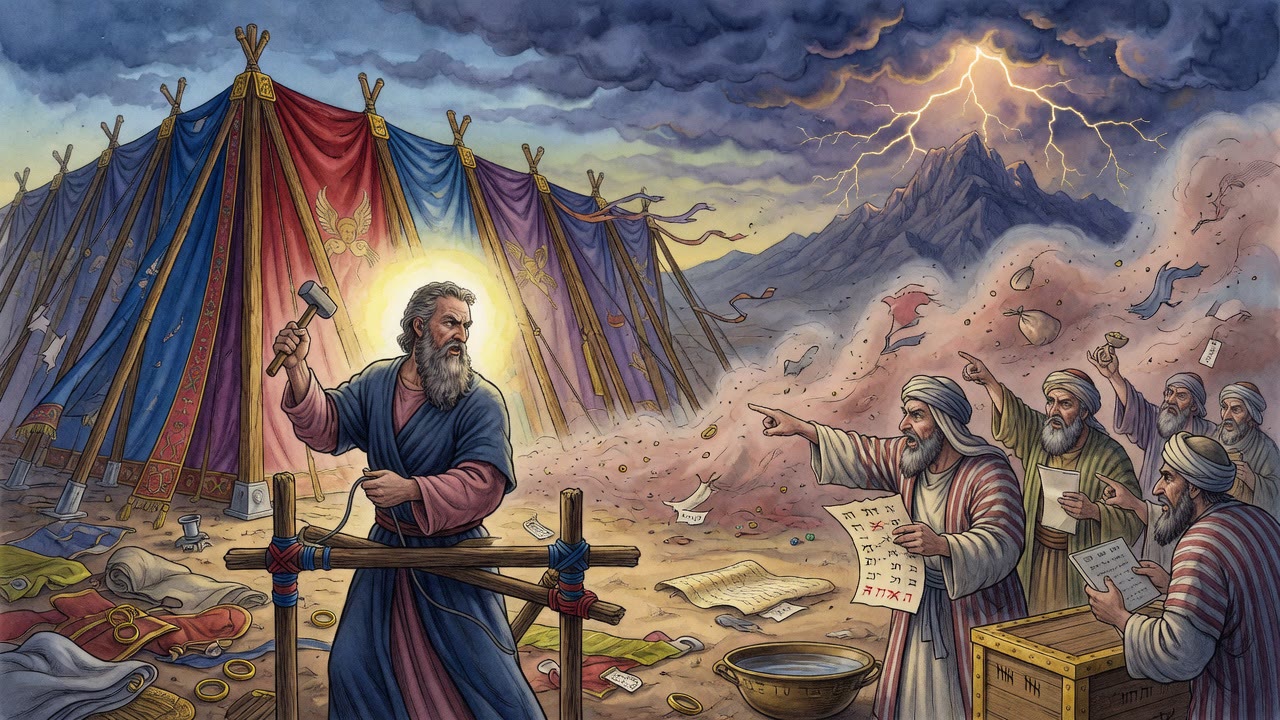
For the seven days of the inauguration Moses raised the Tabernacle and dismantled it twice every day, and no Levite touched it, and no man of Israel helped him. Fourteen times up and fourteen times down, alone, by an old man's hands. That is why it is called by his name.
The day he finished was also the day the demons were finished off the earth. The same word does both. He concluded, and they were concluded, and whatever had been circling the camp in the dark stopped circling it.
Joshua was in the tent the whole time. He was a young man who attended Moses day and night and would not leave the tent, and he got nothing for it that anybody could see, and he watched a man he served raise and strike a sanctuary until his own hands knew every joint of it. Torah comes off the branch the way figs come off a fig tree, a few today and a few tomorrow, never the whole crop at once, which is why the man who guards the fig tree is the one who eats its fruit. Moses' sons did not inherit. The attendant did.
Later, Rabbi Abba HaKohen bar Pappa used to take a different road through his own town so that crowds would not have to get to their feet as he passed. He mentioned it to Rabbi Yosei ben Rabbi Zevida, who told him he had it backwards. Walk in front of them, he said. Let them see you and stand up. You will bring them to the fear of Heaven that way.
A Tent the Size of the World
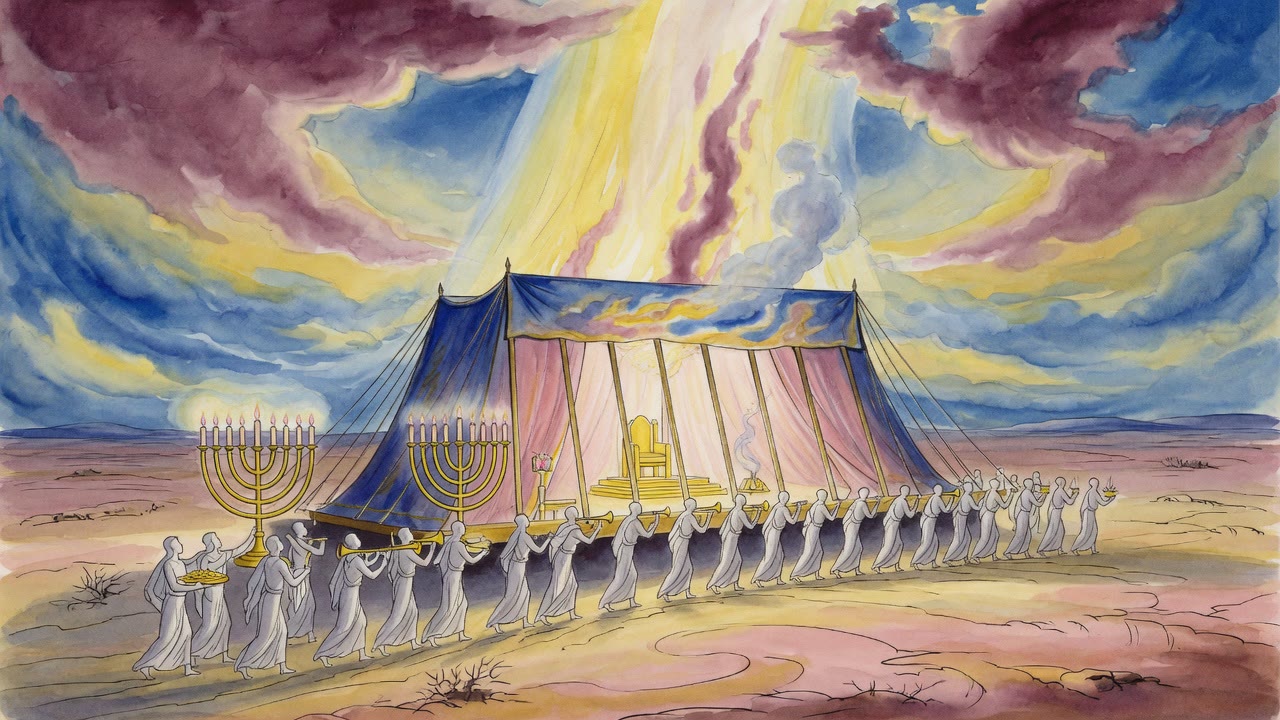
The thing they carried on their shoulders was the world, folded.
Heaven had been spread out like a sheet, and they stretched sheets of goat hair over the frame. A firmament had gone in between the waters to divide them, and a curtain hung inside the Tent to divide it. The waters below had been gathered into one place, and a basin of bronze stood on its bronze stand and held the washing water. Lights were set in the sky, and the lamp of pure gold stood inside. Birds were told to fly over the earth, and the cherubs spread their wings over the ark. On the sixth day a man was made, and Aaron was drawn near to serve.
Then heaven and earth were finished, and all the work of the Tabernacle was finished. God blessed, and Moses blessed them. God sanctified, and it was sanctified.
They took it down at every encampment and put it up at the next one, and every time they did it they were carrying the creation of the world across a desert on poles.
One Blue Thread
He left nothing alone. A man goes out to plough and there is a word waiting about the ox and the donkey. He reaps, and there is a word about the sheaf he forgot in the field. He kneads, he slaughters, he finds a nest, he builds a roof, he hangs a doorpost, he puts on a garment, and every one of those has a word attached to it.
On the garment: four corners and a fringe, and one thread dyed sky blue. Not scraps pulled from the hem. New thread, white and blue, brought and twisted for the purpose. Beit Shammai wanted four fingerbreadths and four strings. Beit Hillel wanted three.
Rabbi Meir said the blue was chosen because blue is the color of the sea, and the sea is the color of the firmament, and the firmament is the color of the Throne of Glory, which appeared once under the feet of the God of Israel like a pavement of sapphire, clear as the sky itself. Look at the thread and you are looking at the last thing in that chain.
A man was weighing out his taxes and writing his receipts, and his father stood over him and said: son, be careful with those. Your life is in them.
← All myths