Parshat Bereshit6 min read

The World Is Unmade and Remade Every Rosh Hashanah

Kabbalists taught our world is spoken in a single breath, pressed back to nothing each new year, and only one turn of a vast wheel of eons.

Curated by Arthur · Told by Maggid ·
Table of Contents
  1. The World Spoken in One Breath
  2. Six Days of Sorting the Chaos
  3. The Night the World Falls Back to Its Origin
  4. The Wheel of Seven Sabbaths
  5. When Light Swallows Death
The World Is Unmade and Remade Every Rosh Hashanah Click for full size

The World Spoken in One Breath

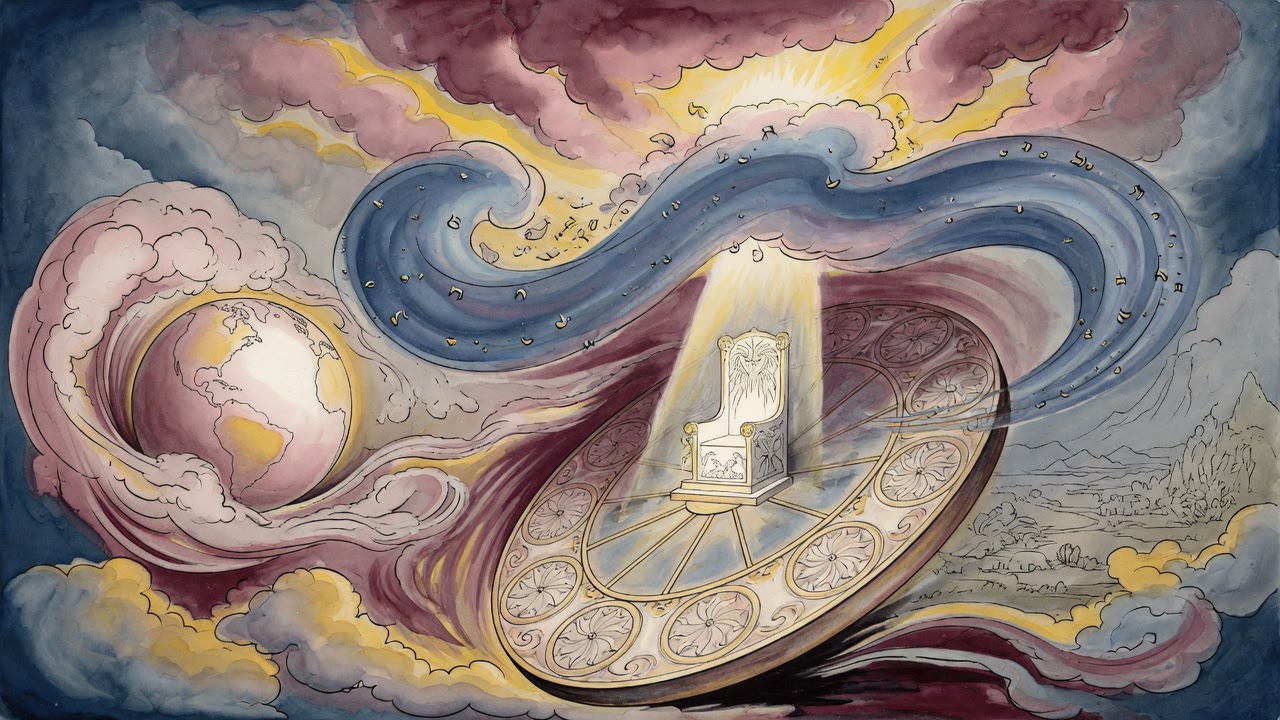
There was no slow kindling, no first spark that caught and spread. God opened His mouth once, and everything that would ever exist was already spoken. Heaven and the floor of the sea. The stars and the black space between them. Every blade of grass that would one day bend in a wind that did not yet blow. All of it arrived in a single breath, whole and at once, with no before and no after anywhere inside the utterance.

A word is not yet a world. What that utterance held was not a finished universe but a roar of raw potential, everything crushed together and shouting at once, light tangled into dark, water folded into water, order and chaos pressed skin to skin. The universe existed. It simply could not yet tell itself apart.

Six Days of Sorting the Chaos

So the labor that followed was not creation. It was separation. On the first day the light was pulled loose from the darkness like a thread worked out of a knot. On the second the waters above were lifted off the waters below. Day by day the roar was quieted into kinds, each thing set in its own place, until the shout of the beginning had been sculpted into a world that could hold still and be looked at.

On the seventh day the hands stopped. Not because the work was unfinished but because it was finally sorted. The rest was the seal on it. What had been one blinding instant now stood ordered enough to bear a name, and the name of its completion was Sabbath.

The Night the World Falls Back to Its Origin

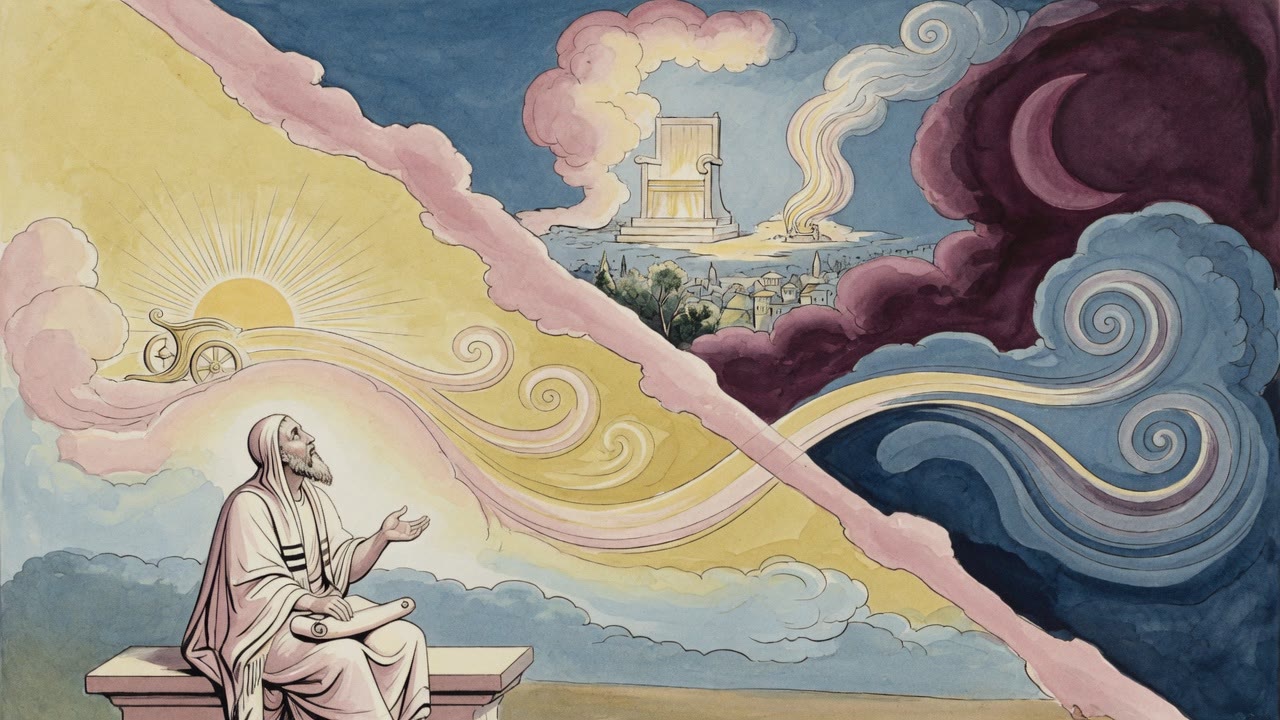
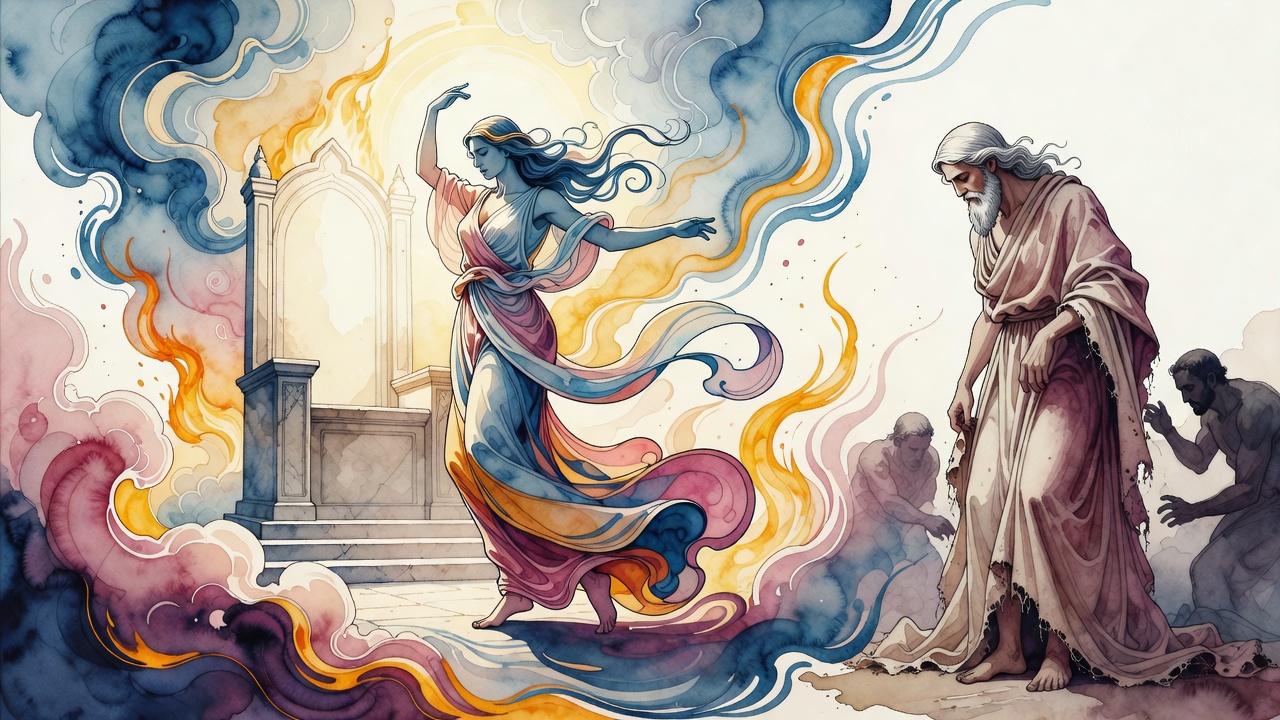
Every year the seal loosens. On the eve of Rosh ha-Shanah the whole of creation is drawn back toward that first instant, as though a hand reached beneath time and pressed the world down to the seed-instant from which it sprang. The slate goes blank. All that was made in the beginning is unmade to nothing and made again, not merely remembered, remade.

Somewhere a man sits awake through that night, and he feels it. Under the ordinary hours, under the smell of the wick and the cold at the window, the ground of things thins to almost nothing. For one breath the world stands on nothing at all. It is being spoken again. He grips the edge of the table, because there is an instant, brief as the first utterance, when nothing is promised, when the One who renews the world could simply decline to say the word a second time and let the silence keep it. Then the sun climbs, the year turns over, and the world is under his feet again as if it had never once been gone. He was not carried across from the old year. He was made new inside a world made new.

The Wheel of Seven Sabbaths

The year is only the small wheel inside a larger one. What Rosh ha-Shanah does to a single year, a slower rhythm does to whole universes.

The name for it is the same word a farmer uses when he lets his field lie fallow every seventh season and calls it Shemittah. On the scale of eons those fallow years swell into seven vast ages, seven Shemittot, and this world is only one turn of that enormous wheel. Ours is not the first. In the age before this one, they say, there was no command and no punishment, no reward held out and none withheld, only a different kind of law that a mind here can barely hold, a world that ran without the yoke of "you shall" and "you shall not." Here the commandments are the walls a soul grows against. There, there were no such walls, and no one there missed them.

Each age is built, allowed to rest, and let go back into the nothing it came from. Universes rise and are unmade across spans that no counting survives. This one, the very ground under the waking man's feet, is a doomed and reborn thing, one held breath in a long chain of held breaths.

When Light Swallows Death

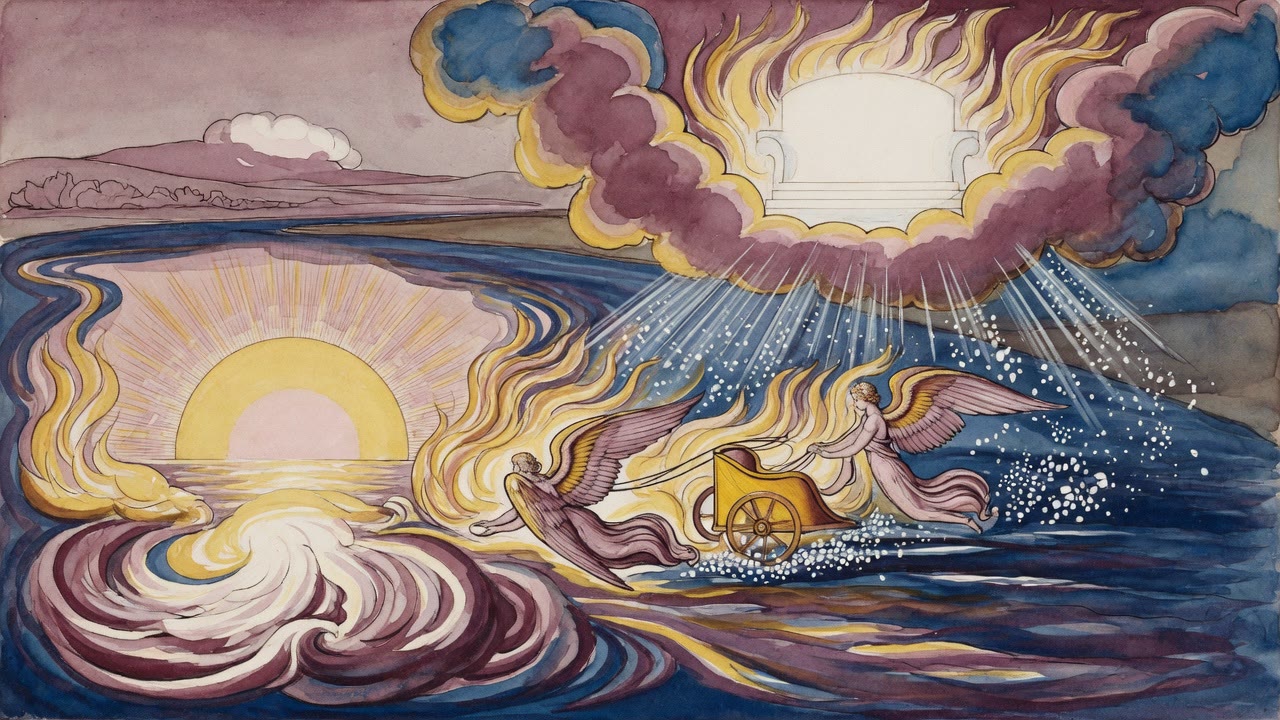
The wheel does not turn toward darkness. At the far edge of the sixth age, just before the greatest rest of all, something waits that the man at the table will not live to see and cannot stop straining toward. Light will rise and swallow death whole. It will pour from the hidden root of divine thought until there is no shadow left for death to stand in, and every creature, the greatest and the least, will know God inside that light. The unclean spirits will be driven off the face of the world like smoke off a snuffed lamp.

Then the cosmic Sabbath comes, a rest on a scale that no week can measure, and with it a new Torah. Not a Torah with a single letter added, not one letter taken away. The very same letters that stand now, only rearranged. The building blocks of the world reshuffled into a meaning no one here has read, the same notes struck into a melody never yet heard, a law of pure emanation in place of the law of creation. Some whisper of a twenty-third letter, invisible from the beginning, folded silent into the alphabet, waiting for that age to be spoken aloud at last.

The man knows none of the arithmetic of it. He knows only that his small year sits inside a larger year, and that inside a larger year still, and that the reset he feels under one Rosh ha-Shanah night is the same breath, drawn slow, that will one day let this whole world lie down and rise as something he has no letters left to name.


← All myths
From the tradition

Sources

3 sources

The texts behind this telling. Some cards carry a translation of the source; others are our own retelling of it, and each card says which. Every card links out to the original.

Or ha-HayimOr HaChaim

Retold in our words. Read the original at the link below.Sefaria-hosted English translation · CC-BY

That, according to some powerful Jewish mystical traditions, is how the universe came to be. Not a slow burn, not a gradual unfolding, but a single, instantaneous burst of divine energy.

Did you ever stop to wonder how God created the universe? The Torah tells us, "God spoke all these words, saying…" (Exodus 20:1). But what if all those words, the entire blueprint of existence, were spoken at once? That's the idea we're exploring. Heaven, earth, stars, oceans, every blade of grass, all of it, boom!, created in a single, unified divine utterance.

In this understanding, there was no "before" or "after" in creation, everything sprang into existence simultaneously. The universe, in its raw, unformed potential, was present in that one divine word. But here's the twist: while everything existed in that instant, it lacked order. It was like a cosmic soup, a swirling chaos of potential.

So, what about the six days of Creation that we read about in Genesis? Well, according to this view, those days weren't about creating something from nothing. Instead, they were about God bringing order to the already-existing universe. On the first day, God separated light from darkness. On the second, He divided the waters. The six days were a process of refinement, of sculpting and shaping the raw material of creation.

This idea comes to us from Rabbi Hayim ben Attar (1696-1743), a fascinating scholar best known for his commentary on the Torah, the Or ha-Hayim ("The Light of Life"). He finds support for this concept in the verse about the Sabbath: "For on it (the Sabbath) He rested from all His work which He had created in order to complete it" (Genesis 2:2). Rabbi Hayim ben Attar interprets this verse as meaning that the world had already been created – in that single utterance. The six days were about perfecting it. The verse doesn't say God rested from all the work he made, but from all the work he had created in order to complete it. It’s a subtle but powerful difference.

There's a parallel tradition, too. The Mishnat Rabbi Eliezer tells us that God spoke the Ten Commandments in a single utterance. If God could deliver the foundational laws of morality in a single breath, is it so far-fetched to imagine the entire universe being created in a similar way?

So, what does this all mean? It suggests a radical interconnectedness to everything. We are all, in a sense, part of that original utterance. We are all fragments of that initial burst of divine creativity, still being shaped and refined, still finding our place in the grand cosmic order. Perhaps, then, our task is to continue the work of creation, to bring order and meaning to our own lives and to the world around us, remembering that we are all connected by that single, powerful, and eternal word.

Full source
Sefer Netivot ha-ShalomChassidic Literature

Retold in our words. Read the original at the link below.Sefaria-hosted English translation · Public Domain

It's tied to Rosh ha-Shanah, the Jewish New Year. It's more than just eating apples and honey, you know? It's about something truly profound: the renewal of creation itself.

Every year, on Rosh ha-Shanah, everything goes back to its very beginning. Creation is reborn, the slate wiped clean. All that was created in the beginning… it all comes into being again. It’s not just a celebration of a new year on the calendar. It's a re-creation. Sefer Netivot ha-Shalom, quoting a teaching attributed to the Ari, the great Kabbalist Rabbi Isaac Luria, tells us this powerful idea. Each Rosh ha-Shanah, the world is re-created. It casts Rosh ha-Shanah as a kind of reaffirmation ceremony, a moment where we collectively acknowledge and celebrate God's ongoing act of creation.

Here's the thing that really grabs me: implicit in this idea is the suggestion that God, who renews the world, might decide not to renew it. It’s a potent reminder of the fragility of existence, the constant need for divine grace.

Rabbi Nachman of Breslov, in his Likutei Moharan, really gets to the heart of it. He describes God as a God of renewal, saying, "Faith is needed – faith that there is a Creator and a Renewer who can create things anew according to His knowledge and judgment." This isn't just about believing in a God who created the world once upon a time. It’s about believing in a God who is constantly creating, constantly renewing, constantly giving us the gift of existence. Every single year.

So, when we celebrate Rosh ha-Shanah, we're not just marking the passage of time. We're participating in this incredible cycle of renewal, reaffirming our faith in a God who chooses to create the world, and us, anew each year. It's a chance to reflect on the past year, to let go of what no longer serves us, and to embrace the possibilities of a fresh start.

What does it mean to you that the world is recreated every year? Does it change how you approach the New Year, or your own life? It certainly gives me something to think about.

Full source
Sha'arei Gan Eden 12cSha'arei Gan Eden

Retold in our words. Read the original at the link below.Sefaria-hosted English translation · CC-BY

These aren't just any years; they're cosmic Shemittot. The word Shemittah might sound familiar – it's the same word used for the sabbatical year, when fields lie fallow, a time of rest and renewal. (Exod. 23:10-11; Lev. 25:1-7, 18-22; Deut. 15:1-11) But on this grand scale, it becomes a cosmic reset. According to Sha'arei Gan Eden, there will be seven of these gigantic eons. Seven Shemittot, each a chapter in the universe's story.

What were things like before this era, you might wonder? Well, according to Sefer ha-Temunah (faith), in the eon before ours, there was no need for commandments! No reward, no punishment, just… a different kind of law. Hard to even fathom. Here, in our era, the commandments are a necessity, the framework within which we strive and grow.

What about the future? Hold onto your hats, because it gets even wilder. The myth tells us that at the end of the sixth eon, right before the cosmic Sabbath begins, something incredible will happen: light will swallow death. Light, all-consuming, banishing the very concept of death. Unclean spirits will be driven from the world, and everyone, "great and small," will know God through the light that emanates from the mystery of divine thought. It’s a powerful image.

Then… the cosmic Sabbath. A day of rest on a scale we can barely comprehend. What does that even mean for the universe? Well, the myth goes on to say that with the arrival of the cosmic Sabbath, a new Torah will emerge, a new cosmic law will prevail. Torah – the teachings, the wisdom, the very blueprint of existence – will be renewed. Wisdom and knowledge will increase among humankind.

Now, here’s where it gets really interesting. The letters of the Torah, the very building blocks of reality, will combine in new ways, taking on new meaning. But here's the kicker: not a single letter will be added or taken away! (Sefer ha-Temunah 62a) Think of it like rearranging the same musical notes into a completely new melody.

This idea, that the Torah is different in different eras, echoes the messianic idea that God will give a new Torah to Israel in the messianic era, different from the present one. It's the Torah of Divine Emanation, in contrast to our current Torah of Creation. This concept, that the Torah is not static, but rather a living, breathing entity that evolves with the cosmos, is both challenging and deeply inspiring.

Now, there’s a fascinating counterpoint to this idea. There's another myth about the twenty-third letter of the Hebrew alphabet – an invisible letter that has existed from the beginning. It will only be revealed in the messianic era, and that will be the genesis of the new Torah, given through the Messiah, just as the original Torah was given to Moses at Mount Sinai.

So, what does all this mean for us, here and now? Perhaps it's a reminder that we are part of something far larger than ourselves, a cosmic drama unfolding across vast stretches of time. Our actions, our choices, ripple outwards, influencing not just our own lives but the very fabric of reality. And maybe, just maybe, we're all playing a part in bringing about that future era of light, knowledge, and cosmic Sabbath.

Full source