5 min read

They Named the Deputy Angel at Midnight and Waited

A lamp, a divine name, and the title of a memuneh who rules an hour. Outside, neighbors whispered Jews could compel heaven. Inside, hands shook.

Curated by Arthur · Told by Maggid ·
Table of Contents
  1. Midnight and a Name That Must Answer
  2. White Lines and Black Lines
  3. What the Street Believed
  4. Rings, Psalms, and the Gray Hour
  5. Authority Above the Officer
They Named the Deputy Angel at Midnight and Waited Click for full size

Midnight and a Name That Must Answer

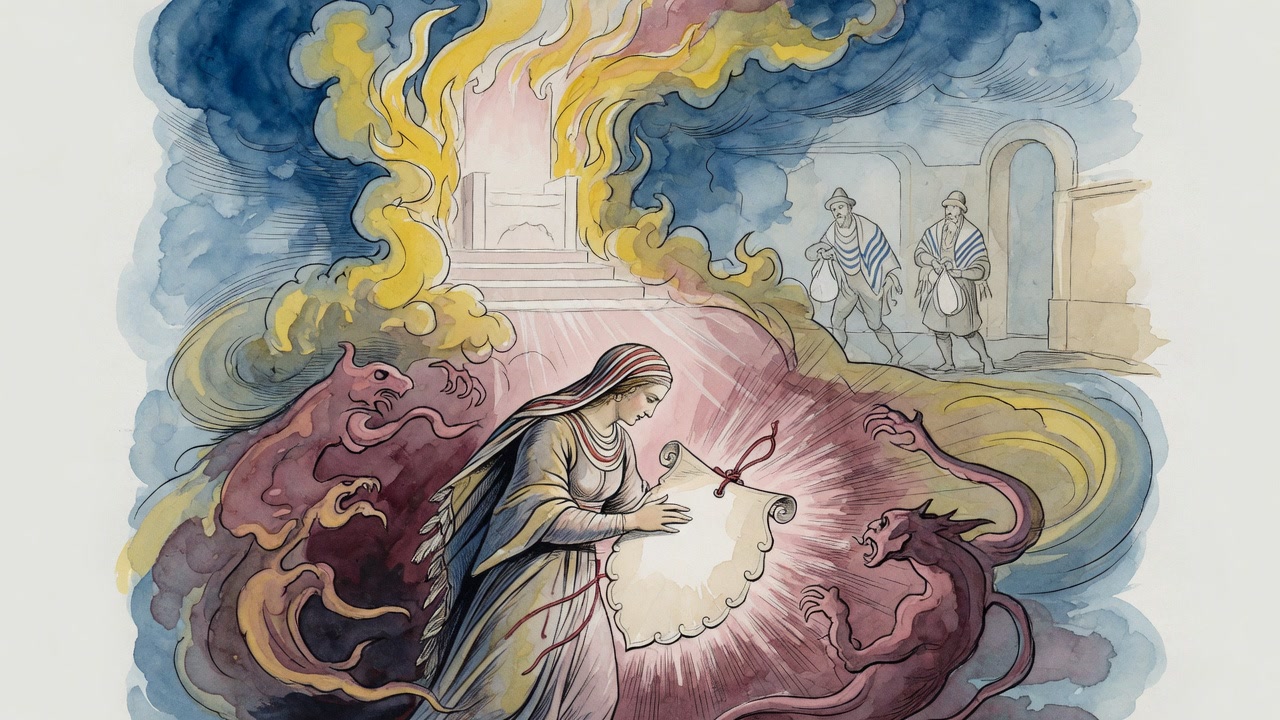
The lamp smoked until the room smelled of burnt oil and nerve. The householder washed his hands a second time and opened the page where the hours had deputies. Every domain, the German pietists taught, has a memuneh, an appointed one. Nation. City. Hour. Force of weather. Know the name, join it to the right divine names, and the deputy must respond. Not because a human outranks heaven, but because the King staffed creation with officers who answer when properly addressed. Job had asked if anyone could number His armies. The Talmud answered no. Infinity still has clerks.

His lips shaped the angel's title carefully, as if a mispronunciation might summon the wrong errand. The room did not explode. Waiting is also a ritual. Outside a dog barked. He flinched as if the bark were an answer from the wrong realm. His wife slept in the next room with a feverish child. The rite was for the child's sleep, not for glory.
White Lines and Black Lines

Torah forbids sorcery that manipulates through demons and banned arts. The same tradition left room for protective work in God's name: amulets, sacred words for healing, wards against what hunts at night. Sefer Hasidim filled pages with how to break a spell, how to detect harm, how to shelter a household when envy walks the street. Eleazar of Worms wrote hierarchies and techniques until angelology looked operational rather than merely poetic. Mazal, malach, sar, memuneh: the words slid into one working vocabulary for forces under God yet nearer than God to the hourly need.

Black magic was a door you do not open. White magic was a fence you build when the dark already knows your address. The householder told himself he was building fence. Sweat still ran into his collar. Fence-building at midnight feels like trespass even when the posek in your head nods and quotes a verse. He checked the amulet's stitching again. Parchment. Ink. A name of God set where a stranger's eye should not idle.

What the Street Believed

Beyond the Jewish street, fear grew larger than practice. Neighbors told each other that Jews were the strongest sorcerers in the land, that sacred Hebrew itself was a weapon, that closed books hid poisons and summons. Rulers swung between shielding Jews as useful subjects and hunting spell-casters when panic needed a face. During plague years the story turned lethal. Incantations were blamed for mass death. Whole communities paid for a legend written by terror, not by the small rites actually whispered over cribs.

Inside the house the man seeking protection did not feel like a legend. He felt small. His amulet was careful ink, not a conspiracy against wells. The gap between what he did and what was said about him could swallow a town. He knew that. Knowledge did not stop his mouth from finishing the formula. A father's fear is a kind of scholarship that skips the footnotes.

Rings, Psalms, and the Gray Hour

Folk books spoke of rings and transformations, of powers legal codes argued over without denying that power exists. The Torah's ban on certain sorceries already assumed the arts were real enough to forbid. Later an authority would claim modern magic is vanity and only ancient arts were real. The folk did not retire on that ruling. Psalms stayed on sickbed lips. Divine names stayed in pendants against a child's skin. The gray hour between piety and spell stretched across centuries because need does not wait for clean categories.

The householder finished the formula and kept the lamp lit a little longer, as if light itself were part of the contract. If the memuneh had heard, the hearing would show as eased fear, a fever dropping, a nightmare that did not return. Magic in this key is judged by aftermath, not by theater. No audience. No applause. Only a pulse under a small hand in the next room.

Authority Above the Officer

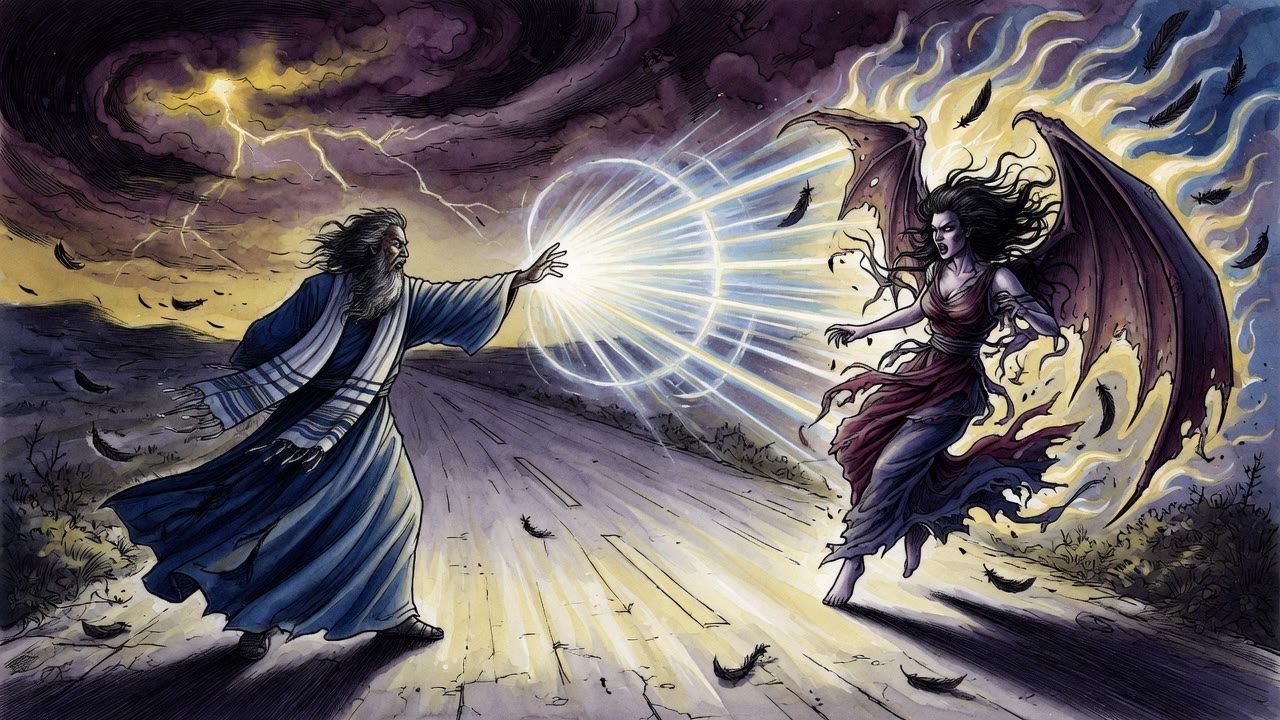
He closed with a line that returned the chain of command to the top. No deputy acts alone. No name works as rebellion. The Talmud's edge, there is none other than Him even regarding sorcery, hung over the desk like a second lamp. If the rite had been vanity, heaven would nullify it as if it never were. If it had been service, the officer would do the errand and step back. Sovereignty remains with the Creator even when an officer of heaven is addressed by name. The householder did not need a treatise. He needed the child to breathe easier before dawn.

Dawn thinned the lamp's importance. He slept a little with his boots still on. In the street the legend of Jewish sorcerers went on without asking his permission. In his pocket the amulet warmed with his pulse, a small Jewish answer to a large night, always under authority, never as free as the fear outside imagined.


← All myths

From the tradition

Sources

3 sources

The texts behind this telling. Some cards carry a translation of the source; others are our own retelling of it, and each card says which. Every card links out to the original.

Jewish Magic and Superstition, Ch. 6Jewish Magic and Superstition (Trachtenberg, 1939)

Retold in our words. Read the original at the link below.Jewish Magic and Superstition, Joshua Trachtenberg (1939) · Public Domain

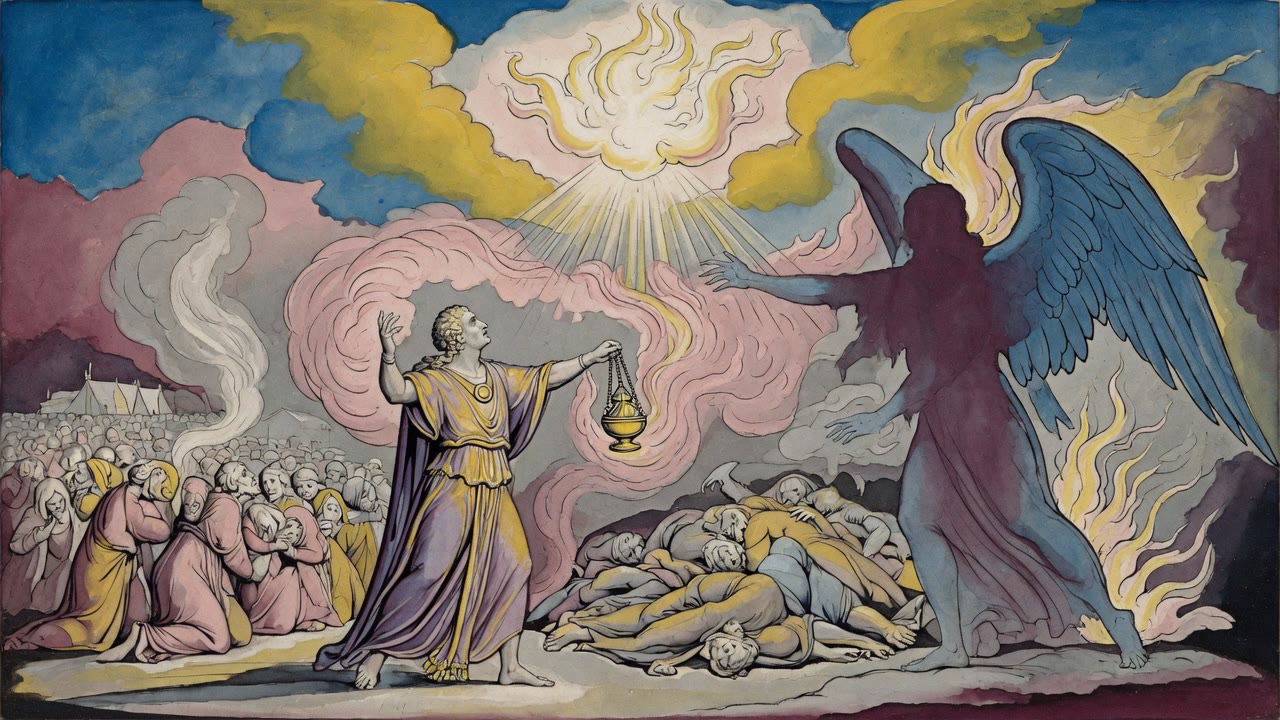
If demons crowded the dark spaces of medieval Jewish life, angels filled the light. Joshua Trachtenberg showed that Jewish angelology was not merely theological, it was operational. Angels could be summoned, directed, and even compelled through the right names and rituals.

The foundation was biblical. (Job 25:3) asks: "Is there any number of His armies?" The Talmud answered: no. The number of angels was infinite, and every domain of creation had its appointed guardian. Eleazar of Worms, the 13th-century German mystic, systematized this into a comprehensive hierarchy documented in Hochmat HaNefesh (the vital soul) and other works. Every nation had a celestial prince (sar). Every city had an angel. Every individual had a personal guardian spirit.

This was not merely a matter of faith. The concept of the memuneh (מְמוּנֶה), the "appointed one" or deputy angel, gave Jewish magical practice its theoretical framework. Each memuneh controlled a specific domain, a nation, a natural force, an hour of the day. If you knew the angel's name, you could invoke it. And if you invoked it correctly, using the proper divine names, it had to respond. The Sefer Hasidim and the Ziyuni both teach that God will not punish any nation until He has first punished its heavenly prince, proving that the earthly and angelic realms are bound together.

The terms for these beings shifted freely. Mazal (star), malach (angel), sar (prince), and memuneh (deputy) were used interchangeably, reflecting a worldview in which angelic and astrological forces merged. The practical result was a system of angel magic in which knowing the right name at the right time gave a person access to cosmic power, always, in theory, mediated through God's ultimate authority, but in practice edging close to the coercive magic the rabbis officially condemned.

Full source
Jewish Magic and Superstition, Ch. 1Jewish Magic and Superstition (Trachtenberg, 1939)

Retold in our words. Read the original at the link below.Jewish Magic and Superstition, Joshua Trachtenberg (1939) · Public Domain

Throughout the Middle Ages, Jews bore a reputation as the most powerful sorcerers in Europe. As scholar Joshua Trachtenberg documented in his 1939 study, this belief was so widespread that kings issued decrees against Jewish magic, inquisitors hunted Jewish spell-casters, and ordinary people genuinely believed their Jewish neighbors could summon demons and brew poisons from human remains.

The accusation ran deep. In 1303, Philippe le Bel of France had to forbid the Inquisition from prosecuting Jews on charges of sorcery, not because he doubted the charges, but because he wanted to retain control over "his Jews." A century later, Pope Alexander V reversed course, ordering inquisitors in Avignon and Provence to pursue "Jews who practised magic, invokers of demons, and augurs." The charge of sorcery became entangled with the blood libel and accusations of well-poisoning, especially during the Black Death of 1348-1349, when entire Jewish communities were massacred on the theory that their incantations had caused the plague.

Where did this legend come from? Trachtenberg argues it was a projection. Medieval Europeans practiced enormous amounts of folk magic themselves, love spells, healing charms, protective amulets. But Jews possessed something that seemed uniquely dangerous: a tradition of sacred names, Hebrew incantations, and angelic invocations that stretched back to the Talmud and beyond. The Hebrew language itself was considered magical, and the fact that Jews guarded their mystical traditions closely only fueled suspicion.

The irony, as Trachtenberg shows, is that Jewish magical practice was far more restrained than the wild accusations suggested. Jews did practice certain forms of protective magic, amulets, divine name invocations, demon-warding rituals. But these operated within a religious framework, always invoking God's authority rather than defying it. The gap between the legend and the reality tells us more about medieval fears than about actual Jewish practice.

Full source
Jewish Magic and Superstition, Ch. 2Jewish Magic and Superstition (Trachtenberg, 1939)

Retold in our words. Read the original at the link below.Jewish Magic and Superstition, Joshua Trachtenberg (1939) · Public Domain

Strip away the medieval slander and a real tradition of Jewish magic emerges, one that Joshua Trachtenberg traced from the Bible through the Talmud and into the folk practices of medieval Ashkenazi Jews. The Torah itself bans certain forms of sorcery (Exodus 22:17), which tells us something important: the biblical authors believed magic was real and effective. They just believed Jews should not practice certain kinds of it.

The Talmud draws a crucial distinction. "Black" magic, using demons, manipulating nature through forbidden means, was prohibited. But "white" magic, invoking God's names, using sacred words for healing, wearing protective amulets, occupied a gray area that most rabbis tolerated or even endorsed. The Sefer Hasidim, composed in 13th-century Germany by Judah the Pious and his circle, is packed with magical practices: how to detect a witch, how to break a spell, how to use divine names for protection.

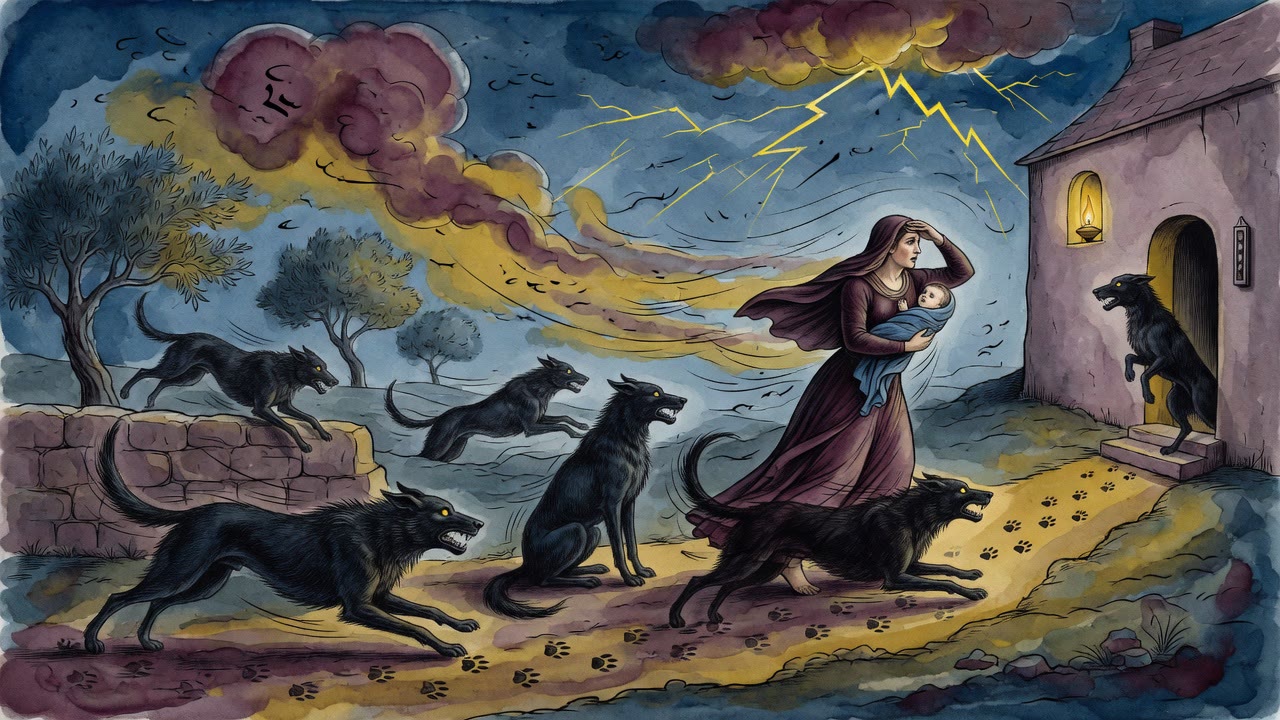
Medieval Jewish authorities wrestled endlessly with the boundaries. Eleazar of Worms, the great 13th-century mystic, recorded elaborate angel-summoning techniques and name-based magic in works like Sefer Raziel and Hochmat HaNefesh (the vital soul). The Ma'aseh Book, a popular collection of Jewish folk tales, included stories of magic rings that could transform a person into a werewolf. Even the legal codes acknowledged the reality of magical power, the question was never whether magic worked, but whether a given practice crossed the line into forbidden territory.

By the 17th century, some authorities tried to close the door entirely. David HaLevi declared flatly: "The Torah forbade only the magic of ancient times; nowadays there is no more magic in the world, but it is all vanity." But the folk tradition told a different story. Ordinary Jews continued to use amulets, recite protective psalms, and invoke angelic names well into the modern era, practices rooted in a magical worldview that the rabbis could regulate but never fully suppress.

Full source