5 min read

Truth and Mercy Fought Beside the Throne

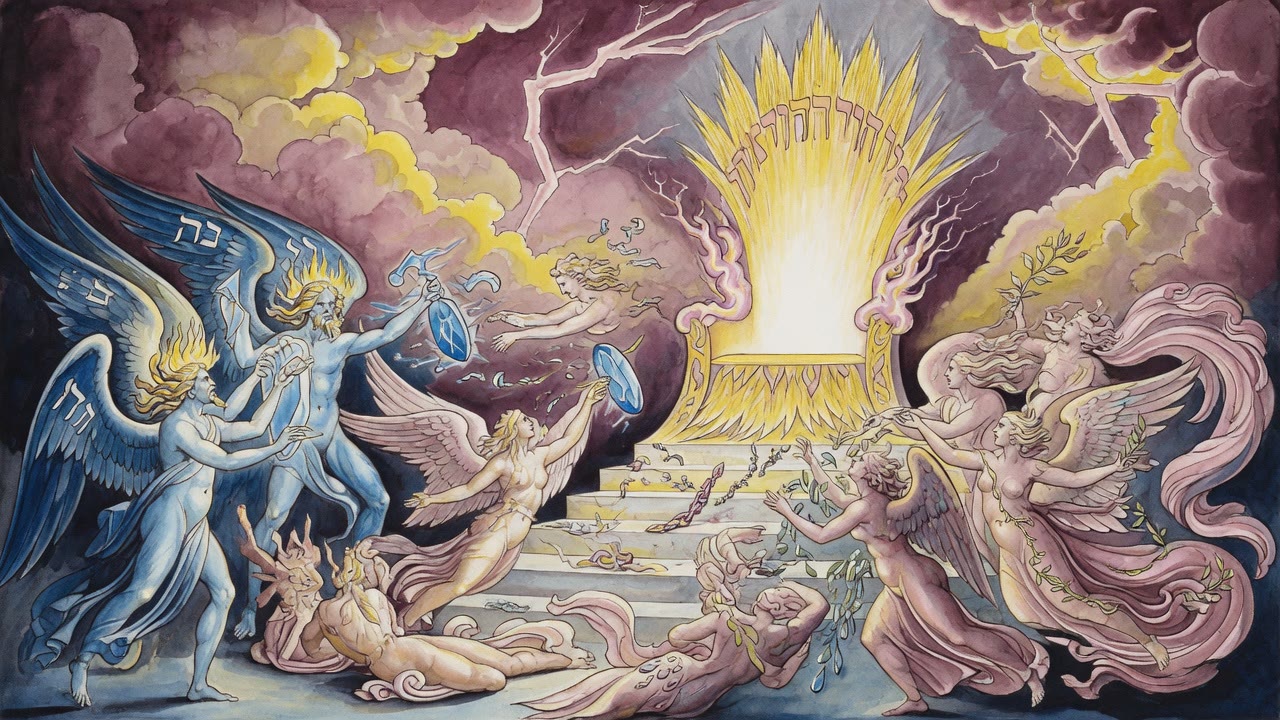
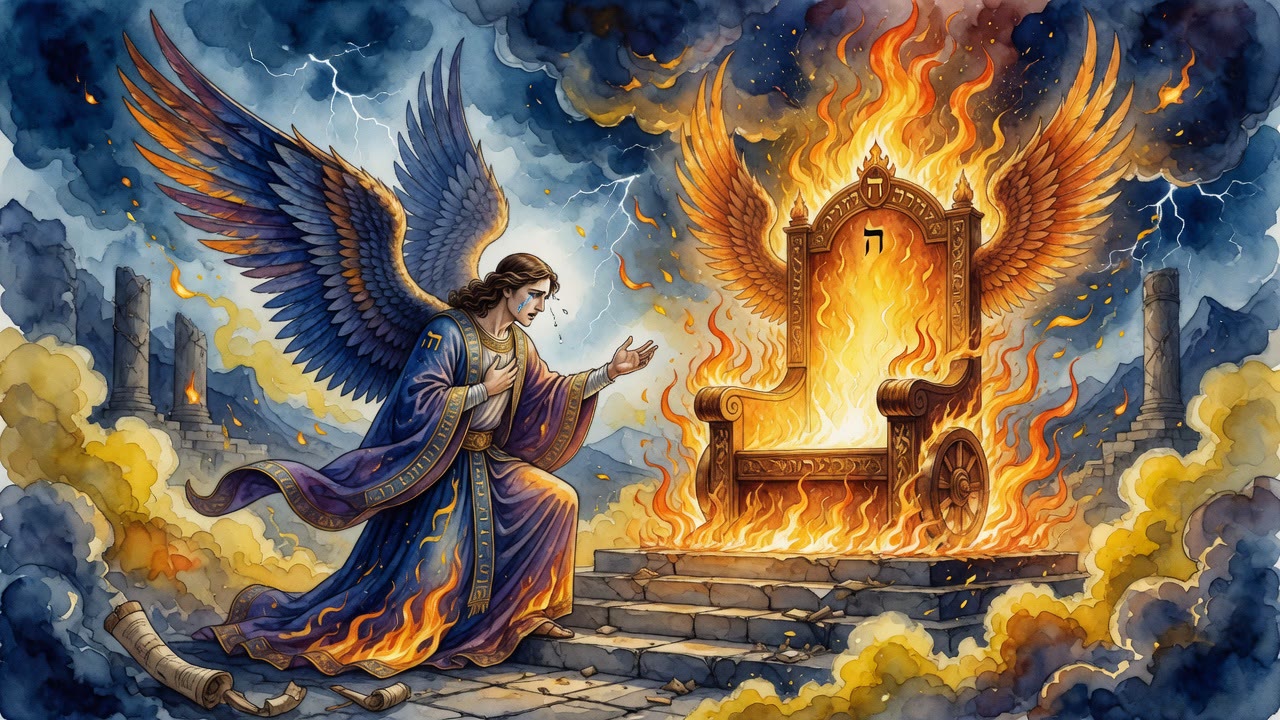
Hosts stood at the right and left of the high throne. Some cried for life, some for death, and truth rose only from the quarrel of voices.

Curated by Arthur · Told by Maggid ·
Table of Contents
  1. The Throne That Sorts Life From Death
  2. Enough, Said Akiva
  3. A Multitude Makes One Verdict
  4. When Judgment Is Not Cruelty
  5. Goodness Will Not Let Evil Keep the Last Word
Truth and Mercy Fought Beside the Throne Click for full size

The Throne That Sorts Life From Death

High above any human court, a seat waited that could tell death from life. Isaiah saw the Lord sitting on a high and exalted throne (Isaiah 6:1). Kings of flesh sat with flatterers. This throne sat with a host, and the host was not decoration. Some stood for exoneration. Some stood for condemnation. The air between them was thick with argument.

Rabbi Simon named what the eye could not ignore. The King of the universe does not rule in a silence that pretends conflict never exists. Heaven keeps a chamber where claims meet claims. A soul's case arrives, and the sides take their places the way soldiers take walls.

Enough, Said Akiva

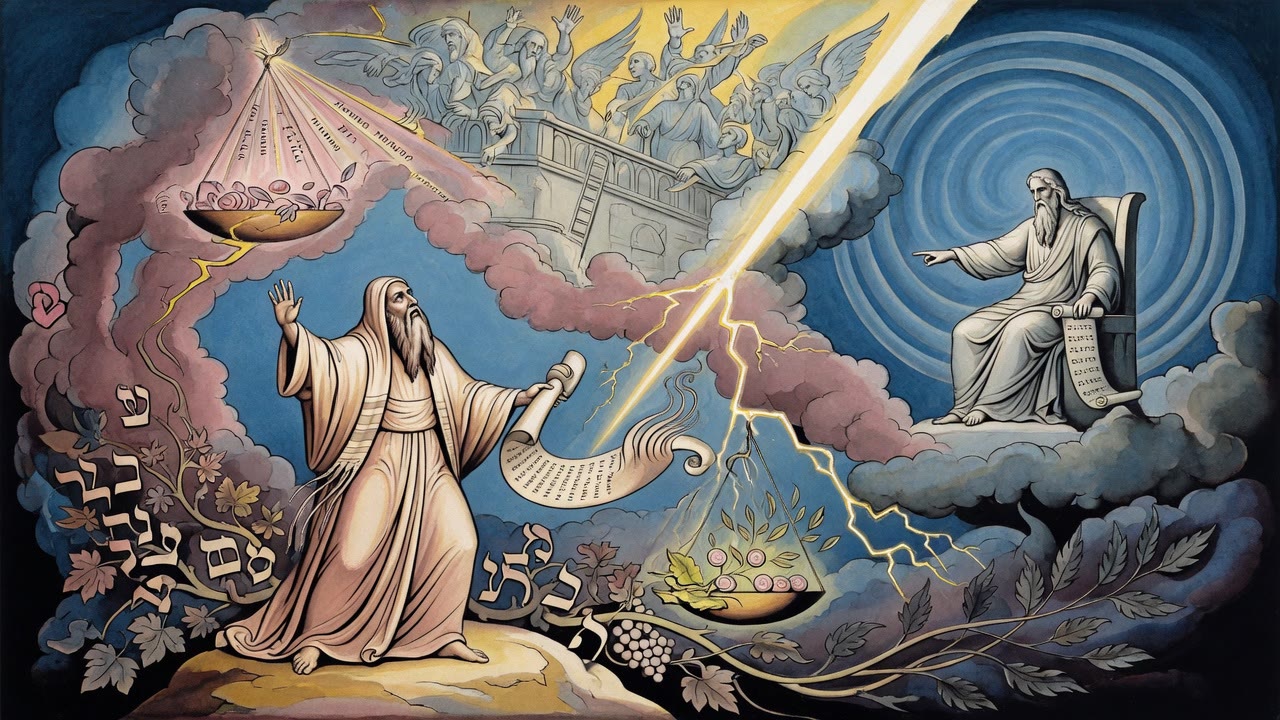
Rabbi Papis reached for a hard verse. "He is of one mind, and who can respond to Him?" (Job 23:13). The line can sound like a closed door. Rabbi Akiva cut across it. "Enough, Papis. One may not challenge the words of the One who spoke and the world came into being, because everything is true and everything is just." The push was not rebellion. It was a refusal to turn God's oneness into a mute wall.

Oneness here does not mean no debate occurs. It means the debate cannot unseat the Judge. The hosts may shout. The throne does not tip. Truth is not the loudest voice. Truth is what remains when every honest claim has been heard and the King still sits.

A Multitude Makes One Verdict

Daniel speaks of "the truth of the matter and a great host" (Daniel 10:21). Rabbi Yochanan, citing Rabbi Acha, hears in that pairing a method. Truth emerges from a multitude of voices. Jeremiah names the Lord God as truth (Jeremiah 10:10). In the court above, truth is not a thin slogan. It is the living God still standing after mercy and severity have finished their briefs.

When Scripture says "And the Lord," some sages hear God and His court together. The case is never a private whim. Even the language of the verse carries a bench. A human judge who refuses counsel is dangerous. The heavenly picture insists on counsel, then on a verdict that does not wobble.

When Judgment Is Not Cruelty

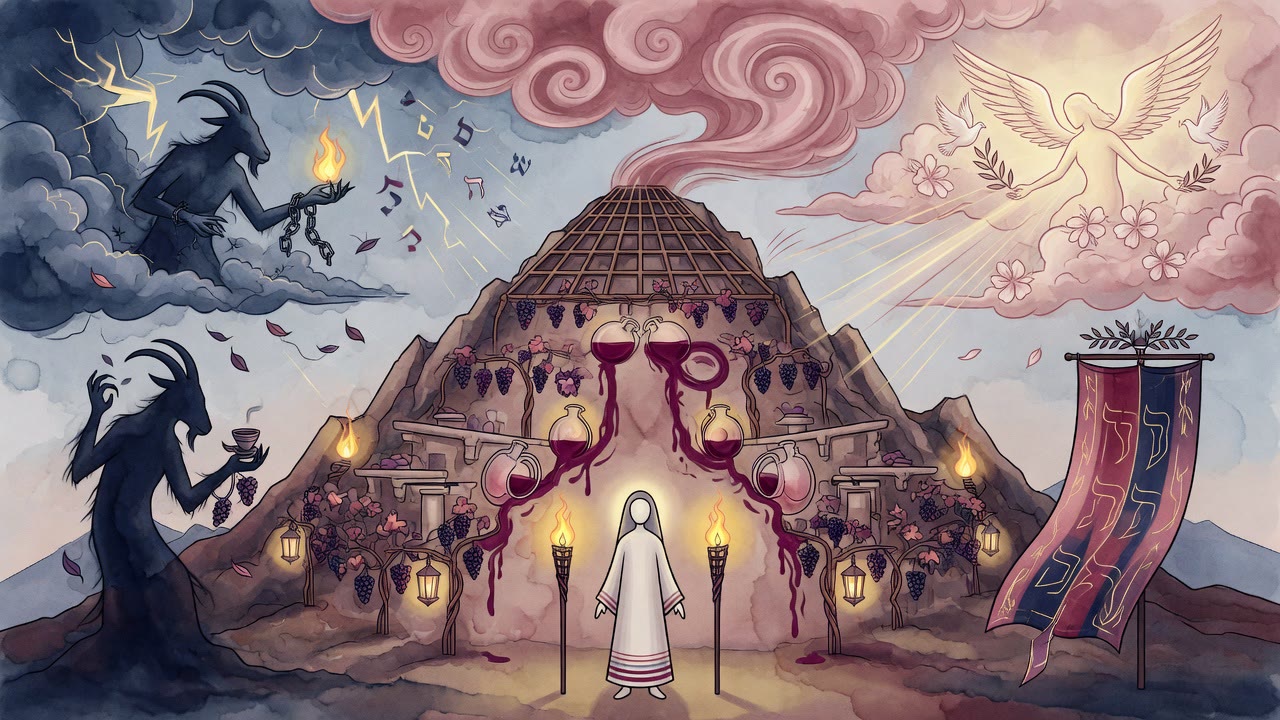
Down in the body of the world, judgment often feels like a blade without a handle. The kabbalists name a stern force, din, whose work is to chasten and to set edges. Left raw, severity burns the field it claims to protect. Softened, the same force can hold a shape that allows good to stand. A baker's spice is food in a pinch and ruin in a jar. Severity follows the same law of measure.

They speak of Zeir Anpin, the Impatient Face through which divine will reaches the lower worlds. Its innermost heart knows judgment. Mitigation is not a trick that cancels justice. It is the difference between a sentence that educates and a sentence that only breaks. The court above is not theater. It is the place where measure is argued until the King sets the dose.

Goodness Will Not Let Evil Keep the Last Word

Another teaching presses further. God's essential nature is goodness. Nothing endures except that goodness. If the Supreme Will is to benefit, then endless punishment without repair contradicts the will that made the court. Severity may pursue the sinner, as Proverbs says evil pursues sinners (Proverbs 13:21). The purpose of the pursuit is not spectacle. It is return.

So the hosts at the right keep speaking for life. The hosts at the left keep speaking for accountability. Mercy is not soft absence of law. Judgment is not hatred dressed as holiness. Between them, under a throne that sorts life from death, truth becomes the name of a God who will not let evil last forever and will not let the world pretend that deeds do not matter. The quarrel continues wherever a case is still open. The Judge remains one.

A human court that silences half its bench becomes a theater of fear. The heavenly picture refuses that shortcut. Advocates for life keep their post even when the case looks hopeless. Advocates for accountability keep their post even when pity would be easier. The King who sits above both is not waiting for applause. He is waiting for a verdict that can still be called true after the shouting ends.

On earth a sufferer feels only the edge of din and calls it cruelty. In the chamber above the same edge is argued, measured, and sometimes sweetened until it can teach without erasing. Goodness does not cancel the trial. It refuses to let the trial become the only forever. That is why the hosts still stand left and right, and why the throne still sorts life from death without tipping into either silence or chaos.

When a case closes, no advocate gets to keep the gavel. The gavel stays above. What remains for the lower world is a justice that can wound and a mercy that can wait, braided under one Name that Jeremiah called truth.


← All myths

From the tradition

Sources

3 sources

The texts behind this telling. Some cards carry a translation of the source; others are our own retelling of it, and each card says which. Every card links out to the original.

Shir HaShirim Rabbah 1:9Shir HaShirim Rabbah

Retold in our words. Read the original at the link below.The Sefaria Midrash Rabbah, 2022 · CC-BY

The book of Shir HaShirim Rabbah, a collection of rabbinic interpretations of the Song of Songs, explores this very question. It uses vivid imagery and insightful debates to paint a picture of a heavenly court, a place where justice, mercy, and, above all, truth reign supreme.

It starts with a verse from (Song of Songs 1:9), "To a mare in Pharaoh's chariots I have likened you, my love." It seems like a strange jumping-off point. But Rabbi Papis connects this to (Job 23:13), "He is of one mind, and who can respond to Him?" The idea being, God is the ultimate authority, and no one can challenge His judgments.

Rabbi Akiva isn't so sure. He pushes back, saying, "Enough, Papis, one may not challenge the words of the One who spoke and the world came into being, because everything is true and everything is just." He points to (Isaiah 6:1), "I saw the Lord sitting on a high and exalted throne." This isn't just about power, it's about a system of justice.

Rabbi Simon adds another layer. He describes this throne as one that "distinguishes between death and life," and pictures God surrounded by a heavenly host, as in I (Kings 22:19). But then comes the kicker: are these hosts on God's right and left just… there? No! Some advocate for exoneration, others for condemnation. We find a similar sentiment in (Daniel 10:20), "The truth of the matter and a great host." Rabbi Yoḥanan, citing Rabbi Aḥa, explains that truth emerges from this multitude of voices, this grand debate. It echoes (Jeremiah 10:10), "The Lord God is truth."

So, what is truth, in this context? Rabbi Aivun says it's that God is the living God and King of the universe. Rabbi Elazar takes it a step further, stating that whenever we see "And the Lord," it implies God and His court. He uses the example of I (Kings 22:23), where the prophet Micaiah says, "And the Lord has spoken evil in your regard." This verse is the climax of a story where Micaiah sees God on His throne, surrounded by the heavenly host, as described in I (Kings 22:19). It's not just God acting alone; it's a process, a deliberation.

But if God is "of one mind," as Rabbi Papis initially suggested, how does this court fit in? Rabbi Elazar clarifies that God alone seals the final verdict. No one else has that power. But what is God's seal? Rabbi Beivai, quoting Rabbi Reuven, says it's emet (אמת), truth itself! He refers to (Daniel 10:21), "However, I will tell you what is inscribed in the writ of truth."

Here's where it gets really interesting. Why both "truth" and "inscribed"? It seems redundant. The answer is subtle but profound: until the ruling is signed, it's "inscribed," meaning it can still be changed. But once it's signed, it becomes emet, immutable truth.

Reish Lakish offers a beautiful, almost poetic interpretation of emet. He points out that alef (א) is the first letter of the Hebrew alphabet, mem (מ) is in the middle, and tav (ת) is at the end. This, he says, echoes (Isaiah 44:6): "I am first and I am last and aside from Me there is no God." "I am first," meaning God didn't receive His kingdom from anyone. "And I am last," meaning He won't transfer it to anyone else. "And aside from Me there is no God," meaning there's no equal to Him. Emet, therefore, encapsulates God's eternal and absolute nature.

So, what does this all mean for us? It suggests that even the Divine operates with a system of justice, deliberation, and ultimately, truth. That even in the face of seemingly arbitrary events, there's a process, a reason, and a commitment to emet guiding the universe.

Full source
Kalach Pitchei Chokhmah 52:15Kalach Pitchei Chokhmah

Retold in our words. Read the original at the link below.138 Openings of Wisdom, trans. Rabbi Avraham Greenbaum, Azamra Institute (2005) · CC-BY

We’ve all been there. But what if even those moments of intense judgment and hardship could be understood differently? What if, at their core, they were actually connected to something good?

Jewish mystical tradition, particularly in texts like Kalach Pitchei Chokhmah (which translates roughly as "Fifty Openings of Wisdom"), wrestles with this very idea. It explores the concept of din, often translated as "stern Judgment," and its complex relationship with divine justice and mercy.

The text explains that the very purpose of stern Judgment is to enact justice and, yes, to chasten the wicked. But here’s the crucial point: the extent to which that Judgment is "mitigated" – softened, sweetened, tempered – determines whether it brings about evil, or whether it can even bring about good.

Think of it like this: imagine a baker adding spices to a cake. A dash of cinnamon? Delicious. A whole jar of chili powder? Not so much. The same principle applies to divine judgment. Too much severity, unmitigated, leads to pain and sorrow. But when that severity is tempered, it can actually contribute to a positive outcome.

Now, the text brings in the concept of Zeir Anpin. In Kabbalah, Zeir Anpin is often associated with the six Sefirot (divine attributes) from Chesed (loving-kindness) to Yesod (foundation). Think of Zeir Anpin as a kind of energetic conduit through which divine will manifests in the world. According to Kalach Pitchei Chokhmah, the "innermost heart" of Zeir Anpin is to execute stern Judgment. It’s part of its essential nature. But here's the kicker: the power of mitigation can gain sway over this inherent severity, causing it to subside.

This doesn't mean Zeir Anpin fundamentally changes. It doesn't suddenly become something else entirely. The text emphasizes that there is "no change in the essential nature of Zeir Anpin." It simply means that the pain and sorrow associated with unmitigated Judgment pass away. As the stern Judgment subsides, so too does the dejection, and – get this – brotherly love begins to reign.

It's a powerful idea. It suggests that even in the midst of hardship, there is the potential for something better, something more loving, to emerge. That the very force that can bring about suffering can also, when tempered, pave the way for connection and compassion. This echoes similar ideas we find throughout Jewish thought, such as in the idea of teshuvah (repentance) where even past misdeeds can be transformed into merits.

So, the next time you find yourself facing a seemingly insurmountable challenge, remember the teaching of Kalach Pitchei Chokhmah. Remember that even stern Judgment can be mitigated, that even in the darkest of times, there is the potential for light, for love, and for a deeper understanding of the Divine plan. Can we always see it in the moment? Maybe not. But the possibility is always there.

Full source
Kalach Pitchei Chokhmah 2:6Kalach Pitchei Chokhmah

Retold in our words. Read the original at the link below.138 Openings of Wisdom, trans. Rabbi Avraham Greenbaum, Azamra Institute (2005) · CC-BY

The core argument hinges on a single, powerful idea: God's essential nature is goodness. According to the Kalach Pitchei Chokhmah (Wisdom), nothing endures except God's goodness. If God’s will is solely to benefit, then the current state of affairs – with all its suffering and injustice – simply cannot last forever.

Some might argue that the punishment of the wicked is simply just desserts. "Evil pursues sinners," as (Proverbs 13:21) tells us. But the text challenges that assumption. It argues that God doesn't punish simply for the sake of punishment. Rather, the punishment is intended to bring the sinner to repentance, ultimately for their own benefit.

Here’s the key: if the purpose of punishment is ultimately good, then the punishment itself, in its unpleasantness, is inherently "bad." And because it is "bad," it goes against the "Supreme Will" of a God whose essence is goodness. The implication is profound. If punishment is inherently contrary to God’s ultimate will, it cannot continue forever. The sinner must eventually be released, redeemed, and brought back into harmony. This isn't just true for individuals, either. It applies to the entire world. If evil exists in the world, and evil is contrary to God's will, then evil's reign must have an end. It simply cannot persist eternally.

This idea offers a powerful sense of hope. It suggests that even in the face of immense suffering, there is an underlying current pushing toward ultimate redemption. It's a vision of a world where goodness ultimately triumphs, not through annihilation, but through transformation. The Kalach Pitchei Chokhmah presents a vision of ultimate optimism, where the very nature of God guarantees that darkness cannot last forever.

Full source