Twelve Banners Took Their Colors from the Breastplate
Aaron held still while twelve princes took colors from the stones on his chest. Judah's lion went up in the first wind.
Table of Contents
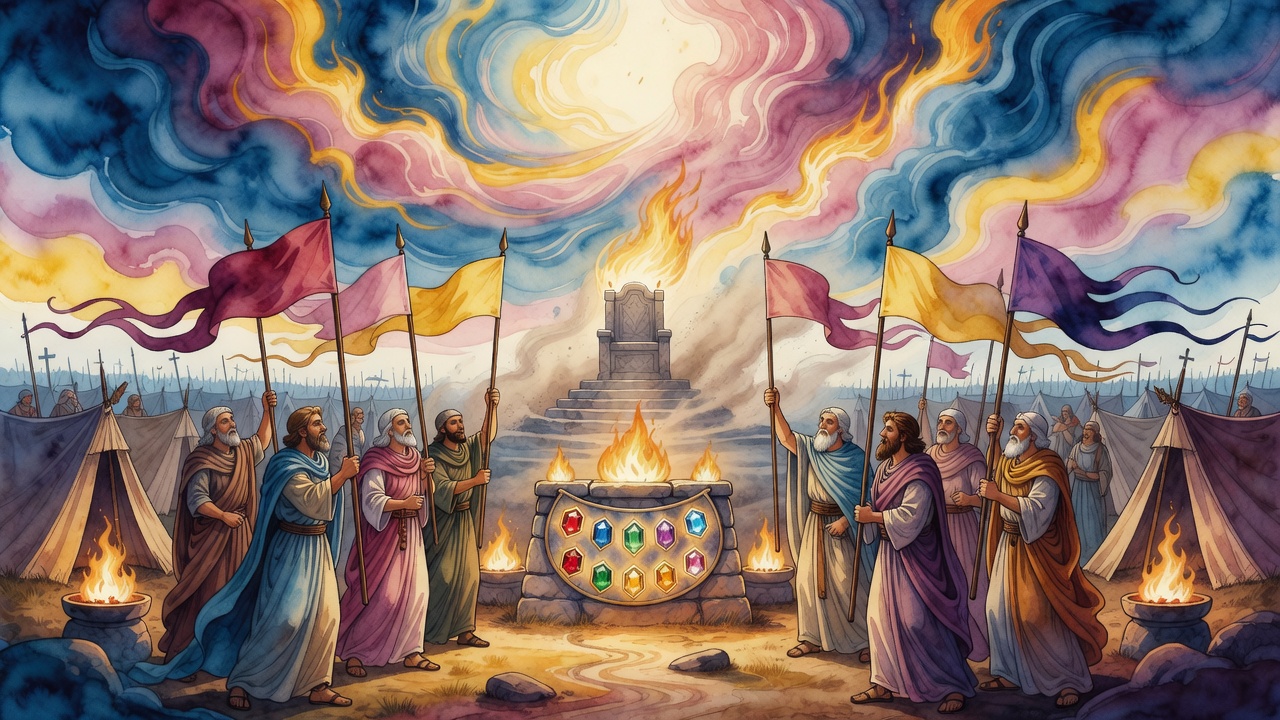
Aaron stood still while the princes of Israel came close enough to see their own reflections in the breastplate. Twelve stones. Twelve names. Every man was already ordered to camp by his standard, by the ensigns of his father's house. The princes took the colors of the flags from those stones, so that when the wind lifted a banner, the camp would remember the same fire that burned on the high priest's chest.
 Click for full size
Gems Before Cloth
Reuben's prince reached first. He wanted red, the color of his stone, and mandrakes stitched on the field, the plant he had once carried to Leah. Judah's prince took a lion and would not share the sky-color with anyone. Benjamin claimed the wolf. Joseph the ox. Simeon wanted walls, the memory of Shechem. Issachar asked for deep blue with sun and moon, a sign of seasons and study.
They argued over thread the way brothers argue over a father's last words. Aaron did not settle it with a speech. He stood. The stones had already settled it. Each man left with the color that had burned on the priest's chest, and with an emblem he would have to live under in weather.
The wilderness would try to erase identity with sameness. The poles refused.
A Camp That Could Find Itself
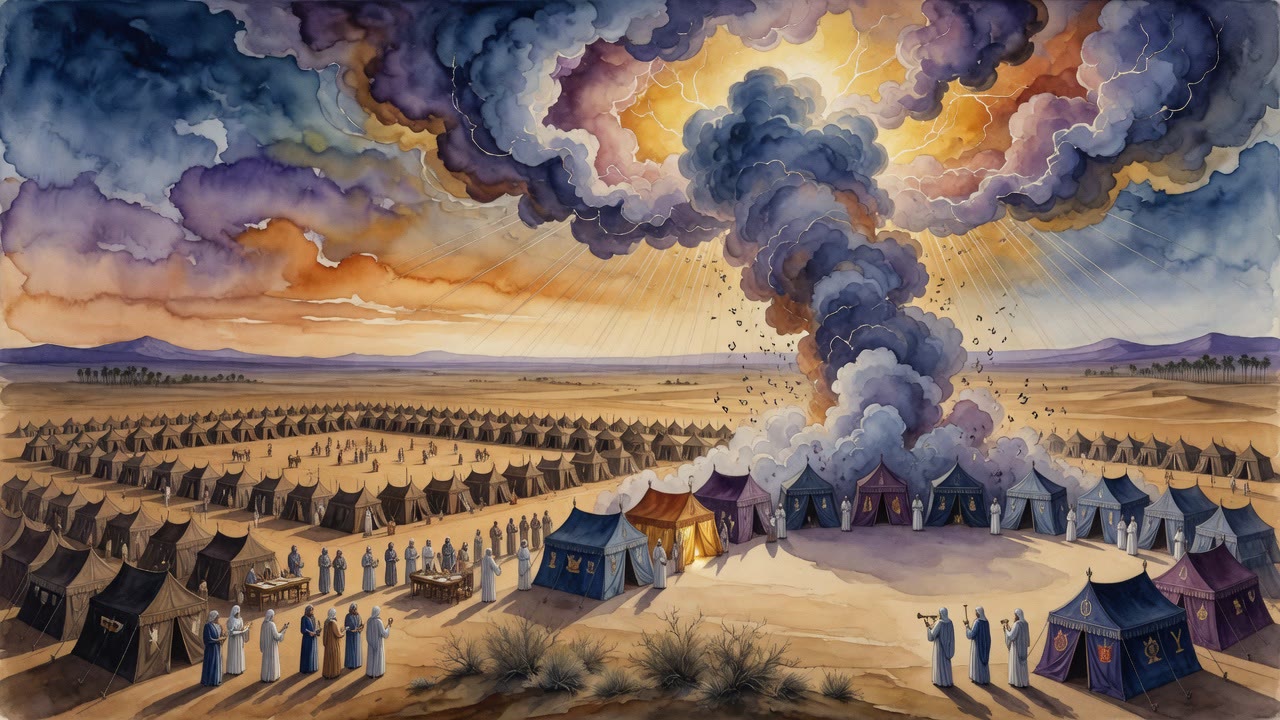
From a ridge the nation sorted itself east, south, west, north. A boy from Dan looked up and knew where home was without asking a stranger. A woman from Asher found her people by the olive light on the flag. A lost toddler could be walked home by color alone. A messenger could find the right prince without memorizing every face in a nation of thousands.
When the cloud moved at dawn, the whole people had to fold and rise without losing their names. The banners went first. Order was how a family kept from dissolving into a crowd.
Naphtali's olive was not Levi's nearness to the Tent. Reuben's red was not Judah's fire. Belonging had a shape a person could point to.
Fruit That Tasted Like Its Mountain
Later the land itself became the question. Calev walked it when others only feared it. He chewed fruit on a ridge and fruit in a valley and they were not the same sweetness. Mountain fruit is not plain fruit. The flavor of one mountain is not the flavor of the next. Plains differ from plains.
Twelve tribes would inherit twelve lands, and the fruit of one would not taste like the fruit of another. Olive oil here. Honey there. Wheat and barley in one run of soil, iron in the stones of another. God had said of Calev, I shall bring him to the land whence he came. Even his portion would keep its own taste.
He came back with juice on his wrist and a report the others did not want.
Calev Stood Under the Poles
The spies returned and argued under those same banners. Some spoke only of walls and giants. Calev spoke of fruit that changed with elevation, of valleys that kept their own sweetness, of a country too particular to be reduced to fear.
He had stood under colors that already confessed difference. He could stand in a land that confessed difference too. The lion snapped east. The ox held west. Judah's prince did not have to become Reuben to stay Israel. Calev would not lie about flavor or fortification to make the camp feel safe.
A few mouths told the truth about the land's strength. Most did not. The poles above them already knew how to keep twelve names from blurring into one crowd. Calev pointed at the fruit stains on his sleeve as if that were evidence a wall could not cancel.
The Wind Kept the Names
Children learned their letters under moving cloth. A boy traced Judah's lion in the dirt with a stick, then looked up to check the cloth against his drawing. A girl from Issachar watched sun and moon rock on blue when the wind came down the wadi.
Cooking smoke rose in twelve neighborhoods of one camp. A priest's breastplate flashed once as he turned. Somewhere east a lion banner snapped. Somewhere west an ox held steady. The people who slept under those signs would inherit a land where every mountain kept its own taste.
← All myths