When Jerusalem's Wisdom Made Athens Look Small
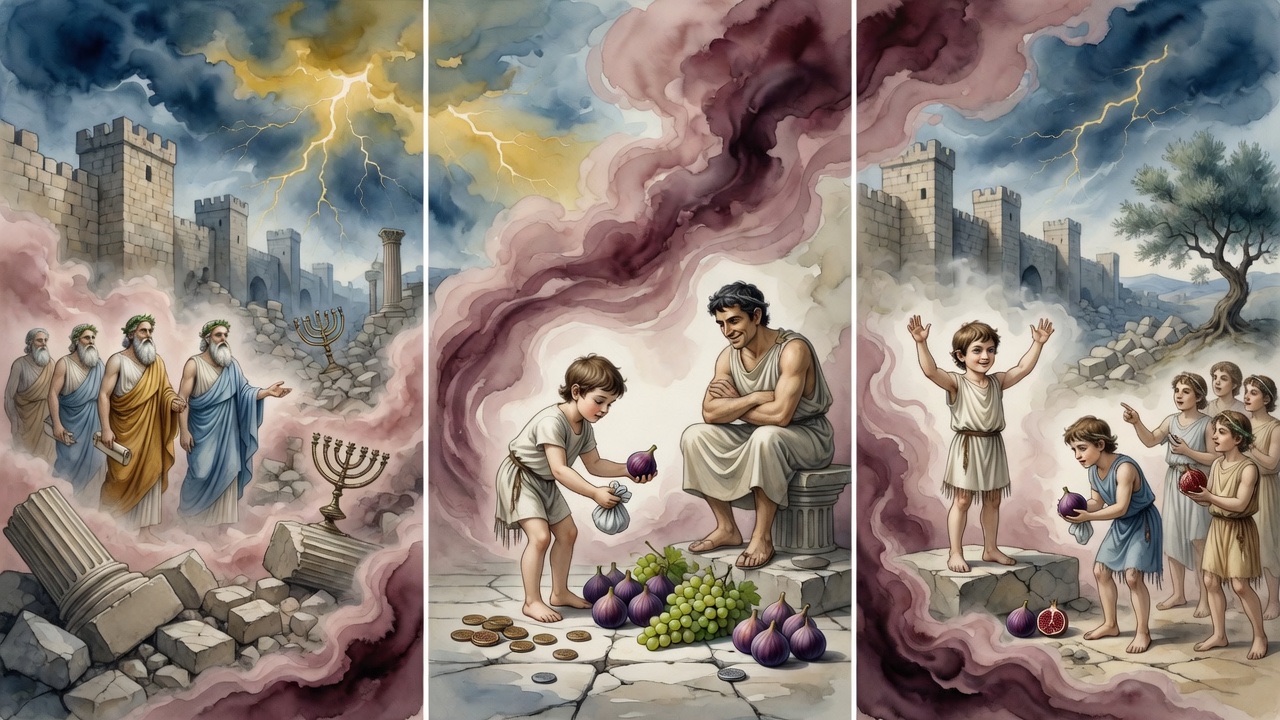
An Athenian handed a Jerusalem tailor a broken stone mortar and told him to sew it. The tailor put sand in his palm and asked for thread.
Table of Contents
A man from Jerusalem asked to sleep at an inn in Athens. The men already drinking there told him their rule. No guest stays without first performing three jumps.
 Click for full size
He did not jump. He asked them to show him how it was done.
One man stood, jumped to the middle of the room, jumped to the entrance, jumped outside. Everyone inside followed to watch. The Jerusalemite bolted the gate behind them. Then he leaned through the window.
"By your lives," he said, "what you sought to do to me, I have done to you."
Sew This Mortar
An Athenian came the other way. He carried a broken stone mortar through Jerusalem and handed it to a tailor.
"Sew this for me," he said.
Stone cannot be stitched. He had chosen the request for that reason. He wanted the tailor to argue with it and look like a fool who could not handle a clever challenge.
The tailor picked up a handful of sand and put it in the Athenian's palm.
"Spin thread out of this," he said, "and then I will sew the mortar for you."
He did not debate the stone. He sent the impossibility back in a form the man had to hold.
How Much Smoke From a Bundle of Wood
Another Athenian stood before a Temple priest and asked how much smoke a bundle of wood produces. He expected a holy man's vague piety. He got a measurement from the altar.
"When it is wet," the priest said, "it all becomes smoke. When it is dry, one third becomes smoke, one third ashes, and one third is consumed by the fire."
He had learned it from the wood of the arrangement, the pile on the Temple altar, where the proportions of fire and fuel were not a riddle for guests. They were the day's work. The Athenian had come with a puzzle. The priest answered from a lifetime of watching wood burn in a place that required the answer to be exact.
The Children Took His Clothes
An Athenian walked into a Jerusalem school and found children without their teacher. He proposed a contest. Winner takes the loser's garments. The children agreed, then insisted the visitor go first, as the elder.
He sat back ready. They gave him their riddle instead. Nine exit, eight enter, two pour, one drinks, and twenty-four serve. He could not answer. They took his clothes.
He went to Rabbi Yohanan and complained that there was a great evil in the city, that when a person comes as a visitor they strip him. Rabbi Yohanan asked whether they had said something he could not answer. The man said yes. The teacher gave him the reading in a few breaths. Nine months leaving the womb. Eight days until circumcision. Two breasts pouring. One infant drinking. Twenty-four months of nursing.
The Athenian went back, spoke the answer, and took his garments. The children quoted Samson at him. Had you not ploughed with my calf, you would not have solved my riddle (Judges 14:18).
The One-Eyed Slave Read the Road
Another Athenian stayed three and a half years in Jerusalem trying to learn the language of wisdom. He did not learn it. When he finally left, he bought a slave in the market and then discovered the man was blind in one eye. After all that time, he could not even protect himself from a basic purchase.
The slave turned to him. "By your life," he said, "he is very wise and sees farther than any full-sighted man."
Outside the city walls the slave told him to hurry or they would miss the caravan. The road ahead looked empty. The Athenian saw nothing. They ran and caught up, because the one-eyed man had already read what was ahead. A female camel, blind on one side. Two in the womb. Two leather flasks, one of wine and one of vinegar. Four mil off. The driver not a Jew.
"How do you know it is blind in one eye?" the Athenian asked.
"One side of the road is grazed and one is not."
"How do you know it carries two?"
"It lay down. I saw the imprint of both."
Wine is absorbed in the dust. Vinegar bubbles. A Jew does not urinate in the middle of the road. Until four mil the hoofprints stay distinct, and after that they smear. The scholar who had failed the language of wisdom for three and a half years bought, as a defective slave, a man who perceived more with one eye than he had managed with two.
Athens had a rule about three jumps. Jerusalem had children who could take a grown man's clothes, a tailor who could hand back sand, and a slave who could smell vinegar on a road that still looked empty.
← All myths