5 min read

When the Bier Flew on the Creatures' Last Word

At death the angels asked what creatures said of the man. Praise lifted his bier into the air. Slander, like serpent venom, spreads past the first bite.

Curated by Arthur · Told by Maggid ·
Table of Contents
  1. Solomon Named the End
  2. What Spreads Past the Bite
  3. The Lane That Watched the Board Rise
  4. After the Lift

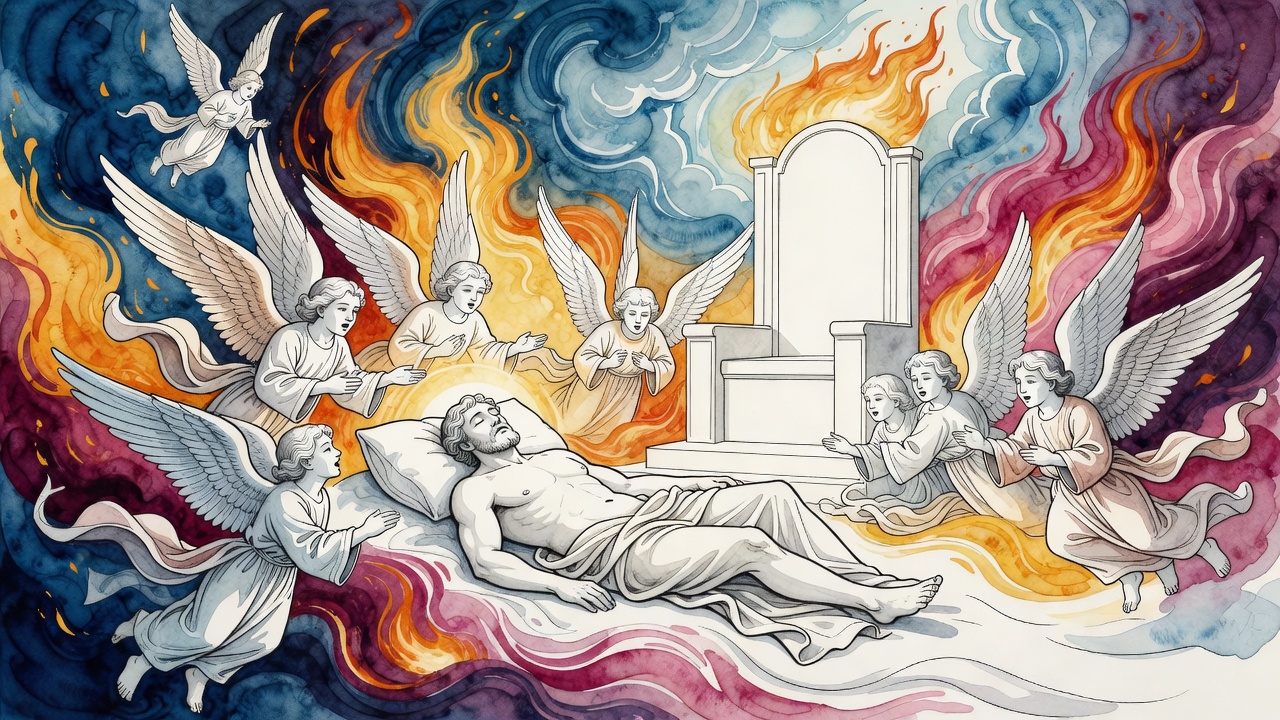
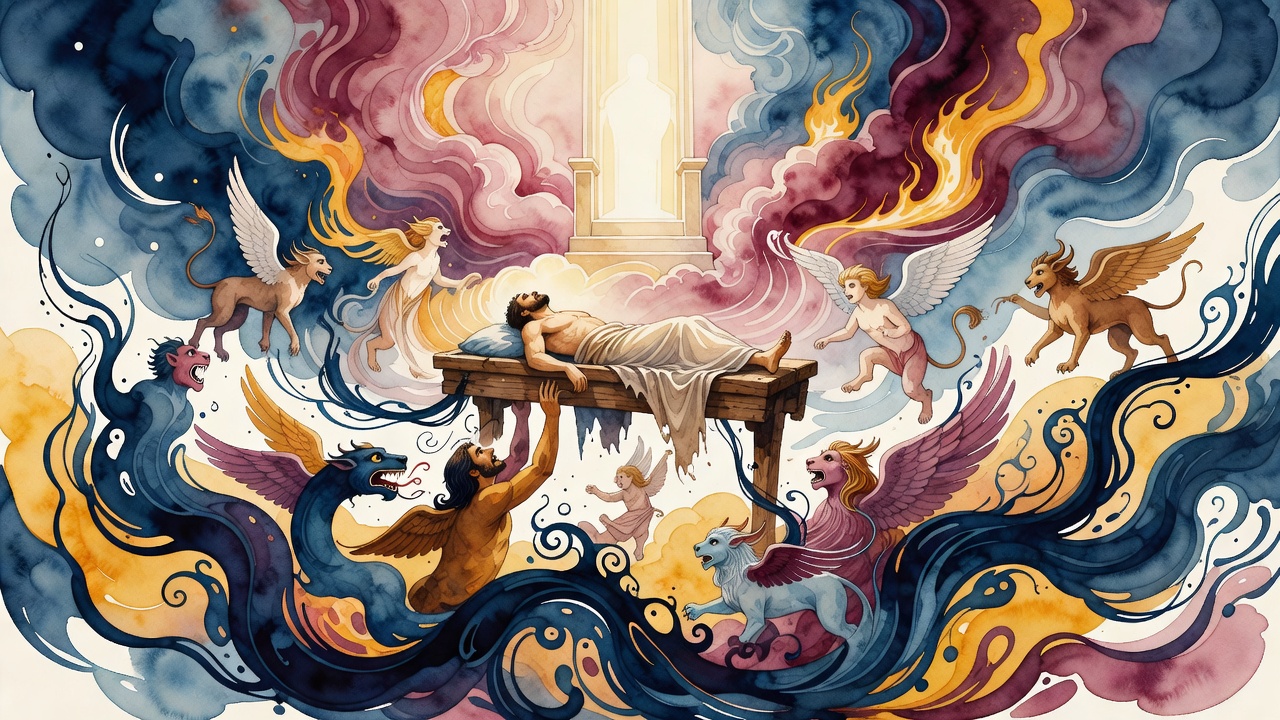
The bier left the house on four shoulders and did not behave like wood. Halfway down the lane the carriers felt the weight lighten, then lift. Hands lost the poles for a breath. The body rose between earth and roof-line while neighbors stopped mid-step and stared at a funeral that had decided to climb.
When the Bier Flew on the Creatures' Last Word Click for full size

Above, the question had already been asked. When a person dies, the Holy One turns to the angels: see what the creatures are saying about him. If the street answers that he was upright and feared God, the bier flies. Memory becomes lift. The last report becomes air under the board.

Solomon Named the End

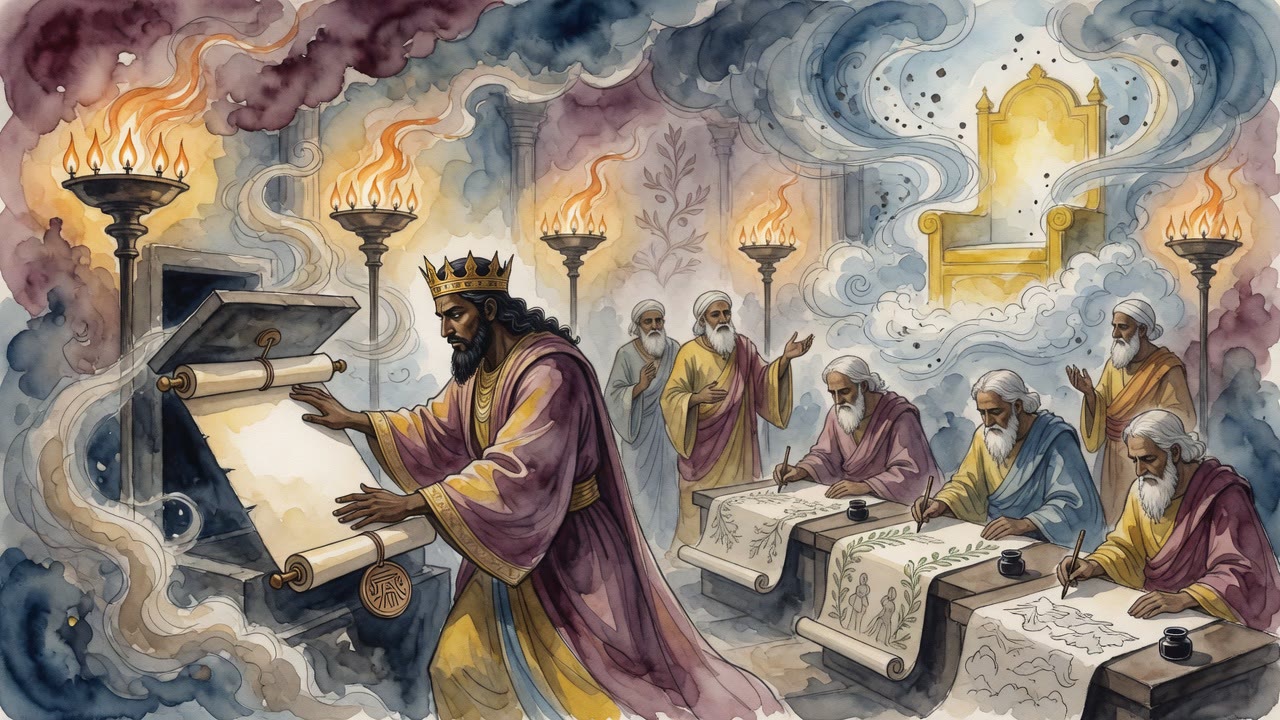
They asked Solomon what the end of everything is. He did not point to gold or throne or the stones of the Temple. "The end is a davar," he said, a word. After the breath stops, people gather and speak. This one was upright. This one feared God. Or they do not. The verse that closes Ecclesiastes presses the same edge: the end of the matter, all having been heard, is fear of God and the keeping of the commandments, for that is all of man (Ecclesiastes 12:13).

Rabbi Levi heard in davar also dever, plague, the death that takes good with wicked without sorting the queue. Plague does not read character. The word spoken after does. Indiscriminate loss still leaves a ledger in human mouths, and Heaven listens to that ledger when the body is already cooling.

When Rabbi Levi bar Sisi died, Shmuel's father rose and recited the verse of the end of the matter. The recitation was not decoration. It was a public weighing. The street heard the claim. The angels heard it too.

What Spreads Past the Bite

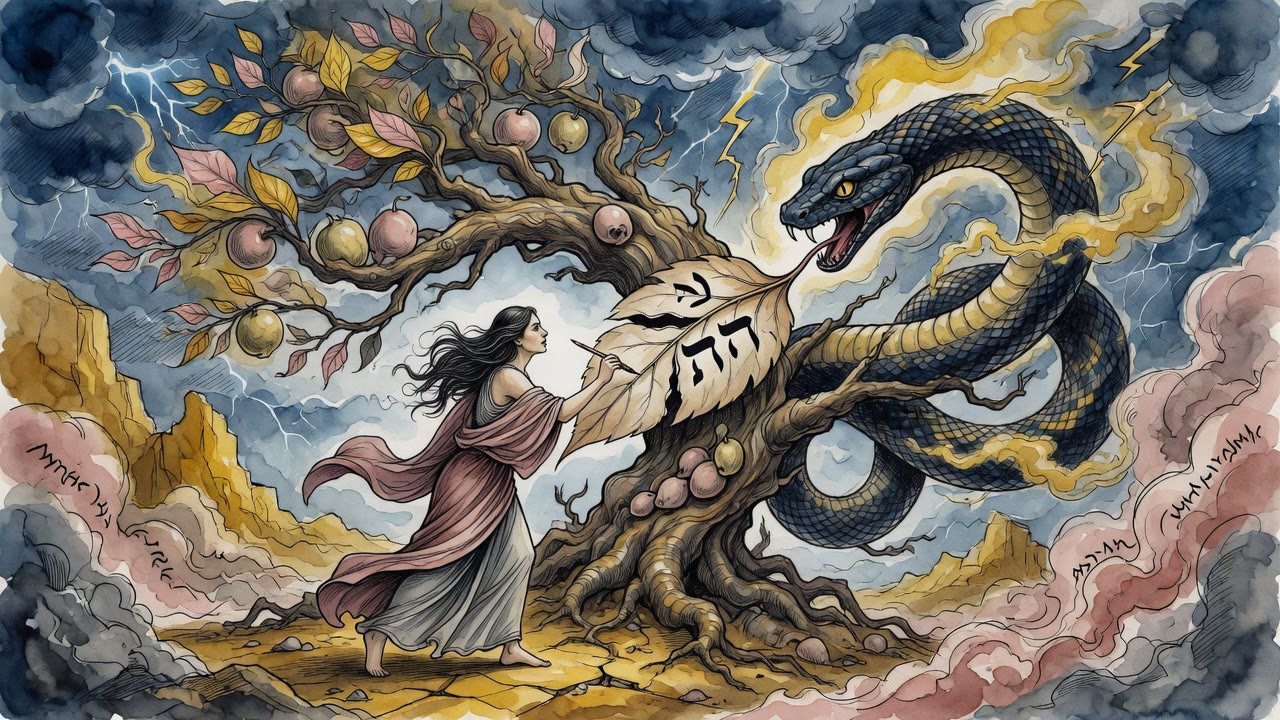
Another mouth works the opposite way. The serpent is asked why venom from one puncture runs through the whole body. It answers, in the voice the sages give it, that the questioner should ask the one who owns a tongue, the baal lashon, the master of speech, the slanderer. A bite is local. A word is not. Lashon hara travels the way venom travels, past the first point of contact into limbs that never saw the fangs.

Why is the serpent's body incomplete? "My tongue caused it." The Garden still stains that answer (Genesis 3). Why hide among fences? "Because I breached the fence of the world." Having broken the first boundary, it becomes the executioner for those who break after it. Rabbi Shimon ben Yochai sets that office on the creature that once spoke against Heaven and against the human pair.

Rabbi Abba bar Kahana tightens the cord another notch. Serpent, lion, and oppressive kingdom strike only when whispered to from above, nilḥash, ordained. Hardship has a source even when the street cannot name it. The same sky that listens for praise at a death also governs the bite. Nothing is random noise. The tongue that ruins and the word that lifts both move under a hearing that does not sleep.

The Lane That Watched the Board Rise

On the day the bier flew, no one in the lane quoted Ecclesiastes. They watched poles leave shoulders and a wrapped body climb the air as if the report of a life had grown wings. Locusts can administer punishments among creatures; here the sky's administration looked like mercy with altitude. The soul's path and the board's path briefly shared a direction. Angels did the lifting the street had earned with its verdict.

A woman who had quarreled with the dead man the week before closed her mouth. A debtor who had been forgiven stepped into the road and did not speak either. The time for shaping the davar had been the years, not the funeral. What could still be said was already in the air under the wood.

The carriers walked beneath an empty load and an occupied sky. Children pointed. Dogs barked once and fell quiet. The funeral that had begun as ordinary sweat now hung between silence and speech, and the only verdict left was what mouths had already given.

After the Lift

When the bier settled again for burial, the wood was only wood. The flight had been a verdict, not a new nature for planks. Dirt closed. The street went back to bread and debt and small talk that can still kill at a distance if it turns serpent-shaped.

Somewhere a living mouth chose praise it did not mean, and the word rang false. Somewhere another mouth chose silence when silence was the only clean tool left. The angels' question does not wait for perfect people. It waits for the report the creatures actually give. Solomon's end stays a word. The serpent's wound stays a tongue. Between them a body either rises for a span above the lane or stays heavy on four tired men who never feel the poles lighten.

The ones who had carried him wiped their palms and looked at the sky that had briefly held their burden. No second flight came. A life had been measured by mouths, and for one stretch of lane a board had answered those mouths with air.


← All myths
From the tradition

Sources

2 sources

The texts behind this telling. Some cards carry a translation of the source; others are our own retelling of it, and each card says which. Every card links out to the original.

Kohelet Rabbah 11:1Kohelet Rabbah

Retold in our words. Read the original at the link below.The Sefaria Midrash Rabbah, 2022 · CC-BY

Ancient Jewish wisdom grappled with these questions too. Take this passage from Kohelet Rabbah, a collection of rabbinic interpretations on the Book of Ecclesiastes. It starts with a rather unsettling verse: "If the serpent may bite without a spell, there is no advantage to the charmer" (Ecclesiastes 10:11).

What does that even mean?

Rabbi Abba bar Kahana offers a powerful interpretation. He suggests that a serpent only bites, a lion only devours, and a kingdom only oppresses if it's been "whispered to from above" – nilḥash in Hebrew, meaning divinely ordained. In other words, everything, even suffering, has a source, a reason, even if we can't always grasp it. God determines who will face hardship.

The passage doesn't stop there. It personifies the serpent, engaging it in a kind of cosmic Q&A. " According to Rabbi Shmuel bar Naḥmani, the serpent would retort, "Don't ask me! Ask the one with a tongue – baal halashon" – a clever play on words, because baal halashon also means "slanderer."

Here, the serpent becomes a symbol of malicious speech, of lashon hara, the destructive power of gossip and slander. The serpent's bite, its venom, is like the damage caused by a lying tongue, spreading far beyond the initial point of contact.

The text continues, probing the serpent about its origins and its degraded state. "Why is your body lacking?" the questioner asks. The serpent replies, "My tongue caused it." This connects directly to the serpent's role in the Garden of Eden, where its slander against God led to humanity's exile (Genesis, chapter 3). The serpent's punishment, its physical form, is a direct consequence of its poisonous words.

Then comes a truly chilling observation. If you were to ask the serpent why it hides among the fences, it would say, "It is because I breached the fence of the world"– meaning that it caused the first sin. Rabbi Shimon ben Yoḥai adds that because the serpent breached this cosmic fence, it became the executioner for all who follow suit. This echoes in the verse "One who breaches a fence, a serpent will bite him" (Ecclesiastes 10:8).

This idea of boundaries, of staying within the "fence" of ethical behavior, is crucial. When we cross those lines, when we engage in harmful speech or actions, we invite the "serpent" into our lives, unleashing destructive forces.

But there's more! Rabbi Shimon ben Lakish vividly describes how, after God condemned the serpent to crawl on its belly (Genesis 3:14), angels descended and amputated its limbs. The serpent's voice then resonated across the earth, a sound likened to the roar of the Tigris River.

The text then shifts to the rivers themselves, personifying them. If you asked the Tigris why its sound is so loud, it would reply, "If only it would be heard among the rivers!" And if you asked the Euphrates why its sound is quieter, it would explain, "My actions speak for me. I bring forth life and abundance quickly."

So, what does this all mean?

This passage from Kohelet Rabbah isn't just a bizarre story about talking serpents and rivers. It's a profound meditation on the nature of suffering, the power of speech, and the importance of boundaries. It also hints that even in the face of hardship, there can be a divine purpose, a lesson to be learned. And it certainly is a reminder to be mindful of our actions, lest we, too, breach the fence and unleash the serpent within.

Full source
Kohelet Rabbah 12:13Kohelet Rabbah

Retold in our words. Read the original at the link below.The Sefaria Midrash Rabbah, 2022 · CC-BY

It all centers around the verse from (Ecclesiastes 12:13): "The end of the matter, everything having been heard: Fear God and observe His commandments, for that is all of man."

What does that really mean? The Rabbis in Kohelet Rabbah aren't content with a simple reading. They dig deeper. They ask: what is "the end of the matter"?

The text suggests that "the end of the matter" – in Hebrew, davar – is what people say about you after you're gone. At the end of a person's life, people gather, and they proclaim things like, "This person was upright," or "This person feared God." In other words, your ultimate destiny, your legacy, is shaped by the collective memory of your actions.

They even ask Solomon himself, "What is the end of everything?" And his answer? "The end is a davar – a word."

Rabbi Levi offers a fascinating, and slightly darker, take. He connects davar not just to "word" or "matter," but to dever, which means plague. Why? Because a plague, like death, "takes the good with the wicked." It's a sobering reminder that death doesn't discriminate. But perhaps it also suggests that even in the face of indiscriminate loss, the memory of the good remains.

The text then makes a surprising connection to locusts – govai in Hebrew. Why locusts? Because, the text says, they "administer the punishment of people and creatures." When someone dies, the Holy One, blessed be He, asks the angels: "See what the creatures are saying about him." If the verdict is positive – "This person was upright and God-fearing" – then, according to this passage, the person's bier "flies in the air." The soul is lifted to heaven by the angels! Ginzberg, in Legends of the Jews, also touches upon the soul’s journey after death, further illuminating this mystical ascent.

We even get a glimpse of this in action. When Rabbi Levi bar Sisi died, Shmuel's father ascended and recited that very verse: "The end of the matter, everything having been heard." It was a public declaration of Rabbi Levi's worth.

But the most beautiful part? The parable of the king and the orchard. The king has an orchard with a hundred vines, each producing a barrel of wine. Over time, vines start to die off – ninety remain, then eighty, and so on. Yet, each time, the remaining vines still produce a hundred barrels of wine. Eventually, only one vine is left, and it still produces a hundred barrels. The king declares that this single vine is more precious to him than the entire original orchard.

This, the text says, is how the Holy One, blessed be He, sees a truly righteous person. Rabbi Levi was as beloved to God as the entire world! And upon his death, people said, "For that is all of man." He embodied the essence of humanity. It's like Midrash Rabbah is whispering to us: the impact of a single, righteous life can outweigh the multitudes.

So, what's the takeaway? It's not just about fearing God and keeping commandments – although those are certainly important. It's about living a life that leaves a positive mark on the world. It's about being the kind of person whose memory inspires others, whose actions resonate long after they're gone. It’s about cultivating that one precious vine within ourselves. What will people say about you at "the end of the matter"? That, perhaps, is a question worth pondering.

Full source