Parshat Bereshit6 min read

When the Letters of God's Name Left Adam and Eve, Only Fire Remained

God set letters of His own name inside Adam and Eve. When they ate, the letters left, and the fire that remained threatened to burn them both.

Curated by Arthur · Told by Maggid ·
Table of Contents
  1. Letters Sewn into Flesh
  2. The Fruit and the Withdrawal
  3. The First Prayer on Strange Earth
  4. Judgment on the Day That Became a New Year
  5. What the Fire Still Remembers
When the Letters of God's Name Left Adam and Eve, Only Fire Remained Click for full size

Letters Sewn into Flesh

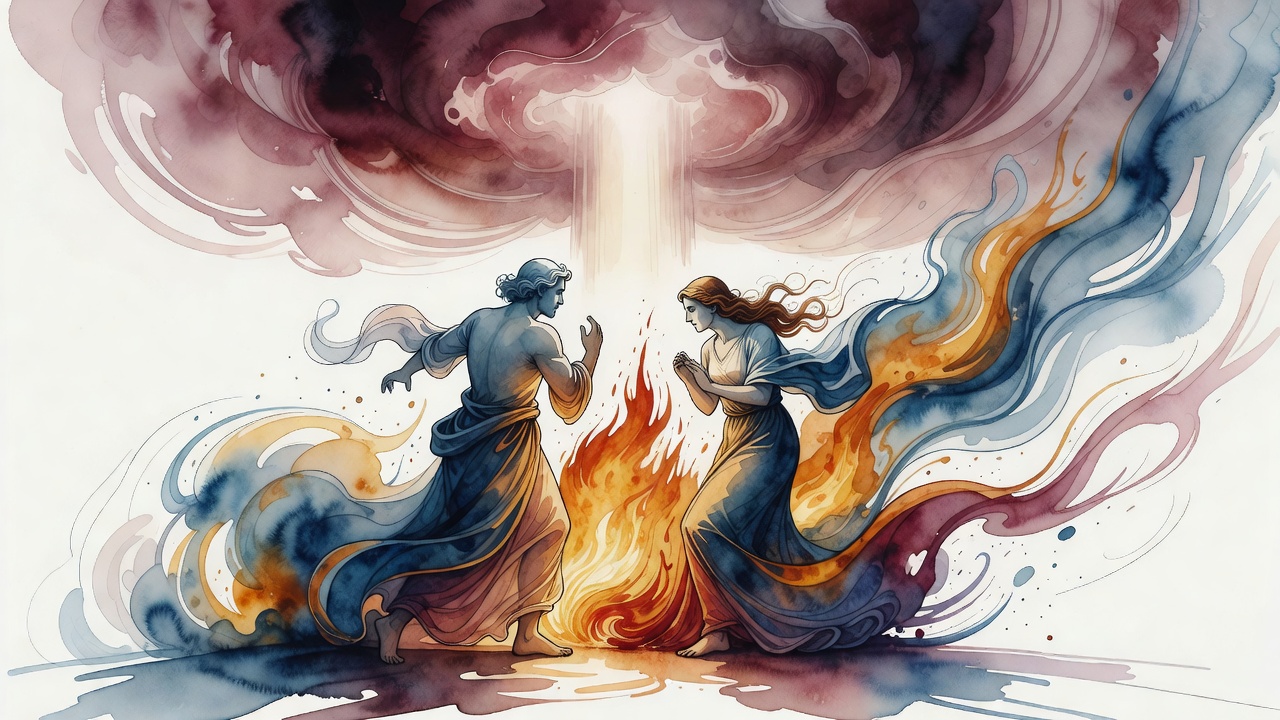
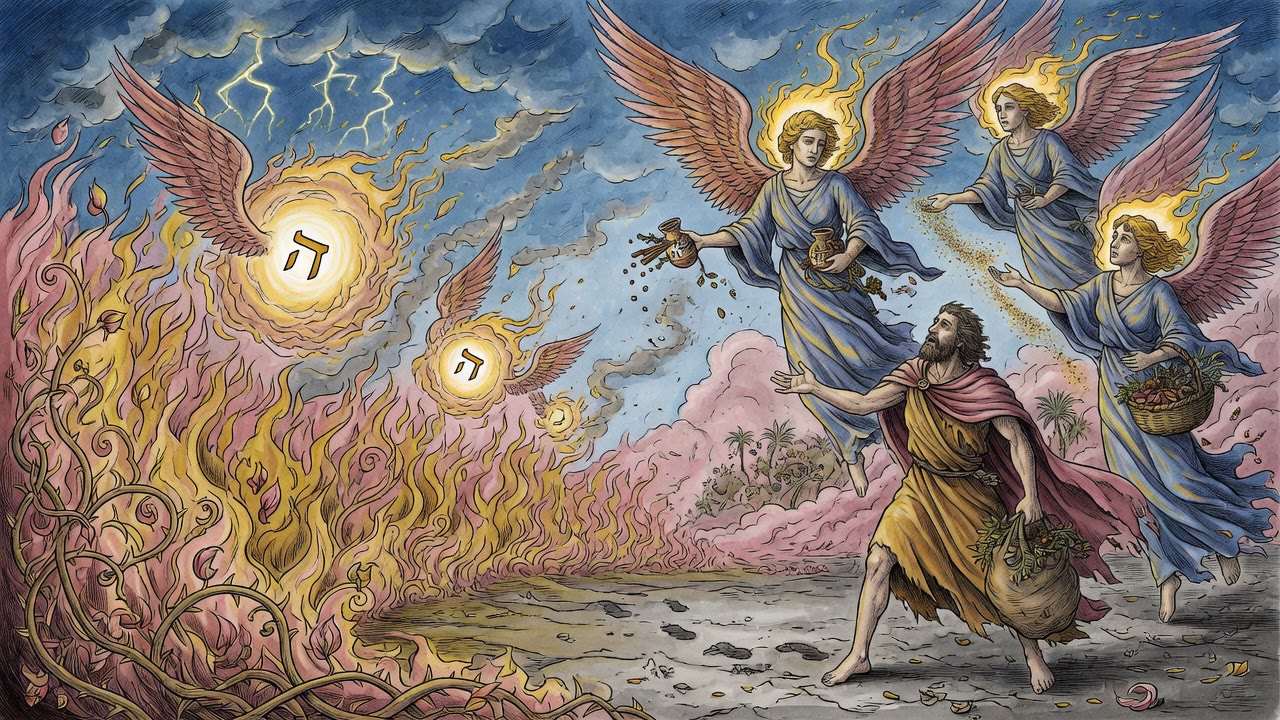
Before she stood beside him, he was only Adam. After she rose from his side he named her Ishah, woman, and named himself Ish, man, as if the shared life required a new grammar. The legends say the Holy One did more than watch the renaming. He stitched fragments of His own Name into theirs. A yod entered Ish. A heh entered Ishah. As long as the couple walked the path set for them, those letters would shield them. The bond between them was not only bone and breath. It was a borrowed holiness that had to be kept under commandment and choice.

The warning came with the gift. If they turned from the path, the letters would withdraw. What remained of Ish and Ishah without Yah would be esh, fire. Not the fire of a hearth. A fire that issues from each body toward the other until nothing is left but ash and accusation. Their marriage was protected by a Name they did not invent and could not keep by force. The garden held fruit and prohibition in the same light, and the letters waited to see which one the hands would prefer.

The Fruit and the Withdrawal

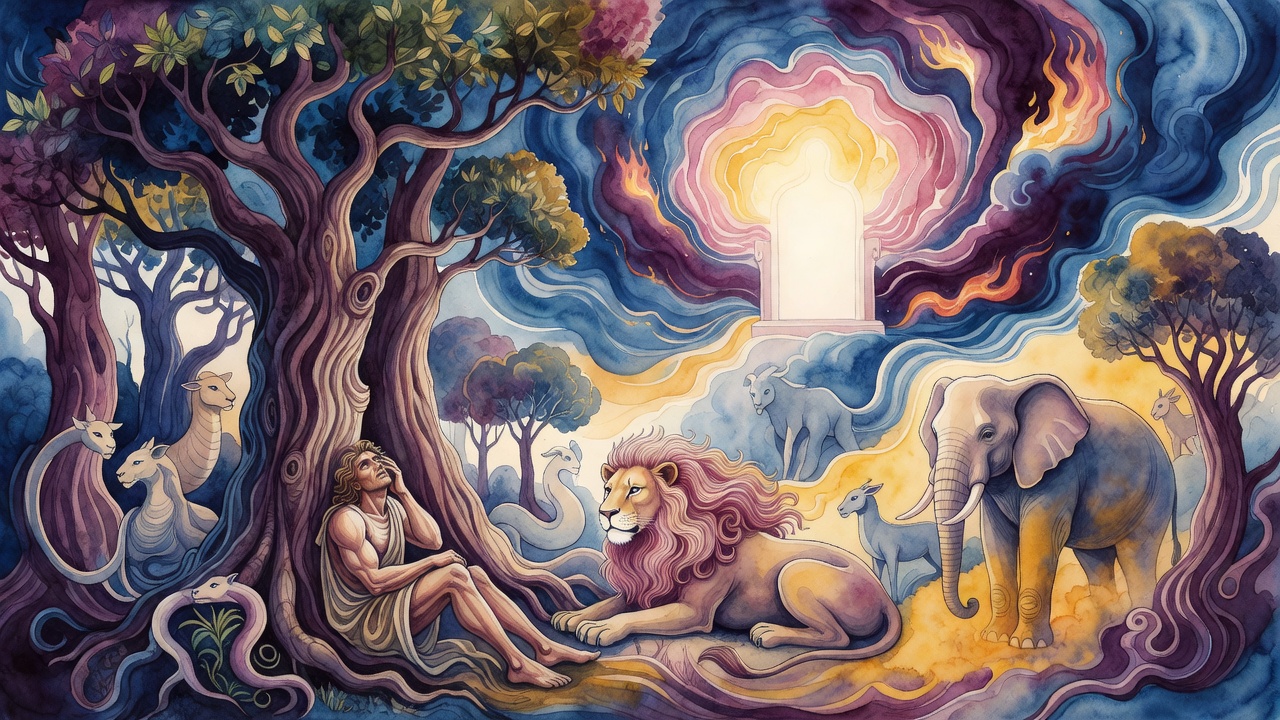
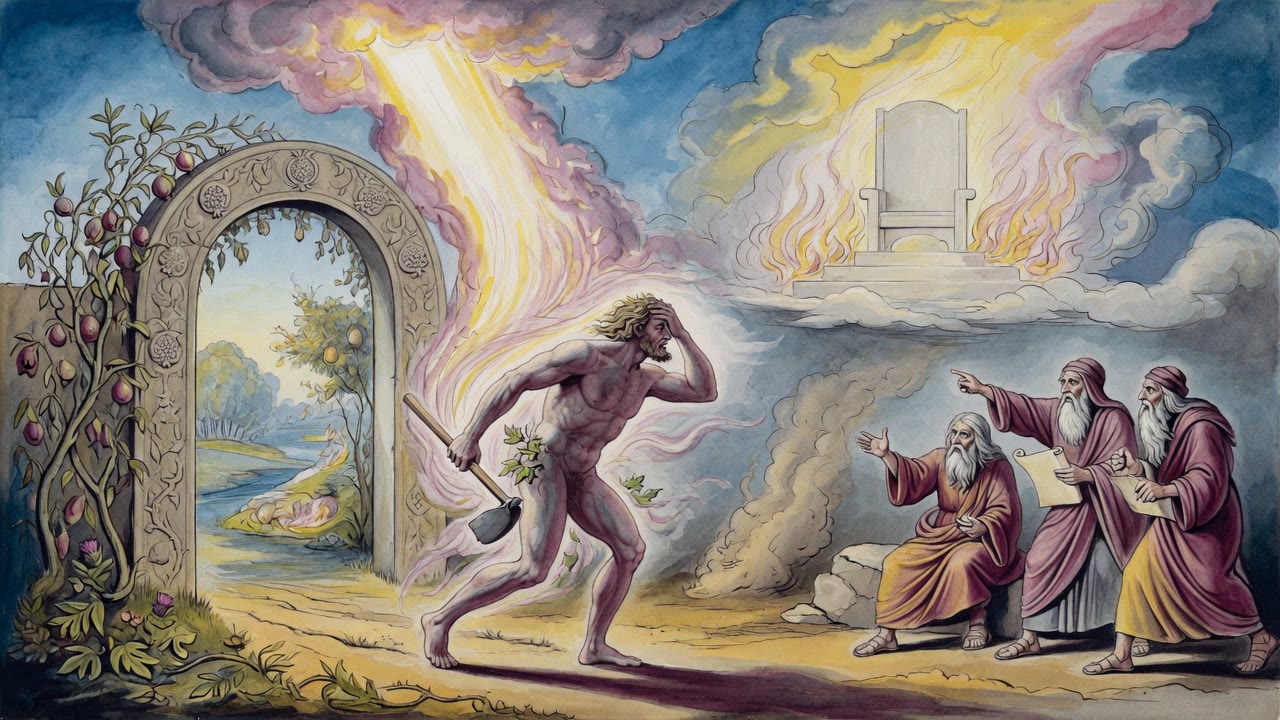
Eve took what the serpent praised. Adam ate what she handed him. Wisdom, the legends insist, fled as soon as the fruit was down. The man who had named every beast found himself a fool who knew nothing. Animals that once bowed now raised fear in him. The ground that had been soft under bare feet hardened into labor. The letters did not argue. They simply left. The protection that had lived inside their names went quiet, and the fire the tradition names as leftover possibility began to show itself in blame, in shame, and in the distance that opened between two bodies that had once been one flesh without fear.

Outside the garden the air felt thinner. Leaves no longer whispered like companions. Adam did not only weep. He stood on soil that demanded sweat and opened his mouth toward the One who had made him, because silence after sin is another kind of death, and he still had breath enough to refuse it.

The First Prayer on Strange Earth

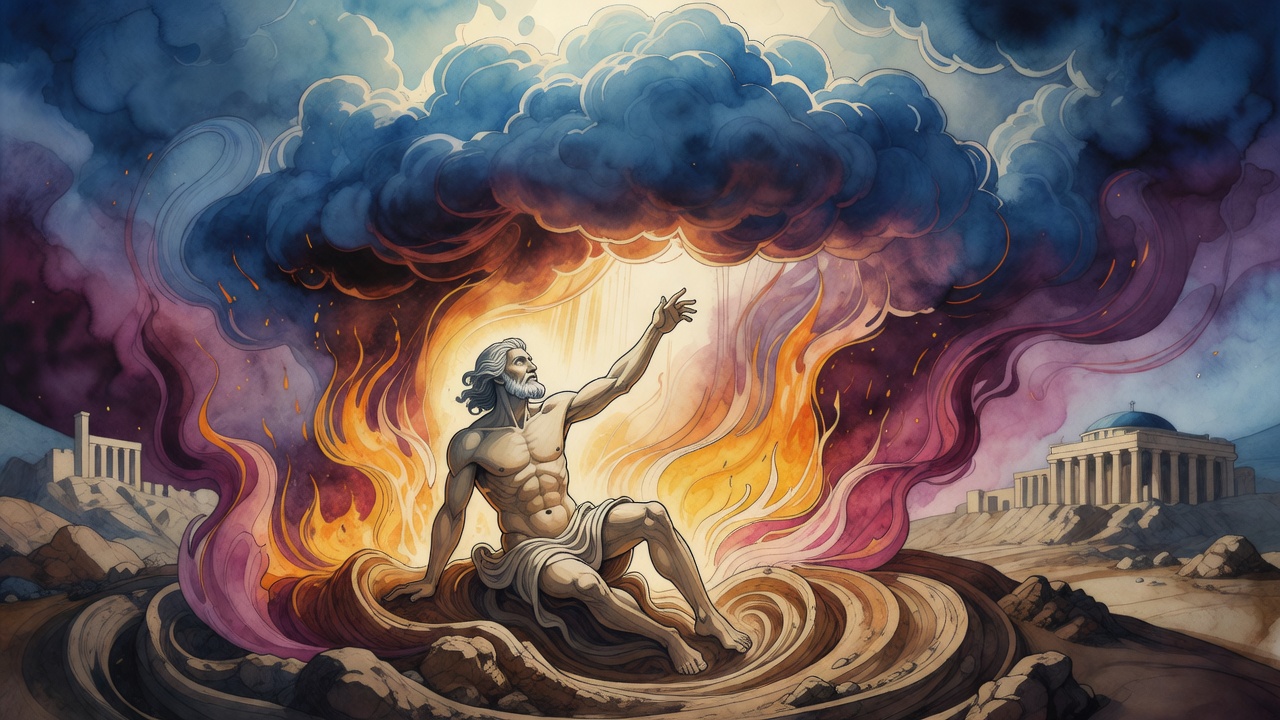
"O God, Lord of the world," he said, "Thou didst create the whole world unto the honor and glory of the Mighty One, and Thou didst as was pleasing unto Thee. Thy kingdom is unto all eternity. Naught is hidden from Thee." He admitted the serpent's cunning and the seduction of the wife of his bosom, then refused the cheap escape of total blame. "I did sin and commit a trespass." From the hour of the tree, he confessed, wisdom had departed. He was an ignorant man who understood not. The earth demanded labor. The beasts inspired dread. The paradise that had been home now stood behind a guard of flame he could not cross.

Then the prayer turned from confession to petition. "Now, O merciful and gracious God, I pray to Thee to turn again Thy compassion to the head of Thy works. Meet me with Thy grace, for Thou art gracious, slow to anger, and full of love." He asked for knowledge of what would befall him, his posterity, and every generation after, month by month and day by day. The first man outside paradise did not only want a cleaner past. He wanted a map for the children who would inherit his exile and still have to plant, marry, and bury under the same sky.

Judgment on the Day That Became a New Year

Tradition places Adam's first judgment on the day later called Rosh Hashanah. Heaven weighed him and absolved him. The voice that had withdrawn protection returned with a different gift. "Thou shalt be the prototype of thy children," God said. "As thou hast been judged by Me on this day and absolved, so thy children Israel shall be judged by Me on this New Year's Day, and they shall be absolved." The calendar of mercy began as a personal verdict on a man who had lost letters from his name and found speech again in prayer.

The sixth day of creation had been crowded. Adam, Eve, cattle, reptiles, beasts of the field, and even incorporeal spirits rushed into being before Shabbat closed the work. Demons, the legends say, received no bodies because time ran out. Humanity received bodies, names, and a conditional seal of Yah. When the seal failed, fire waited. When judgment came, forgiveness waited harder. Between those two waits the whole human story learned its weather, and every later shofar blast (the ram's horn sounded at the New Year) still leans on that first absolution spoken to dust that could pray.

What the Fire Still Remembers

Holiness and hunger can share one house. The Name can dwell between two people. The Name can leave. What remains without it is not neutral silence. It is esh, the heat of two wills turned against each other until love itself becomes a weapon. Adam's prayer did not restore the garden. It taught how to stand on hard ground and still address the Maker as gracious. Rosh Hashanah keeps that first absolution on the calendar so Israel does not forget that the prototype of judgment was also the prototype of mercy, spoken to a man whose name had briefly become fire and who asked, with empty hands, what would become of everyone after him.


← All myths
From the tradition

Sources

3 sources

The texts behind this telling. Some cards carry a translation of the source; others are our own retelling of it, and each card says which. Every card links out to the original.

Legends of the Jews 2:49Legends of the Jews

Retold in our words. Read the original at the link below.The Legends of the Jews by Louis Ginzberg (1909) · Public Domain

See, before Eve, Adam was just… Adam. But after she was created, he called her Ishah (אִשָּׁה), woman, and himself Ish (אִישׁ), man. He essentially let go of the single name "Adam" for them to have these new names. So why the change?

Legends of the Jews, that monumental work by Rabbi Louis Ginzberg, draws on centuries of tradition to explain it. The idea is that God, in His infinite grace, added a piece of His own holy name, the Tetragrammaton (יהוה), often referred to as "Yah," to their names. The letter Yod (י) was added to Ish, and the letter He (ה) was added to Ishah.

What was the purpose? Protection. As long as they followed God's path, observed His commandments, this divine inclusion would shield them from all harm. It was a constant reminder of their connection to the divine and to each other. A bond forged in holiness.

Here's where it gets interesting, and a little bit… well, ominous.

What happens if they strayed? What if they turned away from God's path?

According to this ancient teaching, God's name would be withdrawn. The Yod and the He would disappear. And what would be left? Esh (אֵשׁ). Fire.

Not a cozy, comforting fire, mind you. But a consuming fire. A fire that would issue from each of them, and ultimately… consume the other. Yikes. The very essence of their relationship, the divine spark within it, was contingent upon their faithfulness. Without it, the potential for destructive conflict, for a fire that burns and destroys, was always present. A reminder that relationships, like a flame, require tending, nurturing, and a shared commitment to something greater than ourselves. Otherwise, they can quickly turn into something… destructive.

How often do we consider the "divine spark" in our own relationships? What are we doing to nurture it? And what "fire" might be lurking if we forget to tend the flame?

Full source
Legends of the Jews 2:92Legends of the Jews

Retold in our words. Read the original at the link below.The Legends of the Jews by Louis Ginzberg (1909) · Public Domain

Legends of the Jews turns to Adam's First Prayer After Losing Paradise.

Well, according to Ginzberg's retelling in Legends of the Jews, Adam didn't just slump in despair. He prayed. And it’s a prayer that resonates even now, millennia later.

Him, standing on that newly strange earth, addressing the Divine: "O God, Lord of the world! Thou didst create the whole world unto the honor and glory of the Mighty One, and Thou didst as was pleasing unto Thee." He acknowledges God's power, His sovereignty, His perfect creation. "Thy kingdom is unto all eternity, and Thy reign unto all generations. Naught is hidden from Thee, and naught is concealed from Thine eyes."

Adam admits his fault, but also pleads for understanding. "Thou didst create me as Thy handiwork… But the cunning, accursed serpent seduced me… yea, he seduced the wife of my bosom." He points to the serpent, yes, but he takes responsibility. “I did sin and commit a trespass.”

He then describes the consequences of his actions. He’s lost his innocence, his wisdom. "From the time I ate of the tree of knowledge of good and evil, wisdom departed from me, and I am a fool that knoweth naught, an ignorant man that understandeth not." The earth, once a welcoming home, now demands backbreaking labor. The animals, once his loyal subjects, now inspire fear. It’s a complete reversal of fortune, and he feels it deeply.

And here's where the prayer becomes truly poignant. Adam doesn't just beg for forgiveness; he asks for guidance. "Now, O merciful and gracious God, I pray to Thee to turn again Thy compassion to the head of Thy works… Meet me with Thy grace, for Thou art gracious, slow to anger, and full of love."

He asks, essentially, "What's next?" He wants to know what the future holds for him, for his children, for all the generations to come. "Grant me knowledge and understanding, that I may know what shall befall me, and my posterity, and all the generations that come after me, and what shall befall me on every day and in every month…" request. It's not just about personal salvation anymore. It's about the weight of responsibility for the entire human race, a race he now knows will face hardship, pain, and mortality. He wants to be a good ancestor, to understand the path ahead, to somehow mitigate the suffering he has unleashed.

Adam’s prayer is a powerful reminder that even after mistakes, even after expulsion from paradise, the possibility of connection with the Divine remains. It's evidence of the enduring human need for guidance, for understanding, and for hope, even in the face of profound loss. And maybe, just maybe, it’s a reminder that we, too, can still turn to that same source of compassion and ask for the strength to work through the unknown.

Full source
Legends of the Jews 2:74Legends of the Jews

Retold in our words. Read the original at the link below.The Legends of the Jews by Louis Ginzberg (1909) · Public Domain

What was happening in the cosmos on that day?

Well, according to tradition, Rosh Hashanah (the Jewish New Year) wasn't just the birthday of the year, it was Adam's very own day of judgment! But here's the beautiful part: God absolved Adam on that day. And because of that, God said to Adam, "Thou shalt be the prototype of thy children. As thou hast been judged by Me on this day and absolved, so thy children Israel shall be judged by Me on this New Year's Day, and they shall be absolved. That our own judgment, every year on Rosh Hashanah, is somehow connected back to that original moment of forgiveness.

Let's rewind a little further, back to the very beginning of creation. What exactly was being created, and when? You know, that famous Genesis story – it's packed with details.

Ginzberg, in his "Legends of the Jews," really fleshes out the timeline. He tells us that each day of creation brought forth three things. On the first day, it was heaven, earth, and light. light itself was a creation! The second day gave us the firmament (that's the expanse separating the waters above from the waters below), Gehenna (the fiery place of punishment, a sort of early concept of hell), and the angels. Day three? Trees, herbs, and Paradise!

Then came the celestial bodies on day four: sun, moon, and stars. The grand clockwork of the universe being set into motion. Day five brought forth the creatures of the sea and air – fishes, birds, and even leviathan, that mythical sea monster.

Now, the sixth day… that was a busy one. God had to get everything ready for the Shabbat, the Sabbath, the day of rest. As God intended to rest on the seventh day, the Sabbath, the sixth day had to do double duty. According to the Legends, It brought forth six creations: Adam, Eve, cattle, reptiles, the beasts of the field, and… demons!

Wait, demons?

Yeah, demons. The text says that demons were made shortly before the Sabbath came in, and they are, therefore, incorporeal spirits – the Lord had no time to create bodies for them.

So, there you have it: a glimpse into the legendary creation story, a reminder that even the most ancient tales can offer fresh perspectives on our world, our traditions, and even ourselves. And maybe, just maybe, a little comfort knowing that even Adam got a fresh start. Perhaps we can too.

Full source