5 min read

Wilderness Graves Emptied on the Fifteenth of Av

For forty years each man dug his own grave on the Ninth of Av. In the last year every grave gave its sleeper back until the fifteenth.

Curated by Arthur · Told by Maggid ·
Table of Contents
  1. Dig, and Lie Down
  2. One Night of Wasted Weeping
  3. Every Grave Gives Back
  4. The Fifteenth Dawn
  5. Who Comes Under the Wings
Wilderness Graves Emptied on the Fifteenth of Av Click for full size

Dig, and Lie Down

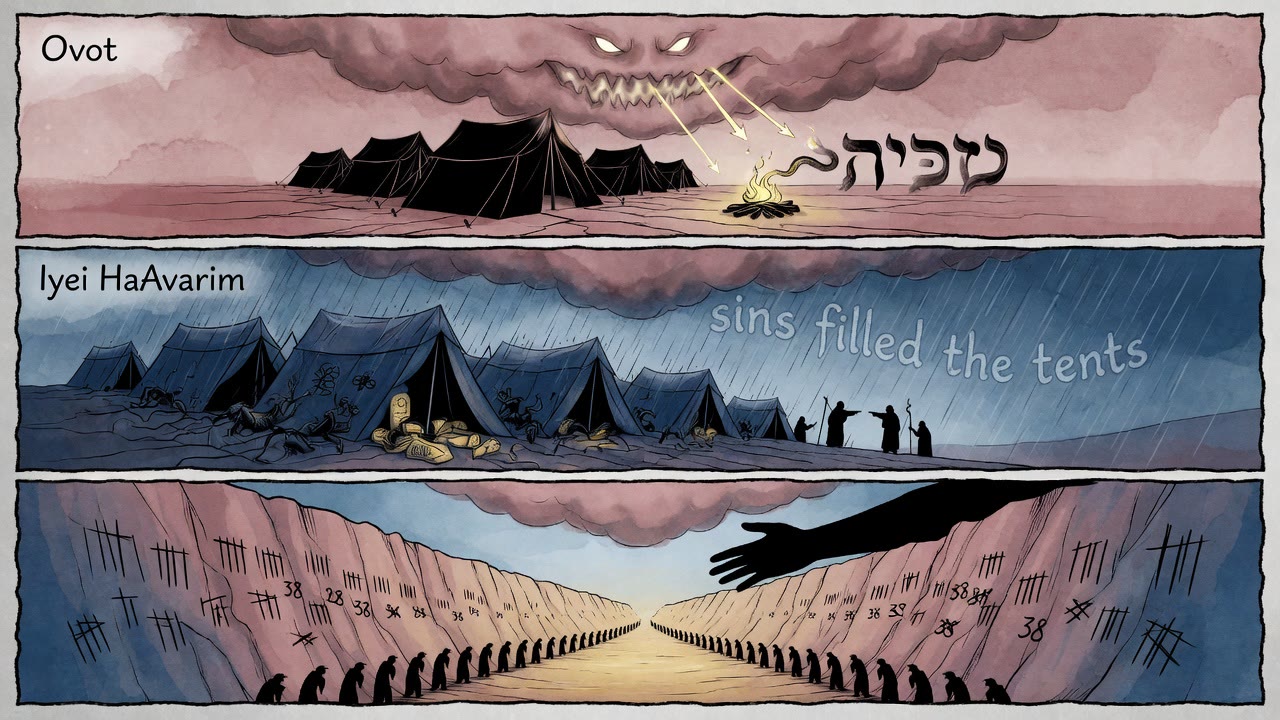
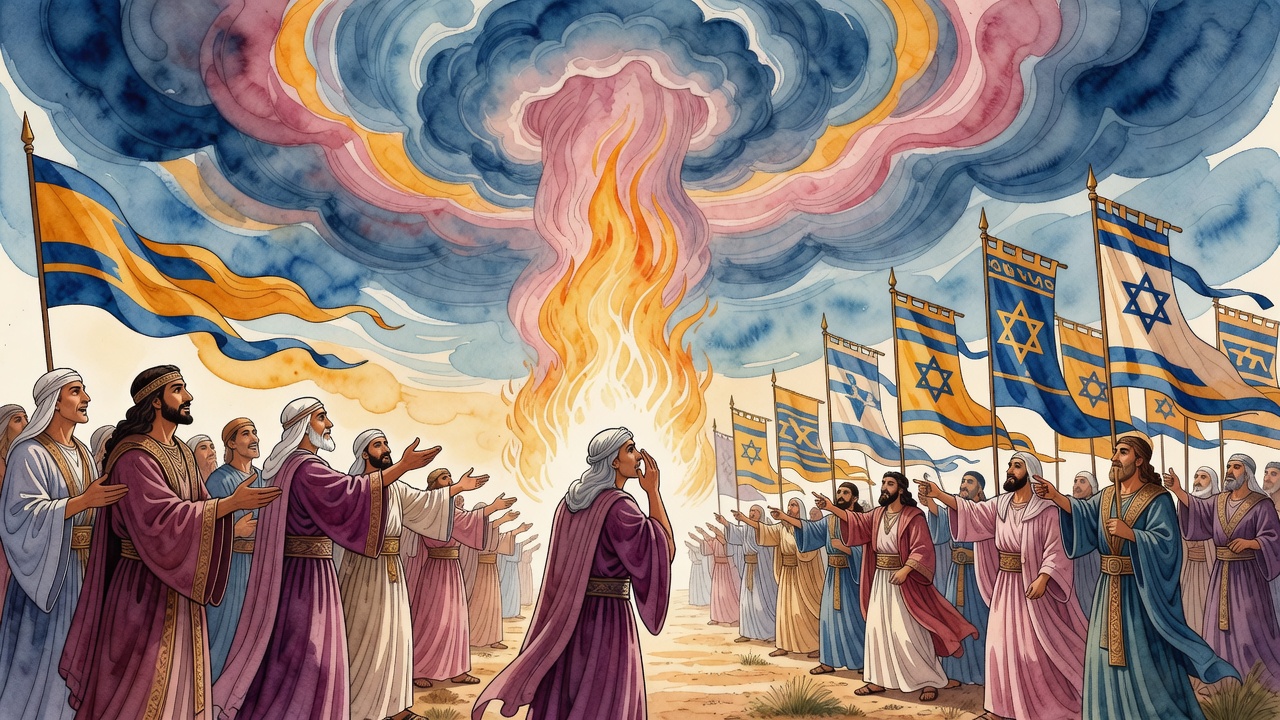
For forty years in the wilderness, the eve of the Ninth of Av carried a dreadful summons. A herald went out from before Moses and cried through the camp: "Go out and dig!" Each man dug his own grave and lay down in it to sleep, not knowing whether he would rise. In the morning the herald called again, "Let the living separate from the dead," and those upon whom the decree had fallen did not stir, while the others climbed out of the earth.

Sand stuck to backs and hair. The living brushed it off and walked back to their tents. The dead stayed where they had chosen to lie. No one asked the herald to soften the cry. The night of needless tears had already priced this custom.

One Night of Wasted Weeping

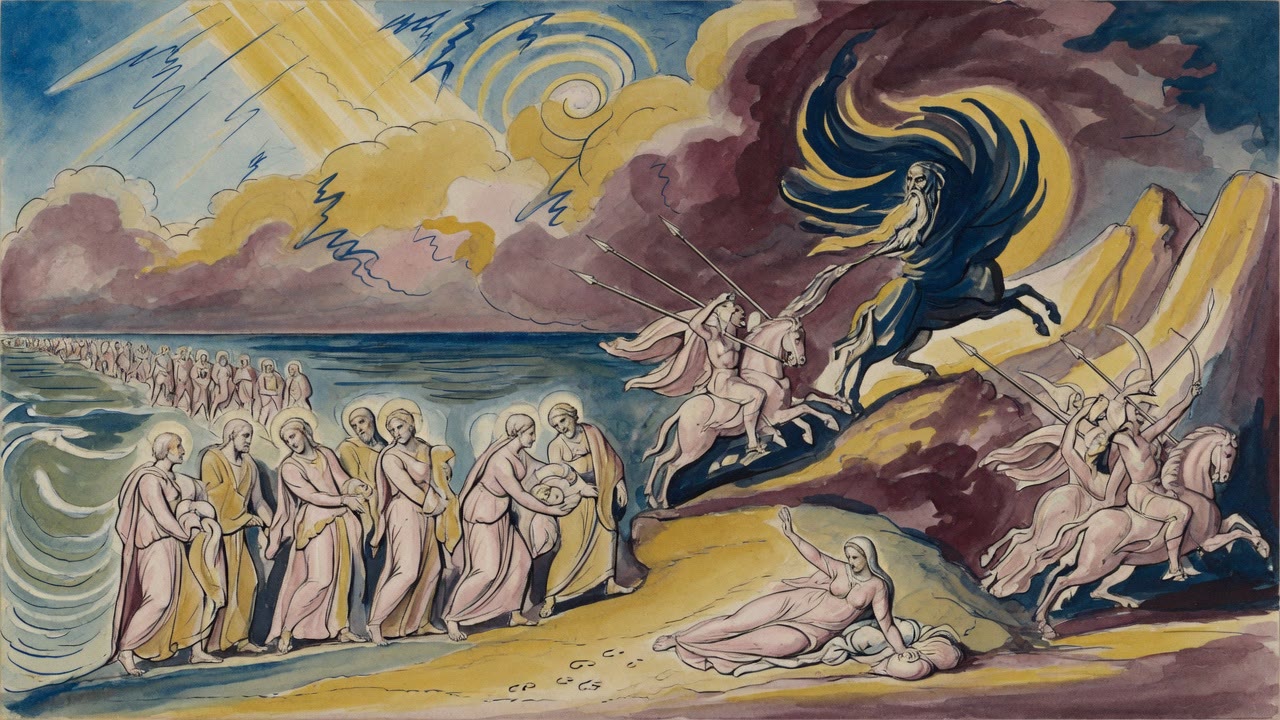
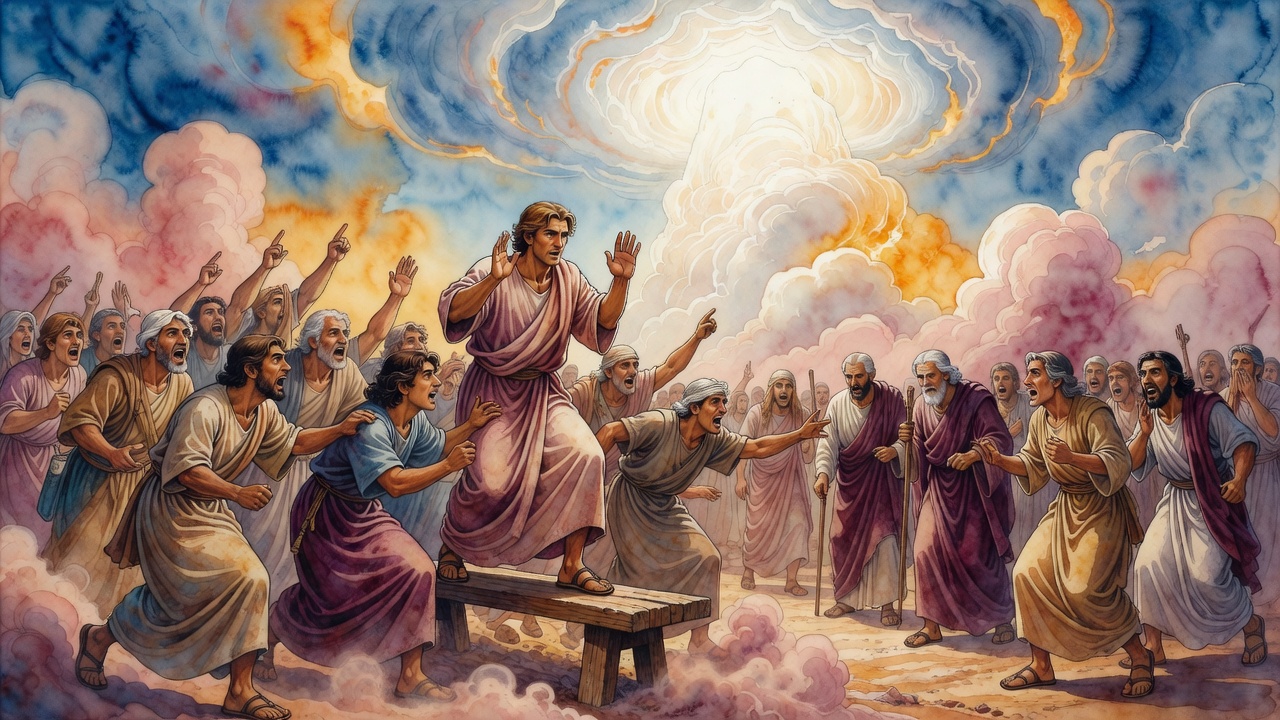
Years earlier, when the spies brought back their report, the whole camp had wept through the dark. The text calls it weeping for nothing, and that wasted weeping fixed a season of weeping for every generation after. Heaven and earth are called to witness that God never wanted those ten princes dead. They sealed their own fate by chasing Moses and Aaron with stones, all the way until the leaders fled beneath the wings of the Divine Presence.

The next morning the people swung the other way and tried to storm the mountain, refusing to accept that the moment had passed. A ban handed down below takes hold above on its own timetable. A thing once decreed does not unwind just because the crowd changes its mind. So God told Moses to go soothe these broken people, not with rebuke but with Torah, with the laws of the offerings they would one day bring in the land.

Every Grave Gives Back

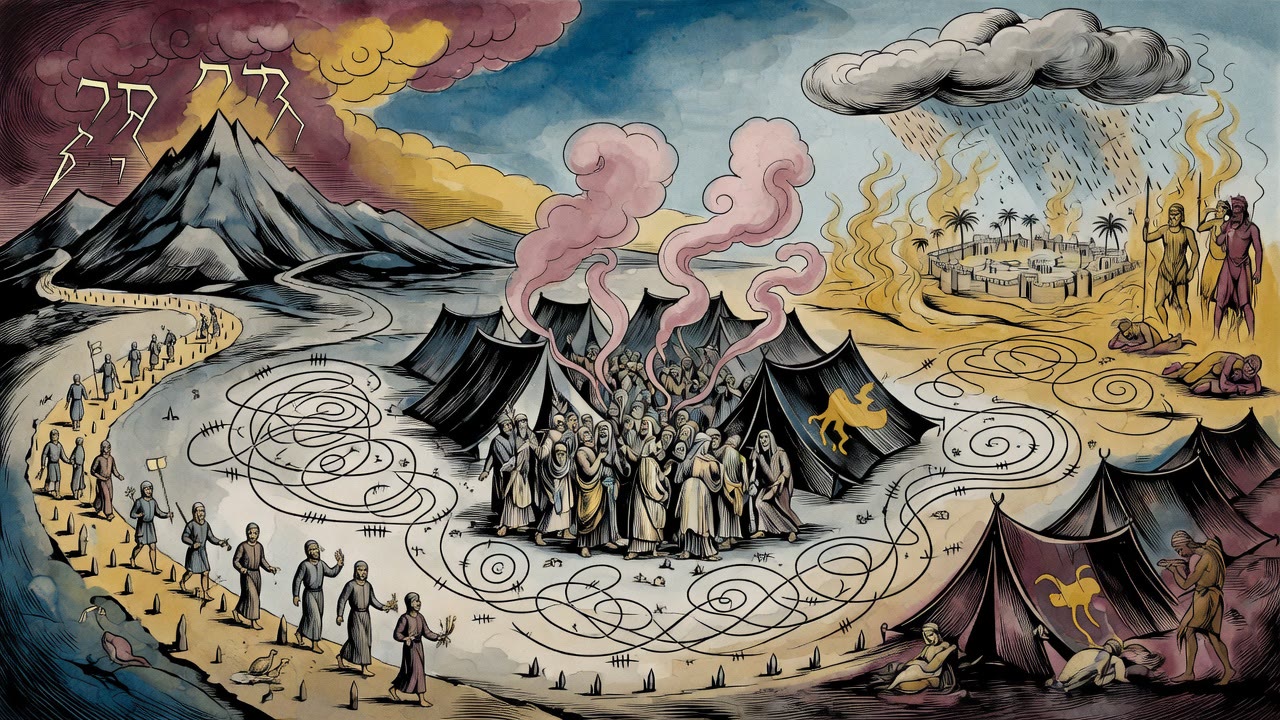
But in the fortieth year, a strange thing happened. The morning came, the herald called, and every single man rose. Not one had died. They were not relieved. They were afraid. "Perhaps we miscounted the month," they said. So that night, the tenth of Av, each one returned to his grave and lay down again. And again, all of them rose.

The eleventh, the twelfth, the thirteenth, the fourteenth: night after night they lay in their graves, and night after night the desert gave them all back to the morning. Dust filled mouths that expected silence. Hands that had dug for death scraped sand from living eyes.

The Fifteenth Dawn

On the fifteenth of Av, they understood at last. The decree of death in the wilderness had been lifted. They would live. Out of that astonishment they made the day a festival, so that, as the Sages taught, there were no festival days for Israel like the Fifteenth of Av and like the Day of Atonement.

The same people who had once wept for nothing now stood blinking in the light of a morning that refused to keep its dead. The graves they had cut so carefully became empty ditches, and the ditches became a calendar mark. Joy arrived late, but it arrived with the force of a law reversed.

Who Comes Under the Wings

Out of that hard season the teachers also drew a generous word on the convert. There is the convert who comes only for the good food and festivals, the one who comes to marry into Israel, and the one like Abraham, who searched the whole world and chose to come under the wings of the Divine Presence on his own. Even the lesser two, when they stumble and return, are met by a God who says: as I loved you, love him; as he sought rest, give him rest.

The camp that once cried without cause and dug without hope learned that Heaven keeps a timetable, and that when the timetable ends, the living must climb out, brush off the sand, and make a feast of the day the graves stayed empty.

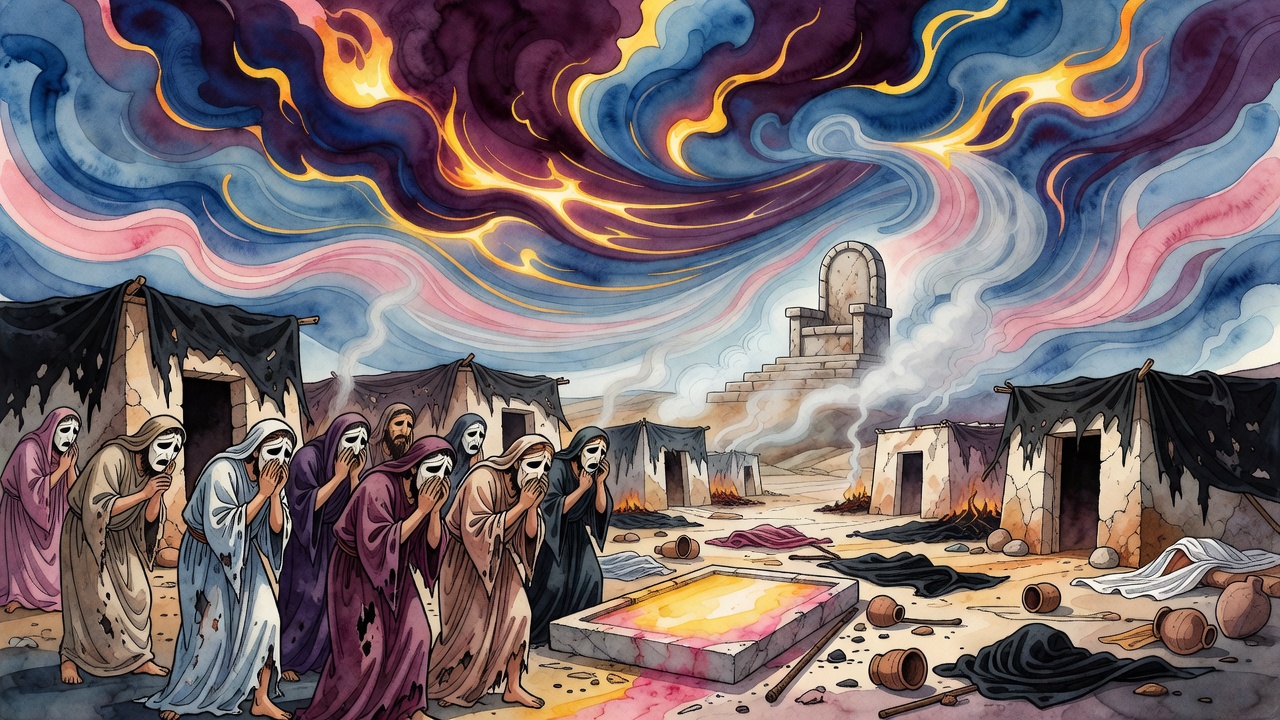
Dirt packed under fingernails. The desert night pressed cold into the open trenches. Mothers counted who returned. Fathers checked the empty places at the fire. Men tore their clothes over giants they had only heard described. Children heard the sobs and learned fear as a lullaby.

Fingers tallied days on palms. Someone blamed the new moon. Some men laughed shakily. Some refused to climb out until a neighbor pulled them. The graves had become a nightly rehearsal for a death that would not come. Someone began to sing. Someone else brought water. The herald, for once, had no death to announce.

The wilderness still stretched ahead. The land still waited. But the annual trench no longer asked for bodies. Joy arrived late, with sand brushed from living eyes and a festival carved from empty ditches.


← All myths
From the tradition

Sources

2 sources

The texts behind this telling. Some cards carry a translation of the source; others are our own retelling of it, and each card says which. Every card links out to the original.

Midrash Shmuel 32:5Midrash Shmuel

Translation of the source text.Midrash Shmuel, Krakow 1893, Public Domain, on Sefaria · CC-BY-SA

On the eve of the Ninth of Av, in all those years that Israel were in the wilderness, a herald would go out from before Moses and announce: "Let everyone go out to dig." And each and every one went and dug a grave for himself, and would sleep in it. On the next day the herald would go out and announce: "Let the living separate from the dead," and they all arose.

When they saw that they had all arisen, they were afraid, and said, "Perhaps we erred in the reckoning of the month." [They went back] and on the night of the tenth, each and every one slept in his grave. On the next day they all arose. Again they went back on the night of the eleventh, and so on the twelfth, and so on the thirteenth, and so on the fourteenth, and so on the fifteenth of Av. And when they saw that not one of them died, they knew that the decree had been annulled, and they made it a festival day.

And thus the Sages taught: "There were no festival days for Israel like the Fifteenth of Av and like the Day of Atonement," etc.

Full source
Tanna Debei Eliyahu Rabbah 29:2Tanna DeBei Eliyahu Rabbah

Translation of the source text.Tanna debei Eliyahu Rabbah, Warsaw 1880 · Public Domain

Blessed is the Omnipresent, blessed is He, before whom there is no favoritism. Because of that needless weeping that Israel wept, weeping was fixed for them for the generations. And throughout all those thirty-eight years - I call heaven and earth to witness against me - it was not in the mind of the Holy One, blessed be He, to put to death those ten princes of Israel, except that they ran after Moses and Aaron to stone them with stones, until they were drawn in and entered beneath the clouds of glory, beneath the wings of the Divine Presence, as it says, "And Moses and Aaron fell on their faces before all the assembled congregation of the children of Israel... and Joshua son of Nun and Caleb son of Jephunneh, of those who scouted the land, tore their garments and said... the land through which we passed to scout it is exceedingly, exceedingly good... and the whole congregation said to pelt them with stones" (Numbers 14:5-10).

Come and see what Israel did and what they brought forth from their lips, and afterward they sought to go up to the land, as it says, "They rose early in the morning and went up to the top of the mountain, saying, Here we are, we will go up to the place of which the LORD spoke, for we have sinned" (Numbers 14:40). What is written after it? "Moses said, Why do you transgress the mouth of the LORD? It will not succeed... yet they presumed to go up to the top of the mountain... and the Amalekite and the Canaanite who dwelt on that mountain came down and struck them and beat them down as far as Hormah" (Numbers 14:41-45). At once they returned and sat in mourning as at first, as it says, "the people mourned greatly" (Numbers 14:39).

From here they said: anyone placed under a ban below for one day, even though they release him, has no release above until three days; and anyone banned below for three days, even though they release him, has no release above until seven days; and anyone banned for seven days, no release above until thirty days; and anyone banned for thirty days, even though they release him, has no release above forever and ever. Therefore it says, "the people mourned greatly."

At that moment the Holy One, blessed be He, said to Moses: Go and appease those poor ones whose hearts have already gone out of them. Moses said before Him: Master of the universe, with what shall I appease them? The Holy One said to Moses: Go and appease them with words of Torah, as it says, "And you shall say to them, When you come into the land of your dwellings... and you make a fire-offering to the LORD, a burnt-offering or a sacrifice" (Numbers 15:2-3). At that moment there was a great quarrel between Israel and the proselytes. The Holy One said to Moses: Why have they made a quarrel one with another? Moses said before Him: Master of the universe, You know. The Holy One said to Moses: Did I not say to you, "And when a proselyte sojourns among you... one statute for you and for the proselyte who sojourns... as you are, so shall the proselyte be before the LORD" (Numbers 15:14-15)?

From here they said: there are three qualities among proselytes. There is a proselyte like Abraham our father, and there is a proselyte likened to a donkey, and there is a proselyte like an idolater in every respect. How is there a proselyte like an idolater in every respect? If he has carrion and torn flesh, abominable creatures and creeping things in his house, he says in his heart, "When will I convert and be among Israel, whose food is good and who have festivals and Sabbaths? When these are used up in my house, I will force myself and convert." And if in the end he reverts to his old ways, sufferings come upon him for his own good and to save him; and as soon as he repents, the Holy One, blessed be He, says: Just as I have loved you, so shall you love him, as it says, "You shall love the proselyte, for you were proselytes in the land of Egypt" (Deuteronomy 10:19). And how is there a proselyte likened to a donkey? Such as one who goes to marry a woman of Israel, and they tell him, "We will not accept you until you convert." He says in his heart, "I will force myself and convert." And if in the end he reverts to his old ways, sufferings come upon him for his own good and to save him; and as soon as he repents, the Holy One, blessed be He, says: Just as he sought rest from you, so give him rest, as it says, "You shall not wrong a proselyte nor oppress him, for you were proselytes in the land of Egypt" (Exodus 22:20). And how is there a proselyte who is like Abraham our father? If he went and searched among all the nations, and once he sees that all the nations tell of the goodness of Israel, he says in his heart, "When will I convert and be like them and come beneath the wings of the Divine Presence?" Of him it says, "Let not the foreigner who has joined himself to the LORD say, The LORD will surely separate me from His people... and the foreigners who join themselves to the LORD to serve Him and to love the Name of the LORD, to be His servants... I will bring them to My holy mountain and make them joyful in My house of prayer; their burnt-offerings and their sacrifices will be accepted on My altar" (Isaiah 56:3, 6-7).

Scripture says, "You shall not utter a false report; do not join your hand with a wicked man to be a corrupt witness... you shall not follow the many to do evil" (Exodus 23:1-2). This is a warning to those who receive slander. Another interpretation: this is a warning to a judge, that he not hear one litigant until his fellow litigant is with him, as it says, "the matter of both of them shall come before the judges" (Exodus 22:8); and likewise it is a warning to a litigant, that he not let the judge hear his words until his opponent is with him, as it says, "the two men who have the dispute shall stand before the LORD" (Deuteronomy 19:17). And likewise, if a man says to his fellow, "So-and-so my friend owes me two hundred zuz, and I have one witness; join with him and you take a maneh," he should answer, "Thus I make known to you: even if you give me all the silver and gold in the whole world in a single hour, I will not testify falsely; how can you say such a thing to me?" And all the people of Jerusalem would do this: they would not enter a banquet house until they knew who would enter with them, and they would not sign a deed until they knew who would sign with them.

Rabbi Nathan said: but is not such a one a scheming witness, and is not such a one a wicked witness, as it says, "you shall do to him as he schemed to do to his fellow" (Deuteronomy 19:19)? Rather, it comes to teach you about robbers and the violent, that they are disqualified as witnesses. Similarly you may say, it is written, "and he was not an enemy to him, nor sought his harm" (Numbers 35:23) - "not an enemy to him nor seeking his harm" shall judge him, as it says, "and the congregation shall judge" (Numbers 35:24) - to disqualify enemies from sitting in judgment.

I have here only enemies; from where do we learn that relatives are disqualified from sitting in judgment? Scripture teaches, "and the congregation shall judge between the slayer and the avenger of blood" (Numbers 35:24). Now you may reason: since the Torah said they are put to death by the mouth of two witnesses, and the Torah said they are put to death by the mouth of judges - just as with witnesses relatives are disqualified, so with judges relatives are disqualified. And further, it is an a fortiori argument: if with witnesses, by whose mouth the matters are not concluded, relatives are disqualified, then with judges, by whose mouth the matters are concluded, is it not right that relatives be disqualified? I have here only the murderer; from where do we learn the others liable to death? Scripture teaches, "upon these ordinances" (Numbers 35:24). One might think that just as capital cases require twenty-three, so monetary cases require twenty-three; Scripture teaches, "upon these ordinances" - these require twenty-three, but monetary cases do not require twenty-three. And further, it says, "the matter of both of them shall come before the judges" (Exodus 22:8). And from where do we learn that capital cases require twenty-three? Scripture teaches, "and the congregation shall judge" - that is ten; "and the congregation shall rescue" - that is another ten; here we have twenty. And from where the other three? You may reason: since the Torah said execute by the mouth of witnesses, and the Torah said execute by the mouth of judges - just as witnesses are two, so judges are two; and since a court may not be evenly balanced, they add one more, so here we have twenty-three men. But originally they used to say that capital cases require thirty, as it says, "and the congregation shall judge," "and the congregation shall rescue," "and the congregation shall restore him" (Numbers 35:24-25) - to teach you that capital cases require thirty.

Full source