Parshat Devarim5 min read

Eleven Days to the Land Became Forty Years

From Horeb to Kadesh Barnea should have taken eleven days; craving, tent murmuring like funeral talk, and fear stretched the road into forty years.

Curated by Arthur · Told by Maggid ·
Table of Contents
  1. Eleven Days on the Map
  2. Go Up Now
  3. Murmuring Like Condolers
  4. The Road That Would Not Shorten
Eleven Days to the Land Became Forty Years Click for full size

Eleven Days on the Map

Moses measured the wasted road on his fingers. Eleven days. From Horeb by way of Mount Seir to Kadesh Barnea, the doorstep of the land (Deuteronomy 1:2). That is all the road should have taken. Moses stood at the edge of memory, white-bearded now, and measured what the people had thrown away with their feet and their mouths. Eleven days of walking. Forty years of graves.
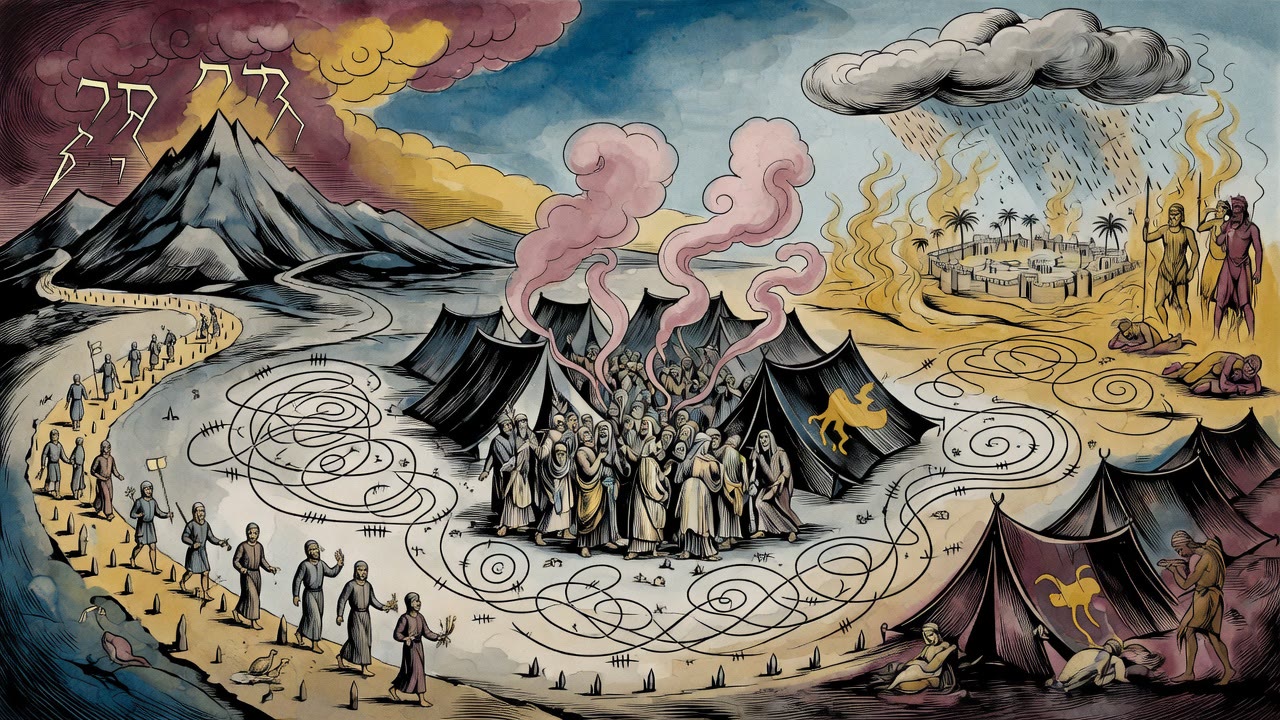
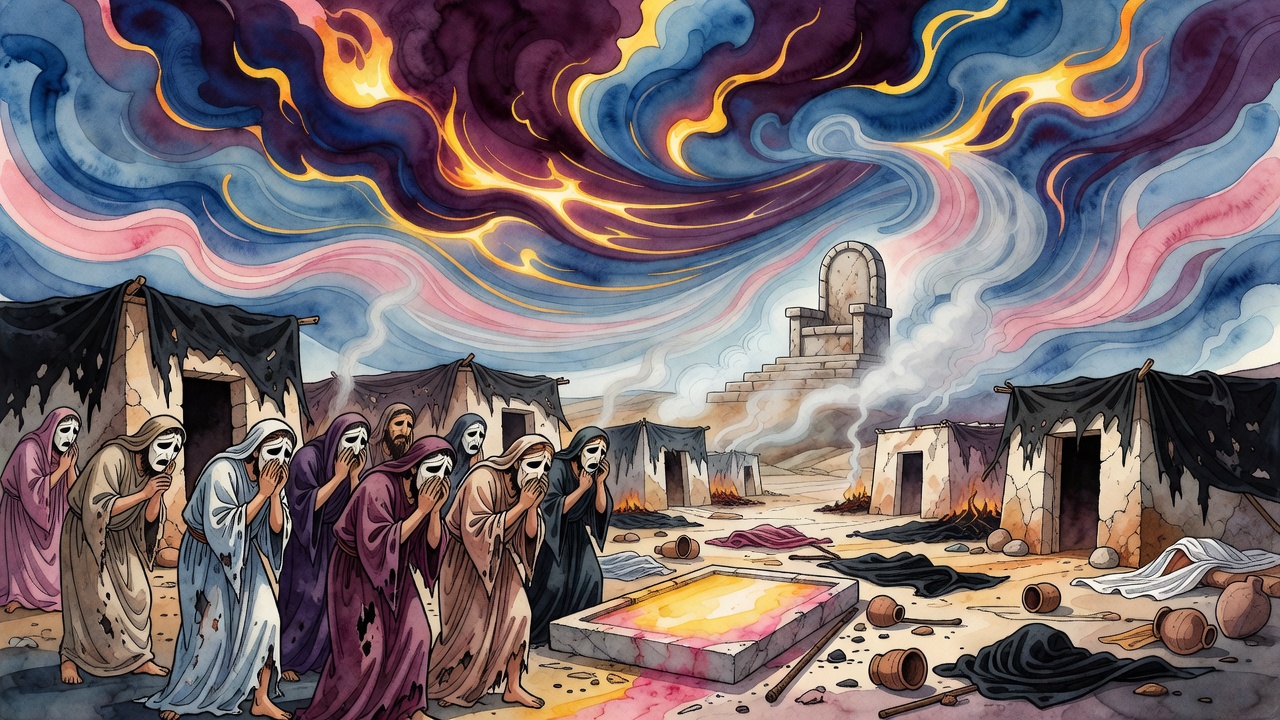
In those eleven days the itinerary still looked almost ordinary on a map. From Horeb to Kivroth Hata'avah, the Graves of Craving, where Israel wept for meat and remembered Egypt's pots more clearly than God's cloud (Numbers 11:31-34). Quail fell. Teeth worked. Desire wrote tombstones. From there to Chatzeroth, where Miriam spoke against Moses and white plague wrote itself on her skin until the camp waited seven days for a prophetess to heal (Numbers 12).

Then the desert of Paran, staging ground for twelve spies and ten bad reports that turned clusters of grapes into monsters in the mouth of rumor. Geography turned into confession. Every place name was a failure with coordinates. Moses could still point to the map. The map could no longer point the people home.

Go Up Now

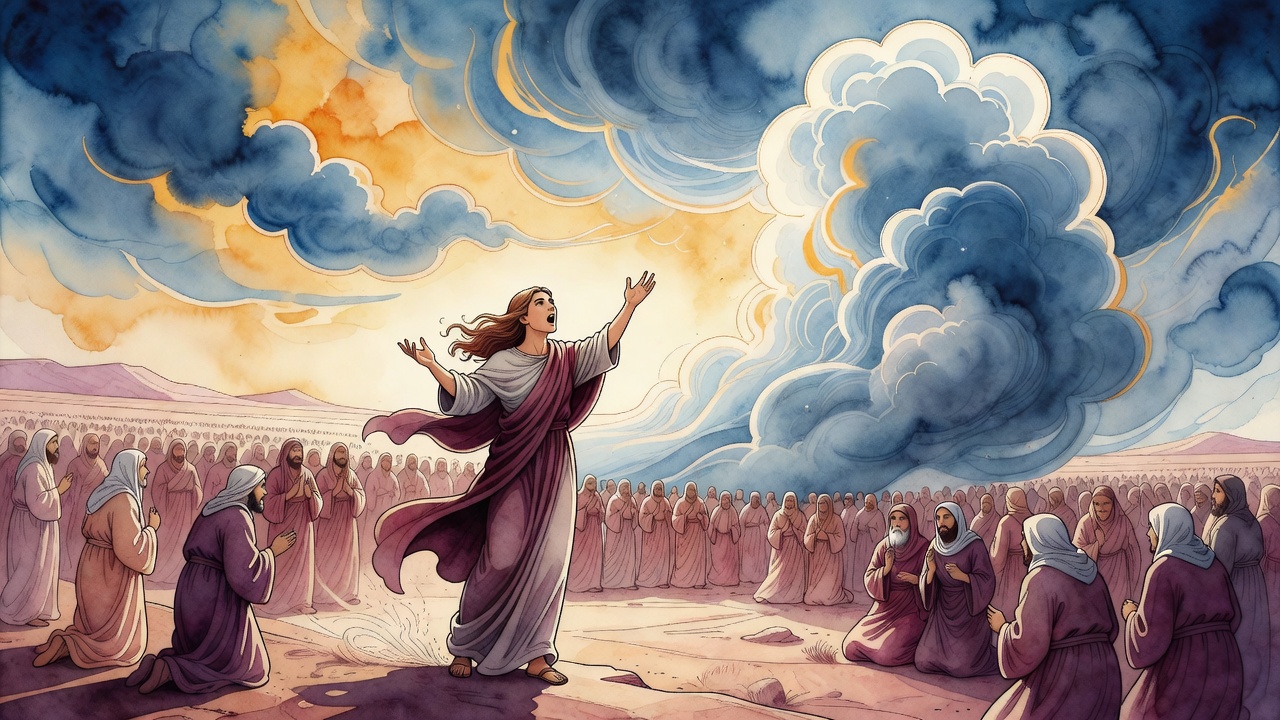
"See, the Lord your God has set the land before you." Not a distant prophecy. Not a rumor traded at a well. Moses said he was not speaking from approximation or hearsay but from what their eyes could still measure if they would open them. "Go up and possess it, immediately, as the Lord the God of your fathers has spoken." The command was present tense. The land was already set down like a table for a meal that only required guests to stand and walk.

Doubt still whispered that the moment was not ripe. Wait. Later. After more supplies. After a better report. After someone else goes first. The people had once drawn near Moses in order, heads of tribes and elders first, the young honoring the old. Later they rushed him in a free-for-all, the young pushing the elders, the elders pushing the heads, a stampede of enthusiasm without hierarchy.

Eagerness without order sabotaged the very ascent it pretended to want. Moses had told them the land was before their faces. They answered with feet that would not climb and mouths that would not bless. The table stayed set. The guests preferred the kitchen of complaint.

Murmuring Like Condolers

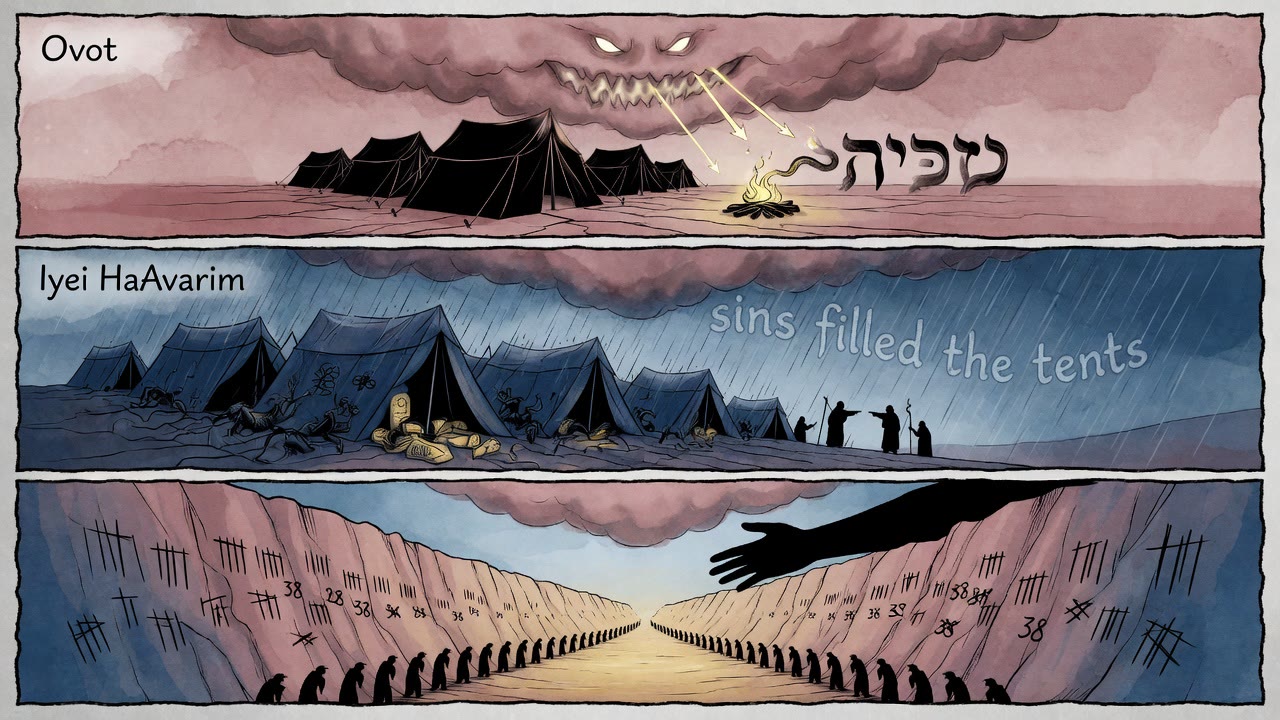
Inside the tents the sound was not ordinary complaint about sand or water. "And you murmured in your tents" (Deuteronomy 1:27). The sages heard people speaking like condolers at a funeral, validating despair, amplifying fear, turning faithlessness into shared pity that felt like kindness and worked like poison. "The words of the murmurers are like those of condolers" (Proverbs 26:22).

A man told his neighbor that the land ate its inhabitants. The neighbor agreed and added giants. A woman said their children would be plunder. Another woman wept as if the plunder had already happened. No one stood up inside the canvas to say the cloud still led and the manna still fell. Condolence became the camp's common language, a professional mourning for a future they refused to enter.

A knife of judgment was said to descend from heaven and split their stomachs. The image joined Numbers 14:29, the generation dying in the wilderness, to the proverb's line about words that descend to the chambers of the stomach. Negativity did not stay in the mouth. It burrowed. It poisoned. The pity party became the death it staged.

The Road That Would Not Shorten

Eleven days should have been enough. Craving dug the first graves at Kivroth Hata'avah. Discord at Chatzeroth cut the second wound in the leadership itself. The spies' terror at Paran sealed the decree against a generation. Moses could still point at the land and say it was set before them. The people could still answer from inside canvas walls with the tone of professional grievers who find comfort in agreeing that hope is naive.

Children born in the desert would grow up learning the map their parents would not walk. They would hear the eleven-day truth as a story about someone else's legs. Forty years is not a travel delay caused by bad weather. It is what happens when a nation prefers the language of condolence to the command to climb.

The map never changed. Horeb still stood. Kadesh Barnea still waited at the door. The legs refused the short road until an entire generation's bones marked every mile they would not take in courage. Moses' last speeches would still measure that lost eleven days like a scar that never stopped teaching.

Moses closed his eyes and still saw the eleven-day road shining like a path no one would take. The people closed their tent flaps and still heard one another agree that hope was a kind of foolishness. Between those two silences the years stacked like stones on a grave.


← All myths
From the tradition

Sources

3 sources

The texts behind this telling. Some cards carry a translation of the source; others are our own retelling of it, and each card says which. Every card links out to the original.

Sifrei Devarim 2:1Sifrei Devarim

Retold in our words. Read the original at the link below.Sifrei by Rabbi Shraga Silverstein · CC-BY

The Torah, in the book of Devarim (Deuteronomy), gives us a little geographical detail that hints at a much bigger story about journeys, delays, and maybe even missed opportunities.

"Eleven days from Chorev by way of Mount Seir to Kadesh Barnea" (Devarim 1:2).

Eleven days. That's all it should have taken to travel from Chorev (Mount Sinai, where the Ten Commandments were given) to Kadesh Barnea, the doorstep of the Promised Land. Just eleven days! So, what happened? Why did it take forty years?

Well, the Sifrei Devarim, an ancient collection of legal interpretations on the book of Deuteronomy, unpacks this verse. It seems that in those eleven days, they actually went from Chorev to Kivroth Hata'avah, then to Chatzeroth, and finally to the desert of Paran. Place names, yes, but each one echoes with significance.

Kivroth Hata'avah… the "Graves of Craving." It was here, according to the Torah, that the Israelites succumbed to their desires, complaining about the lack of meat and longing for the "good old days" of Egypt (Numbers 11:31-34). They were so focused on what they lacked that they lost sight of the incredible gift they were being offered: freedom and a land of their own.

Then, Chatzeroth. The Torah tells us Miriam, Moses' sister, spoke out against him here, resulting in her being afflicted with tzara'at, a skin disease (Numbers 12). Discord and internal strife became another obstacle on their journey. It wasn't just about physical distance, was it?

And finally, the desert of Paran. This is the staging ground for the spies. Twelve men were sent to scout out the land of Canaan, and ten of them returned with a discouraging report, filling the people with fear and doubt (Numbers 13). This, more than anything, sealed their fate.

So, that's the itinerary. Eleven days to travel, forty years to learn a lesson. How often do we let our cravings, our internal conflicts, our fears, delay us from reaching our own "Promised Lands," whatever those may be? What "eleven-day" journey are we prolonging with our own doubts and missteps?

Full source
Sifrei Devarim 24:1Sifrei Devarim

Retold in our words. Read the original at the link below.Sifrei by Rabbi Shraga Silverstein · CC-BY

Our story comes from Sifrei Devarim, a collection of legal interpretations on the Book of Deuteronomy. It zeroes in on a specific verse, (Deuteronomy 1:27): "And you murmured in your tents."

What’s so bad about a little murmuring? According to the Sifrei Devarim, this wasn't just idle complaining. It was something far more insidious. The people, huddled in their tents, weren't just expressing disappointment. They were acting like…condolers. When someone’s grieving, what do readers often do? We commiserate. We validate their pain. We might even subtly amplify their feelings, all with the best intentions, of course. But according to this interpretation, that's exactly what the Israelites were doing – amplifying their despair, their lack of faith in God’s plan. They were conducting a giant pity party. As it is written (Proverbs 26:22) "The words of the murmerers are like (those of) condolers."

The Sifrei Devarim doesn't just leave it at a simple scolding. It goes on to say that a "knife descended from heaven and split their stomachs." Ouch.

Morbid imagery. Where does that come from?

The text links this image to (Numbers 14:29), which speaks of the Israelites dying in the wilderness because of their lack of faith. But it also brings in another verse from Proverbs (26:22): "and they (the words) descend to the chambers of the stomach." It's a powerful metaphor. Their words, their negativity, burrowed deep inside them, poisoning them from within. Like acid eating away at their insides.

The punishment, according to this interpretation, wasn't just about divine retribution. It was a direct consequence of their own actions. Their murmuring created a toxic environment, a spiritual sickness that ultimately consumed them.

How easily negativity can spread, how quickly it can take root, and how deeply it can affect not only ourselves but those around us. It’s a call to be mindful of the atmosphere we create with our speech, to choose faith and hope over despair and complaint, even when things look bleak. Because sometimes, the most dangerous weapon we wield is our own tongue.

Full source
Sifrei Devarim 20:1Sifrei Devarim

Retold in our words. Read the original at the link below.Sifrei by Rabbi Shraga Silverstein · CC-BY

Doubt whispers in your ear, "Wait, the moment isn't ripe. It's not time."

Then comes this powerful declaration: "See, the L-rd your G-d has set the land before you." (Sifrei Devarim 20:21)

It's not some distant prophecy or a second-hand account, but a present reality. "I am telling you not from approximation or from hearsay, but from what you see with your own eyes," the text insists. It’s not about blind faith, it's about recognizing the opportunity right in front of you.

"Go up and possess it," the text urges, "immediately, as the L-rd the G-d of your fathers has spoken to you." This isn't a suggestion; it’s a divine command. And the speaker isn't acting on their own authority. "I am telling you this not of myself, but by the behest of the Holy One Blessed be He."

So, what’s holding us back?

The Sifrei Devarim doesn't shy away from human flaws. It highlights a stark contrast in how the people approached Moses. On one occasion, as described in (Deuteronomy 1:22), "And all of you drew near to me" – promiscuously. Now, the Hebrew used here suggests a lack of order, a kind of chaotic rush. A free-for-all.

But then, elsewhere in Deuteronomy (5:26), we read: "And you approached me (deferentially), all the heads of your tribes and your elders." The text highlights a proper order, a respect for hierarchy. The young honored the elders, and the elders honored the heads.

The Sifrei contrasts these two moments: "And here it is written 'And all of you drew near to me and you said', promiscuously, the young pushing the elders, and the elders pushing the heads."

What does this contrast reveal? Maybe that eagerness without respect, enthusiasm without order, can actually hinder progress. It suggests that a lack of proper conduct, a disrespect for wisdom and experience, can sabotage even the most promising opportunities. in your own life.

The Sifrei Devarim isn't just a historical text; it's a mirror reflecting our own human tendencies. It demands respect, order, and a recognition of the wisdom of those who have come before us.

It's a call to look inward, to examine our own motivations and behaviors. Are we rushing forward blindly, or are we approaching life's challenges with humility and a willingness to learn?

Remember the promise that's already before you, but also remember the importance of approaching it with the right spirit. Maybe, just maybe, the timing is always right – as long as our hearts are.

Full source