6 min read

Zeresh Designed the Gallows and Her Sons Hanged on It

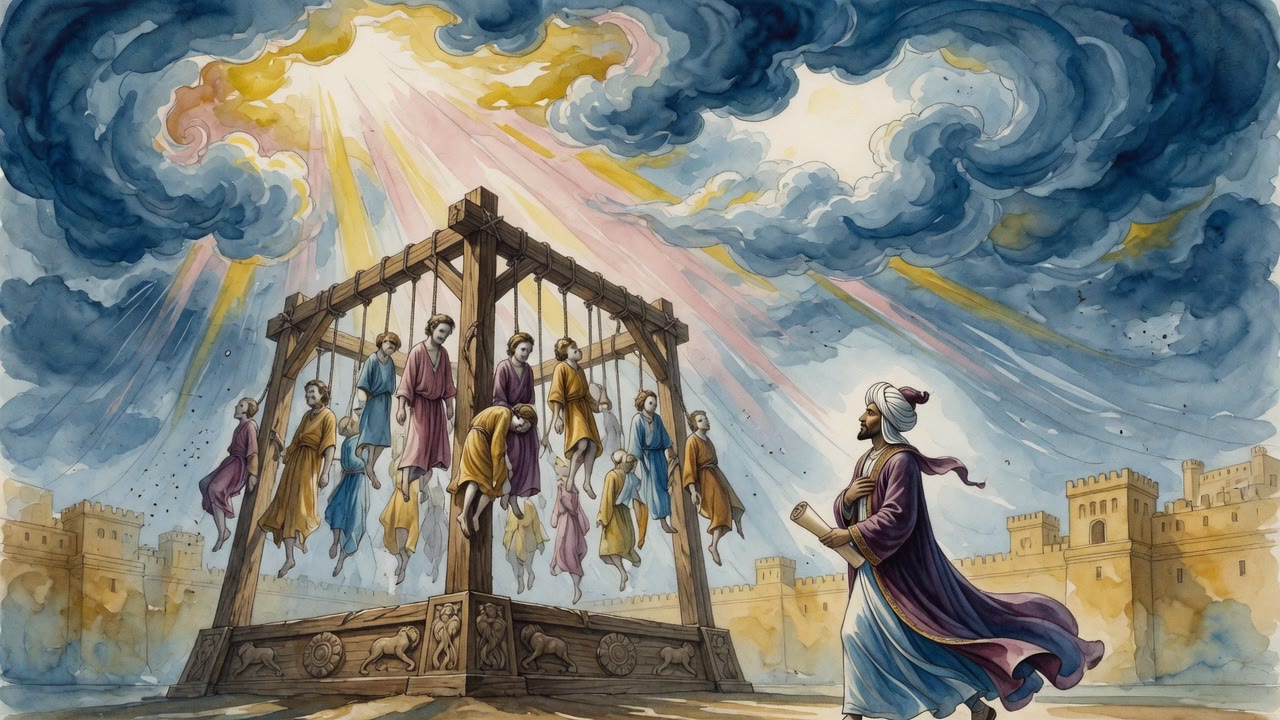
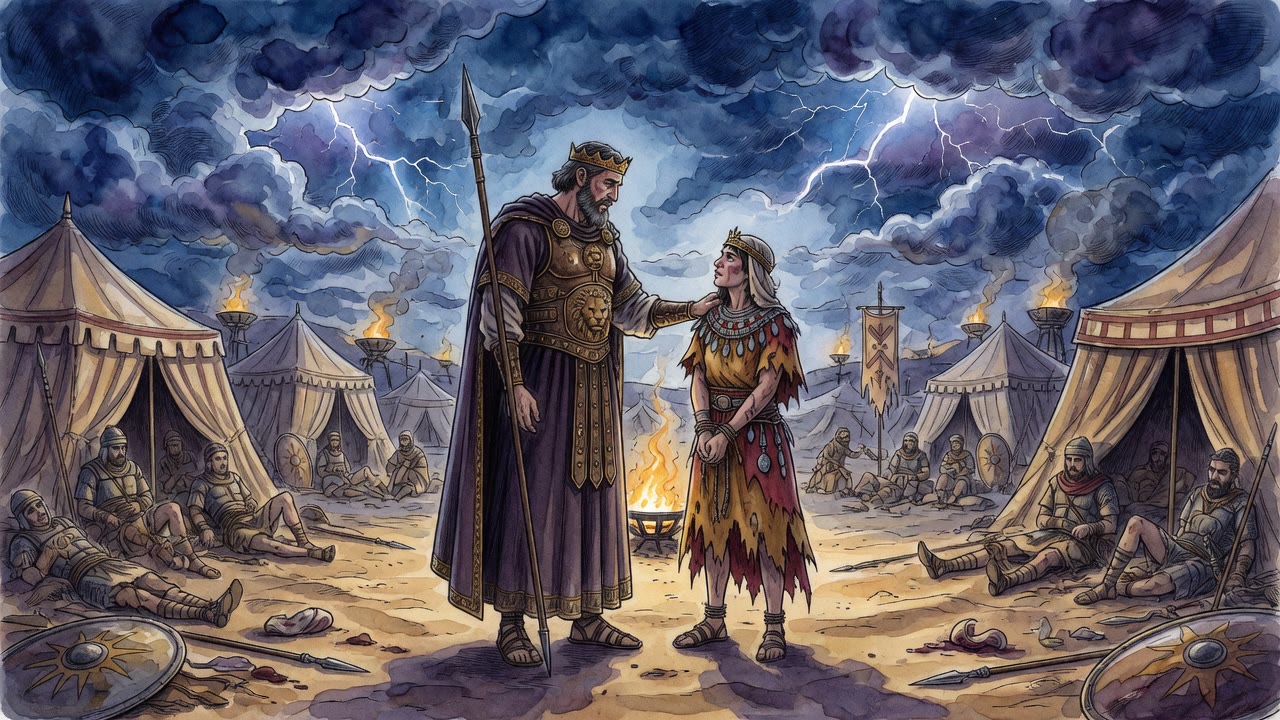
Behind Haman stood Zeresh, who closed every escape but the gallows and measured the beam, until the wood she built took her own sons.

Curated by Arthur · Told by Maggid ·
Table of Contents
  1. The Only Counsel Worth Hearing
  2. The Craftsmen She Summoned Before Nightfall
  3. Haman Climbs to Test the Beam
  4. The Older Cunning in Shimei's House
  5. The Wood Took Her Own House
Zeresh Designed the Gallows and Her Sons Hanged on It Click for full size

The Only Counsel Worth Hearing

Two hundred and eight of them filled the room, sons and friends and hangers-on, and every mouth had a plan. Haman sat among them still shaking from the gate of Shushan, where one Jew had refused to bend a knee to him. Burn him, one said. Chain him in a pit. Drive him into the wilderness. Put out his eyes. Haman listened, and none of it cooled the heat in his chest.

Then his wife spoke, and the room went quiet.

"If the man you speak of is a Jew," Zeresh said, "you will do nothing to him except by cunning." She had studied this people the way a general studies a wall before he throws men at it. Fire? She named Hananiah, Mishael, and Azariah, who walked out of Nebuchadnezzar's furnace without the smell of smoke on their coats. Prison? "Joseph went free from prison." The desert? "The wilderness did no harm to the Israelites who crossed it." Blind him, then. "Samson blind pulled down more than Samson seeing ever did."

One by one she closed the doors her husband's friends had thrown open. Every rescue in their history, she showed, had a seam a miracle could slip through. All but one.

"Hang him," she said. "No Jew has ever escaped death on the gallows."

The Craftsmen She Summoned Before Nightfall

Haman went home glad for the first time in days, and Zeresh did not wait for morning. She sent for men who worked wood and men who worked iron and set them to raising a beam fifty cubits tall, higher than the roofs, higher than the trees, high enough that all of Shushan would have to look up to see the shape hanging there.

While the carpenters cut and the smiths hammered, she took up a cithern and played. The strings rang out over the yard like a wedding tune. Her children heard it and came, and they danced around the rising post, in and out of the shadow it threw longer and longer across the ground as it climbed. None of them stopped to ask whose weight the beam was measured to hold.

Haman moved among the workers promising reward. "To the woodworkers I will give wages in plenty," he called, "and the ironworkers I will seat at my own banquet." A gallows going up like a feast hall, a mother playing over the sound of the saws, sons laughing at the foot of it.

Haman Climbs to Test the Beam

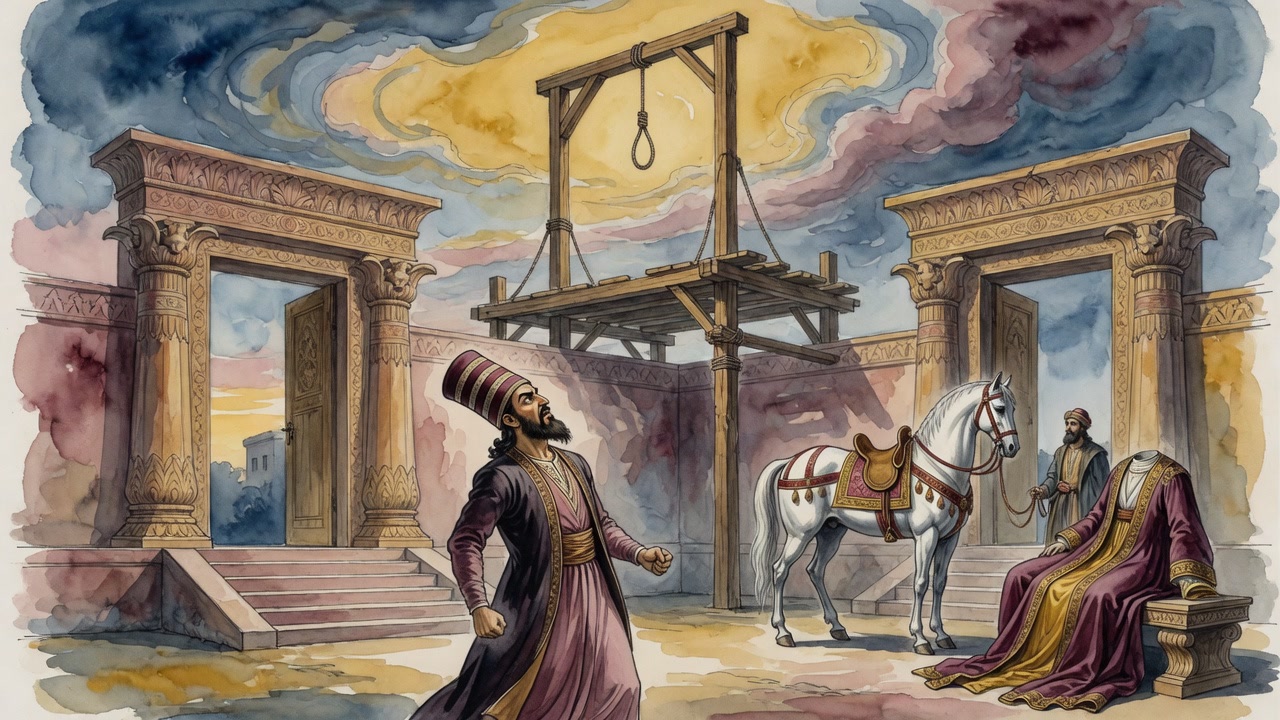
When it stood finished against the sky, Haman could not keep his hands off it. He wanted to be sure the thing would hold, that the rope would run clean, that nothing would fail him in the morning when he dragged Mordecai out to die on it. So he climbed. He set his own weight to the wood his wife had designed and tested every joint of it himself.

A voice came down out of heaven while he stood there. It did not shout. It said, as if noting a plain fact, "It is good for Haman the villain, and for the son of Hammedatha it is fitting." He heard it and did not understand it. He climbed down and went to bed, and above him the beam waited in the dark, already fitted, he thought, to another man's neck.

The Older Cunning in Shimei's House

Zeresh had built her whole plan on one certainty. No daughter of Israel, no son of it, could out-scheme her. But an older cunning had already been laid down against her, generations back, in a house she had never heard of.

When David was at war with his own son Absalom, two of the king's spies, Jonathan and Ahimaaz, ran from Absalom's soldiers and found a gate standing open. It was the house of Shimei. They dropped down into the well in the yard, and Shimei's wife, whose name no one wrote down, moved fast. She spread cloth over the mouth of the well and dressed it as a woman's chamber, curtained and private, and when the soldiers came searching she let them look. They would not push into a lady's room after men as righteous as those two. They gave up the search. The spies lived.

For hiding two righteous men, the tradition holds, that nameless woman was promised two righteous descendants who would one day stand in a Persian court and turn back the ruin of Israel. Her quiet trick in the yard was still working while Zeresh played her cithern.

The Wood Took Her Own House

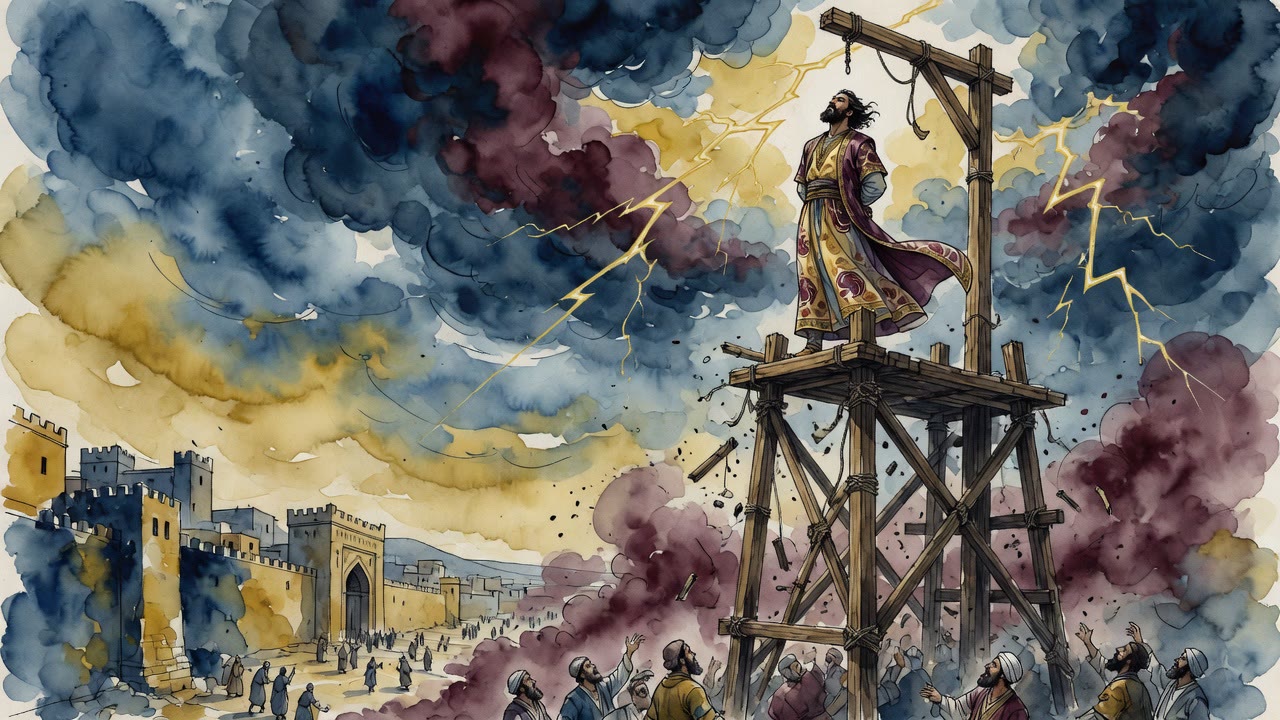
Morning did not go as Zeresh had measured it. The man she meant to hang rode through Shushan in royal robes with her own husband leading the horse. By the time the sun went down it was Haman the king's officers came for, and the beam fifty cubits tall took the man who ordered it built. The rope ran clean. Zeresh had seen to that herself.

Her sons did not dance long. Ten of them were hanged on wood before the story was done, and the household that had laughed around the rising post was scattered and stripped and remembered only for the gallows it raised. The woman who measured the beam outlived the use she built it for, and every joint she had tested held exactly as she promised, against her own.


← All myths

From the tradition

Sources

3 sources

The texts behind this telling. Some cards carry a translation of the source; others are our own retelling of it, and each card says which. Every card links out to the original.

Legends of the Jews 12:192Legends of the Jews

Retold in our words. Read the original at the link below.The Legends of the Jews by Louis Ginzberg (1909) · Public Domain

The familiar version gives us he plotted to annihilate the Jewish people in ancient Persia. But the Legends of the Jews, that incredible collection of rabbinic tales compiled by Louis Ginzberg, gives us some seriously disturbing details about Haman's preparations for Mordechai's execution.

Haman, puffed up with his own self-importance, returns home brimming with malicious glee. His wife, Zeresh, that partner in crime, is thrilled with his plan to impale Mordechai. She springs into action, summoning craftsmen skilled in wood and iron. What for, you ask? Well, to construct the very instrument of Mordechai’s demise.

The scene: carpenters and blacksmiths hard at work, crafting a towering cross. According to Ginzberg’s retelling, Zeresh strums a cithern – an ancient stringed instrument – filling the air with a twisted celebratory tune. The children? They dance around the gruesome project, utterly oblivious to the horror of it all.

Haman, reveling in his power, promises the craftsmen lavish rewards. "To the wood workers I shall give abundant pay," he boasts, "and the iron workers I shall invite to a banquet!" Can you imagine? It’s a perversion of joy, a celebration of impending death.

But here's where the story takes a truly bizarre turn. Haman, not content with simply ordering the cross, decides to test it himself. He wants to ensure it's "in working order," as the Legends of the Jews puts it. He’s practically giddy with anticipation!

And then, a voice rings out from Heaven. It's a chilling pronouncement: "It is good for Haman the villain, and for the son of Hammedatha it is fitting."

Talk about foreshadowing. It's a grim warning, a divine echo that seals Haman's own fate. The very instrument he intended for Mordechai will ultimately become his own. It's a classic case of poetic justice, a powerful reminder that evil often boomerangs back onto its originator.

The story is so much more than just a plot point in the Purim narrative. It’s a stark look at the seductive nature of evil, and the terrifying joy some derive from inflicting pain. It’s a reminder that even in the darkest moments, there is often a glimmer of hope, a promise that justice will ultimately prevail. What do you think, does this story change how you view Haman and the Purim story?

Full source
Legends of the Jews 12:190Legends of the Jews

Retold in our words. Read the original at the link below.The Legends of the Jews by Louis Ginzberg (1909) · Public Domain

A story where the queen wasn't just a pretty face; she was the brains of the operation, and her advice had deadly consequences.

Haman, as you likely know, was the wicked advisor to King Ahasuerus who plotted to annihilate all the Jews in the Persian Empire. But according to the Legends of the Jews, compiled by Rabbi Louis Ginzberg, Zeresh was more than just a wife – she was Haman's most cunning advisor.

Haman, frustrated and humiliated by Mordecai's refusal to bow down to him, was seething. He had gathered his advisors and his sons, a small army of two hundred and eight individuals, to figure out what to do. But none of them could offer advice as chillingly effective as Zeresh.

"If the man thou tellest of is a Jew," she said, "thou wilt not be able to do aught to him except by sagacity." She understood something crucial about the Jewish people: their history was filled with miraculous escapes and divine interventions.

She systematically dismantled every one of Haman's potential plans, referencing familiar stories. "If thou castest him into the fire, it will have no effect upon him," Zeresh pointed out, reminding him of Hananiah, Mishael, and Azariah, who emerged unscathed from Nebuchadnezzar's fiery furnace (Daniel 3).

And she wasn't done. Imprisonment? "Joseph went free from prison." Exile in the wilderness? "Thou knowest the desert did no evil to the Israelites that passed through it." Blinding him? "Samson blind did more mischief than ever Samson seeing!" It’s a rapid-fire history lesson designed to instill one idea: you can't beat these people at their own game.

Zeresh, it seems, had a remarkable understanding of Jewish resilience and the power of faith. Each example she cites highlights a moment where the Jewish people faced seemingly insurmountable odds and were saved.

So, what was her solution? It was brutal, simple, and terrifyingly effective: "Therefore hang him, for no Jew has ever escaped death by hanging."

Think about the weight of that statement. Hanging, she argued, was a method of execution that seemingly bypassed divine intervention. It was a stark, physical finality. There was no room for miracles, no opportunity for prayer, no chance of escape.

Of course, as we know from the Book of Esther, Zeresh's plan ultimately backfired. The gallows Haman built for Mordecai became his own instrument of demise. But her words reveal a chilling insight into the mind of someone determined to destroy a people: understand their strengths, and then exploit their vulnerabilities.

What does this tell us? Perhaps that even the most seemingly foolproof plans, born of hatred and fueled by arrogance, can be overturned by courage, faith, and a little bit of divine intervention. And that sometimes, the quiet voice in the background can be the most dangerous one of all.

Full source
Legends of the Jews 12:50Legends of the Jews

Retold in our words. Read the original at the link below.The Legends of the Jews by Louis Ginzberg (1909) · Public Domain

Sometimes, the answer is more surprising than you think.

Readers often focus on the great men – the kings, the warriors, the prophets. But what about the women behind the scenes? The unsung heroines whose quiet acts of courage and piety shape the destiny of nations?

The story of Shimei is a perfect example. Now, Shimei himself isn't exactly a household name. But according to tradition, he's a key ancestor of the Mashiach, the Messiah, the one who will ultimately redeem Israel. (Legends of the Jews, Ginzberg). But why Shimei? What makes him so special?

Well, the answer, surprisingly, lies with his wife.

During the tumultuous reign of King David, when he was at war with his own son Absalom, two of David's spies, Jonathan and Ahimaaz, found themselves in a tight spot. They were fleeing from Absalom's soldiers, desperate for a place to hide. Luckily, they stumbled upon Shimei's house, the gate standing open as if waiting for them. They slipped inside and concealed themselves in the well.

Now, here’s where Shimei's wife steps into the limelight. She understood the gravity of the situation, the danger these men were in. She didn't panic. Instead, she acted swiftly and decisively. She transformed the well into what appeared to be a lady's chamber. Think quickly draped fabrics, perhaps some feminine adornments – whatever it took to create the illusion.

When Absalom's men arrived, they searched the premises, their eyes scanning every nook and cranny. But when they came to the "lady's chamber," they hesitated. They reasoned that men as righteous and saintly as Jonathan and Ahimaaz would never seek refuge in such a private, feminine space. And so, they gave up the search, and Jonathan and Ahimaaz were saved.

Pretty clever. The text doesn't tell us her name, but her quick thinking saved the lives of two pious men. Her act of kindness resonated far beyond that single moment. According to tradition, God saw her deed and determined to reward her. As we find in Midrash Rabbah, for having rescued two righteous men, she would be blessed with two righteous descendants who would ultimately play a role in averting the ruin of Israel. That’s some serious ripple effect from one act of bravery.

We often underestimate the power of seemingly small acts of kindness and courage. This story reminds us that even in the shadows, even when no one is watching, our actions can have profound consequences, shaping not only our own lives but also the destiny of generations to come. And that sometimes, the greatest heroes are the ones whose names we may never even know.

Full source