Parshat Vayera5 min read

Abraham Mourns Abimelech in Philistine Court

When Abimelech of Gerar dies, Abraham crosses into Philistine halls to mourn a king who once opened his land and learned fear by night.

Curated by Arthur · Told by Maggid ·
Table of Contents
  1. A Throne Without Its King
  2. The Night God Seized a Stranger's Heart
  3. Covenant Leather and a Morning Prayer
  4. Lot's Parallel Clock
  5. What Abraham Carried Out of the Hall
Abraham Mourns Abimelech in Philistine Court Click for full size

A Throne Without Its King

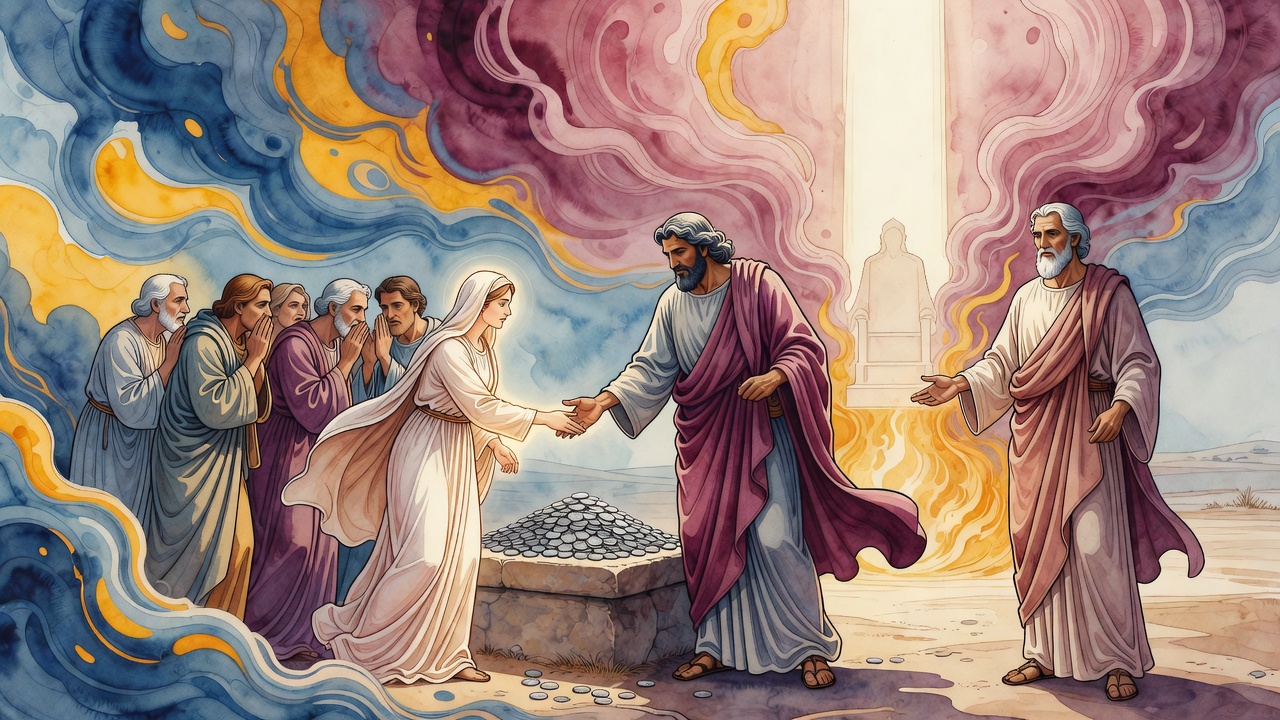
The court at Gerar smelled of oil and dust and the quiet panic of succession. Abimelech of the Philistines was dead. His twelve-year-old son, Benmelek, took the throne and wore his father's name like armor borrowed too early. Courtiers measured their bows. Soldiers measured the boy. The land waited to learn whether the new mouth would keep the old treaties.
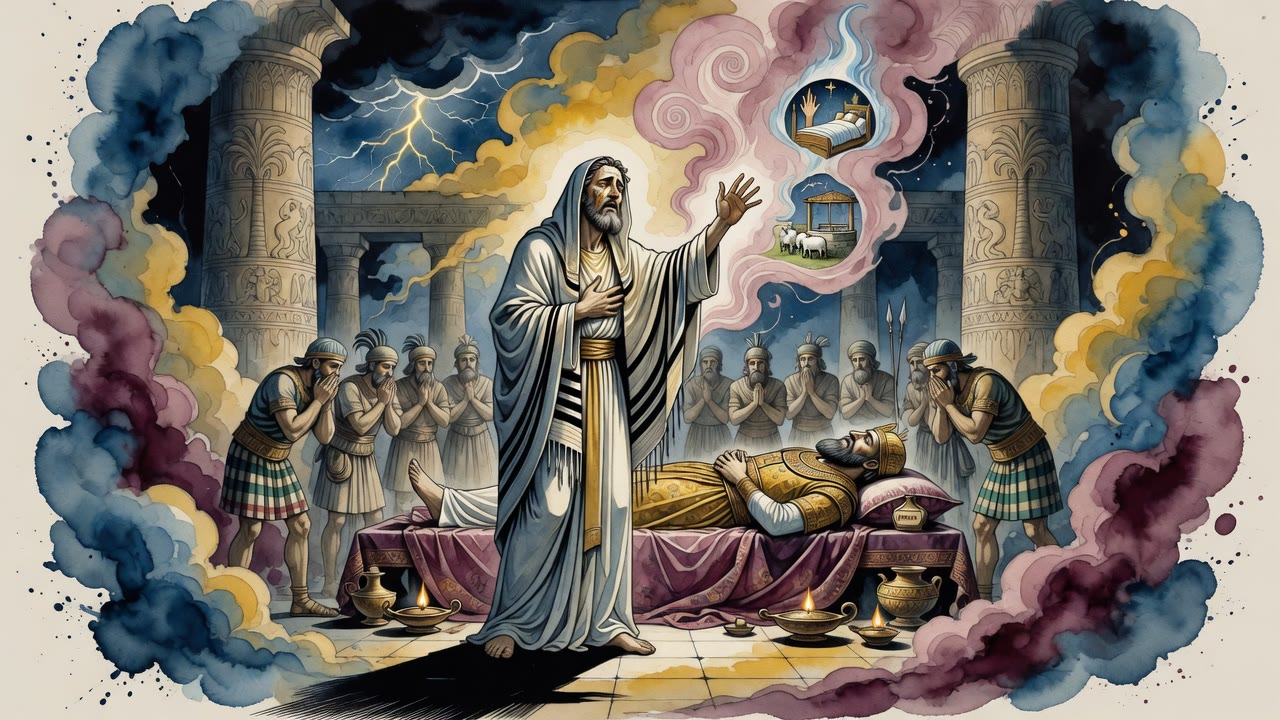
Abraham came to mourn.

He did not come as a conqueror counting weakness. He came as a man who had once stood under the same night sky as this king and watched fear do honest work. Condolence is a strange diplomacy. It says the dead mattered enough to interrupt the living. Servants led him through halls where Abimelech had once paced after a dream that nearly killed him. The boy-king sat stiff, eyes too old for the chair.

Abraham spoke the words of grief that strangers share when heaven has already made them almost kin. Outside, Philistine horses stamped. Inside, a treaty held its breath.

The Night God Seized a Stranger's Heart

Years earlier God had entered Abimelech's sleep and closed a fist around his future. "Fool of the world! You are a dead man because of the woman you have taken." The king woke into a body that would not finish what desire had begun. Sarah was in his house under a false name, and heaven refused the theft.

Abimelech argued innocence into the dark. God answered with precision: restore the woman, ask the prophet to pray, live. The Philistine king did what many kings never do. He obeyed a dream that cost him pride. He opened his land. "Behold, my land is before you," he told Abraham, and meant the whole country, not a polite strip of pasture.

A stranger honored the patriarch more cleanly than some brothers honor brothers. That comparison would later burn another Abimelech, the one who slaughtered seventy kin on one stone for a crown. Heaven held up a mirror: better the Philistine who feared God at night than the Israelite who murdered for a throne by day. A close neighbor who learns reverence can outrank a distant brother who learns only blood.

Abraham never forgot the king's open hand. That is why mourning was not theater. It was payment on an old kindness.

Covenant Leather and a Morning Prayer

The peace did not end with Abraham. When Isaac walked the same Philistine roads, wells became arguments and arguments became treaties. Flocks pressed against flocks. Names of water turned into lawsuits. One morning the seal was not a carved stele but a strip of bridle leather. Isaac broke a piece from his ass's bridle and gave it as testimony. Small. Practical. Hard to counterfeit in a story later.

Then Isaac prayed for them, and they were enlarged. The Targum keeps both facts in one breath: token and petition, leather and blessing. A covenant that only trades water rights without prayer is a contract. A covenant that asks heaven to widen the other party becomes something stranger and more dangerous to hatred.

Abimelech's people left that morning with a scrap of harness and a wider future than their fear had budgeted. Isaac left with quieter wells. The road between their camps kept its dust and its possibility.

Lot's Parallel Clock

Around the same stretch of years, Lot died at one hundred forty-two, far from the valley that had burned. His sons Moab and Ammon married Canaanite women and seeded nations that would later press against Israel with their own hungers. Abraham's household and Lot's household kept writing history in different inks while Abimelech's line passed a name from father to boy-king.

Death does not wait for neat chapters. It stacks patriarchs, Philistine thrones, and half-remembered nephews into the same season and leaves the living to sort the meanings. Abraham, standing in Gerar's hall, carried all of it: Sarah's near theft, the dream, the open land, Isaac's later leather, Lot's long shadow. Grief made room for the whole inventory.

What Abraham Carried Out of the Hall

Abraham left the Philistine court with dust on his cloak and a young king's stare on his back. He had seen a foreign ruler learn fear correctly, open land generously, and die without becoming a parable of pure villainy. He had also seen how thin a throne is when a child must fill it.

The mourning visit was a ledger entry in the long account between the household of promise and the peoples who brushed against it. Some neighbors learn by dream. Some learn by war. Abimelech of Gerar learned by a night when his body would not obey him, and by a morning when he chose restitution over reputation.

Outside, the road toward Beer-sheba waited with its familiar heat. Inside the hall, Benmelek sat under a name heavier than his years, and the treaty-leather of another generation waited its turn to be tested by the next drought, the next well, the next temptation to forget that strangers can become witnesses of God.

Abraham did not look back twice. Once was enough to fix the image: a boy on a throne, a dead king's kindness still active in the room, and a patriarch who knew how rare such kindness is among men with armies.


← All myths
From the tradition

Sources

3 sources

The texts behind this telling. Some cards carry a translation of the source; others are our own retelling of it, and each card says which. Every card links out to the original.

Legends of the Jews 5:274Legends of the Jews

Retold in our words. Read the original at the link below.The Legends of the Jews by Louis Ginzberg (1909) · Public Domain

Legends of the Jews turns to Kingdom of Abraham of Abimelech.

His story doesn't end there, though. His twelve-year-old son, Benmelek, took over the throne, adopting his father's name as his royal title. Abraham, ever the mensch, even paid a visit to the court to offer his condolences. It paints a picture of a world where even across cultural and religious divides, basic human courtesies were observed.

What about Lot, Abraham's nephew who made that fateful choice to settle in Sodom? He also met his end around this time, at the age of one hundred and forty-two. Quite the lifespan, even by biblical standards!

Lot's legacy took a different turn. His sons, Moab and Ammon, both married Canaanite women. the verse says Moab had one son, and Ammon had six. These unions led to exceedingly numerous descendants. These are the figures who would eventually become the ancestors of the Moabites and Ammonites – nations that would play a significant role in the history of Israel, often as adversaries.

It's interesting to consider how these seemingly small details – the ages, the successions, the marriages – ripple outwards, shaping the future of entire peoples. These aren't just names on a page; they are the seeds of nations, their stories intertwined with the grand narrative of the Jewish people. How do seemingly small choices influence the trajectory of our lives and the lives of generations to come?

Full source
Midrash Tanchuma Buber, Vayera 25:2Midrash Tanchuma Buber, Vayera

Translation of the source text.Midrash Tanchuma (Buber), Public Domain, on Sefaria · CC-BY-SA

What is the meaning of (Proverbs 27:10): "A close neighbor is better than a distant brother"? The Holy One, blessed be He, said to Abimelech ben Jerubbaal: Better than you was Abimelech king of the Philistines, for he greatly honored Abraham, as it is said (Genesis 20:15): "And Abimelech said, Behold, my land is before you." Why did he say so? Rather, he saw all the honor with which the Holy One, blessed be He, had honored him, as it is said (Genesis 20:3): "And God came to Abimelech in a dream of the night." He said to him: Fool of the world, "you are a dead man because of the woman whom you have taken" (ibid.). All this tranquility is in your hand, and you are dying over a woman! Should you not have considered that she is a married woman (be'ulat ba'al)? What is this "married woman"? Rather, she is the spouse (be'ulah) of a husband (ba'al).

Full source
Targum Pseudo-Jonathan on Genesis 26:31Targum Pseudo-Jonathan on Genesis

Retold in our words. Read the original at the link below.The Targum of Jonathan ben Uzziel, trans. J. W. Etheridge, London, 1862 · Public Domain

The treaty is signed in the morning. The Targum Pseudo-Jonathan adds a detail the Hebrew only whispers. "He broke off from the bridle of his ass, and gave one part to them for a testimony. And Izhak prayed for them, and they were enlarged" (Genesis 26:31).

Two elements stand out. First, the bridle. Second, the prayer.

A strip of leather as witness

In the ancient world, covenants often required a physical token, a stone, a pile of rocks, a divided animal. Here, Isaac snaps a strip from his ass's bridle and hands it to Abimelech. It is a small, practical thing. But the Targum treats it as formally significant: gave one part to them for a testimony. The leather is now a legal witness. The oath is bound in an object both parties carry.

The Torah often uses humble objects to seal eternity. A rainbow. A pillar. A strip of bridle. Pseudo-Jonathan honors the pattern.

And Isaac prayed for them

This is the line that the Targum adds without apology. Isaac prayed for them, and they were enlarged. Abimelech and his men, who had expelled Isaac from Gerar, now leave with the patriarch's prayer on their backs. The Aramaic suggests something like made prosperous or expanded, their households grew, their fortunes widened.

The rabbis taught that one who prays for another is answered first. But the Targum shows Isaac praying for his former adversaries and leaving them blessed. This is what tzedakah looks like on a covenant scale.

The takeaway: the Jewish ideal of peacemaking is not silence. It is blessing your enemies after they sign the paper.

Full source