Absalom's Hair Hung Him Between Heaven and Earth
He made a ceremony of the shears. The mule ran out from under him. Joab found a prince who could not get his own head free.
Table of Contents
Absalom lifted the shears where the court could watch. When the hair grew heavy he did not cut it in a room. He cut it in the open and put the weight on a scale (2 Samuel 14:25-26).
 Click for full size
He Weighed His Hair in Public
No man in Israel was as beautiful, and he treated the fact like a banner. The number traveled. Two hundred shekels by the king's weight. A prince who looks like that does not need to shout. He only needs to pass the gate, smile, and let the locks do the rest of the work while David aged on the throne.
He rode through the city with that head uncovered on purpose. Hearts turned. Hands reached. The shears came out only when the weight troubled him, and even the cutting was a show. Beauty that keeps a ledger is already a claim on a crown.
The Mule Ran On Without Him
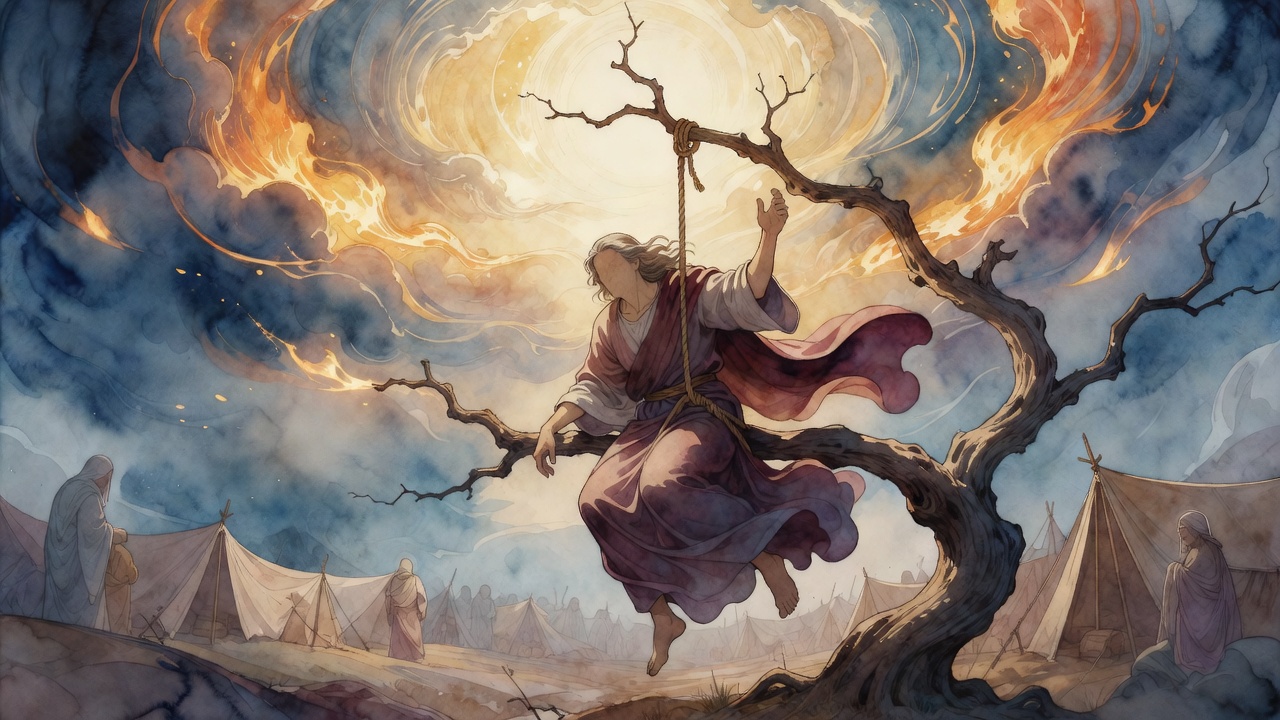
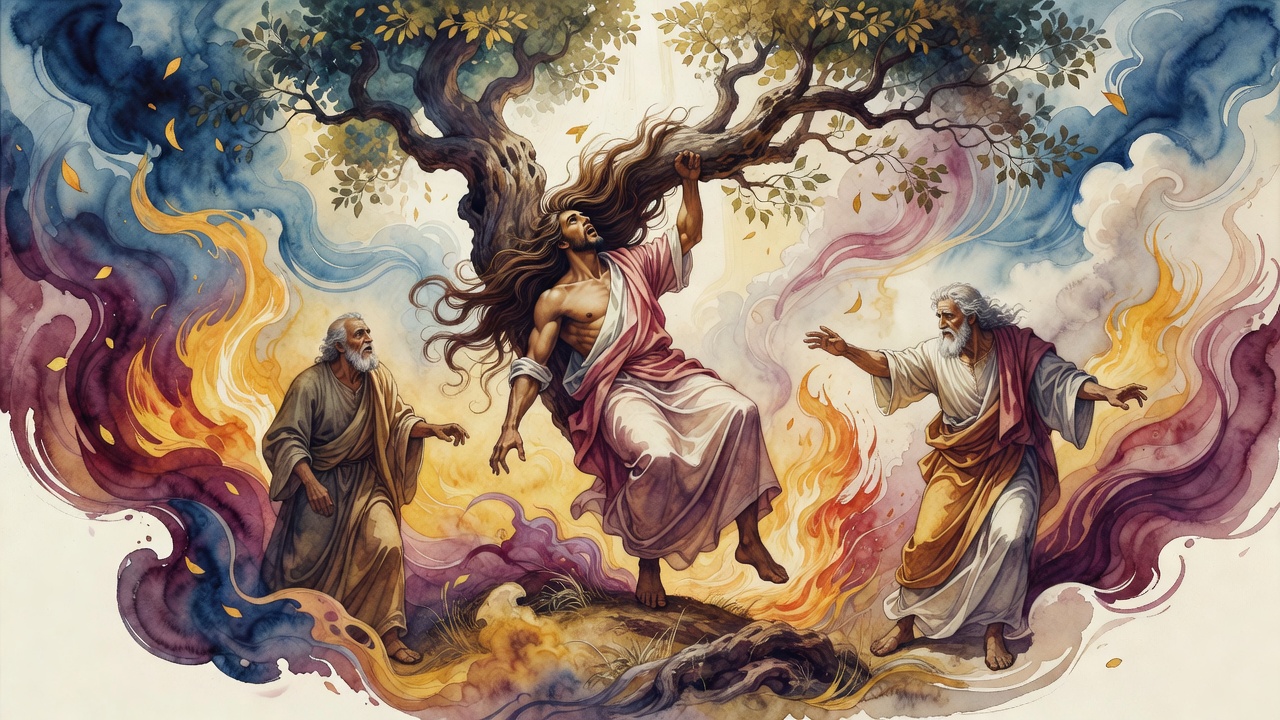
The rebellion broke. The wood of Ephraim ate more men than the sword. Trees took riders. The ground betrayed horses. Absalom fled on a mule, the famous hair still his, and the mule ran under the thick branches of a terebinth.
For a breath he was still a rider. Then the branches took the hair he had been weighing for years, and the animal did not stop. His hands went up. The scalp held. The mule ran out from between his knees, and the son of the king hung between heaven and earth with his feet kicking at nothing.
He could not get his own head free. Soldiers saw a prince dangling like laundry, neither mounted nor fallen. The forest did not need a noose. It needed only the weight he had spent years advertising.
Ahithophel Wanted the Empty Throne
Beside the son's revolt stood Ahithophel, whose word had once been counted like an oracle. He had read signs and thought they pointed to his own kingship. They pointed to his granddaughter Bathsheba. He did not read that far.
He joined Absalom. He poured advice. He urged the son to take the father's concubines on the roof, a crime so public that even a won throne would not hold him. Absalom would ruin David and still be condemned. The way would open for the sage.
Absalom took other counsel. Ahithophel went home, set his house in order, and hanged himself. Two men left the ground by the neck, one by vanity, one by hunger for a chair that had never been his.
Joab Drove Three Spears
Joab found him in the terebinth. Joab had once brokered Absalom's return from exile. He looked up at the hanging prince and finished what the hair had begun.
Three spears through the heart that had planned a crown. Then the armor-bearers closed in. The mule, indifferent as animals are to royal fashion, had already walked on.
David's cry afterward needed no polish. He would have died in the son's place. The boast had been public. The death was public. Hair for hair's pride, and a father on the wall hearing it too late to climb the tree.
The Charge Waited for the Deathbed
Years later, when David's days drew near to die, he charged Solomon only then (1 Kings 2:1). Not in the easy middle of the reign. At the edge. He had watched a son hang in a tree and a friend choose a rope. Some instructions will not take if there is still time to dilute them.
Guard the kingdom. Remember the blood. Do not confuse brilliance with loyalty. Do not confuse beauty with right. Moses, at the end of the wilderness, had stacked every word before he left, light and heavy together. David waited until death was in the room, then put the load in Solomon's hands.
Solomon received a kingdom already scarred. Between heaven and earth Absalom had learned the cost of a mirror. On the ground David had learned the cost of a household that could not hold its brilliance. On the deathbed the next king inherited both, and the shears were long since put away.
← All myths