6 min read

Beasts Circled Cain Until God Marked Him

After Abel's blood hit the ground, animals closed around Cain. God set a mark on the first murderer, and the world learned what mercy costs.

Curated by Arthur · Told by Maggid ·
Table of Contents
  1. The Circle of Teeth
  2. A Sentence Without a Precedent
  3. What the Sign Looked Like
  4. The Presence That Climbed Away
  5. Seven Went Down From One Bed
Beasts Circled Cain Until God Marked Him Click for full size

The Circle of Teeth

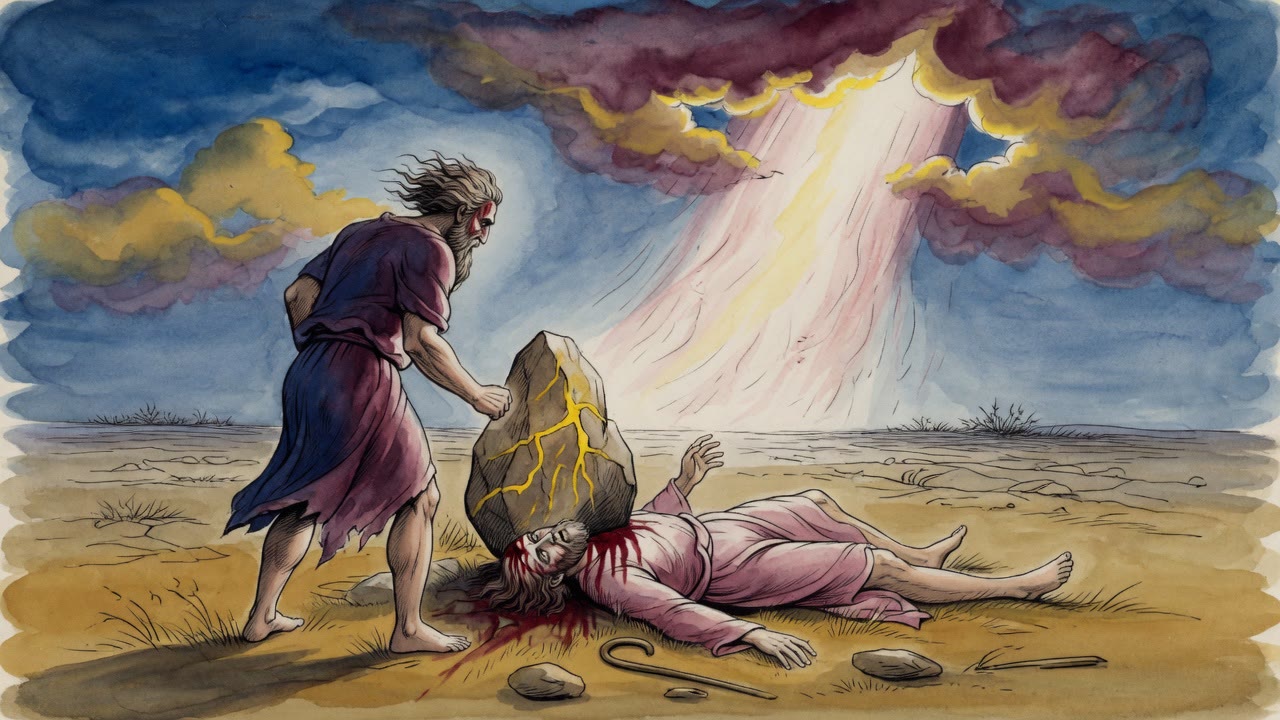
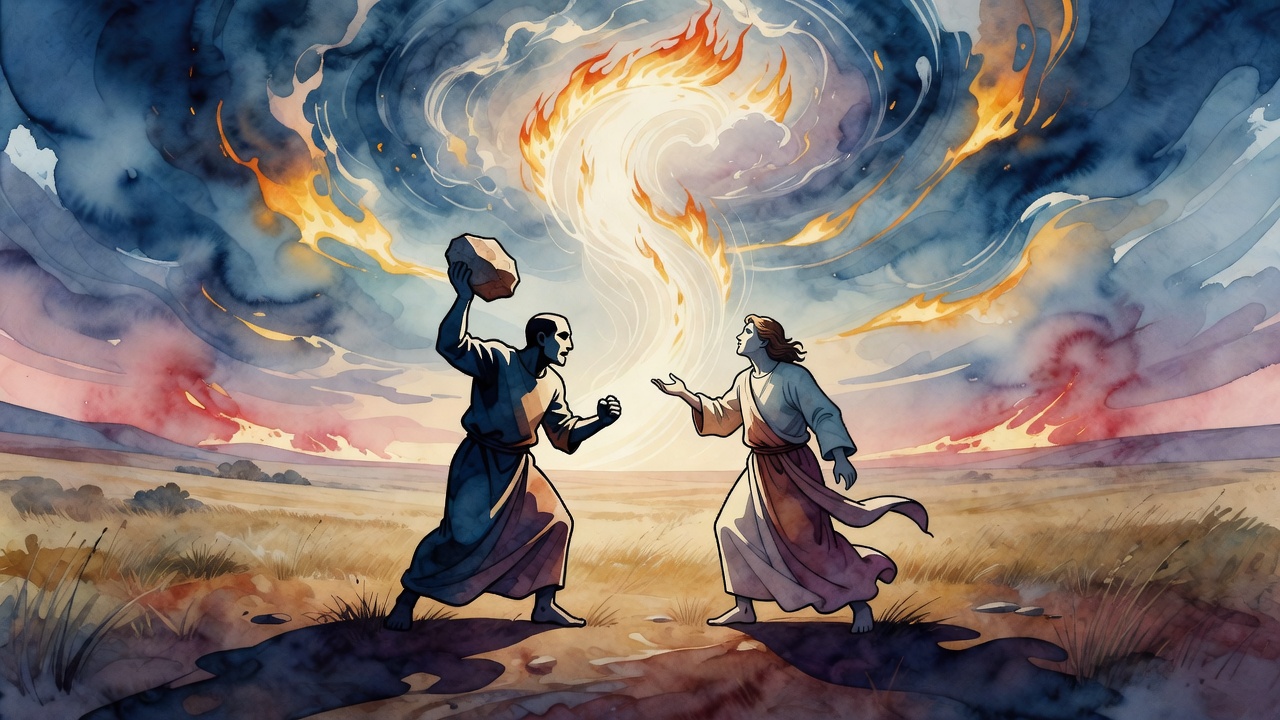
Cain still had red under his nails when the first jackal stepped out of the brush. Then a second. Then a bird with a hard eye. The beasts of the field and the birds of the air gathered around the first murderer as if the ground itself had called a court.
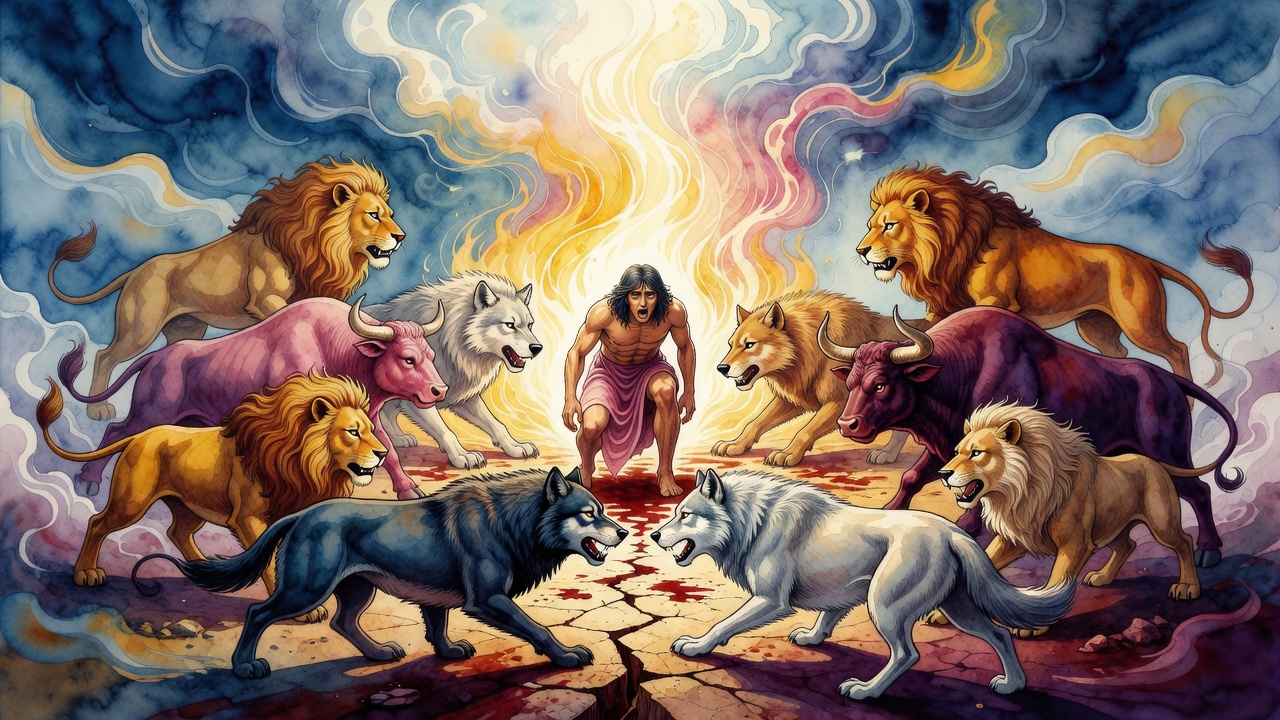
They smelled Abel's blood. They wanted a justice no human bench could name yet, because no human bench had ever sat. Cain backed toward a rock. His brother lay still between furrows that would not close. The sky did not open. The animals did.

In one telling the primeval serpent itself came to demand a verdict, the old mouth that had already poisoned Eden now speaking for a dead shepherd. God did not hand Cain to their teeth. He answered the circle with a sentence that protected the killer and threatened whoever would finish him. Sevenfold vengeance hung over any creature that tried to close the case with more blood.

Cain's breath came short. He had expected exile, or fire, or a voice that would unmake him. He had not expected a leash that kept the world from eating him alive before law had words.

A Sentence Without a Precedent

Rabbi Nehemya hears the strangeness of that mercy. Cain had no example. No one had murdered before. He was the first to learn what a fist and a field can do to a brother. From that day forward the rule would be clear for every later hand. For Cain alone the court of heaven spoke as if inventing itself in the dirt.

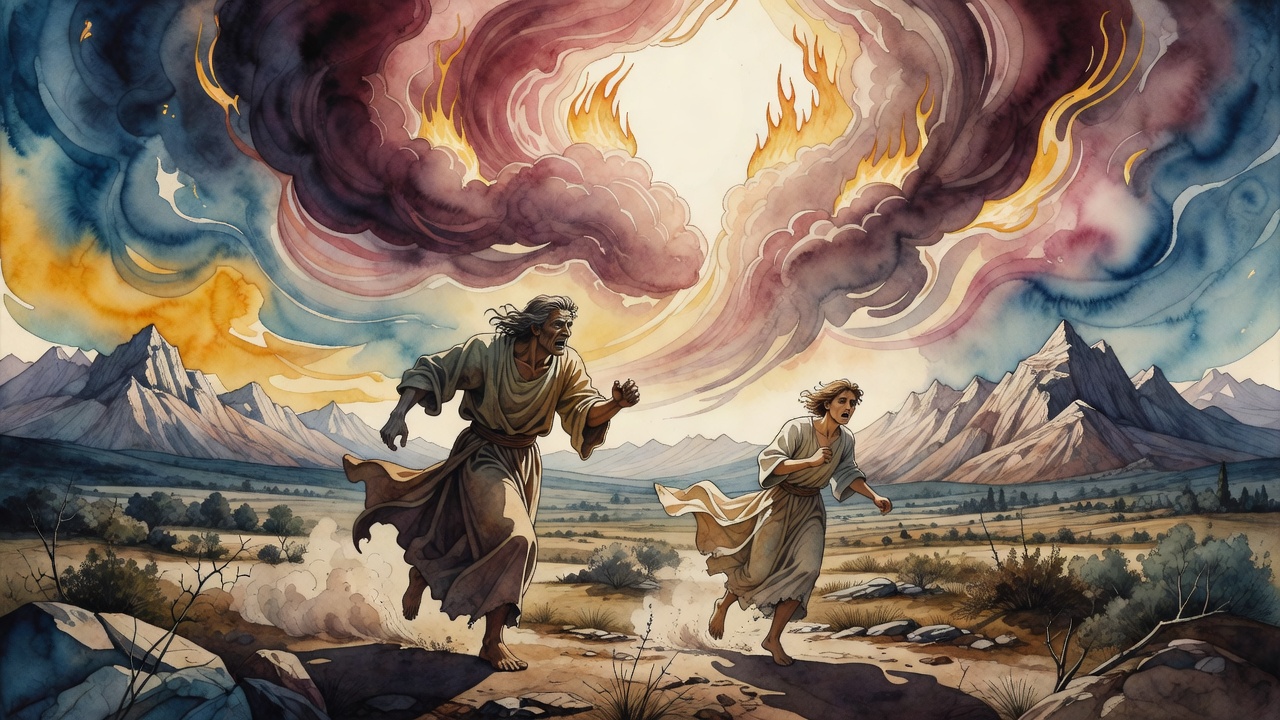
He walked. The blood still cried from the ground that had opened its mouth to receive it. The animals still watched from the tree line. Mercy here was not softness. It was a boundary drawn so revenge would not become the only teacher on earth.

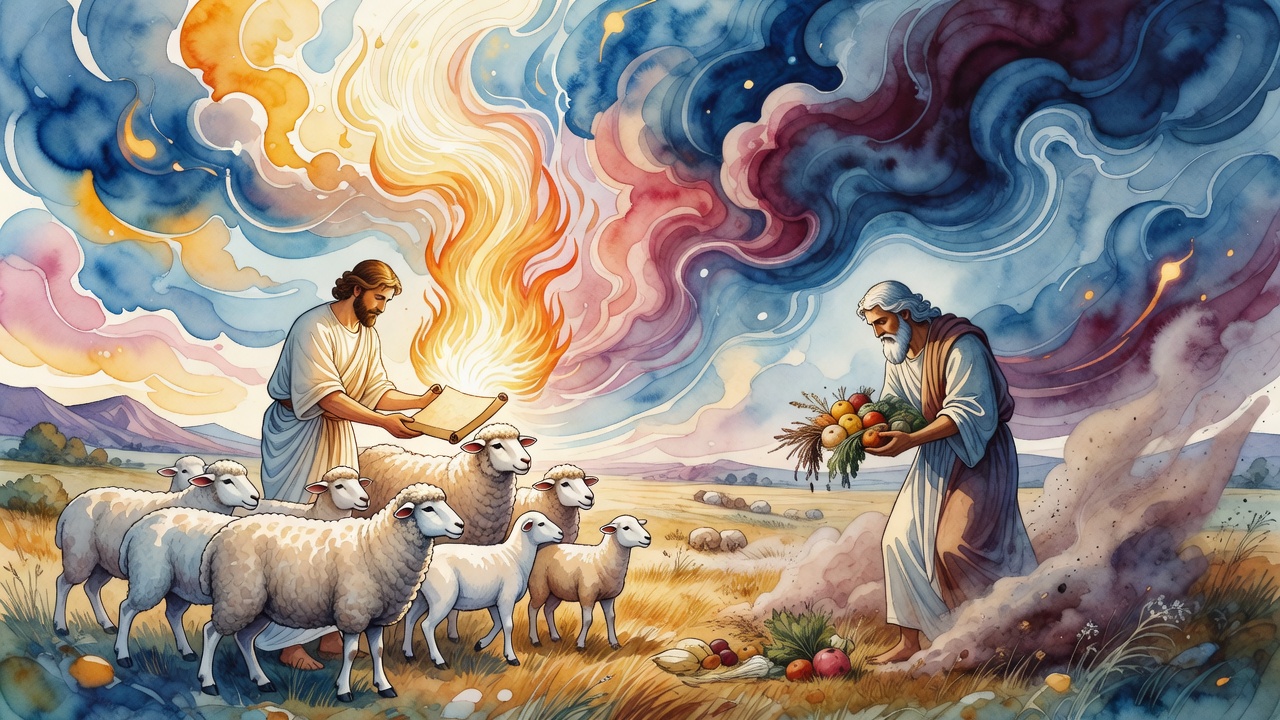
Abel had brought a better offering. Cain had watched the smoke refuse him. Jealousy had done the rest. Now jealousy wore a new face: the face of a man who could not die yet and could not sleep.

What the Sign Looked Like

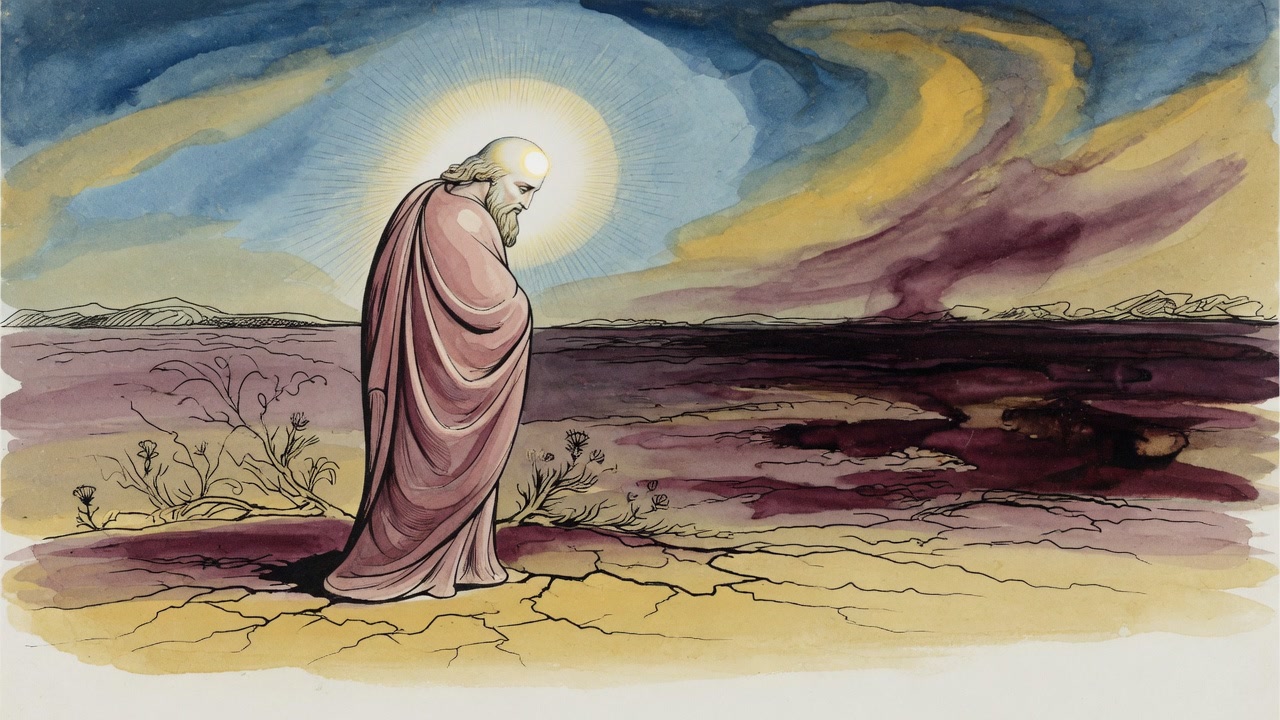
Then God set a sign on him, and the sages refuse a single picture.

Rabbi Yehuda says the orb of the sun shone for him, because the lights were made to be signs. Rabbi Nehemya recoils. Would heaven gild a wicked man with daylight? Better leprosy glowing on the skin, a living warning like the sign later shown in Egypt when a hand turned white. Rav gives Cain a dog that walks at his heel, a living fence against every hunter. Abba Yosei ben Kesari sees a horn push from his head, so that every stranger who met him would stop short of the kill.

Some say God made Cain himself into a sign for murderers: look, and do not do this. Others say a sign for penitents: look, and return, for Cain confessed. Rabbi Levi, quoting Rabbi Shimon ben Lakish, sets a long fuse under the whole tale. Cain's sentence waited for the Flood. When the waters erased haykum, all existence, they also answered the day Cain rose, vayakam, over his brother. Delayed judgment is still judgment. The mark bought time, not innocence.

Cain touched his face in the dark, not knowing which version he wore. Sun. Sore. Dog. Horn. All of them said the same thing to the world: this man is not yours to finish.

The Presence That Climbed Away

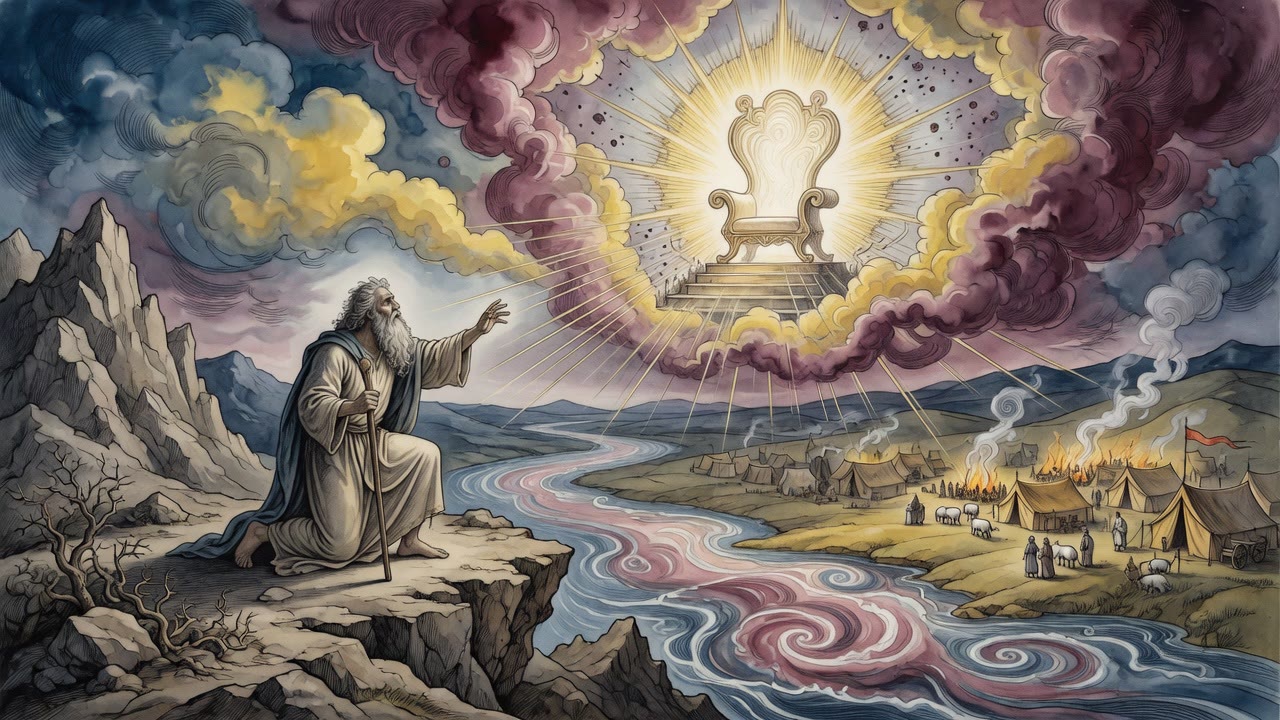
The murder did not only mark one man. After Adam and Eve hid among the trees, the Shekhinah (שכינה), the Divine Presence, began to leap upward from the lower world. The verse does not say simple walking. It says mithalekh, a motion the sages hear as ascent, a Presence pulling away.

Sin by sin it climbed. Cain. The generation of Enosh. The Flood. Babel. Sodom. Egypt. Seven firmaments rose between earth and nearness like floors in a building no one could scale from below.

Against those seven withdrawals the tradition sets seven who pulled presence back down: Abraham, Isaac, Jacob, Levi, Kehat, Amram, and Moses. The world that watched Cain walk with a dog or a horn or a white stain was already a world from which God had begun to step back. Every later righteous life would be a rope thrown upward toward a Presence that had learned to climb.

Seven Went Down From One Bed

Before the field, before the blood, there had been a bed and a day crowded with miracles. Two went up and seven came down: Cain and his twin sister, Abel and two twin sisters. Creation, intimacy, and birth in a single span that left no time to learn what a brother is for.

Eve said she had acquired a man with the Lord. Rav Aha's sting still hangs in the air: the serpent was your serpent, and you were Adam's. Blame moved like a torch from mouth to mouth until it found a field and a stone.

Cain left Eden's edge wearing whatever mark heaven chose. Behind him the ground refused to be quiet. Ahead of him waited a long road that ended, in one hard reading, only when the rain of the Flood closed the case the beasts had opened.

He did not look like a lesson. He looked like a man the animals would not touch, and men would not trust, and God would not erase until the whole earth needed washing. The first murder taught the world blood. The first mark taught the world that even blood does not always get the last word on the same day it is spilled.


← All myths
From the tradition

Sources

3 sources

The texts behind this telling. Some cards carry a translation of the source; others are our own retelling of it, and each card says which. Every card links out to the original.

Bereshit Rabbah 22:12Bereshit Rabbah

Retold in our words. Read the original at the link below.The Sefaria Midrash Rabbah, 2022 · CC-BY

What happens after the first murder? After Cain kills Abel, what kind of justice, or mercy, is extended? (Genesis 4:15) tells us: "The Lord said to him: Therefore, anyone who kills Cain, vengeance will be taken on him sevenfold. The Lord placed a sign for Cain, so that anyone who would find him would not smite him."

What does that actually mean? That's where the Rabbis of the Midrash (rabbinic interpretive commentary) come in. In Bereshit Rabbah, a collection of rabbinic interpretations of the Book of Genesis, they wrestle with the implications of this verse. What does it mean that God protects Cain, even after such a terrible act?

This teaching presents different viewpoints. Rabbi Yehuda and Rabbi Neḥemya offer their interpretations. Rabbi Yehuda suggests that the animals, beasts, and birds gathered, demanding justice for Abel's blood. God responds, essentially saying, "Because of your actions, anyone who kills Cain will be killed. The entire natural world crying out for justice.

Rabbi Levi offers a different perspective, saying that the primeval serpent itself came to demand justice. God replies similarly, promising protection for Cain, albeit a protection that ensures anyone who takes his life will pay dearly.

Then there's Rabbi Neḥemya's thought. He suggests that Cain's sentence was different from that of other murderers because he had no precedent, no one to learn from. From this point forward, however, "anyone who kills Cain will be killed." It's a fascinating idea, that Cain's ignorance, his lack of example, somehow mitigates his guilt, at least initially.

But what about the "sign" God placed on Cain? Again, the Rabbis diverge. Rabbi Yehuda believes that God caused the orb of the sun to shine for him. After all, regarding the creation of the lights, including the sun, it is written: “They will be as signs” (Genesis 1:14).

Rabbi Neḥemya finds that hard to swallow. Would God really bestow such a blessing on someone so wicked? Instead, he proposes that God caused leprosy to glow on him, drawing a parallel to (Exodus 4:8), where leprosy is referred to as a sign. "It will be that if they do not believe you, and do not heed the voice of [the first] sign, [they will believe the voice of the latter sign]." The latter sign was leprosy, indicating that leprosy is called a sign.

Rav offers a more concrete image: God gave Cain a dog for protection. Abba Yosei ben Kesari suggests that God caused a horn to sprout forth from him. Both interpretations serve the same purpose: to ensure that anyone who encounters Cain would be deterred from harming him.

Rav offers another interpretation: God rendered him a "sign" for murderers, to warn others not to follow Cain’s practice. Rabbi Ḥanin suggests something almost opposite: God rendered him a “sign” for penitents, for others to follow his practice. Why? Because Cain confessed his sin (as we see earlier in Bereshit Rabbah).

Finally, Rabbi Levi, quoting Rabbi Shimon ben Lakish, suggests that Cain's sentence was pending until the Flood, which washed him away, drawing a parallel between the phrase "He obliterated all existence [haykum] that was on the face of the earth" (Genesis 7:23) and "Cain rose [vayakam]" (Genesis 4:8).

So, what are we left with? A multitude of interpretations, each offering a glimpse into the complexities of divine justice and mercy. Is Cain protected as evidence of God's compassion, or marked as a warning to others? Is he given a chance to repent, or simply delayed in receiving his ultimate punishment?

Perhaps the answer lies in the ambiguity itself. The Rabbis, in their wisdom, don't offer a single, definitive answer. Instead, they invite us to confront these questions, to explore the nuances of sin, punishment, and the enduring possibility of redemption. And maybe, just maybe, that's the most profound sign of all.

Full source
Bereshit Rabbah 19:7Bereshit Rabbah

Retold in our words. Read the original at the link below.The Sefaria Midrash Rabbah, 2022 · CC-BY

The familiar story centers on their shame and banishment, but the Rabbis of the Midrash (rabbinic interpretive commentary) saw something even deeper happening at that moment. Something that changed the very fabric of reality. to Bereshit Rabbah, a classic collection of rabbinic interpretations of the Book of Genesis. This particular passage, Bereshit Rabbah 19, grapples with the verse "They heard the voice of the Lord God moving about in the garden with the day breeze; the man and his wife hid from the presence of the Lord God among the trees of the garden" (Genesis 3:8). God walking in the garden, Adam and Eve hiding. But the Rabbis, masters of close reading, noticed something peculiar.

The Hebrew word used here for "moving about" is mithalekh. Rabbi Ḥalfon points out that the word hilukh, related to mithalekh, can also refer to sound. He even finds another use of the word in (Exodus 9:23), "And fire went [vatihalakh] earthward." So, is the verse saying God was walking? Or is something else going on?

Rabbi Abba bar Kahana offers a stunning interpretation. He notes that it doesn't say mehalekh (walking), but mithalekh, which he understands to mean "leaping up and ascending." What does that mean?

Here's where it gets really interesting. Rabbi Abba bar Kahana suggests that before the sin, the Divine Presence, the Shekhina, was present right here in the lower world, intimately connected to humanity. But when Adam sinned, the Shekhina began to withdraw. Not just metaphorically, but literally.

Imagine the Shekhina, the very essence of God’s presence, ascending, level by level, away from humanity. According to this midrash, with each subsequent sin, Cain's, the generation of Enosh, the Flood, the Tower of Babel, the wickedness of Sodom, and the Egyptians, the Shekhina retreated further, rising to the first, second, third firmaments, and so on, until it reached the seventh!

A pretty bleak picture. Humanity’s actions drove God away. But the story doesn't end there.

Corresponding to those seven descents into sin, the midrash tells us, arose seven righteous individuals: Abraham, Isaac, Jacob, Levi, Kehat, Amram, and Moses. Each one, a beacon of light, worked to bring the Shekhina back down. Abraham brought it down from the seventh to the sixth, Isaac from the sixth to the fifth, and so on, until finally, Moses brought the Shekhina all the way back down to earth!

Rabbi Yitzḥak adds a powerful closing thought. Quoting (Psalm 37:29), "The righteous will inherit the earth and dwell [veyishkenu] upon it forever...", he asks, what about the wicked? Will they float in the air? No, he answers, the wicked prevented the Shekhina from dwelling, from shchen, on the earth. They disrupted the connection between the Divine and the mundane.

So, what does this all mean? Sin doesn't just harm us individually; it can create a distance between us and the Divine Presence. But equally important, it highlights the power of righteousness. Each act of kindness, each moment of connection, each effort to live a moral life, can help bring the Shekhina back down to earth, making the world a more sacred and connected place. It's a constant ebb and flow, a continuous dance between humanity and the Divine. And we all have a role to play.

Full source
Bereshit Rabbah 22:2Bereshit Rabbah

Retold in our words. Read the original at the link below.The Sefaria Midrash Rabbah, 2022 · CC-BY

The Torah touches on this in the story of Adam and Eve, and the Rabbis of the Midrash (rabbinic interpretive commentary) have some fascinating things to say about it.

In Bereshit Rabbah, a collection of rabbinic homilies on the Book of Genesis, we find a discussion about the verse “And the man was intimate [vehaadam yada]” (Genesis 4:1). Rabbi Huna and Rabbi Yaakov bar Avin, citing Rabbi Abba bar Kahana, make a bold claim: Before Adam, no creature engaged in cohabitation! The text emphasizes, "vehaadam yada Eve his wife", notice that Adam is mentioned before the verb. This, they say, indicates that Adam was the first. He, in a way, taught the means of intimacy to all.

There's more to unpack here. The word "yada," meaning "to know," is used again when the text says, “[He banished the man…] and the man was intimate [yada] [with Eve [ḥava]]” (Genesis 3:23–4:1). This second usage isn't just about physical intimacy. It's about Adam realizing what he had lost – the tranquility of the Garden of Eden. He also realized what Eve had done.

Rav Aḥa adds a stinging jab directed at Eve: "The serpent was your serpent, and you were Adam's serpent [ḥivia]." Harsh. Essentially, the serpent caused Eve's downfall, and Eve, in turn, caused Adam's. It's a blame game echoing through the ages.

Then comes the birth of Cain. "She conceived and gave birth to Cain," and Rabbi Elazar ben Azarya points out something remarkable: Three miracles occurred on that very day. Creation, cohabitation, and procreation, all in one fell swoop! Talk about a busy day.

Rabbi Yehoshua ben Korḥa offers an even wilder image: Two people went up into the bed, and seven descended! He's referring to Cain and his twin sister, and Abel with his two twin sisters. Twins all around!

And what about Eve's declaration, "I have acquired a man with [et] the Lord"? What does that little word "et" even mean?

Rabbi Yishmael asks Rabbi Akiva about it, referencing the teachings of Naḥum of Gam Zo, who taught that "et" and "gam" are inclusive expressions. Why is it included here? Rabbi Akiva explains that had it been written “Kaniti ish Hashem” (I have acquired a man of God), it might have implied that she had acquired God Himself! So, the "et" is there to clarify "with God," not of God.

But Rabbi Yishmael isn't satisfied. He challenges Rabbi Akiva, quoting (Deuteronomy 32:47), "For it is not an empty matter for you [mikem]" – meaning, if it seems empty, it’s because of your own lack of understanding! He then offers his own interpretation: Previously, Adam was created from earth, and Eve from Adam. But now, offspring will come about in our image and likeness. A man can't produce offspring without a woman, nor a woman without a man, nor can either do it without the Divine Presence. In other words, "Kaniti ish et Hashem" means: I have acquired this child through a man and through God.

So, what do we take away from all this? The story of Adam and Eve isn't just a simple tale of creation and transgression. It's a complex exploration of intimacy, responsibility, and the role of the Divine in the creation of life.

Full source