7 min read

The Stone Cain Drove Into Abel's Forehead in the Field

Two brothers stand in an open field arguing over a sister, a strip of land, and whether God judges anyone. One of them picks up a stone.

Curated by Arthur · Told by Maggid ·
Table of Contents
  1. The Brothers Divide the World Between Them
  2. A Sister No One Could Agree On
  3. The Quarrel Climbs Up to Heaven
  4. The Stone Goes Into the Forehead
  5. The Killer Builds the First City

The field is empty except for the two of them. Cain has walked his brother out past the last of the planted rows, past the place where the soil he works gives way to the grass Abel grazes his flock on, and now there is nothing around them but open ground and the smell of crushed stalks underfoot. Abel does not know yet that this is why his brother brought him here. He thinks they are going to settle something. He is right, but not the way he hopes.
The Torah lets Cain begin to speak and then goes silent. "And Cain spoke to Abel his brother, and it came to pass when they were in the field, that Cain rose up against Abel his brother and slew him" (Genesis 4:8). Between the speaking and the rising, a sentence breaks off mid-breath. Something was said in that field. The words that filled the silence have come down to us, and they are not small words.

The Brothers Divide the World Between Them

It started with a line drawn on the ground. They had agreed to split everything their parents had brought into the world. One brother would take the land, all of it, every furrow and hill and standing tree. The other would take the movable things, the flocks, the tools, the cloth, the herds that could be driven from place to place. A clean division. Two men, two halves, no overlap.

The trouble was that a man who owns no land still has to stand somewhere. "The ground under your feet is mine," Cain said. "Lift them." And Abel, wrapped in wool from his own flock, answered, "Then strip off what you are wearing, because the cloth on your back is mine." Cain stood there owning the earth Abel stood on. Abel stood there owning the shirt off Cain's body. Neither could move without trespassing on the other. The division that was supposed to end the quarrel had built a trap with two brothers locked inside it.

A Sister No One Could Agree On

Underneath the property, there was something older and worse. They had not come into the world alone. A sister had been born alongside Cain, and two sisters alongside Abel, and the marriages had already been arranged the only way they could be, brother to the other's twin. That much was settled. What was not settled was the extra sister, Abel's second, the one with no brother to balance her.

Each of them wanted her. Cain because she was beautiful and he was the elder and the elder takes what he wants. Abel because she had been born at his side and a man does not give away what came into the world with him. They had argued it in the tent and gotten nowhere, and the argument had followed them out into the open ground, where the land dispute and the woman dispute braided together into a single rope of grievance that neither could put down.

The Quarrel Climbs Up to Heaven

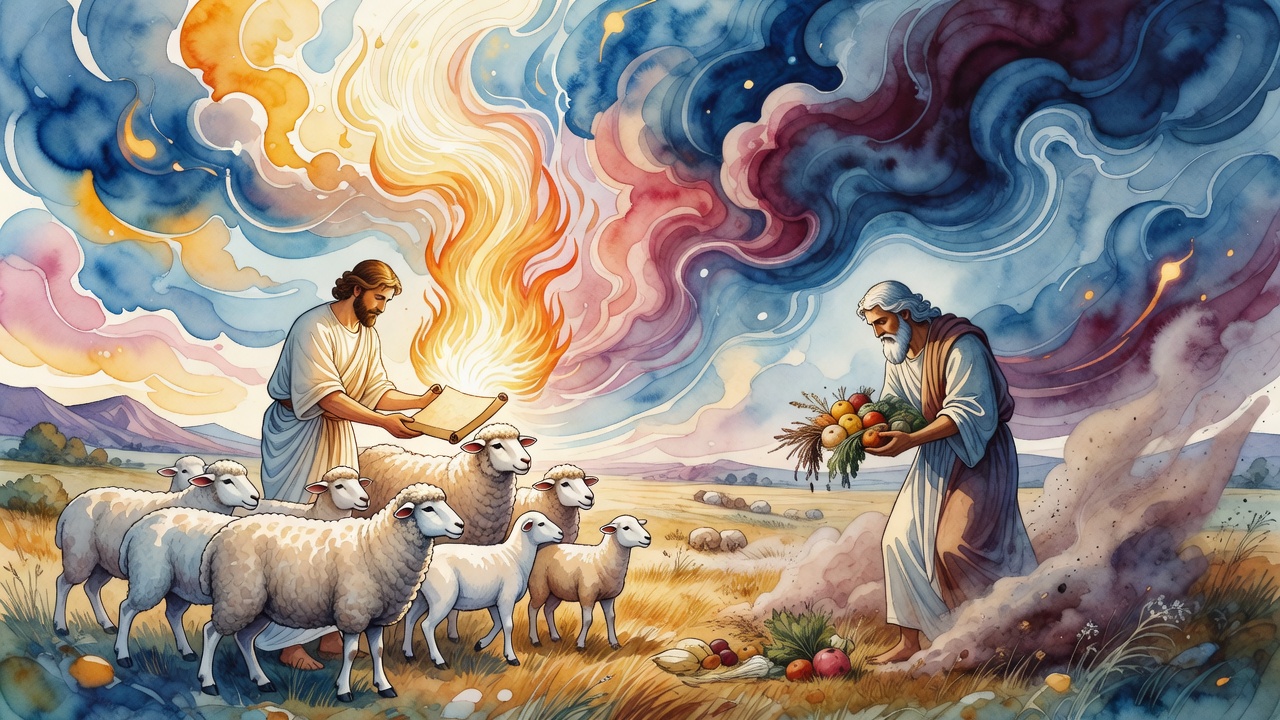
So Cain reached for the largest grievance of all, the one that swallowed the others. He had brought God an offering from the ground he tilled, fruit pulled from soil he had broken with his own hands. Abel had brought the firstborn of his flock and their fat. And God had turned toward Abel's gift and turned away from Cain's (Genesis 4:3-5), and Cain had been chewing on it ever since.

"There is no justice and no Judge," Cain said. "The world was made, yes, made good even. But no one is steering it. Your smoke went up and mine lay flat on the altar because the One above happens to like your face. That is all it was. Favor. Whim. There is no reward waiting for the righteous and no reckoning coming for the wicked, and there is no other world after this one where any account gets settled. There is only this field, and you, and me."

Abel held his ground on the soil he did not own. "There is a judgment," he said. "And there is a Judge. And there is another world. Your offering was refused because your deeds were refused. Mine was accepted because mine were better. Heaven does not play favorites. It weighs." He believed God watched every move a man made and kept the ledger honest. He said so with the whole world tilted against him and an angry brother an arm's length away.

The Stone Goes Into the Forehead

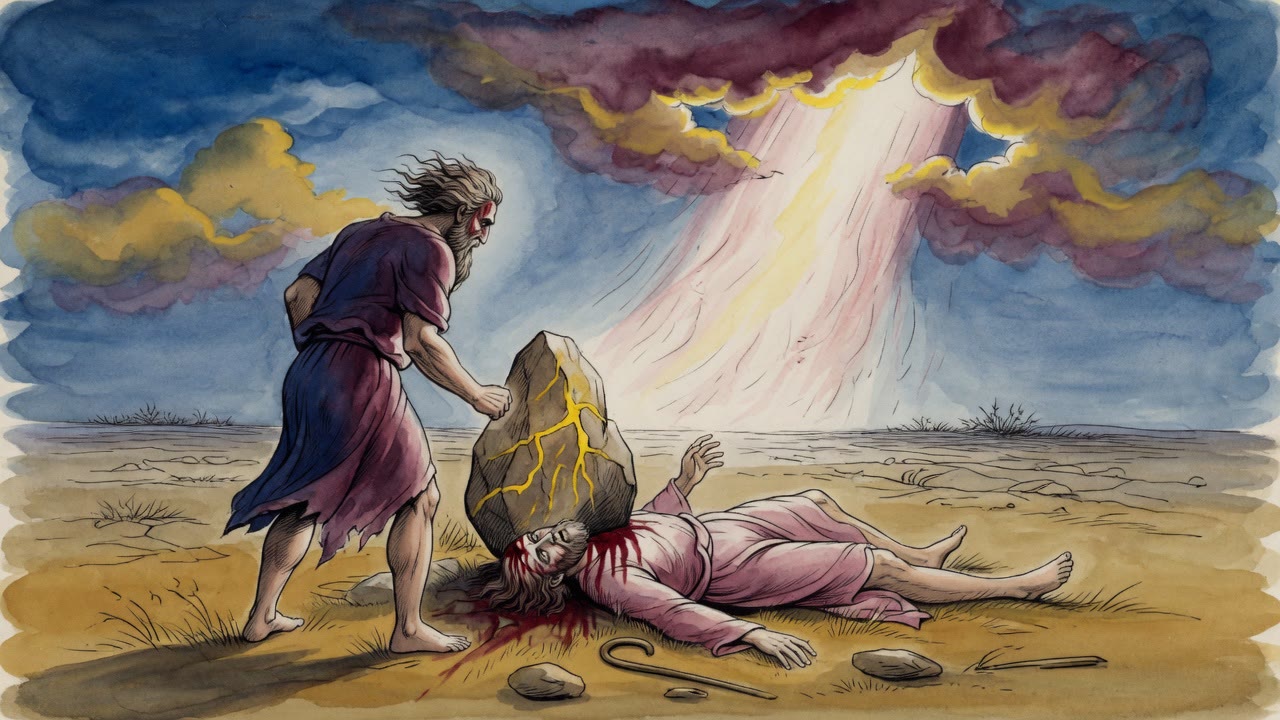
That was the sentence that did it. There is a judgment, and there is a Judge, and there is another world. Cain heard in it everything he could not stand, that the field was being watched, that the favor shown to Abel was deserved, that the older brother could lose and stay lost. His hand found a stone on the ground he owned.

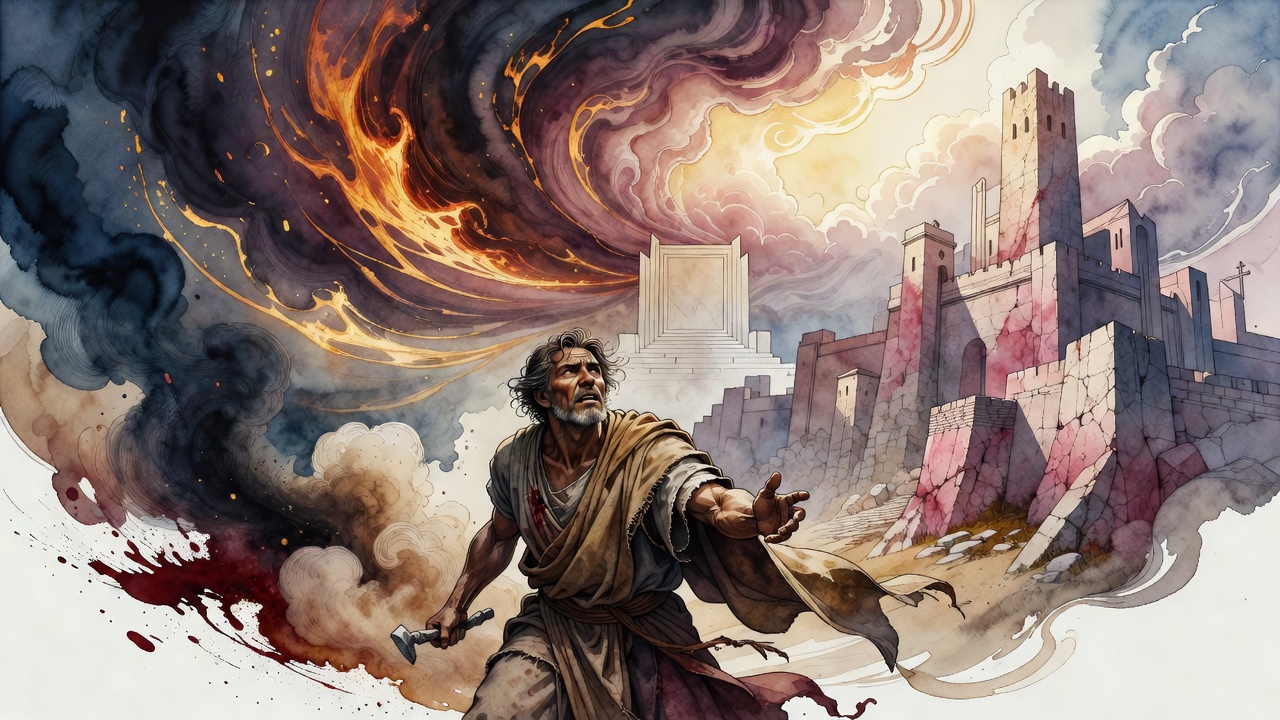
He drove it into Abel's forehead. The grass that had been Abel's pasture took the weight of him as he went down, and the milk-and-firstborn brother who believed the universe kept accounts died in the open with his belief intact and his skull broken. The first man to argue that no one is watching had just killed the first man to insist that Someone is, and he had done it where he assumed no eye could reach.

The Killer Builds the First City

He was wrong about the watching. The voice came for him in the field. Where is your brother. And Cain, who had hidden the body and thought the hiding was enough, gave the answer that has never stopped echoing. I do not know. Am I my brother's keeper (Genesis 4:9). The man who said there was no Judge stood arguing with the Judge over a corpse he had buried.

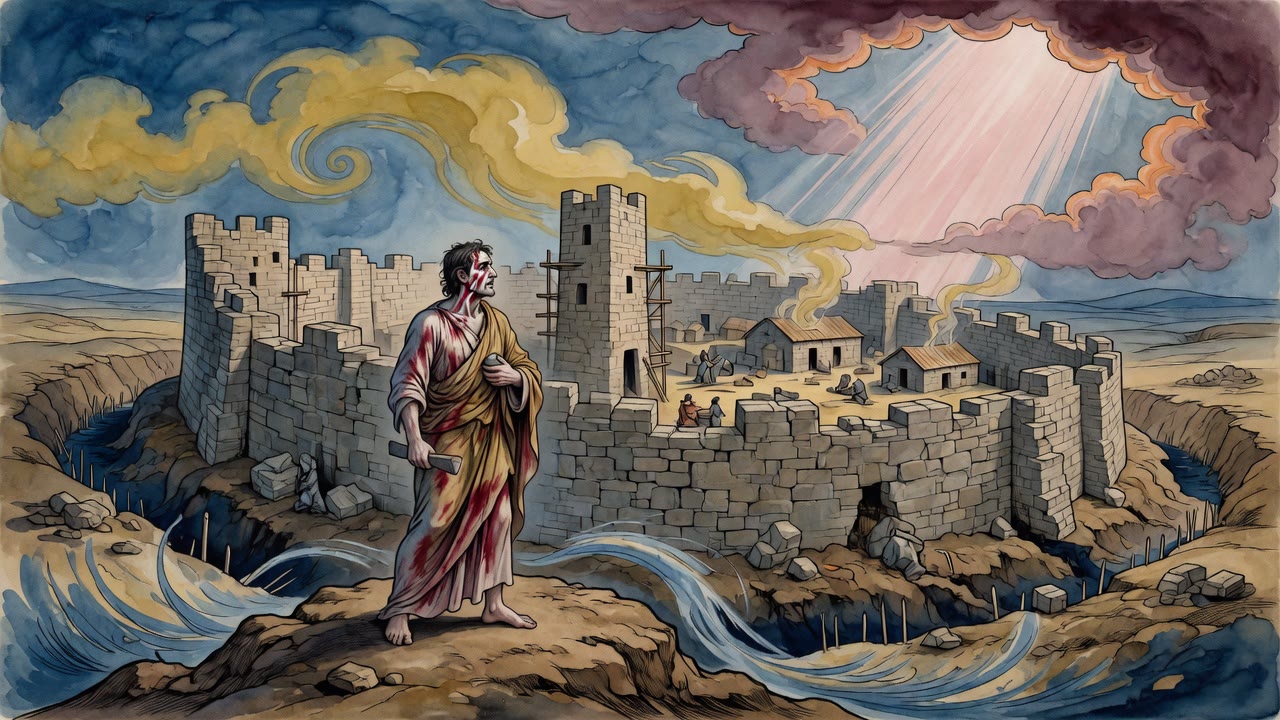
What he did next is the strangest part. He did not wander off and vanish into the wild. He built. He raised the first city, ran the first property lines across open country, set the first weights and measures so that one man's portion could be measured against another's. The brother who killed over a strip of ground and a single woman became the founder of the whole apparatus of owning, fencing, and counting. The first murder and the first civilization came out of the same covetous hand, and the hand never washed clean.


← All myths
From the tradition

Sources

4 sources

The texts this telling draws on, in full. Open a card to read inline, or expand it for a wider, quieter read.

Targum Jonathan on Genesis 4Targum Jonathan

(Genesis 4:8) contains one of the strangest silences in the Torah. It says "Cain spoke to Abel his brother," and then nothing. The sentence just stops. The next thing that happens is the murder. What did Cain say? The Hebrew does not tell us. The Targum Jonathan fills that silence with an extraordinary theological debate.

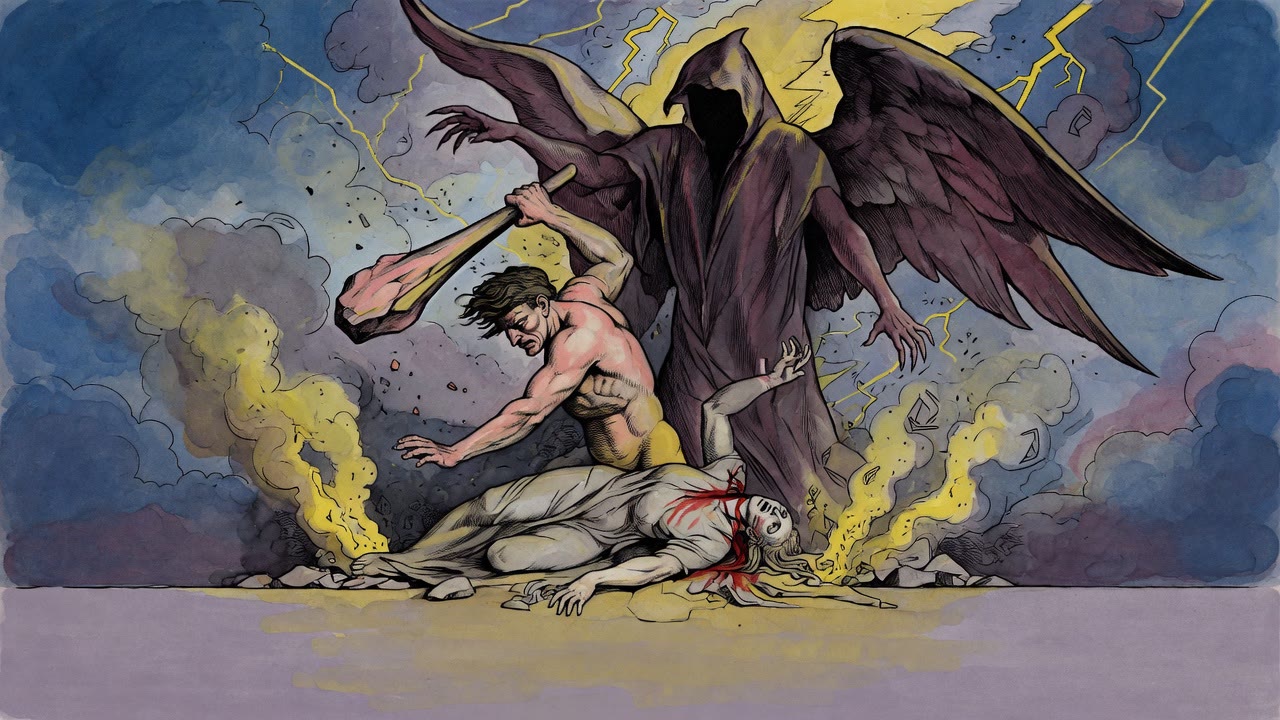
Cain argued that the world was created in goodness but is not governed by justice. God plays favorites. That is why Abel's offering was accepted and his was not. Abel countered that the world is governed according to good works, and there is no favoritism in judgment. His offering was accepted because his deeds were better. Cain then escalated. "There is neither judgment nor Judge, nor another world. No reward for the righteous. No vengeance on the wicked." Abel responded with the opposite creed. "There is a judgment, and there is a Judge, and there is another world." Because of these words, the Targum says, they fought, and Cain "drave a stone into his forehead, and killed him."

The murder weapon is another Targum addition. Genesis does not say how Cain killed Abel. The Targum specifies a stone to the forehead.

The chapter's strangest claim comes at its very beginning. The Targum says Eve "had desired the Angel" and that when Cain was born, she declared "I have acquired a man, the Angel of the Lord." This reflects an ancient tradition, also found in Pirke DeRabbi Eliezer, that Cain's true father was not Adam but Sammael, the angelic figure. Abel, by contrast, was born "from her husband Adam," as his twin. The brothers were half-brothers at best, one human and one partially angelic, which reframes the entire rivalry.

Cain's offering also gets a specific date. It happened "on the fourteenth of Nisan," the date that would later become Passover. And when God marked Cain to protect him, the Targum says He "sealed upon the face of Cain the mark of the Name great and honourable," the divine Name itself engraved on a murderer's face.

Full source
Antiquities I.2Antiquities of the Jews (Josephus)

Cain didn't just kill his brother. According to Josephus, he then built a city, invented weights and measures, drew the first property lines. And turned the entire human world toward violence and greed. The first murderer was also the first civilization-builder. That uncomfortable pairing sits at the heart of this retelling.

Adam and Eve had two sons. Abel, the younger, was a shepherd, righteous, believing God watched his every action. Cain worked the ground and was "wholly intent upon getting." When both brothers brought sacrifices, God preferred Abel's offering of milk and firstborn lambs over Cain's harvest of crops (Genesis 4:3-5). The reason Josephus gives is striking: God honored what grew naturally over what was forced from the earth by a covetous hand.

Cain murdered Abel and hid the body, thinking he could escape discovery. God confronted him. Cain deflected, first claiming ignorance, then snapping back with the famous line: he was not his brother's keeper. But God already knew. Rather than killing Cain, He cursed him, marked him, and cast him out with his wife.

Here's where Josephus's account gets dark. Cain didn't repent. He founded a city called Enoch after his eldest son, fortified it with walls, and compelled his family to live inside. He invented private property and commercial measurements, tools Josephus frames not as progress but as corruption, replacing the simplicity of early human life with "cunning craftiness."

Cain's descendants followed the pattern. Lamech had seventy-seven children. His son Jabal invented tents; Jubal invented the harp and psaltery; Tubal mastered metalwork and warfare. Innovation after innovation, all born from the line of a murderer.

Meanwhile, Adam, grieving, two hundred and thirty years old, fathered Seth. Seth's line was righteous for seven generations. His descendants invented astronomy and, fearing a prophesied destruction by fire and flood, carved their discoveries onto two pillars, one of brick, one of stone. So the knowledge would survive whatever came next.

Full source
Bereshit Rabbah 22:2Bereshit Rabbah

"And the man knew Eve his wife" (Genesis 4:1). Rabbi Huna and Rabbi Yaakov son of Rabbi Avin in the name of Rabbi Abba bar Kahana said: No creature had relations before Adam the first man. It is not written here "And he knew," but rather "And the man knew Eve his wife" he made known the way of the world to all.

Another interpretation: "And the man knew" he knew from what tranquility he had been cast out; he knew what Eve had done to him. Rabbi Acha said: The serpent is your serpent, and you are the serpent of Adam. "And she conceived and bore Cain" (Genesis 4:1). Rabbi Elazar ben Azariah said: Three wonders were done on that very day: on that day they were created, on that day they had relations, on that day they brought forth offspring.

Rabbi Yehoshua ben Korcha said to him: Two went up to the bed and seven came down: Cain and his twin sister, and Abel and his two twin sisters. "And she said: I have acquired a man with the LORD" (Genesis 4:1) this woman saw children and said: Behold, the acquisition of my husband is in my hand.

Rabbi Yishmael asked Rabbi Akiva, saying to him: Since you served Nachum of Gam Zo for twenty-two years, who taught that "akh" and "rak" are terms of limitation, and "et" and "gam" are terms of inclusion this word "et" that is written here, what does it signify? He said: Had it said "I have acquired a man, the LORD," the matter would have been difficult; rather it says "with the LORD."

He said to him: "For it is no empty thing for you" (Deuteronomy 32:47), and if it is empty, it is empty from you because you do not know how to expound it. Rather, "with the LORD": in the past Adam was created from the earth, and Eve was created from Adam; from here onward it shall be "in our image, after our likeness" (Genesis 1:26) not man without woman, and not woman without man, and not the two of them without the Divine Presence.

Full source
Bereshit Rabbah 22:7Bereshit Rabbah

Bereshit Rabbah turns to What Cain and Abel Were Really Fighting About.

The Torah is concise, leaving us to confront the underlying tensions. And that's where the beauty of Jewish tradition comes in – the rabbis and sages throughout the ages stepped in to fill in the gaps, offering us different interpretations. Bereshit Rabbah, a classic collection of rabbinic interpretations on the Book of Genesis, dives right into this very question.

One explanation offered is strikingly practical. Cain and Abel decided to divide the world. One would take the land, the other the movable property. But, of course, disputes arose. "The land you're standing on is mine!" one might have argued. "No, what you're wearing is mine!" the other retorted. It escalated quickly, ending with the ultimate act of violence. A fight over possessions, a struggle for dominance – a story as old as time itself.

Then, Rabbi Yehoshua of Sikhnin, quoting Rabbi Levi, offers a different perspective. Both Cain and Abel possessed land and movable property. Their quarrel wasn't about earthly possessions, but something far more sacred: the location of the Temple. "The Temple shall be built in my domain!" each brother declared. Bereshit Rabbah connects their argument to the phrase "when they were in the field," linking the "field" to the future site of the Temple in Jerusalem, as the prophet Micah says, "Zion will be plowed like a field" (Micah 3:12). It transforms the story from a petty squabble into a conflict over spiritual destiny.

And the interpretations don't stop there. Yehuda bar Rabbi suggests they were fighting over who would marry "the first Eve." Wait, what does that mean? Remember, according to earlier traditions (Bereshit Rabbah 17:7, 18:4), Adam had a wife before Eve, named Lilith, and perhaps the tradition of the "first Eve" carried on.

But Rabbi Aivu dismisses this, saying the first Eve had already returned to dust. So, what then were they quarreling about?

Rabbi Huna offers a final, fascinating possibility. He suggests that an extra twin sister was born with Abel. Cain wanted to marry her because he was the firstborn, entitled to certain privileges. Abel, however, argued that he should have her because she was born with him. This interpretation introduces the element of forbidden love, of sibling rivalry intertwined with desire, fueling the deadly conflict. Rabbi Huna explains that Cain said, “I will take her, as I am the firstborn,” and Abel countered, “I will take her, as she was born with me.”

What's so powerful about this passage in Bereshit Rabbah is that it doesn't give us one definitive answer. It presents us with a spectrum of possibilities, each offering a different lens through which to understand the complexities of human nature and the origins of violence. It reminds us that the Torah is not just a text to be read, but a text to be wrestled with, interpreted, and brought to life through our own understanding.

So, the next time you read the story of Cain and Abel, consider these different interpretations. Was it a fight over land? A dispute over the Temple's location? A struggle for love and lineage? Maybe, just maybe, it was a little bit of all of those things. And perhaps, in understanding the potential reasons behind their conflict, we can gain a deeper understanding of the conflicts within ourselves and the world around us.

Full source