Pesach5 min read

The Binding of Isaac the Torah Refused to Tell You

The Torah gives the Akedah nineteen quiet verses. The Rabbis filled the silence with angel tears, Satan in the road, and a son who volunteered to die.

Curated by Arthur · Told by Maggid ·
Table of Contents
  1. Three Days, and a Voice on the Road
  2. The Son Tied the Knots
  3. The Angels Wept Onto His Face
  4. He Died, and Came Back
  5. Sarah Was Never Told

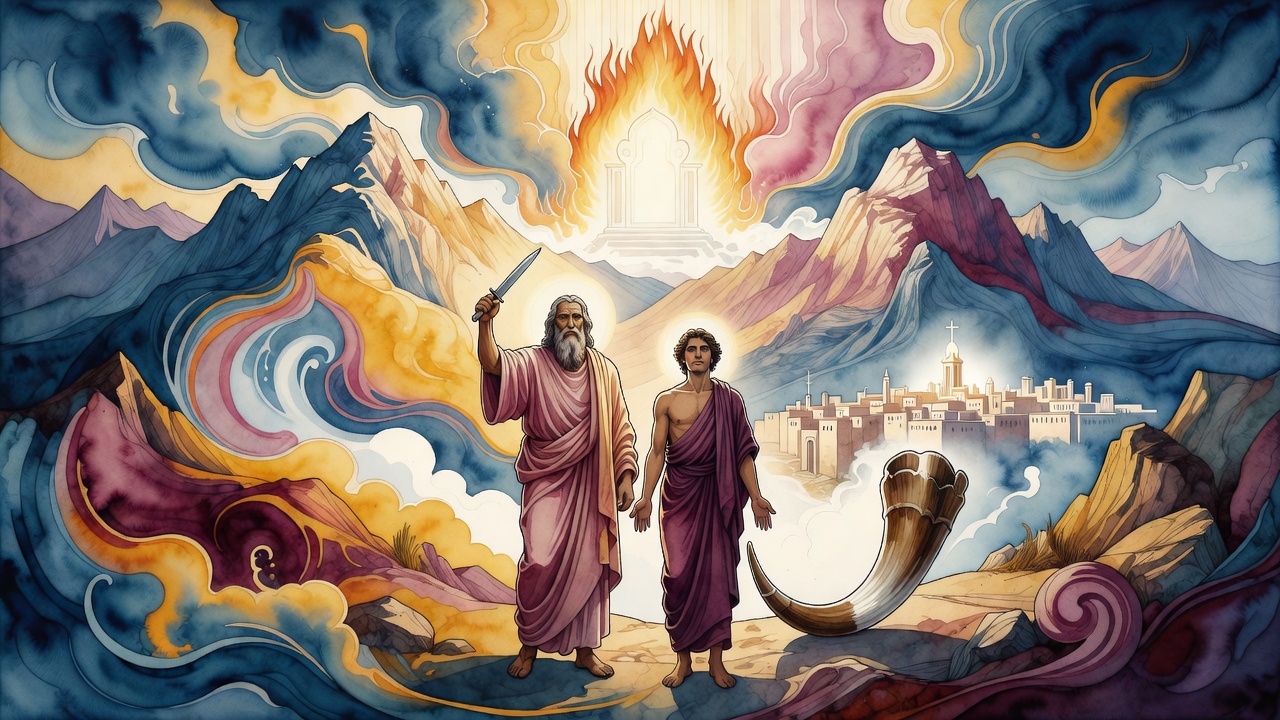
Abraham woke before the birds and split the firewood himself. He could have sent a servant. He saddled the donkey with his own hands, in the dark, so that no one would ask where he was going or why his face had gone gray. He did not wake Sarah. He had been told to take their son up a mountain and give him back, and there was no version of that sentence he could say out loud in his own house.
Behind him slept Isaac, thirty-seven years old and stronger than his father. Not a boy. A grown man who could have pinned the old man's arms in a heartbeat if it came to that. It would come to that, and he would not lift a hand.

Three Days, and a Voice on the Road

The mountain was three days off. God could have set them there in a breath. Instead He made them walk, and the walking is where the testing really happened, because three days is long enough to talk yourself out of anything.

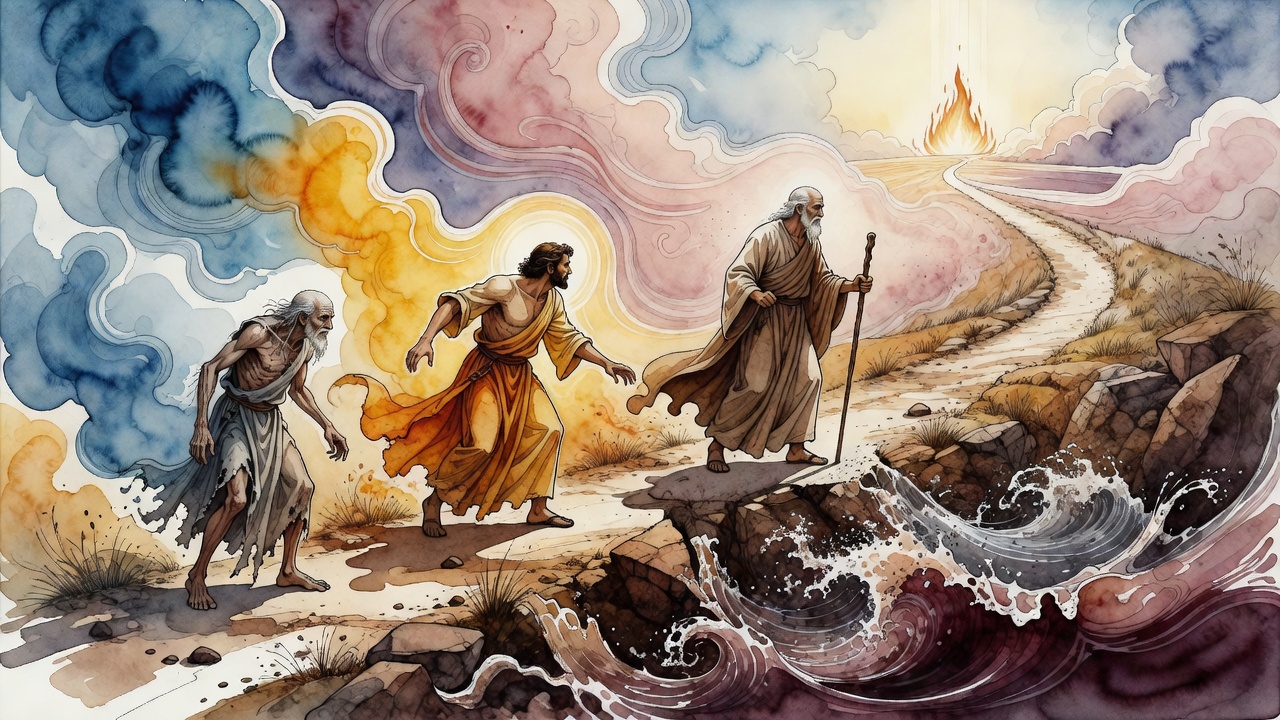
A traveler fell in beside them on the first day, an old man, kind-eyed, reasonable. What kind of God, he asked, tells a father to butcher the son he waited a hundred years for? You are old. You misheard. Go home. Abraham kept walking. The traveler dropped back and reappeared beside Isaac, younger now, a companion his own age, murmuring that the old man had finally lost his mind and meant to kill him on that hill. Isaac kept walking. So the stranger went on ahead and became a river where there had been dry road, black water rising to Abraham's knees, his waist, his throat, until the old man lifted his face clear of it and cried out, and the river drained back into dust. The Accuser had thrown everything he had. They climbed.

The Son Tied the Knots

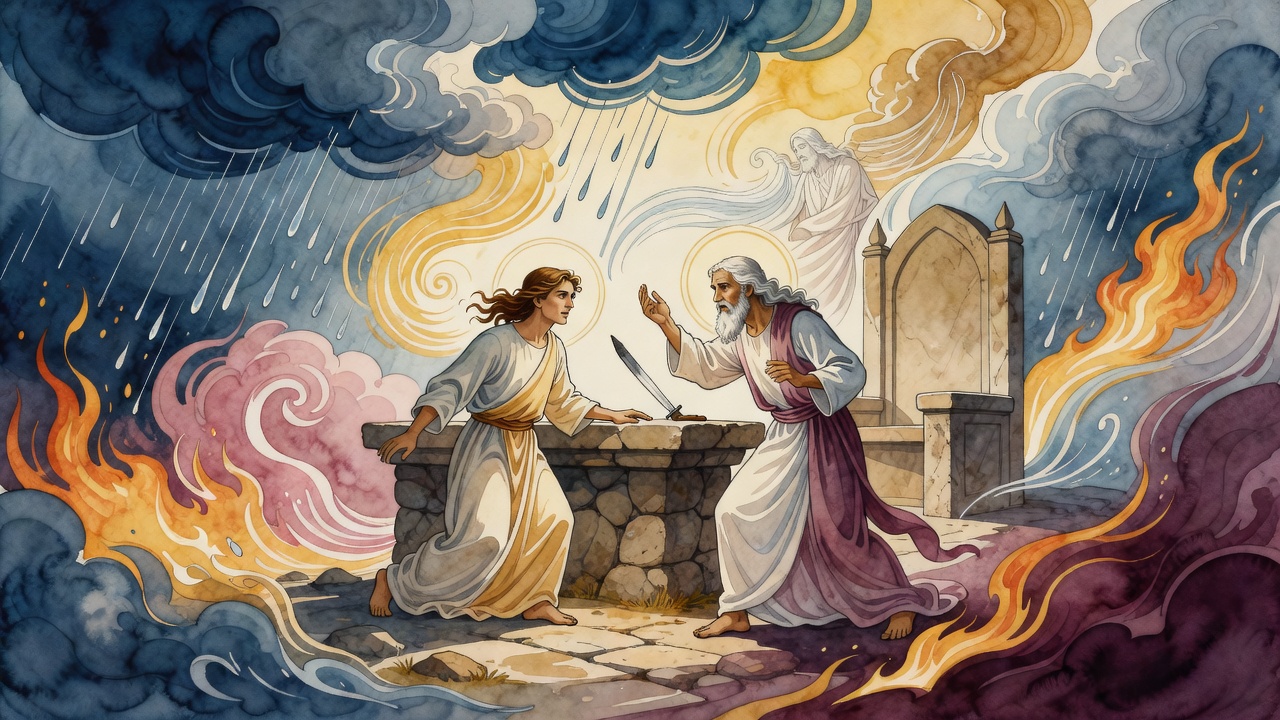
At the top Isaac looked at the wood, the fire, the knife, and the empty place where the lamb should have been, and he understood. He did not run. He asked his father to bind him tight, hand and foot, because he was afraid that when the blade came down his body would flinch on its own and spoil the offering, and he wanted it clean. He helped stack the stones. He lay down on them. A father and a son built that altar together, and only one of them held the knife, and both of them had agreed.

The Angels Wept Onto His Face

Above them the angels broke ranks. They had never seen anything like it and could not bear to watch it finish. They wept, and their tears fell out of heaven, and where the tears struck Isaac's open eyes they burned. He lay bound and staring straight up while the grief of heaven dripped into his face and scarred it. Years later, when he was old and blind and could be fooled in the dark by a son in borrowed clothes, this was the reason. He had once looked up into a sky that was crying over him.

He Died, and Came Back

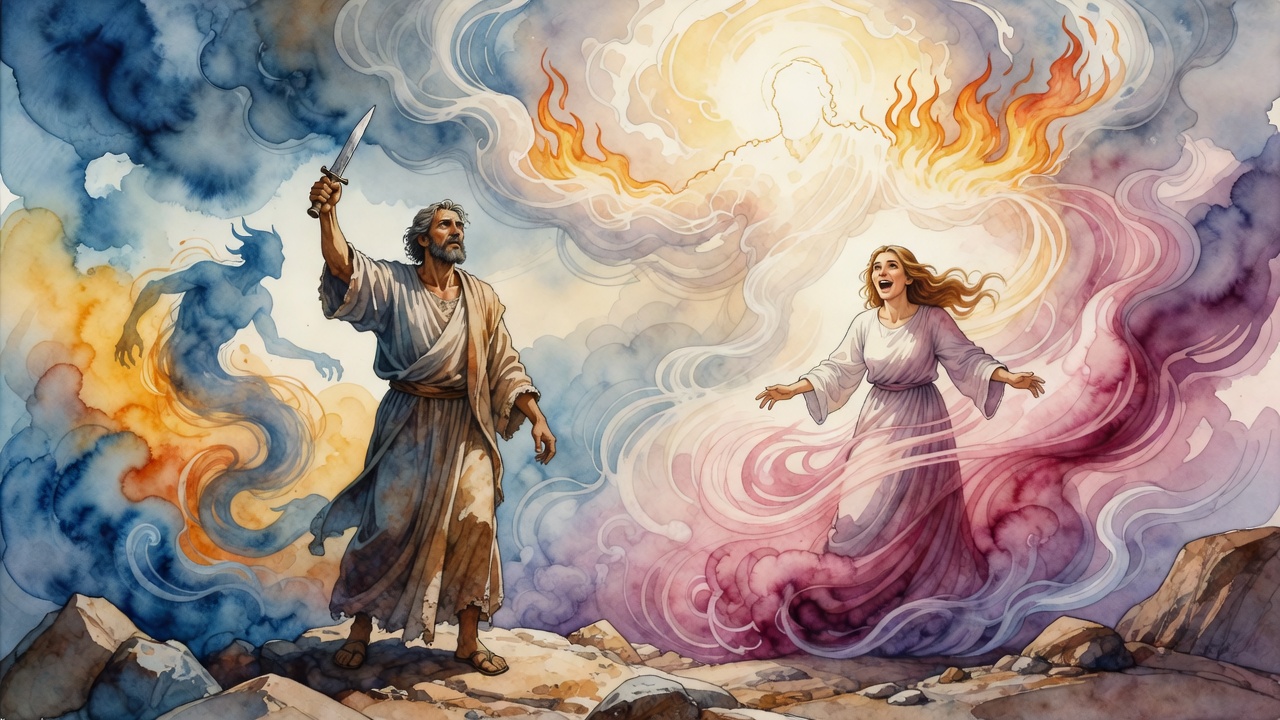
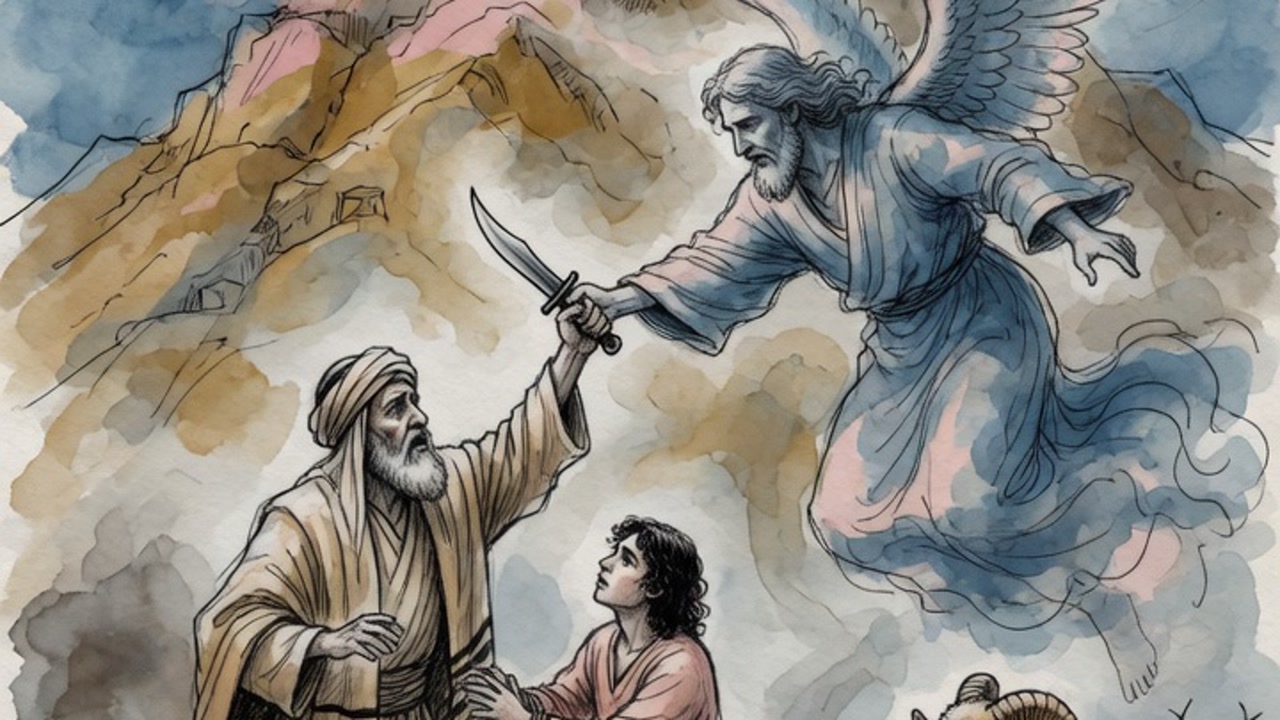
Then, in the oldest and strangest telling, the knife came down. Isaac died on the altar his own hands had built. His soul left him and rose to the academy of heaven and sat among the righteous, and God, who had seen enough, brought him back with the dew that will one day wake all the dead. When the angel finally cried out and the old man turned and saw the ram caught in the thicket, the boy on the stone was already breathing again, returned from a place no living man had been. The ram had been waiting in that bush since the sixth evening of creation, made at dusk for exactly this, and its horn is the one that will sound when the world ends.

Sarah Was Never Told

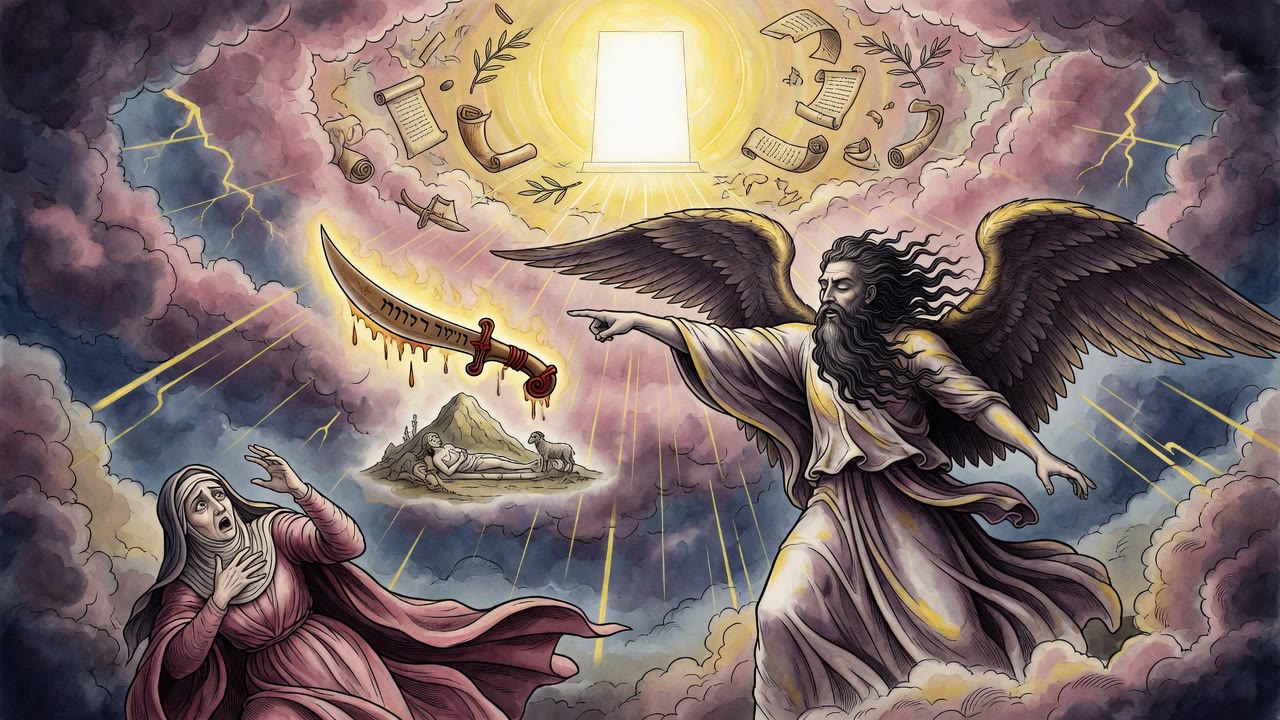
They came down the mountain alive, and the Accuser, beaten on the road, went to find the one person no one had thought to protect. He came to Sarah in her tent and told her the truth bent just enough to kill: your husband took your son up a mountain and put a knife to his throat. He let her picture it. He said nothing about the ram, or the voice, or the boy walking home that very hour. Her heart stopped. When Abraham reached the tent with Isaac alive at his side, he found her already gone, and the next thing the Torah records is the price he paid for a cave to bury her in. The binding had two altars. Only one of them is in the story.


← All myths

From the tradition

Sources

9 sources

The texts this telling draws on, in full. Open a card to read inline, or expand it for a wider, quieter read.

Targum Jonathan on Genesis 22Targum Jonathan

The Binding of Isaac is terrifying in the Torah. In the Targum, it is something else entirely. Isaac was not a passive child led to slaughter. He was thirty-six years old, and he volunteered.

It started with a fight. Ishmael boasted that his circumcision at thirteen proved his devotion, since he could have refused. Isaac answered: "If the Holy One, blessed be He, were to require all my members, I would not delay." God heard this declaration, and that is what triggered the trial. The Binding was not arbitrary. It was a response to Isaac's own words.

On the third day of travel, Abraham saw the cloud of glory hovering over Mount Moriah, a visible sign invisible to the servants, who were told to wait behind. The altar Abraham built was not new. The Targum says it was the same altar Adam had originally constructed, destroyed in the Flood, rebuilt by Noah, and destroyed again in the generation of the Tower of Babel. Abraham was the fourth builder of the same sacred altar.

At the moment of sacrifice, Isaac asked his father to bind him tightly so he would not flinch and render the offering unfit. Then the Targum describes a split screen: Abraham's eyes looked at Isaac. Isaac's eyes looked at the angels in heaven. Abraham could not see them. The angels wept, crying out, "Come, behold how these solitary ones kill the one the other!" The ram that appeared was no ordinary animal, it had been created during the twilight of the sixth day of Creation, prepared since the foundation of the world.

After the binding, the angels carried Isaac to the school of Shem, where he studied for three years. And Sarah? Satan told her Abraham had killed their son. She cried out, choked, and died from the shock. The Binding of Isaac cost Sarah her life.

Full source
Legends of the Jews 5:233Legends of the Jews

Legends of the Jews turns to Isaac Willingly Helped Build the Altar for His Own Sacrifice.

The biblical text gives us glimpses, but the aggadah, the rabbinic tradition of storytelling, fills in the gaps, painting a vivid picture of the scene. Imagine Abraham's joy, as Ginzberg tells us in Legends of the Jews, upon hearing Isaac's faithful words. They arrive at the designated place, and together, father and son build the altar. Isaac, the younger man, even helps by handing Abraham the stones and mortar. There's a terrible, unsettling intimacy to this act.

Then comes the unimaginable. Abraham arranges the wood, the fuel for the sacrifice, upon the altar. He binds Isaac, placing him on top of the wood, ready to be slain as a burnt offering to God. It’s a moment of profound tension, a test of faith unlike any other.

Here, in these legendary accounts, Isaac speaks. His words are not of fear, but of a heartbreaking understanding and acceptance. "Father, make haste," he says. "Bare thine arm, and bind my hands and feet securely." He understands the potential for his own human weakness. He knows that at the sight of the knife, his instinct for survival might kick in.

"I am a young man, but thirty-seven years of age," Isaac continues, according to this tradition (quite different from the innocent child we often picture). "Thou art an old man. When I behold the slaughtering knife in thy hand, I may perchance begin to tremble at the sight and push against thee, for the desire unto life is bold." He fears injuring himself, invalidating the sacrifice, and causing his father pain.

What a burden for a son to carry! What profound selflessness!

He then asks his father to turn up his garment, gird his loins, and burn him completely. And then, the most poignant request of all: "Gather the ashes, and bring them to Sarah, my mother, and place them in a casket in her chamber. At all hours, whenever she enters her chamber, she will remember her son Isaac and weep for him."

Imagine Sarah's grief, a grief compounded by the fact that she was not even consulted in this momentous decision. Isaac, even in his final moments, is thinking of his mother, trying to soften the blow of his loss. He is thinking of how she will grieve and how she will remember him. He seeks to provide her with a tangible reminder, a focal point for her sorrow.

The Akedah is more than just a test of faith. It's a story of obedience, yes, but also of profound human emotion, of a father's agonizing decision and a son's ultimate sacrifice. It's a story that continues to resonate with us, challenging us to consider the complexities of faith, love, and loss. What would we do in such a situation? Could we show such unwavering commitment? Could we exhibit such heartbreaking grace? These are questions that linger long after the story ends.

Full source
Legends of the Jews 5:228Legends of the Jews

It’s a theme that runs deep through the story of Abraham and Isaac on their journey to Mount Moriah.

As Abraham and Isaac made their way, the Satan – the accuser, the adversary – appeared to Abraham, disguised as a very old, humble man. Imagine the scene: A stooped figure, radiating sadness, approaching Abraham. "Are you mad?" he asks, according to Legends of the Jews. "To sacrifice your only son? God gave him to you in your old age! How can you slaughter someone innocent? Surely, this isn't from God! God wouldn't command such evil!"

Abraham, wise and discerning, immediately recognized the voice of the Satan trying to lead him astray. He rebuked him, sending him away.

The Satan wasn't finished. He then approached Isaac, this time appearing as a handsome, persuasive young man. "Don't you know your foolish old father is leading you to your death for no reason?" he pleads. "Don't listen to him! Don't let your precious life be lost!"

Isaac, understandably shaken, relayed these words to Abraham. But Abraham, unwavering, warned his son: "Pay him no mind. He is the Satan, trying to turn us from God's command." Again, Abraham rebuked the adversary.

Frustrated, the Satan resorted to a more dramatic tactic. As Abraham, Isaac, and their two young companions continued their journey, they encountered a sudden, raging brook blocking their path. A massive torrent of water where none had been before!

They waded into the water, trying to cross, but the deeper they went, the higher the water rose, until it reached their necks. They were terrified. This reminds us of other stories of trials in sacred Jewish texts, such as the trials faced when crossing the Red Sea.

But Abraham, remembering the landscape, knew something was amiss. "This place," he declared, "had no brook before! It is surely the Satan, trying to divert us from God's command!"

Once more, Abraham rebuked the Satan. "The Lord rebuke you, O Satan! Begone! We go by the command of God!"

And with Abraham's powerful words, the Satan was terrified and vanished. The waters receded, and the ground became dry once more. Abraham, resolute, continued onward with Isaac toward the place God had shown him.

What does this little episode teach us? It’s more than just a fantastical story. It highlights the constant presence of doubt and opposition when we strive to follow a path of faith, or any path we believe is truly right. The Satan doesn't always appear as a monstrous figure; sometimes, it's a whisper of "reason," a tempting shortcut, or an overwhelming obstacle. The story reminds us that true faith requires recognizing these distractions and choosing to stay the course, even when the waters rise.

Full source
Pirkei DeRabbi Eliezer 31:11Pirkei DeRabbi Eliezer

Pirkei DeRabbi Eliezer, a fascinating collection of stories and interpretations, gives us a glimpse. Rabbi Judah paints a stark picture: "When the blade touched his neck, the soul of Isaac fled and departed." The sheer terror, the feeling of life slipping away. And then, the voice. The voice from between the two Cherubim – those powerful angelic beings – booming out, "Lay not thine hand upon the lad!" (Genesis 22:12).

What a moment! According to Rabbi Judah, Isaac's soul returned. He was freed, stood on his feet, and understood something profound: "in this manner the dead in the future will be quickened." And he blessed God, saying, "Blessed art thou, O Lord, who quickeneth the dead." It's a powerful connection: the near-death experience, the divine intervention, and the hope for resurrection.

The story doesn't end there. Rabbi Zechariah adds another layer, introducing a ram created specifically for this moment, a ram prepared "at the twilight." – divinely preordained. But of course, the forces of opposition are never far away.

Enter Sammael, often identified with the adversary, the one who seeks to thwart God's plans. Sammael, Rabbi Zechariah tells us, was "standing by, and distracting it, in order to annul the offering of our father Abraham." He's trying to ruin everything, to prevent the sacrifice and, perhaps, to derail the entire future of the Jewish people.

The ram, in its divinely-ordained panic, gets caught: "And it was caught by its two horns in the trees, as it is said, 'And Abraham lifted up his eyes, and looked, and behold, behind him a ram caught in the thicket by its horns' (Genesis 22:13)." But even then, the ram plays an active role. It "put forth its leg and took hold of the coat of our father Abraham." It's almost as if it's saying, "Here I am! Don't forget about me!"

Abraham sees the ram, frees it, and offers it up "instead of Isaac his son, as it is said, 'And Abraham went and took the ram, and offered it up for a burnt offering in the stead of his son' (Genesis 22:13)." A substitution. A life spared. A promise fulfilled.

What does it all mean? Maybe it's about the constant struggle between good and evil, even in the most sacred moments. Maybe it's about the power of divine intervention, the assurance that even when we face seemingly insurmountable challenges, a way will be provided. Or maybe, just maybe, it's about the enduring hope for redemption, for life after death, for the ultimate triumph of the divine. It is, after all, a story we continue to confront, to learn from, and to find meaning in, generation after generation.

Full source
Legends of the Jews 5:239Legends of the Jews

Legends of the Jews turns to The Ram at the Binding Was Created at the Dawn of Time.

The answers, according to Jewish tradition, are, well, The story of the akeidah, the Binding of Isaac, is so central to our understanding of faith and sacrifice. But the ram? It wasn't just some random animal that wandered into the scene at the perfect time. Oh no. According to some sources, its creation was just as extraordinary as the role it played.

What about after the sacrifice? Did it just disappear? Absolutely not! The Rabbis taught that every single part of that ram was used for something sacred. Nothing went to waste.

In Legends of the Jews, Ginzberg recounts how the ashes from the parts of the ram that were burned on the altar became the foundation for the inner altar in the Temple. This was the very altar where the kippur sacrifice, the expiatory sacrifice, was brought each year on Yom Kippur, the Day of Atonement. The very ground upon which atonement was made was, in a way, built upon the sacrifice of that ram. It's a powerful connection.

But the story doesn't end there.

David, King David, the sweet singer of Israel? He used the ram's sinews to make ten strings for his harp, the instrument he used to compose and play the Psalms. Imagine the power and holiness imbued in those strings!

Even Elijah the Prophet got in on it! His girdle, the belt he famously wore, was said to have been made from the ram's skin.

But perhaps the most amazing part of the story involves the ram's two horns. One of them, the tradition tells us, was blown at the end of the revelation on Mount Sinai. Can you picture that scene? The earth shaking, the thunder roaring, and then... the blast of a horn, marking the moment God gave the Torah to the Jewish people. The Zohar, a central text of Jewish mysticism, hints at secrets within every detail.

And the other horn? The Rabbis taught that it will be blown to announce the end of the Exile, the ingathering of the exiles, heralding the Messianic Age. As we find in Midrash Rabbah, it’s tied to the prophecy in Isaiah (27:13): "And it shall come to pass in that day, that the great horn shall be blown, and they shall come which were ready to perish in the land of Assyria, and they that were outcasts in the land of Egypt, and shall worship the Lord in the holy mountain at Jerusalem."

So, the next time you hear the story of the Binding of Isaac, remember the ram. It wasn't just a last-minute substitute. It was an integral part of the divine plan, its very essence woven into the fabric of Jewish history and destiny. From atonement to prophecy, that ram's legacy continues to resonate through the ages. What does it mean that even in a moment of near-tragedy, nothing is wasted, and everything can be transformed for good? Something to think about.

Full source
Legends of the Jews 5:229Legends of the Jews

Legends of the Jews turns to Satan Told Sarah That Abraham Had Slaughtered Isaac.

Consider the story of Abraham and Isaac – the binding of Isaac, or the Akeidah as it's known in Hebrew. It's one of the most powerful and unsettling stories in the Torah. God asks Abraham to sacrifice his beloved son, Isaac. But what about Sarah, Isaac's mother? How did she factor into this monumental test of faith?

In Ginzberg's retelling in, Legends of the Jews, Satan doesn't just sit idly by while Abraham prepares to follow God's command. Oh no. He gets involved. He appears to Sarah disguised as an old man. A seemingly harmless, perhaps even helpful, figure.

"Where did your husband go?" he asks innocently enough. Sarah, unsuspecting, replies that he's gone to work. "And Isaac?" Satan presses. Sarah tells him Isaac has gone with his father to a place of Torah study – a Beit Midrash (rabbinic interpretive commentary).

Then comes the twist of the knife. Satan, dripping with false sympathy, says: "O thou poor old woman, thy teeth will be set on edge on account of thy son, as thou knowest not that Abraham took his son with him on the road to sacrifice him."

Can you imagine the devastation? The sheer horror of those words sinking in? The rug being pulled out from under you in such a cruel and calculated way?

In that very hour, Sarah's loins trembled, and all her limbs shook. “She was no more of this world,” it says. A stark, almost poetic way of describing the profound shock and emotional trauma she experienced.

But here's the incredible part: even in the face of such devastating news, Sarah finds a wellspring of faith within herself. She pulls herself together and declares: "All that God hath told Abraham, may he do it unto life and unto peace." What an amazing declaration of faith, even in the face of what seems like utter catastrophe. Despite the fear, despite the pain, she trusts in God's ultimate plan. She blesses the situation, wishing for life and peace, even though everything within her must have been screaming in protest.

It makes you wonder, doesn't it? How often do we encounter our own "Satans" in disguise? Whispering doubts, spreading fear, trying to undermine our faith and trust? And how can we, like Sarah, find the strength to stand firm, to choose faith over fear, and to bless the path that's been laid out for us, even when we don't understand it?

Full source
Bereshit Rabbah 56:6Bereshit Rabbah

The familiar story is this: Abraham, tested by God, is asked to sacrifice his beloved son, Isaac. He obeys, bringing Isaac to Mount Moriah. Just as Abraham raises his knife, an angel intervenes. God provides a ram as a substitute sacrifice. But what about the knife itself?

The verse in (Genesis 22:10) simply states, "Abraham extended his hand and took the knife to slaughter his son." Seems straightforward. But the rabbis, masters of close reading and interpretation, saw more. The Bereshit Rabbah, a classic midrashic (rabbinic interpretive commentary) collection, explores this very phrase.

The passage recounts a discussion between Rav and Rabbi Ḥiyya the Great. Rav asks Rabbi Ḥiyya a fascinating question: How do we know that, according to Rabbi Yehuda HaNasi, ritual slaughter (shechita) must be performed with an object that is movable – something not attached to the ground?

Rabbi Ḥiyya answers that Rabbi Yehuda HaNasi derives it from the verse itself: "Abraham extended his hand." The implication? The object used for slaughtering must be capable of being taken up in the hand. It has to be mobile, separate.

Rav is skeptical. He wonders if Rabbi Yehuda HaNasi offered this as a mere homiletical interpretation, a nice idea but not a binding legal principle. If so, perhaps he later retracted it. But if it was presented as a direct derivation from the text, a real rule, then it's much more solid.

To clarify, the text brings in a teaching from Levi: If a potential slaughtering tool was attached to the ground from the beginning, it's invalid. But if it was detached and then re-attached, it’s valid. Think of it like a butcher's knife that's been temporarily placed in a holder.

This brings us to a discussion in the Mishnah (the earliest code of rabbinic law) Ḥullin, a section of the Talmud dealing with ritual slaughter. It states that slaughter is valid even if performed with a hand sickle, a harvest sickle, flint, or even a reed. Now, a reed might seem problematic since it grows from the ground! According to Rabbi Yehuda HaNasi, the Bereshit Rabbah explains, this must refer to a reed that was detached and then re-attached. This reinforces Levi's statement.

But the story doesn't end there. Rabbi Yosei adds a fascinating detail about reeds. He states that five things are forbidden regarding a stalk of a reed: it can't be used for slaughter, circumcision, slicing meat, wiping hands, or picking teeth. Why? Because, he says, an evil spirit rests upon it. Yikes!

So, what can we take away from this deep dive into a single verse? It shows us how the rabbis meticulously examined every word, searching for deeper meanings and legal implications. It highlights the importance of using movable objects for ritual slaughter. And it gives us a little spooky folklore about the humble reed.

It also illustrates the dynamic nature of rabbinic interpretation. Ideas are presented, questioned, refined, and sometimes even contradicted. There is a constant wrestling with the text, seeking to understand God's will.

Next time you read the story of the Binding of Isaac, remember that seemingly simple knife. It's a reminder that even the smallest details can hold profound significance, inviting us to delve deeper into the tradition of Jewish tradition.

Full source
Targum Jonathan on Genesis 22:19Targum Jonathan

The familiar story is this: Abraham, tested by God, is commanded to sacrifice his beloved son. But what happened to Isaac in those heart-stopping moments?

The familiar Genesis account leaves us with Abraham returning to his servants, but notably silent about Isaac (Genesis 22:19). Where was he? Some later Jewish traditions fill in the gaps in truly remarkable ways.

The knife flashes, poised above Isaac's throat. But instead of death, something extraordinary occurs. The midrash, the interpretive tradition, paints a picture of Isaac's soul taking flight. As Tree of Souls (Schwartz) tells it, his soul didn't simply vanish; it ascended, rising through the very palaces of Heaven.

Can you picture it? Isaac's soul, soaring through the celestial realms. The angels themselves escort him to a special place: the celestial academy of Shem and Eber. This academy, a place of learning, isn't just any school. According to Sefer ha-Yashar, Abraham even told Sarah he was taking Isaac there before they set off for Mount Moriah! And here, Isaac spends three years immersed in the study of Torah. What a reward for his ordeal!

The Zohar tells us that all the Treasuries of Heaven were opened to him: the celestial Temple, which has existed since Creation, the Chambers of the Chariot, and all the palaces of heaven. He was shown the Treasuries of Ice and Snow, as well as the Treasury of Prayers, and the Treasury of Souls. Imagine seeing where you came from, tracing your lineage all the way back to the seed of Adam!

But it doesn’t stop there. Isaac was also granted a vision of the future, all the generations that would spring from Abraham. He even glimpsed the End of Days! No heavenly secret was withheld from Isaac's pure soul. He even found his own face on the Pargod, the curtain of God!

Meanwhile, back on Earth, Abraham stood frozen, knife raised. But to him, it felt like a single breath. Then the angel's voice rang out: "Lay not your hand upon the lad." In that instant, Isaac's soul returned to his body.

And when Isaac felt his soul restored, he exclaimed, "Blessed is He who quickens the dead!" (Pirkei de-Rabbi Eliezer 31). Isaac arose, reborn, seeing the world anew. He understood, as Pirkei de-Rabbi Eliezer points out, that this was how the dead would come back to life in the future.

However, regardless of its origins, this midrash offers a powerful image. This legend emphasizes the rabbinic belief in the pre-existence of the Torah, as this academy existed long before the giving of the Torah at Mount Sinai. As Genesis Rabbah 56 and other texts indicate, the academy of Shem and Eber was a place of immense spiritual significance. It represents a connection to ancient wisdom and prophetic insight.

So, the next time you read the story of the Akedah, remember Isaac's heavenly journey. Think about the wisdom he gained, the mysteries he witnessed. It’s a reminder that even in the face of unimaginable trials, there's the potential for profound spiritual growth and revelation. And perhaps, a glimpse of what awaits us beyond this world.

Full source
Pirkei DeRabbi Eliezer 31:1Pirkei DeRabbi Eliezer

The tenth trial, according to Pirkei DeRabbi Eliezer, is the one that tests Abraham most sharply.

"And it came to pass after these things, that God did prove Abraham" (Genesis 22:1). That's how the story begins. Simple enough. But what follows is anything but. According to Pirkei DeRabbi Eliezer, these trials weren't just random occurrences. God was testing Abraham, trying to know his heart, to see if he could persevere and keep all the commandments. for a second. Keeping all the commandments. but the Torah hadn't even been given yet! How is that possible? The text continues, explaining that Abraham kept all the precepts of the Torah before it was even given! As it is said, "Because that Abraham obeyed my voice, and kept my charge, my commandments, my statutes, and my Torah" (Genesis 26:5). Abraham was already living a life of obedience and devotion. He was ahead of the curve.

What does this have to do with the binding of Isaac, the Akeidah? What does it have to do with the tenth trial? The text sets the stage, reminding us of Abraham's commitment, his unwavering faith.

Then, almost as an aside, we get this little detail: "And Ishmael went repeatedly from the wilderness to see his father Abraham." It's a small line, but it hints at the complex family dynamics at play. It reminds us that Abraham wasn't just a figure in a religious text; he was a father, a husband, a man with relationships and responsibilities. And perhaps, just perhaps, these relationships played a part in the trials he faced. We see a glimpse of the human element amidst the divine testing. The Akeidah story will continue, exploring the depths of Abraham's faith and the unimaginable request God makes of him.

Full source