4 min read

Isaac Asked Abraham to Bind Him Tightly on Moriah

Isaac was no passive child on Moriah. He carried the wood, helped build the altar, and asked Abraham to bind him before fear moved.

Curated by Arthur · Told by Maggid ·
Table of Contents
  1. The Fire and Knife Spoke First
  2. Isaac Carried the Wood
  3. Tie Me Before I Tremble
  4. The Angels Broke Before the Knife

Sarah dressed Isaac for a lesson, not a death.

Abraham told her the boy needed to go study the service of God with Shem and Eber. She believed enough to let him leave and feared enough to cling before she did. She dressed him beautifully. A precious stone shone on his turban. She kissed him, held him, and told Abraham to guard the only son bound to her soul.

Then the road took him.

The Fire and Knife Spoke First

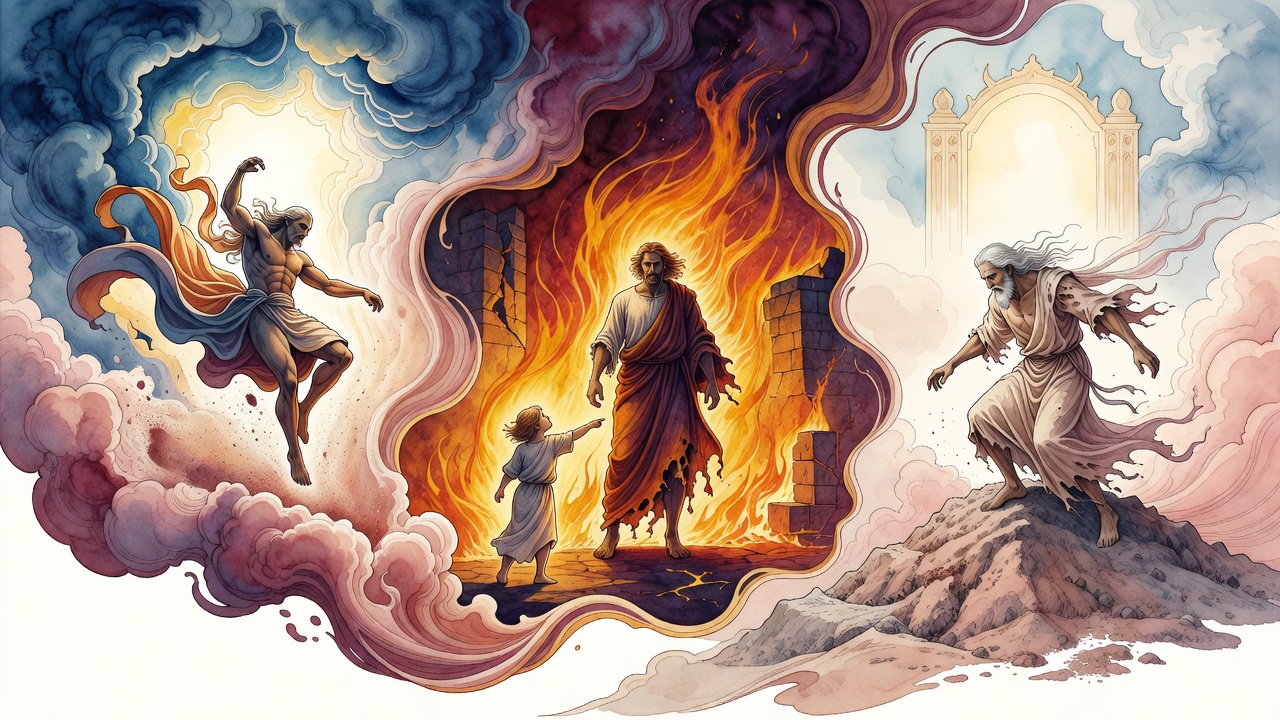
Abraham walked with fire, knife, wood, and silence. Isaac walked beside him. Ishmael and Eliezer came part of the way, already whispering about inheritance, already measuring a death that had not happened. The holy spirit answered their ambition before the mountain did. Neither one would inherit what they imagined.

When the servants stayed behind, father and son went on alone.

Isaac saw the pieces of the offering without the offering itself. Fire. Wood. Knife. No lamb. The question rose because the objects had begun speaking louder than Abraham. Where was the animal for the burnt offering?

Abraham answered at last. God had chosen Isaac.

Isaac Carried the Wood

The son did not run.

He kept walking. The wood lay on his back like the shape of the altar before the altar existed. Every step up Moriah brought the command closer to skin, breath, wrist, throat. Isaac was thirty-seven years old in this telling, old enough to know the body does not surrender easily. The desire for life is bold. It can surge even in a righteous man.

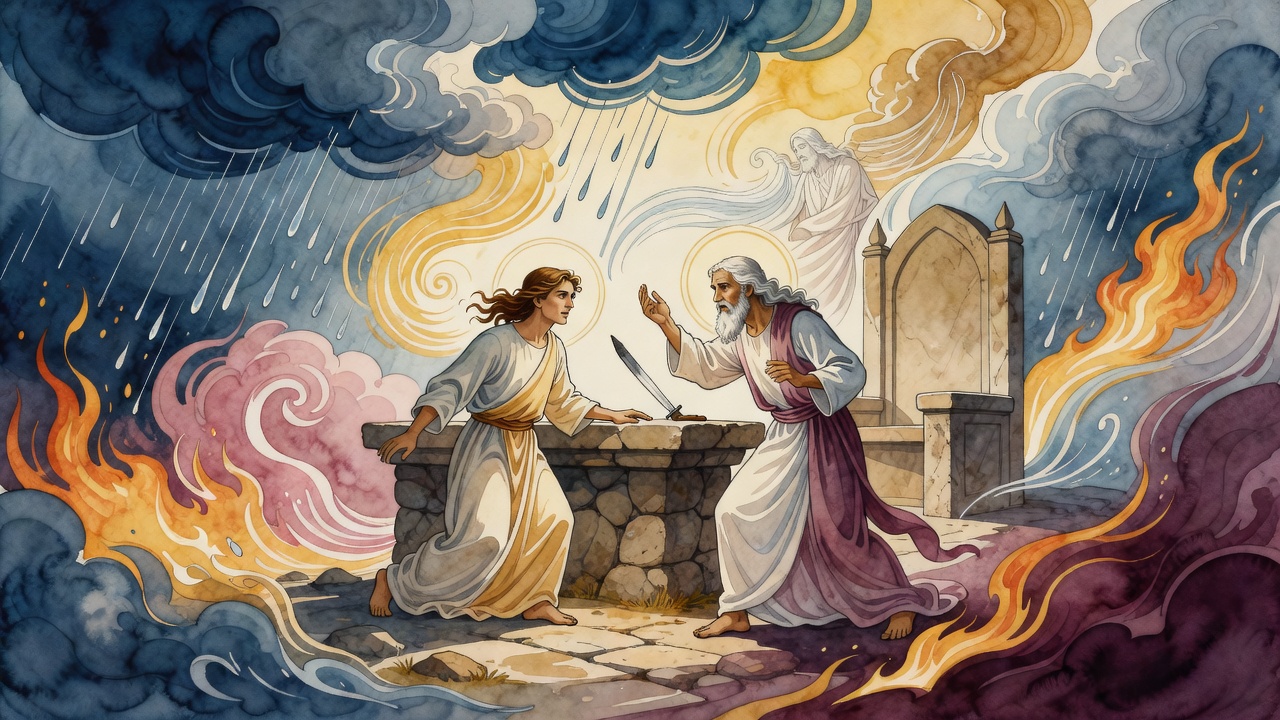
At the place, Abraham began to build. Isaac helped him. Stone passed from son to father. Mortar filled the gaps. The victim prepared the platform that would hold him.

Tie Me Before I Tremble

Then Isaac spoke with terrible tenderness.

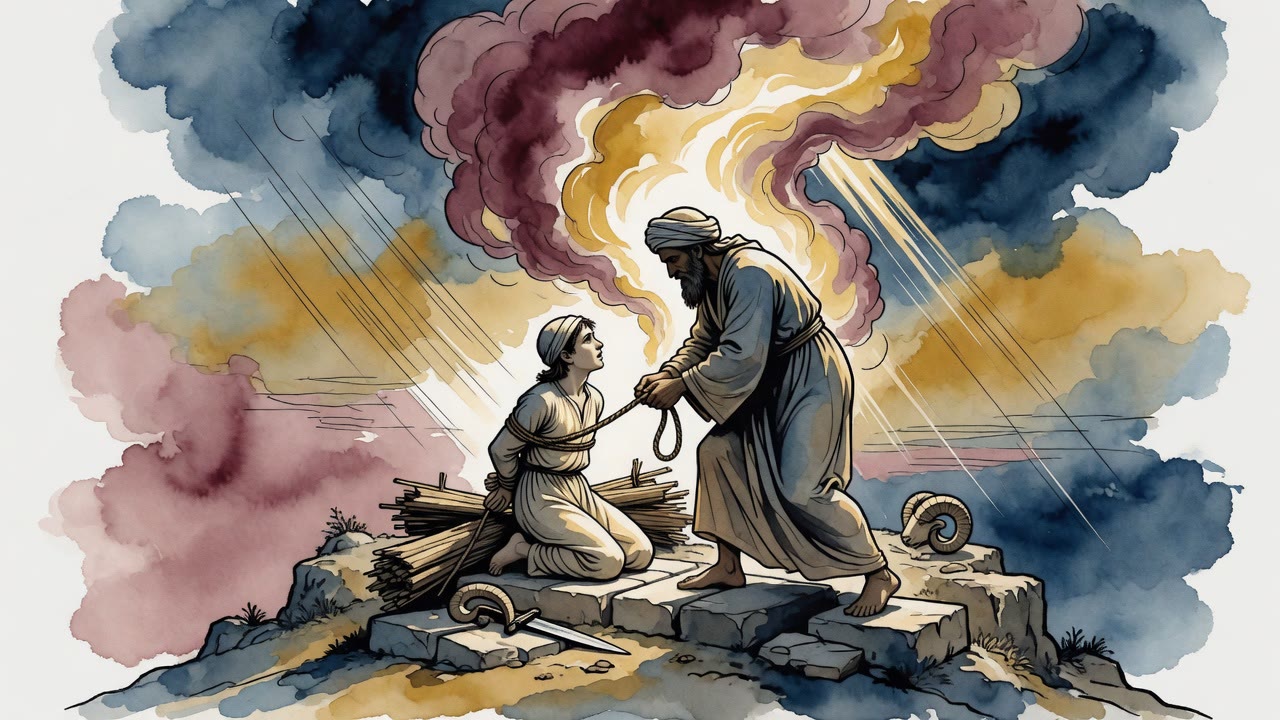
Bind my hands and feet tightly, he told Abraham. Bare your arm. Hurry. If I see the knife and my body jerks, I may wound myself and ruin the offering. I may make you suffer more. I may fail at the very moment I want to obey.

He did not pretend courage had erased fear. He made room for fear and then asked to be bound against it. That is the part of the Akeidah that turns Isaac from an object into a participant. He knew the body. He knew the will. He knew that holiness sometimes needs rope because flesh still wants to live.

That request changes the whole mountain. Isaac is not carried up as a child who cannot understand. He is not merely the beloved object through which Abraham proves obedience. He is a grown son who sees the command, sees the knife, sees his father's age, and decides to help the offering remain whole if heaven truly wants it.

He also thinks of Sarah. He asks what should be done with his ashes, how his mother should receive the memory of him. Even before the knife rises, Isaac's mind has gone back down the mountain to the woman who dressed him for a lesson and let him go.

The Angels Broke Before the Knife

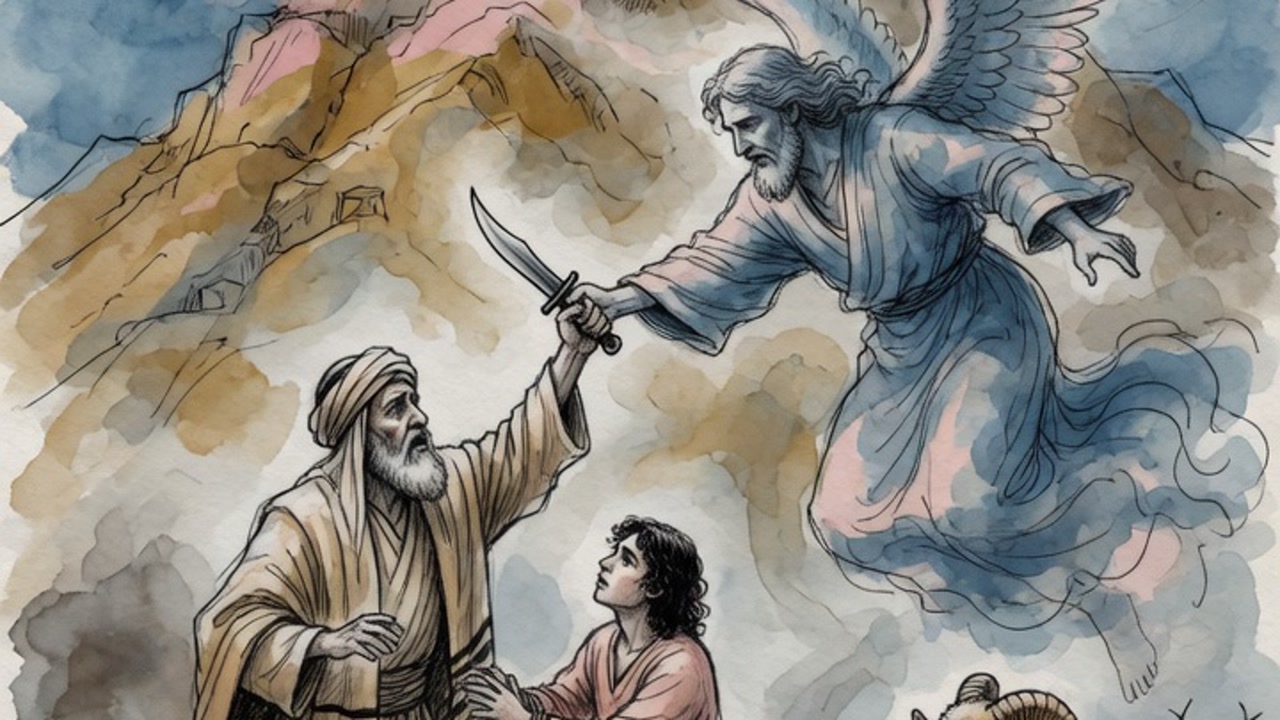
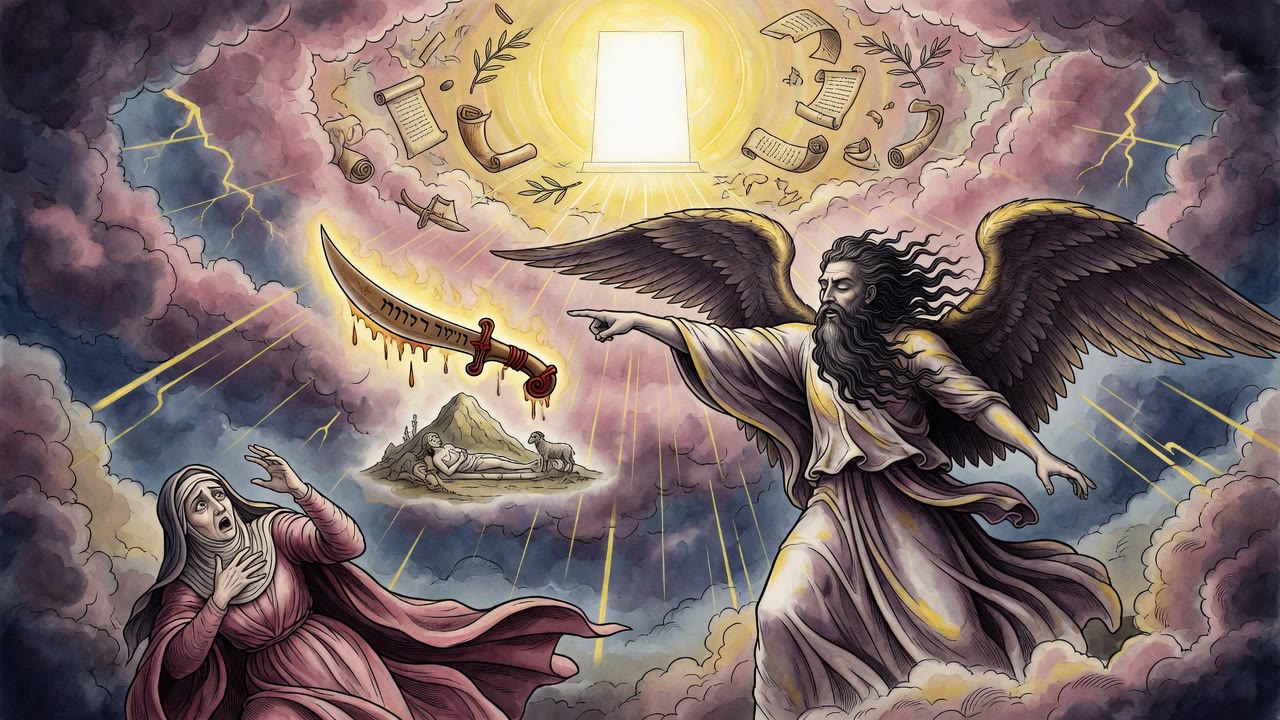
Abraham laid him on the wood. Tears fell from the father's eyes onto the son. Tears fell from the son's eyes onto the altar. Above them, the angels could not bear the sight. They cried out against the breaking of a promise. Had God not said that Isaac would carry the covenant forward?

The knife rose.

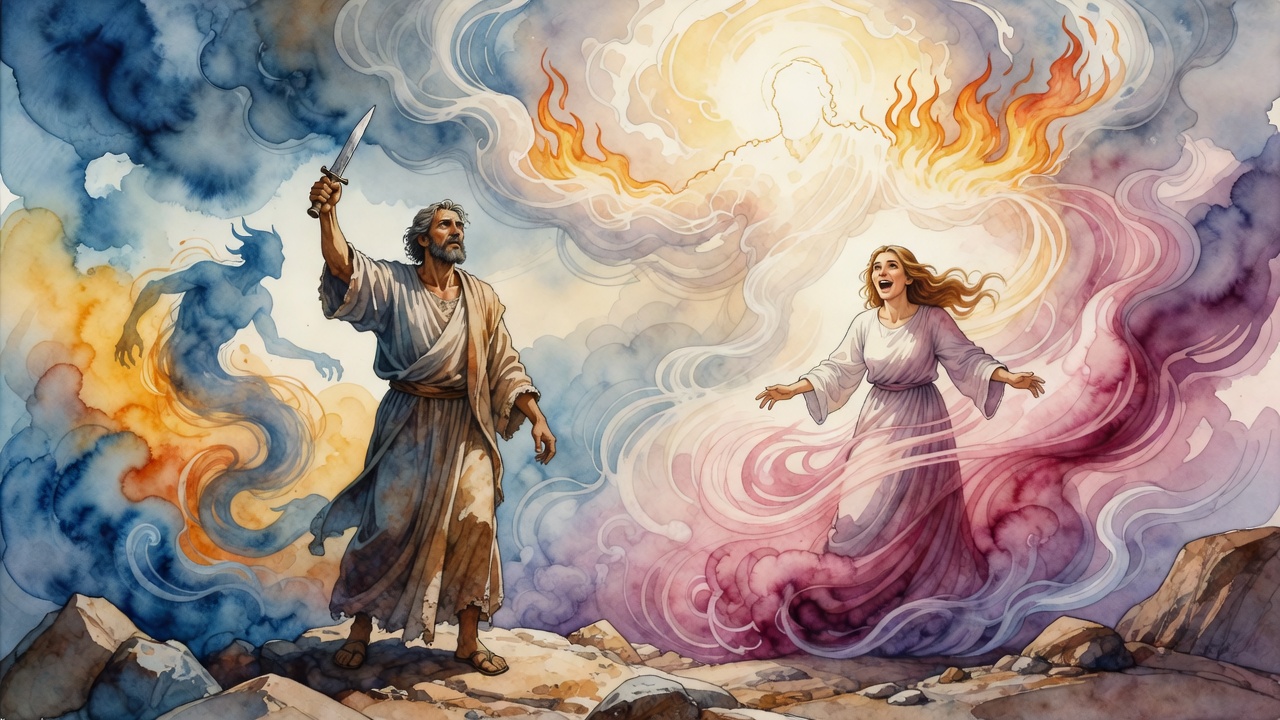
At the last instant, the voice stopped Abraham. The ram waited in the thicket. Isaac lived. But the mountain did not give him back unchanged, and it did not give Sarah back her peace. When the news reached her through the accuser's cruel mouth, relief struck with such force that her soul left her.

Isaac came down alive. Sarah died from the aftershock.

The ram ends the act, but it does not erase what Isaac had already offered. Before the animal appeared, before the voice stopped the knife, Isaac had already placed his fear in Abraham's hands and made his own body part of the command.

The ropes therefore become part of Isaac's speech. They say what his mouth has already said: bind the will before panic can scatter it on the holy mountain itself.


← All myths

From the tradition

Sources

4 sources

The texts this telling draws on, in full. Open a card to read inline, or expand it for a wider, quieter read.

Legends of the Jews, V. Abraham, The Journey To MoriahLegends of the Jews

One of the most powerful, and frankly, unsettling, of these stories is the Akeidah, the Binding of Isaac.

It all starts with a test. God, in perhaps the ultimate trial of faith, asks Abraham to sacrifice his beloved son, Isaac. As we read in Legends of the Jews, drawn from various midrashic (rabbinic interpretive commentary) sources by Ginzberg, the conversation is almost painfully human. "Take now thy son," God commands. Abraham, ever the arguer, replies, "I have two sons...". The exchange goes on, a heartbreaking dance of clarification, until God finally says, "Even Isaac."

Can you imagine the weight of those words? "Even Isaac." The son he waited so long for. The son through whom God promised to build a nation.

Abraham wrestles with this command internally. How can he separate Isaac from his mother, Sarah? He decides on a ruse. He tells Sarah that Isaac needs to study the service of God with Shem and Eber. Sarah, though hesitant, agrees, saying, "My soul is bound within his soul."

The scene that follows is filled with heart-wrenching details. Sarah dresses Isaac in a beautiful garment, a precious stone adorning his turban. She showers him with kisses and embraces, pleading with Abraham to protect him. “O my lord, I pray thee, take heed of thy son… for I have no other son nor daughter but him.” It’s a mother’s love, raw and palpable. As they depart, Sarah, Abraham, and Isaac all weep, a great weeping that extends even to their servants.

But the journey to Moriah is fraught with more than just emotional turmoil. According to Ginzberg, Ishmael and Eliezer, who accompany them initially, begin to argue about who will inherit Abraham’s possessions after Isaac’s sacrifice. The Ruach (spirit) Hakodesh, the holy spirit, interjects, declaring that neither will inherit.

Then comes Satan, ever the tempter. He appears first as an old man, questioning Abraham’s sanity: "Art thou silly or foolish, that thou goest to do this thing to thine only son?" When that fails, he approaches Isaac as a handsome youth, warning him that his father is leading him to slaughter. Abraham, recognizing Satan’s deceit, rebukes him each time.

But Satan is persistent. He transforms himself into a raging brook, a seemingly insurmountable obstacle. As Abraham, Isaac, and the young men try to cross, the waters rise, threatening to drown them. Abraham, recognizing the supernatural nature of the obstacle, again rebukes Satan, invoking God’s name. The brook vanishes.

Meanwhile, back at home, Satan appears to Sarah disguised as an old man. He reveals the truth: Abraham is taking Isaac to be sacrificed. Sarah is devastated, her limbs trembling. Yet, in a moment of profound faith, she responds, "All that God hath told Abraham, may he do it unto life and unto peace."

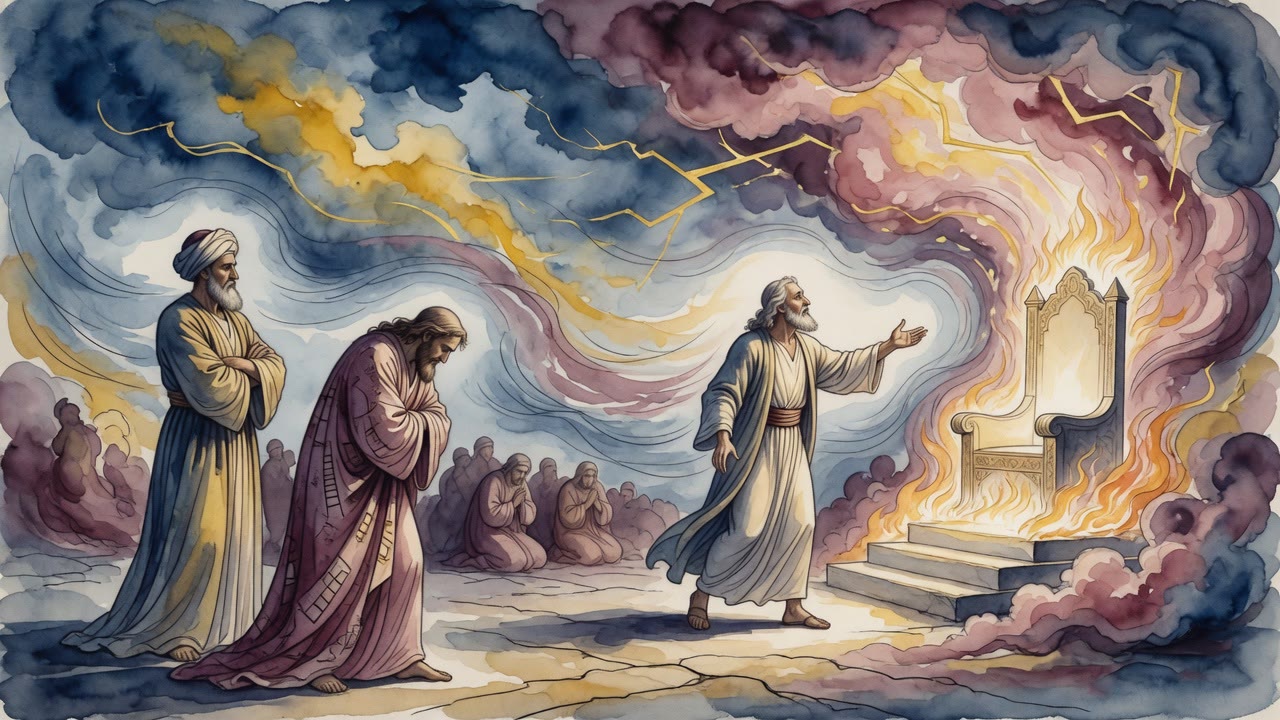
Finally, on the third day, Abraham sees the place from afar. He sees a pillar of fire reaching to heaven, a cloud of glory. He asks Isaac if he sees the same. Isaac does. Abraham knows then that Isaac is accepted before God. He asks Ishmael and Eliezer, but they see nothing special. "Abide ye here with the ass," Abraham tells them, "you are like the ass, as little as it sees, so little do you see." He and Isaac will go to worship, and, he prophesies unconsciously, they will both return.

This is the setup, the prelude to one of the most challenging moments in the Torah. The journey to Moriah is a journey of faith, of doubt, of temptation, and ultimately, of surrender. What happens next is even more astounding. But that, my friends, is a story for another time.

What does this journey tell us about ourselves? About our capacity for both unwavering faith and crippling doubt? About the sacrifices we are willing to make, and the limits of our obedience? It’s a story that continues to resonate, to challenge, and to inspire, thousands of years later.

Full source
Legends of the Jews, V. Abraham, The 'akedahLegends of the Jews

The story, as we find it elaborated upon in Legends of the Jews by Ginzberg, takes us far beyond the spare verses of Genesis. It paints a vivid picture, filled with dialogue and emotion, giving us a deeper understanding of the figures involved.

As Abraham and Isaac journeyed together, Isaac, ever observant, asks a poignant question: "Behold, the fire and the wood, but where then is the lamb for a burnt offering before the Lord?" Can you imagine the weight of that question hanging in the air? Abraham's response, in this version, is direct and startling: "The Lord hath chosen thee, my son, for a perfect burnt offering, instead of the lamb."

Isaac's reaction is equally striking. He accepts his fate with joy and cheerfulness, declaring his willingness to fulfill God's command. “I will do all that the Lord hath spoken to thee with joy and cheerfulness of heart.” He even urges his father to bind him tightly, fearing that in a moment of weakness, his youthful desire for life might cause him to resist, potentially invalidating the sacrifice. He asks that after the slaughter, his ashes be given to his mother Sarah, to remind her always of her son.

There’s a raw, almost unbearable, tenderness in this exchange. The narrative dwells on the physical realities of the impending act. Abraham builds the altar, Isaac hands him stones, and the scene is set for a father to sacrifice his beloved son.

As Abraham prepares to carry out God's command, the text emphasizes the unity of purpose between father and son. God, from His heavenly throne, witnesses their unwavering devotion. Tears stream down Abraham's face onto Isaac, and from Isaac onto the wood of the altar, a veritable flood of sorrow and faith.

But the angels are in turmoil. They cry out, questioning the apparent breaking of God's covenant with Abraham. "Where is the reward of Abraham," they ask, "he who took the wayfarers into his house, gave them food and drink.?" Their tears, even fall upon the knife, preventing it from cutting.

Then comes the pivotal moment: the archangel Michael's cry, "Abraham! Abraham! Lay not thine hand upon the lad, neither do thou any thing unto him!"

Abraham, caught between divine command and angelic intervention, hesitates. He questions whose voice he should obey. Only then does God Himself intervene, reaffirming the promise and rewarding Abraham’s unwavering faith. "By Myself have I sworn, saith the Lord, because thou hast done this thing, and hast not withheld thy son, thine only son, that in blessing I will bless thee."

Isaac, miraculously spared, blesses God for bringing the dead back to life. Abraham, not wanting to leave without offering a sacrifice, finds a ram caught in a thicket, provided by God as a substitute.

The narrative doesn't end there. It goes on to describe the extraordinary destiny of this ram. Nothing went to waste: its ashes became the foundation of the inner altar in the Temple, its sinews were used for David's harp, and its horns would one day herald both the revelation at Sinai and the final redemption.

The story concludes with a conversation between Abraham and God, exploring the reasons behind this profound test. God explains that it was to demonstrate to the world Abraham's unwavering fear of God. Abraham, in turn, pleads for God to remember the Akedah when his descendants sin, that the merit of Isaac's near-sacrifice may atone for their transgressions.

And God promises that on Rosh Hashanah, the Jewish New Year, the blowing of the shofar (ram's horn) will serve as a reminder of this event, prompting divine forgiveness.

The text even connects the site of the Akedah to the future Temple in Jerusalem, acknowledging the contributions of both Abraham (who called it Yireh, "He will see") and Shem (who called it Shalem, "Peace"). God, not wanting to offend either, combined the names into Yerushalayim, Jerusalem.

Finally, we learn that after the Akedah, Isaac spent three years in Paradise, while Abraham returned home to find Sarah dead from grief, believing her son had been sacrificed.

So, what are we to make of this complex and challenging story? It’s a tale of faith tested to its absolute limit, of obedience and divine intervention, and of the enduring covenant between God and the Jewish people. It’s a story that continues to provoke discussion and inspire awe, reminding us of the profound depths of human faith and the mysteries of the divine will. And perhaps most importantly, it serves as a powerful reminder of the importance of compassion and the sanctity of human life. It makes you wonder: what "knife" is being held over you right now? What are you willing to sacrifice for your faith, your family, your beliefs? And what are you praying will be spared?

Full source
Legends of the Jews 5:233Legends of the Jews

Legends of the Jews turns to Isaac Willingly Helped Build the Altar for His Own Sacrifice.

The biblical text gives us glimpses, but the aggadah, the rabbinic tradition of storytelling, fills in the gaps, painting a vivid picture of the scene. Imagine Abraham's joy, as Ginzberg tells us in Legends of the Jews, upon hearing Isaac's faithful words. They arrive at the designated place, and together, father and son build the altar. Isaac, the younger man, even helps by handing Abraham the stones and mortar. There's a terrible, unsettling intimacy to this act.

Then comes the unimaginable. Abraham arranges the wood, the fuel for the sacrifice, upon the altar. He binds Isaac, placing him on top of the wood, ready to be slain as a burnt offering to God. It’s a moment of profound tension, a test of faith unlike any other.

Here, in these legendary accounts, Isaac speaks. His words are not of fear, but of a heartbreaking understanding and acceptance. "Father, make haste," he says. "Bare thine arm, and bind my hands and feet securely." He understands the potential for his own human weakness. He knows that at the sight of the knife, his instinct for survival might kick in.

"I am a young man, but thirty-seven years of age," Isaac continues, according to this tradition (quite different from the innocent child we often picture). "Thou art an old man. When I behold the slaughtering knife in thy hand, I may perchance begin to tremble at the sight and push against thee, for the desire unto life is bold." He fears injuring himself, invalidating the sacrifice, and causing his father pain.

What a burden for a son to carry! What profound selflessness!

He then asks his father to turn up his garment, gird his loins, and burn him completely. And then, the most poignant request of all: "Gather the ashes, and bring them to Sarah, my mother, and place them in a casket in her chamber. At all hours, whenever she enters her chamber, she will remember her son Isaac and weep for him."

Imagine Sarah's grief, a grief compounded by the fact that she was not even consulted in this momentous decision. Isaac, even in his final moments, is thinking of his mother, trying to soften the blow of his loss. He is thinking of how she will grieve and how she will remember him. He seeks to provide her with a tangible reminder, a focal point for her sorrow.

The Akedah is more than just a test of faith. It's a story of obedience, yes, but also of profound human emotion, of a father's agonizing decision and a son's ultimate sacrifice. It's a story that continues to resonate with us, challenging us to consider the complexities of faith, love, and loss. What would we do in such a situation? Could we show such unwavering commitment? Could we exhibit such heartbreaking grace? These are questions that linger long after the story ends.

Full source
Legends of the Jews 5:262Legends of the Jews

Jewish tradition explores that very edge of human emotion in the story of Sarah, Abraham’s wife, after the near-sacrifice of Isaac. It’s a tale found in Ginzberg's Legends of the Jews, and it's a poignant, almost unsettling, coda to the main event.

Remember the story? God tests Abraham’s faith, commanding him to sacrifice his beloved son Isaac. Abraham, unflinchingly, obeys – or at least, he goes through the motions until an angel intervenes at the last moment.

What about Sarah? Where was she during all this? The Torah itself is strangely silent. But the Legends fill in the gaps, painting a picture of a mother’s agonizing search for her son.

After the Akedah, the binding of Isaac, Sarah is frantic. She knows something terrible has happened. She rises, the Legends tell us, and embarks on a desperate quest to find Isaac. She travels to Hebron, questioning everyone she meets, but no one can give her news of her son. Her servants search the houses of Shem and Eber - figures from the line of Noah, representing wisdom and tradition. They search the entire land. But Isaac is nowhere to be found. The silence is deafening.

And then, Satan appears.

Yes, that Satan. In this tale, he's not just a symbol of evil, but a messenger, a kind of twisted truth-teller. He comes to Sarah disguised as an old man, and delivers a cruel, manipulative blow. He says, "I lied to you. Abraham didn't kill your son. He is not dead." The relief, the sheer, unadulterated joy that would flood Sarah at those words. After days of agonizing uncertainty, after fearing the absolute worst, she discovers that her son is alive.

But here’s the twist, the truly devastating part: the Legends tell us that when Sarah heard these words, "her joy was so exceedingly violent that her soul went out through joy."

She dies. From joy.

It’s a shocking end. A stark reminder that even the most positive emotions, when experienced at such an extreme intensity, can be overwhelming, even fatal.

Why this ending? What does it tell us about the Akedah and its aftermath? Perhaps it highlights the immense emotional toll the event took on Sarah, a toll the Torah itself only hints at. Perhaps it's a commentary on the fragility of the human spirit, its vulnerability to both sorrow and overwhelming happiness. Or maybe, just maybe, it's a way of emphasizing the magnitude of God's test, and the impossible choice Abraham faced, a choice that ultimately cost Sarah her life, even though Isaac was spared.

It leaves us pondering the delicate balance between faith, obedience, and the very human capacity for love, loss, and ultimately, the bittersweet agony of overwhelming joy.

Full source