The Brothers Told Joseph That One Brother Had Simply Vanished
Ten men stand before Egypt's ruler and say one brother simply went from them, while Joseph hears his own sale cleaned into passive grammar.
Table of Contents
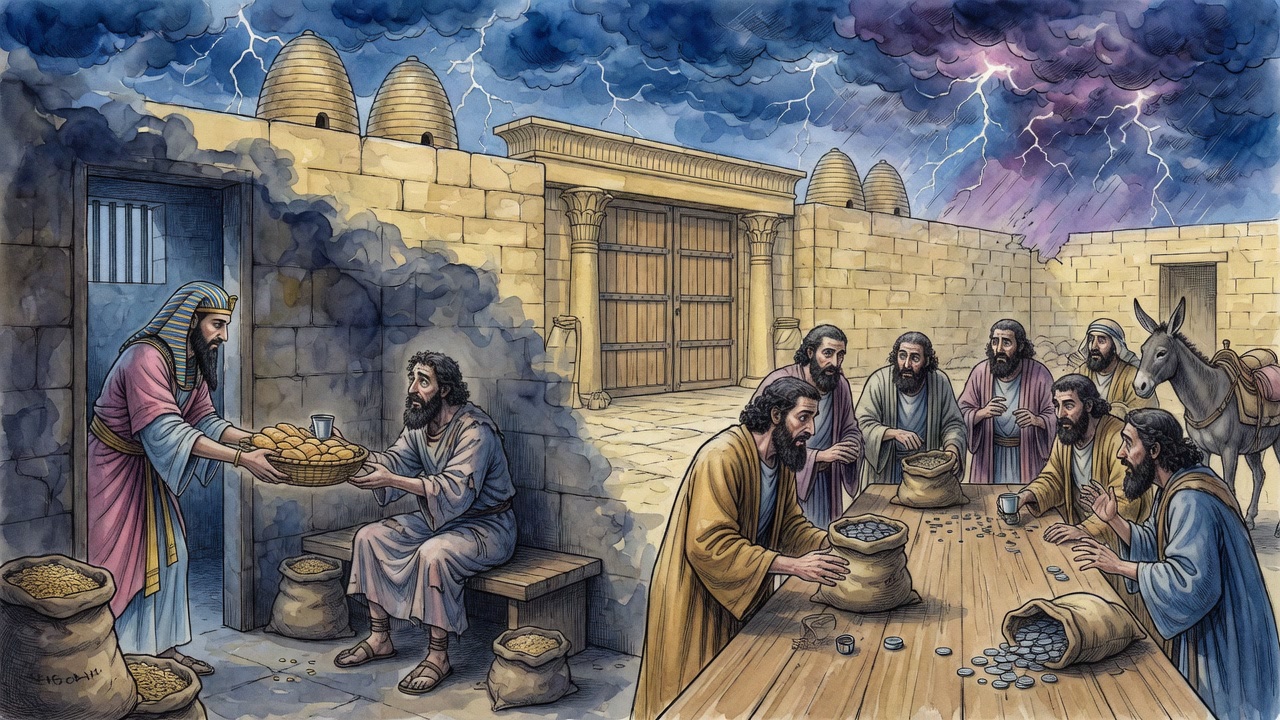
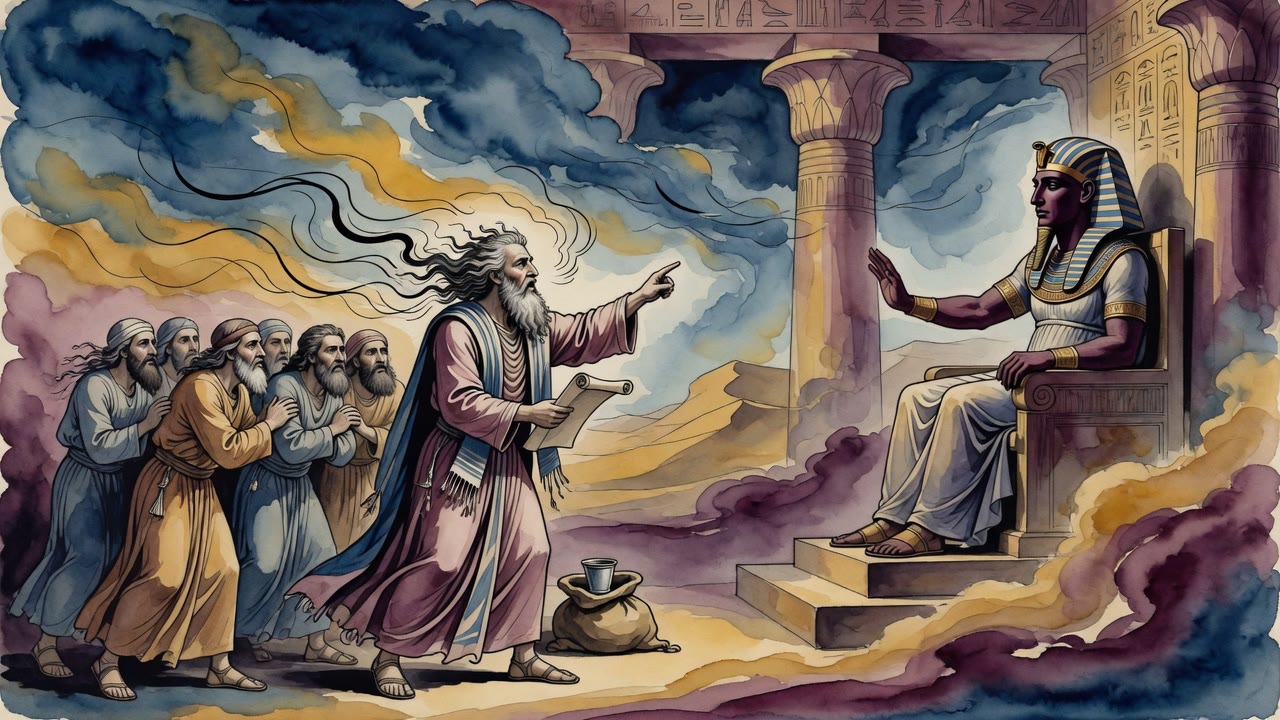
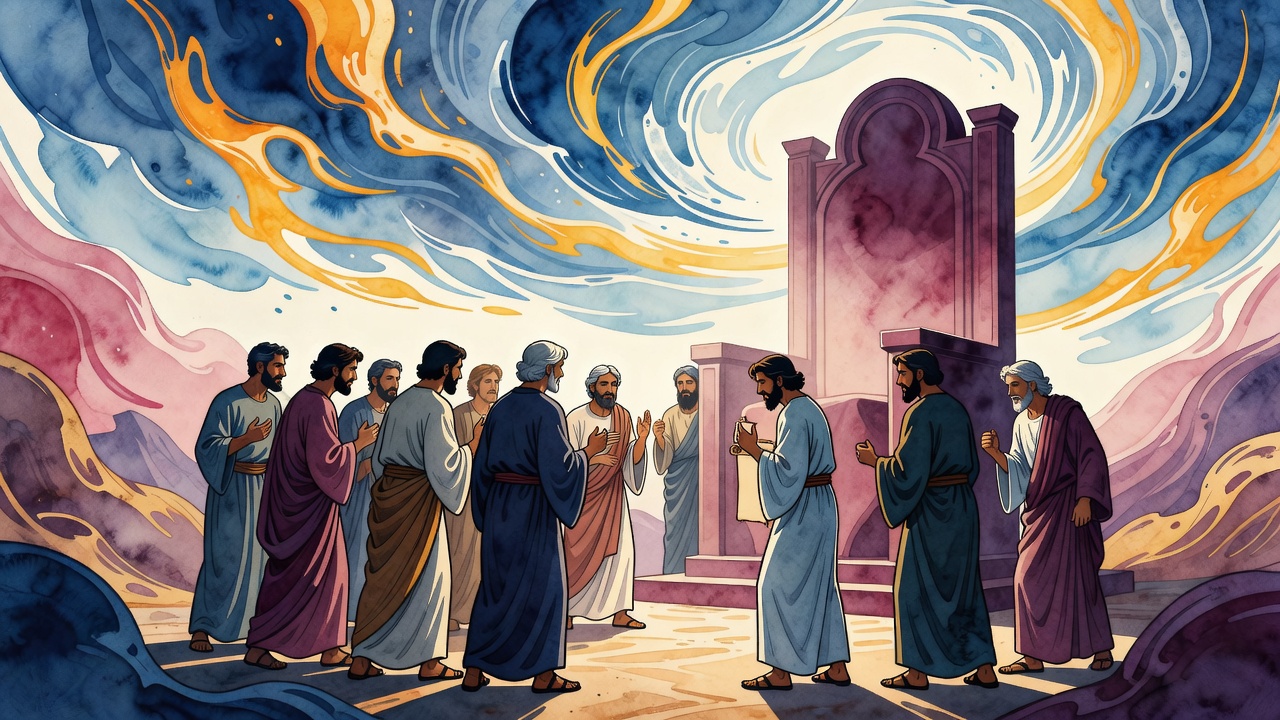
They stood in the Egyptian hall with dust still on their hems and volunteered the family arithmetic before anyone forced it from them. Twelve brothers. One youngest still with the father. "And one went from us, and we know not what hath been in his end."
 Click for full size
The man on the throne was Joseph. He heard his own life cleaned into a passive phrase. They had thrown him into a pit at Dothan. They had sat down to eat. They had sold him to Midianite merchants. They had stained a coat with goat blood and handed their father a lie. Now, before the brother they did not recognize, they said only that one went from them, as if the road itself had opened and swallowed a boy.
Evasion as a Kind of Confession
Targum Pseudo-Jonathan keeps their wording exact. The Aramaic softens the crime into weather. No agency. No pit. No silver. Joseph listens for the missing verbs and finds them all. The rabbinic ear hears this as the moment he knows they have not yet repented. They are still editing the story for polite company.
Guilt often sounds like grammar. People who have done a thing speak of the thing as if it happened to them. "One went from us" is the language of men who still cannot say "we sold him." Joseph does not unmask himself yet. He lets the sentence hang in the hall like a coat that does not fit.
The Torah of Man Across Three Lives
Later midrash would set Joseph beside David and Moses under one strange phrase: "this is the Torah of man." When Nathan brought David the promise of an everlasting house, David bowed and called it a small thing in God's eyes. Rabbi Simon heard a parable there. A man does his fellow a small kindness, and the fellow answers that today is small, but the end will be great. So God told David: this is only the beginning.
The same "Torah of man" opens onto Joseph, beautiful of form, and onto Moses, most excellent of prophets. The sages set David and Moses' side by side and marveled at how their lives rhymed: kingship, sacrifice, high places raised and ordered, arrivals in happiness. Joseph belongs in that company as the man whose private wound becomes public salvation. The brothers' passive sentence is the wound still unhealed. The later rhyme of great lives is what happens when Heaven refuses to let a sold boy remain only a sold boy.
Judah's Friend Who Would Not Leave the Line
Beside the brothers who erased Joseph stands another figure who refused to erase a different brotherhood. When Judah turned aside, Scripture names "a certain Adullamite, whose name was Hirah." Rabbi Judah bar Simon would not let the name pass. This Hirah, he taught, is the same soul who appears centuries later as Hiram, king of Tyre, friend of David's house. One love for the line of Judah runs from Adullam to the building of the Temple.
Scripture says "his friend Hirah the Adullamite," and later, "for Hiram had always loved David." Always, all the days. Friendship that begins with one man of Judah becomes timber and gold for the House. The contrast with Joseph's brothers is sharp. Hirah cleaves. The brothers discard. One story measures loyalty across centuries. The other measures betrayal across a single afternoon at a pit.
What Joseph Waited to Hear
Joseph does not need them to invent a prettier past. He needs them to use active verbs. Until they can say what they did, they cannot become the men who will protect Benjamin. The whole engine of the later tests turns on that demand. Food, silver cups, the threat to the youngest: all of it presses them toward a sentence that finally owns its subject.
The myth of the brothers is not only about cruelty. It is about the long work of making language honest again. "One went from us" is where they start. The Torah will not let them finish there. Somewhere beyond that Egyptian hall, a friend of Judah will love a line without flinching, and a sold boy will feed the world that sold him. Between those poles stands a family learning how to speak.
Joseph's face does not change in the hall, but the sentence works on him like a second sale. To be erased is a different injury from being hated. Hatred at least keeps your name. "One went from us" removes the name and leaves a weather report. The brothers think they are being careful. They are being transparent in the wrong direction.
Years of Egyptian power have not made Joseph soft, but they have made him patient. He can wait for language to catch up to guilt. The tests that follow are not sadism. They are speech therapy for a family that has forgotten how to use the first person plural with honesty. When Judah later offers himself for Benjamin, the grammar finally turns. Agency returns. The pit is no longer weather.
Hirah's long love for Judah's house stands as a counter-melody, not a distraction. Somewhere in the wider story of the tribe, loyalty can last from Adullam to Tyre. The brothers' failure is not destiny. It is a choice that can be unlearned, slowly, under the pressure of a ruler who knows every missing word.
← All myths