5 min read

Joseph Fed His Prisoner Well While His Brothers Found the Money

Joseph chained Simeon in front of his brothers, then ordered good food sent to the cell as soon as they left. The cruelty and the care were the same plan.

Curated by Arthur · Told by Maggid ·
Table of Contents
  1. The Moment the Chains Appeared
  2. The Food He Sent
  3. What Jubilees Says About the Accusation
  4. The Brothers Who Blamed Themselves

The Moment the Chains Appeared

The brothers had come to Egypt looking for grain and found their brother in charge of the grain and did not recognize him. Joseph had recognized them immediately. He had taken twenty years of absence and exile and slavery and prison and set it aside long enough to think clearly about what needed to happen next. He needed Benjamin. He needed to see the youngest brother, the one born from Rachel, the one who had not been there in the pit that day. He needed to know if Benjamin was alive and what his brothers had done with him. He could not simply ask.

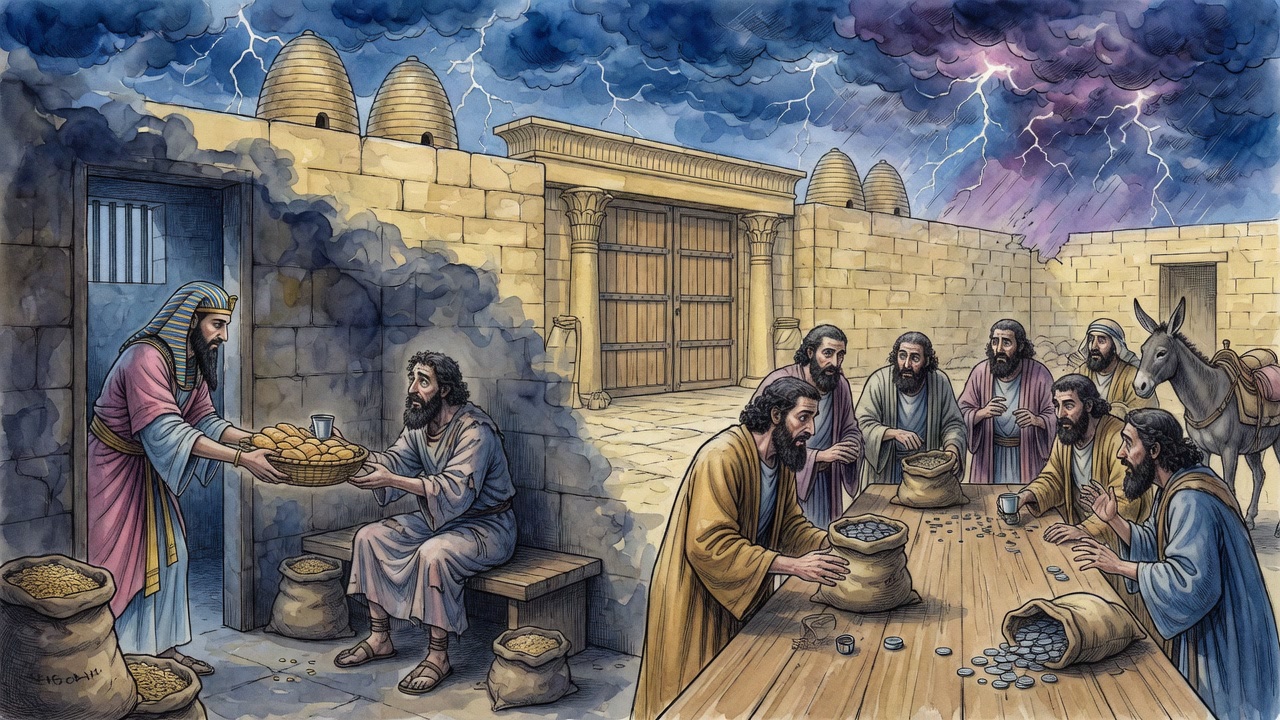
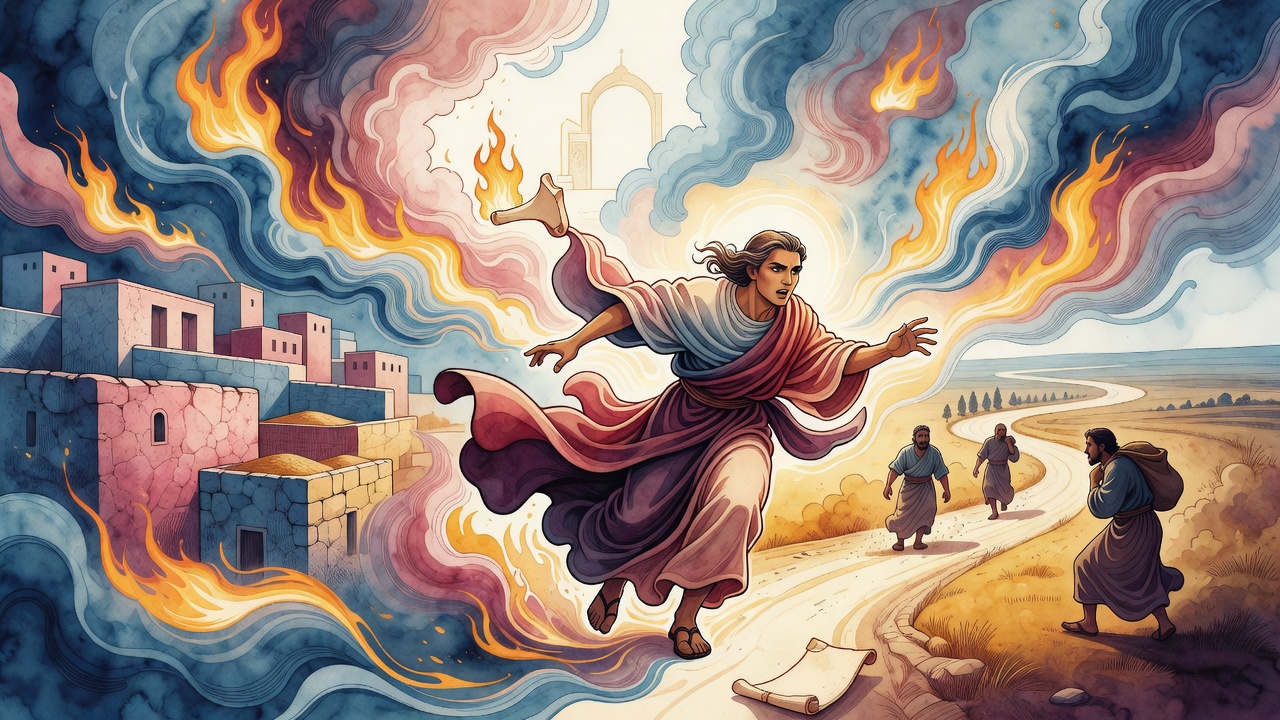
So he accused them of being spies. He kept them for three days and said he would keep all of them except one, who would go back and fetch the youngest. Then he changed the terms: all of them would go except one. He chose Simeon. He bound him in front of his brothers' eyes. They watched the chains go on. They heard the guards take him away. Then they turned to go back to Canaan with their sacks of grain, and as soon as they were out of the throne room Joseph changed the order.

The Food He Sent

The moment his brothers were out of sight, Joseph ordered good food brought to Simeon's cell. Not prison rations. Proper food, the kind a man of standing would be served. The Legends of the Jews preserves this detail precisely: Joseph had Simeon well provisioned as soon as the others could no longer see what was happening. The cruelty had been theater. The imprisonment was real enough, Simeon would not be going home, but the man in the cell would be eating well.

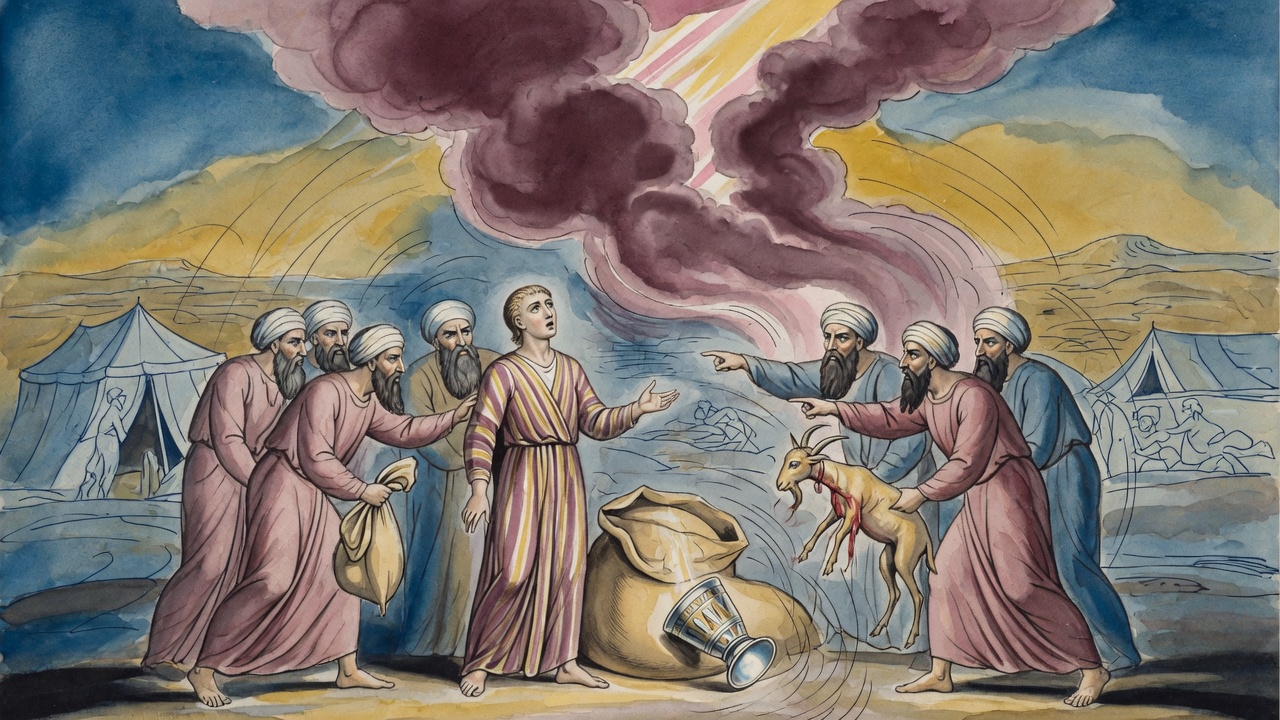
The brothers, meanwhile, had discovered something worse than imprisonment. When they stopped for the night and opened their sacks to feed their donkeys, one of them found his money. All of it. The silver he had paid for grain was sitting at the top of his sack, returned to him with no explanation. His heart sank. He told his brothers. Their hearts sank together. They said to one another: what is this that God has done to us? They had not yet opened all their sacks. They did not yet know all of them had their money back. They would find out when they got home.

What Jubilees Says About the Accusation

The Book of Jubilees, retelling the same scene with its characteristic interest in exact dialogue and motivation, preserves the specific accusation Joseph leveled at the brothers when they arrived. He had looked at them, strangers from Canaan in his grain hall, and said immediately: are you not spies? He had watched their faces and listened to their explanation and given them nothing to read in his own face in return. He was an Egyptian official to them. He was a wall.

Jubilees records that the test Joseph was running had multiple stages. He needed to know if they had repented. He needed to know how they would treat Benjamin, another favored son of Jacob. He needed to watch them under pressure and see if they were the same men who had thrown him in the pit or if twenty years had changed them into someone he could afford to know again. The good food sent to Simeon's cell was not mercy for mercy's sake. It was also part of the test. He was keeping the hostage alive and well because he needed the hostage returned eventually, because the plan required all the brothers to come back with Benjamin, and a dead or broken Simeon would give his father too good a reason to refuse.

The Brothers Who Blamed Themselves

Jacob's sons, the Legends of the Jews records, understood the money in the sacks as punishment for what they had done to Joseph. They did not know they were looking at their brother's accounting. They thought they were looking at God's. They had sold their brother for silver, and now their silver had come back to them in a way that made no sense, in a way that made every transaction in Egypt feel dangerous and unstable. The same God who had watched them throw Joseph in the pit was watching them now, and apparently taking an interest in their silver.

They were right that someone was watching. They were wrong about who was doing the accounting. The man who had ordered the money returned was the man whose money it had originally been, in a way they had not considered. Joseph had been sold. Now he was returning silver. The mathematics of what had happened between them was still being worked out, and he was the one doing the calculation.


← All myths
From the tradition

Sources

6 sources

The texts this telling draws on, in full. Open a card to read inline, or expand it for a wider, quieter read.

Legends of the Jews 1:224Legends of the Jews

The brothers of Joseph certainly did.

Let’s rewind a bit. A famine strikes, and his brothers, unaware of his true identity, travel to Egypt to buy grain. The story unfolds with layers of deception and recognition, and the brothers are caught in Joseph’s intricate plan.

After an initial meeting filled with tension and veiled accusations, Joseph decides to hold one of the brothers captive. Now, the Biblical text itself doesn’t explicitly detail Joseph’s treatment of the imprisoned brother, Simeon. But the Legends of the Jews, that masterful compilation of rabbinic lore by Louis Ginzberg, adds a fascinating detail. It tells us that even as Simeon was bound and taken to prison before the eyes of his brothers, as soon as they were out of sight, Joseph ordered good food to be brought to him. Joseph, according to this legend, treated Simeon with great kindness in private.

Why this apparent contradiction? Perhaps Joseph was wrestling with his own emotions, torn between the desire for revenge and a lingering sense of familial connection. Or maybe, as the legend suggests, he aimed to soften the blow for Simeon, a small mercy amidst the larger drama.

The nine remaining brothers are then allowed to depart, their sacks filled with grain. But here's the catch: Joseph insists they return with their youngest brother, Benjamin. As they journey back, Levi, missing his close companion Simeon, opens his sack and discovers the money he had paid for the grain. A wave of fear washes over them.

"Where, then, is the lovingkindness of God toward our fathers Abraham, Isaac, and Jacob," they lament, "seeing that He hath delivered us into the hands of the Egyptian king, that he may raise false accusations against us?"

Their terror is palpable. They see this as a sign of divine abandonment, a cruel twist of fate. Is this punishment? Are they doomed?

Judah, however, offers a starkly different interpretation. "Verily, we are guilty concerning our brother," he declares, "we have sinned against God, in that we sold our brother, our own flesh, and why do ye ask, Where, then, is the lovingkindness of God toward our fathers?"

His words cut through the despair. He recognizes the source of their misfortune, not as a random act of divine cruelty, but as a direct consequence of their own actions. They are reaping what they sowed. The guilt over their treatment of Joseph, long buried, resurfaces with devastating force. It's a moment of painful self-awareness, a recognition of their collective sin.

This is more than just a story about famine and mistaken identity. It's a story about responsibility, about the enduring power of guilt, and about the possibility of facing up to the consequences of our choices. It reminds us that sometimes, the challenges we face are not external forces acting upon us, but echoes of our own past deeds. It begs the question: What unresolved issues linger in your past, shaping your present? And what will you do about them?

Full source
Book of Jubilees 42:11Book of Jubilees

In case you're not familiar, the Book of Jubilees is an ancient Jewish text that retells the stories of Genesis from a slightly different angle, adding details and interpretations not found in the Torah itself. It's a fascinating glimpse into how these stories were understood and embellished centuries ago.

So, where were we? The brothers, minus Joseph of course, are in Egypt, desperately trying to buy grain to feed their starving families back in Canaan. They encounter a powerful Egyptian official, who, unbeknownst to them, is none other than their long-lost brother, Joseph. But Joseph, still carrying the pain of their betrayal years ago, doesn't reveal his identity. Instead, he decides to test them.

As Jubilees 42 tells us, Joseph confronts them, immediately suspicious: "Are ye not spies, and have ye not come to explore the approaches of the land?" He accuses them of espionage, a serious charge that could carry severe consequences. What must have been going through their minds at that moment? Fear? Confusion? Perhaps a flicker of guilt?

Joseph throws them in prison. But then, just as suddenly, he releases them, all except Simeon. He keeps Simeon as collateral, a bargaining chip to ensure their return. The tension is palpable. It’s a clever move, adding pressure and suspense to the unfolding drama.

He sends the other nine brothers back to Canaan, but here's where it gets really interesting. Joseph, in a move that seems both generous and manipulative, fills their sacks with corn, providing them with the much-needed sustenance they came for. But there's more. He also secretly returns their money, placing it back into their sacks without their knowledge.

Can you imagine their surprise when they discover the money? Relief at having food, mixed with bewilderment and perhaps a growing sense of unease? This act, according to the Book of Jubilees, adds a layer of complexity to Joseph's character. Is he being merciful? Or is he setting them up for something even bigger?

Joseph then lays down the condition for Simeon's release: they must bring their youngest brother, Benjamin, back with them to Egypt. He knows about their family dynamics. He knows their father, Jacob, is still alive, and that they have a younger brother. He's been gathering information, carefully arranging the situation to his advantage.

And so, the brothers journey back to Canaan, burdened with grain, unknowingly carrying their money, and facing the daunting task of telling their father everything that has happened. The Book of Jubilees tersely states, "And they went up from the land of Egypt and they came to the land of Canaan; and they told their father all that had befallen them."

The stage is now set for the next act. How will Jacob react to this news? Will he allow Benjamin to go to Egypt, risking the loss of another son? And what is Joseph's ultimate plan? The Book of Jubilees, along with the Torah, leads us into a powerful story of family, betrayal, and the long, winding road to reconciliation. It makes you wonder: how would you react in a similar situation? Would you seek revenge? Or would you find a way to forgive?

Full source
Legends of the Jews 1:208Legends of the Jews

Legends of the Jews turns to Abraham, Joseph and the Patriarchs.

He accuses them, and it’s quite the accusation: “Verily, ye are spies!” according to Legends of the Jews. He lays it on thick, doesn't he? Joseph argues that normal people buying corn would return home promptly. But these brothers? They’ve been loitering for three days, wandering around the less-than-savory parts of the city. In Joseph’s eyes, this reeks of espionage.

What a predicament! How do you even begin to defend yourself against such a charge?

The brothers, understandably bewildered and probably terrified, try to explain. "We thy servants are twelve brethren, the sons of Jacob, the son of Isaac, the son of the Hebrew Abraham." They attempt to establish their lineage, their identity, their bona fides, if you will. They are sons of Jacob, grandson of Abraham, solidifying their connection to the land of Canaan.

Then they offer an explanation for their… extended stay. They have a younger brother at home with their father. And another brother, one who "hath disappeared." They admit to searching for him, even in the "disreputable houses." According to Ginzberg, this detail is crucial. They weren't just aimlessly wandering; they were desperately searching for their lost brother.

Did they really expect to find Joseph in such a place? Perhaps not. But their willingness to look everywhere shows their desperation and, perhaps, a hint of guilt for their past actions.

It makes you wonder about the weight of secrets and the long shadows they cast. The brothers are carrying the burden of their betrayal, and now they find themselves in a situation where their past actions, combined with Joseph’s clever manipulation, have landed them in deep trouble.

Is justice being served? Is this simply payback? Or is something more profound at play here? The story of Joseph and his brothers is far from over. It's a interplay of family, forgiveness, and the enduring power of fate. And it all begins with that loaded accusation: "Verily, ye are spies!"

Full source
Legends of the Jews 1:222Legends of the Jews

The scene: Joseph, now a powerful figure in Egypt, has just made a demand. He wants one of his brothers to stay behind as a hostage, a guarantee of their good faith. It's a tense moment, thick with suspicion and fear. And Simon, known for his fiery temper, is not having it.

"You want to do to me what you did to Joseph?!" he explodes, the old wound, the old betrayal, ripped open once more. You can almost hear the echoes of that terrible day when they sold their brother into slavery.

His brothers, weary and desperate, plead with him. "What can we do?" they cry. "Our families will starve!" Hunger, the most basic of needs, trumps everything. It's a stark reminder of the brutal realities of their world.

Simon, unyielding, declares, "Do as you will, but let me see the man who dares to imprison me!" He's ready to fight. He’s not going down without a struggle.

Joseph, ever the strategist, has anticipated this. He calls on Pharaoh for backup, requesting seventy of his strongest warriors to assist in arresting "robbers" – a euphemism, of course, for his own brothers, and especially for Simon.

But when these seventy valiant men approach Simon, something extraordinary happens. He lets out a mighty roar, and they all collapse, teeth flying! The power of his anger, his righteousness (or perhaps his sheer stubbornness), is enough to literally knock them off their feet. Talk about a display of strength!

Panic erupts. Pharaoh's men, the onlookers, everyone except Joseph and his son Manasseh, flee in terror. Joseph, the orchestrator of this whole drama, remains calm, almost detached.

Then, Manasseh, Joseph's son, steps forward. And here's where it gets really interesting. He delivers a swift blow to the back of Simon's neck, shackles his hands and feet, and throws him into prison.

The brothers are stunned by Manasseh’s strength. And Simon himself, defeated but perceptive, cries out, "This blow was not dealt by an Egyptian, but by one belonging to our house!" Simon recognizes a certain… familiarity in the attack. A knowledge of their family, their ways. Is it just physical prowess? Or is there something deeper, something more subtle, at play?

Perhaps Manasseh, raised in Egypt but still connected to his Hebrew heritage, embodies the complicated legacy of this family. He is both insider and outsider, capable of both great strength and, potentially, great understanding.

This brief episode, found within Legends of the Jews, a compilation of midrashic (rabbinic interpretive commentary) and aggadic traditions, leaves us with so much to ponder. What is the true nature of justice and revenge? Can we ever truly escape our past? And what role do family ties, both broken and unbroken, play in shaping our destinies? These aren't just questions for the brothers of Joseph; they're questions for all of us.

Full source
Midrash Tanchuma Buber, Miketz 17:3Midrash Tanchuma Buber, Miketz

What did Joseph do? He commanded that the names of the people who entered, which were written down each and every day, be brought to him. They came in on the first day, and the names of those who had entered were brought before him, and so each and every day they would inform him. When Joseph's brothers came down, they did not all enter through one gate. The keeper of the gate would say to him, "What is your name?" He said to him, "Reuben son of Jacob son of Isaac," and likewise Simeon, and likewise all of them. They brought the written records to Joseph. When he read them, he knew that his brothers were there. He sent for Manasseh his son. He said, "See where they are going." Manasseh went and saw them going about in the marketplace, going out from this market to that market, from this lane to that lane. He sent after them and they came before him. When he saw them he surely recognized them, "but he made himself a stranger to them" (Genesis 42:7). What is the meaning of "he made himself a stranger to them"? Rabbi Yohanan said: He became as a stranger toward them. "And he said to them, 'From where do you come?'" (ibid.). He said to them, "You are spies" (ibid. 42:9). They said to him, "No, my lord; your servants have come to buy food" (ibid. 42:10). "We your servants are twelve brothers" (ibid. 42:13). Rabbi Yohanan said: It is like a raven that brought fire into its nest. He said to them, "Are you brothers?" They said to him, "Yes." "And why did you not all enter through one gate?" They said to him, "Because our father commanded us thus, on account of the eye." He said to them, "By the life of Pharaoh, surely you are spies" (Genesis 42:16). When he would swear falsely, he would swear by the head of Pharaoh. To what is the matter comparable? To a woman who stole a sheep from the flock and fled, and the shepherd was running after her. She went to her house and covered it with a garment. The shepherd said to her, "Have you seen a sheep?" She said to him, "May I eat the flesh of this one lying on the bed, for I know nothing." So too Joseph: when he wished to swear falsely, he would swear by the life of Pharaoh. "And they said to him, 'No, my lord; your servants have come to buy food'" (ibid. 42:10). He said to them, "You should know that you are spies. Why were you going about and circling the whole province?" They said to him, "We had a brother, and we sold him as a slave, and from the hour that we sold him, our father sits and mourns over him. And we have come down with the money in our hands, to say: wherever we find him, we will redeem him." He said to them, "Can a man who sells a thing go back on it?" They said to him, "For this we have come down, and double the money is in our hands to redeem him." He said to them, "And what if he does not wish to sell him?" They said to him, "Even if we are burned over him, we will not move until we redeem him." He said to them, "That is what I said to you, saying: you are spies" (ibid. 42:14). What did he do? "And he took Simeon from them" (ibid. 42:24). He said, "He bound me and cast me into the pit; I too will bind him." What did they do? They loaded up and went to their father, "and they told him all that had befallen them" (ibid. 42:29). He said to them, "Go, buy us a little food" (ibid. 43:2). Judah said to him, "The man solemnly warned us, saying, 'You shall not see my face' etc." (ibid. 43:3). He said to them, "I will not send Benjamin even if I am killed." They said to him, "It is better for you to lose one soul and not seventy." What did he do? He set his heart upon Benjamin and began to pray over them: "And may God Almighty grant you mercy before the man" (Genesis 43:14), because they had said "the man spoke" (ibid. 42:30), therefore he said "before the man."

Full source
Targum Pseudo-Jonathan on Genesis 42:28Targum Pseudo-Jonathan on Genesis

The silver fell out, and the brothers' hearts stopped. Targum Pseudo-Jonathan on (Genesis 42:28) preserves their reaction: "knowledge failed from their hearts, and each wondered with his brother, saying, What is this which the Lord hath done, and not for sin of ours?"

The first time they name God

This is a stunning moment. Nowhere in the previous chapters did the brothers attribute the events of their lives to God. Selling Joseph into slavery? No mention of the Lord. Deceiving their father with the bloody coat? Silence. Returning from Dothan to eat lunch? Nothing. But the instant their own money appears in their sacks unbidden, they ask: what is this which the Lord hath done? The Aramaic paraphrase, which took its final form in the Land of Israel around the seventh or eighth century CE, captures the emergence of theological consciousness in a group of men who had previously behaved as though God was not watching.

Not for sin of ours?

That last clause, "and not for sin of ours?", is where the self-awareness turns inward. They are not asking what the Lord has done as a neutral observation. They are asking whether they are being paid back for something. The rabbinic tradition reads this as the second stage of their repentance: after confession (42:21), the acknowledgment that events can be divine reckoning. Fear of God has begun to enter the family.

The takeaway

Sometimes a small, inexplicable event unlocks a whole theology. The silver in the sack did what twenty-two years of successful lying could not: it reminded the brothers that there was a ledger.

Full source