Parshat Miketz5 min read

Jacob Held Benjamin While the Famine Closed In

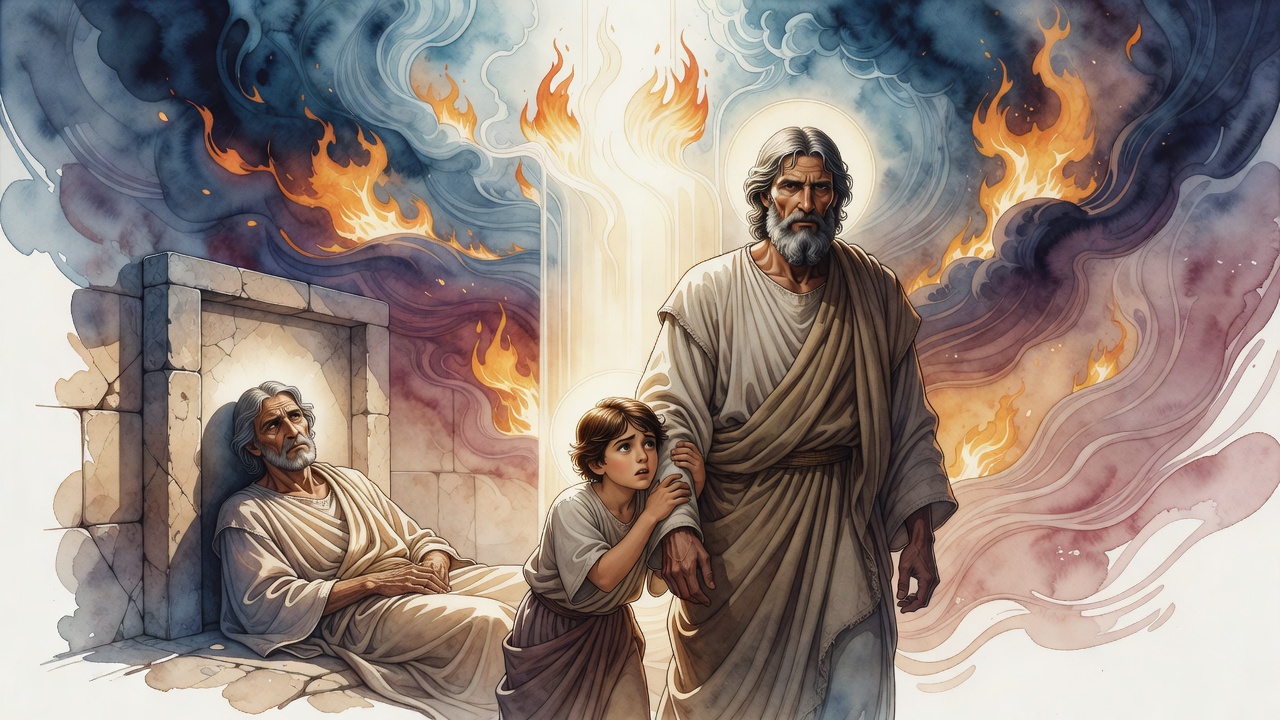
Simeon sat in an Egyptian cell. Benjamin clung to Jacob's sleeve. Hunger pressed the house until Judah forced the choice.

Curated by Arthur · Told by Maggid ·
Table of Contents
  1. Money Returned in the Sacks
  2. Reuben's Offer and Judah's Silence
  3. Rachel's Son Still Alive in the House
  4. Judah Locks the Door of Choice
  5. The Road South Again
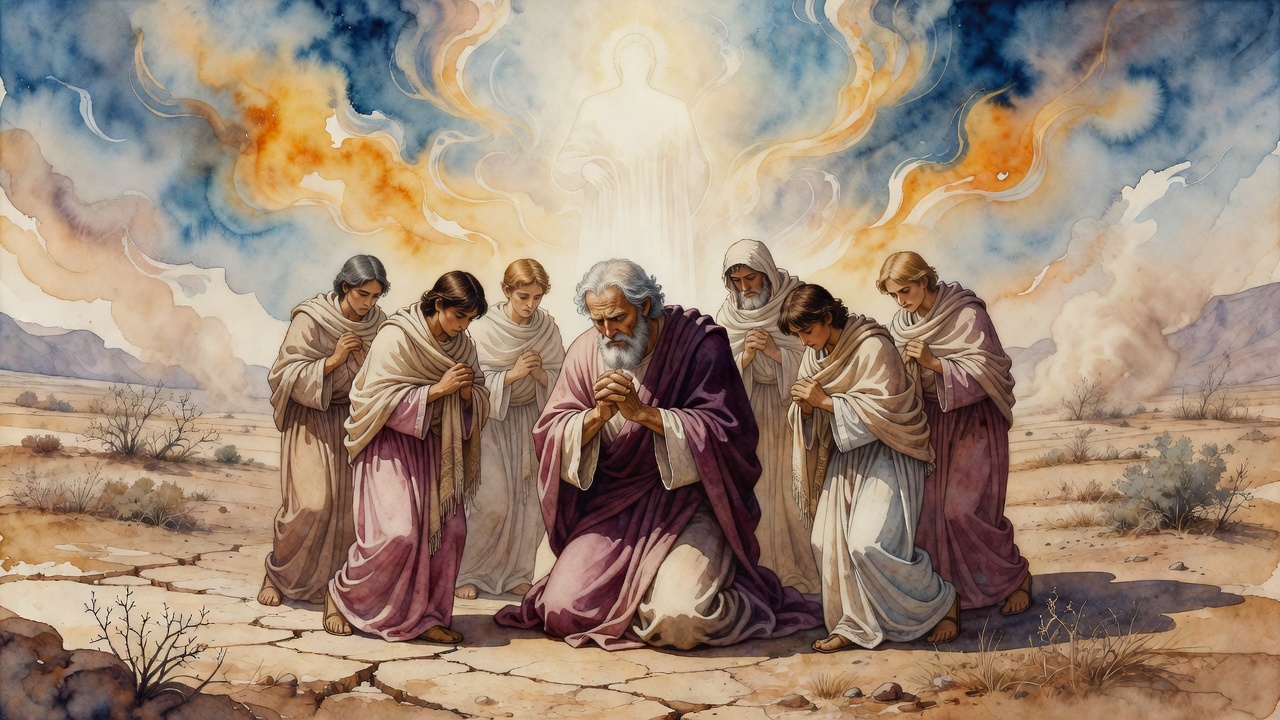
Jacob Held Benjamin While the Famine Closed In Click for full size

Money Returned in the Sacks

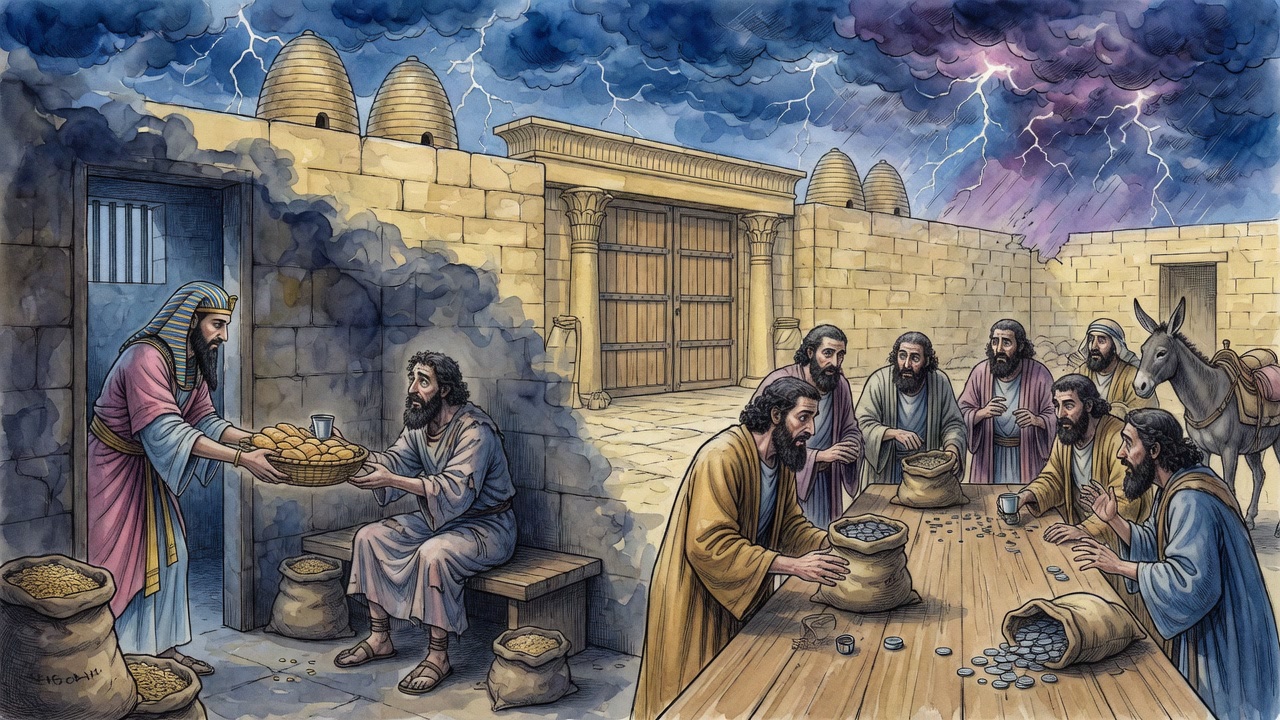
Jacob tore the mouth of the first sack open and silver glittered up at him like a trap. The brothers stood in the doorway with dust on their heels and Egypt still in their nostrils. Grain sat heavy on the floor. The money they had paid sat heavy beside it, as if the road itself had spat the price back into their hands.

"What is this that you have done to me?" Jacob cried. His voice cracked the room. He saw Joseph gone into a beast's mouth years ago. He saw Simeon held in a foreign prison. He saw the youngest, Benjamin, and the old fear closed its fingers around the boy's wrist.

Outside, the famine kept walking from field to field. Inside, the returned coins made every story the sons told sound thinner. They spoke of a viceroy who asked too many questions. They spoke of a demand no father wanted to hear. Jacob heard only the arithmetic of loss: one son dead in a story, one son locked under Egypt's roof, one son still warm under his hand.

He would not open that hand.

Reuben's Offer and Judah's Silence

Reuben stepped forward first. "Thou shalt slay my two sons if I do not bring thy son and place him before thee!" The words landed hard and empty. Jacob did not look at him. Grandsons as collateral did not loosen a father's grip on the last living piece of Rachel. A man who has already buried a coat full of blood does not pawn the next generation to recover the last.

"Abide ye here," Jacob said. Stay. Do not open that road again.

Judah did not shout. He watched the children of the household press closer each day, thinner, hungrier, eyes measuring empty jars. He knew the famine would do what argument could not. He waited while the land itself became the prosecutor. Nights passed with little sleep. Even the servants looked at the sealed jars as if jars could be persuaded.

Rachel's Son Still Alive in the House

Years earlier, on the new moon of the fourth month, in a week the old calendars still mark with care, the Holy One had opened Rachel's womb and she had named the child Joseph. Jacob had felt the future turn in that birth. He had told Laban to give him his wives and sons so he could go home to Isaac and build a house of his own. Joseph had been the hinge of that hope.

Joseph was gone. Benjamin remained. Every time Jacob looked at the boy he saw both the opened womb and the closed grave. He would not send that body into Egypt's mouth. Not for grain. Not for Simeon. Not for any viceroy's demand.

The grandchildren came anyway with empty hands. "Bread," they said, and the word had no manners left in it. Their small voices did what Reuben's oath could not. Jacob looked from Benjamin's face to the hollow cheeks of the next generation and felt the trap close from both sides.

Judah Locks the Door of Choice

Jacob finally broke. "Return and buy for us a little food," he told the sons, as if a little could be bought without Egypt's price.

Judah set the price where Jacob could not ignore it. "If thou wilt send our brother with us we will go down and buy corn for thee, and if thou wilt not send him then we will not go down." No Benjamin, no audience. Judah stacked the details like stones: the throne, the wisdom, the questions about their father, the threat if they returned incomplete. He praised the stranger's understanding until praise itself became pressure. No Abimelech of the Philistines compared to this ruler, he said. The brothers would not risk that court again without the boy.

"Send, we pray thee, the lad with us," Judah said, "and we will go down and buy thee food for our support, and not die through hunger."

The room held its breath. Jacob's hand was still on Benjamin's sleeve. Hunger had become louder than grief, but grief had not left. It only stood aside far enough for the road to open.

The Road South Again

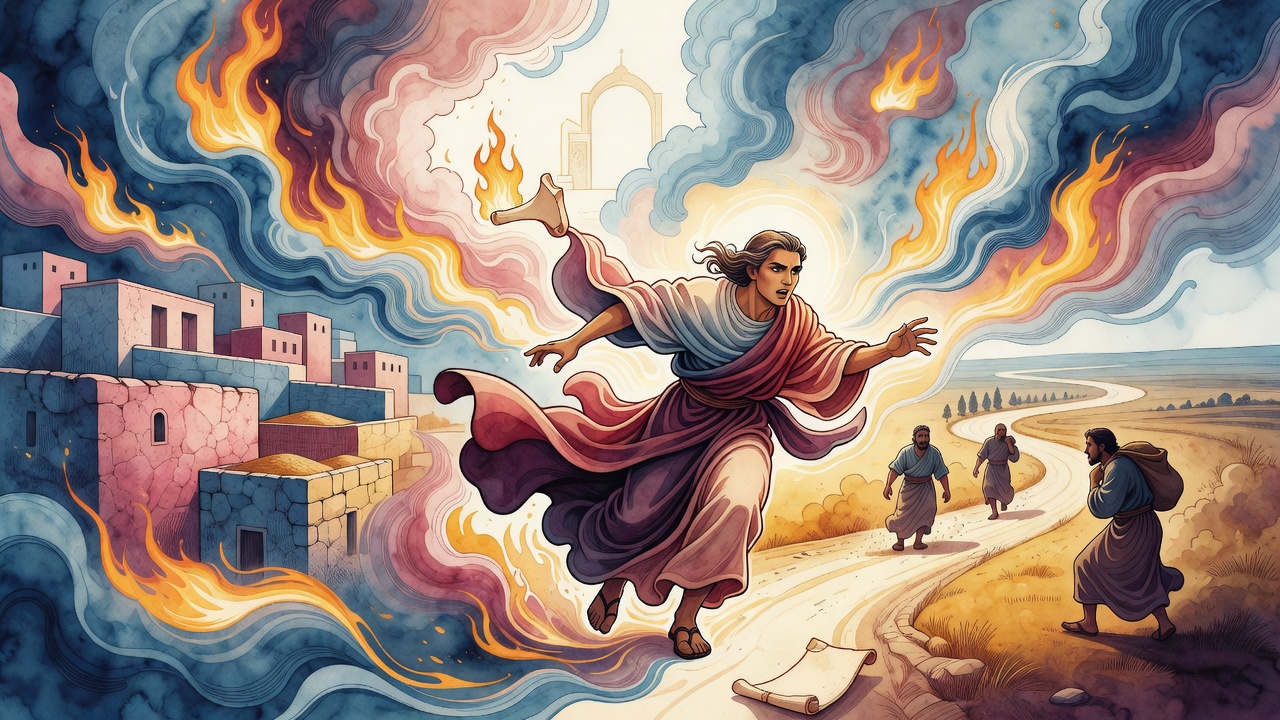
When Jacob's fingers finally loosened, Benjamin did not speak. He was a boy between a father's terror and a land that ate sons. The brothers loaded the sacks a second time. They took double money, as if honesty could be prepaid. They took balm and honey and spices for a stranger who already held one of them.

Jacob watched them go until the dust took their shapes. He had sent Joseph once and received a bloody coat. Now he sent Benjamin into the same direction of the world, with Judah's life pledged where Reuben's oath had failed. Behind him the returned silver still waited to be explained. Ahead, Egypt waited with full storehouses and a half-hidden face.

The famine did not care which son walked. Covenant history did. Somewhere on that road a brother who was not dead was already counting steps, and a father who thought he was finished with hope was about to be unfinished again.


← All myths
From the tradition

Sources

2 sources

The texts behind this telling. Some cards carry a translation of the source; others are our own retelling of it, and each card says which. Every card links out to the original.

Jasher 52Book of Jasher

Retold in our words. Read the original at the link below.The Book of Jasher, J. H. Parry edition (1887) · Public Domain

Joseph, after some theatrics and accusations, has now demanded they bring their youngest brother, Benjamin, back to Egypt as proof of their honesty. But getting Jacob to agree? That’s the challenge.

When the brothers return home, they find that the money they paid for the grain has mysteriously reappeared in their sacks, terrifying them and Jacob. "What is this that you have done to me?" Jacob cries. According to the Book of Jasher, Jacob laments the potential loss of Benjamin, fearing he'll suffer the same fate as Joseph. He exclaims that he sent Joseph to inquire after their welfare, only to be told he was devoured by a wild beast. Now Simeon is held prisoner, and they want to take Benjamin as well? Jacob is understandably distraught.

Reuben, ever impetuous, offers a drastic guarantee: "Thou shalt slay my two sons if I do not bring thy son and place him before thee!" But Jacob isn't buying it. "Abide ye here," he says, refusing to risk another son. Judah urges them to wait until the famine worsens, knowing hunger will eventually force Jacob's hand.

Worsen it does. The famine grips the land. People are flocking to Egypt for food. Back in Canaan, the children of Jacob's sons are starving, surrounding their grandfather and begging for bread. Jacob, seeing their suffering, is moved to action. "Return and buy for us a little food," he tells his sons.

But Judah lays down the law. "If thou wilt send our brother with us we will go down and buy corn for thee, and if thou wilt not send him then we will not go down." He reminds Jacob of the viceroy's stern warning: no Benjamin, no audience. He then proceeds to lavish praise on the Egyptian ruler. According to Judah, no one compares to this king: not even Abimelech, the Philistine king.

He describes the viceroy's palace, his throne, his wisdom, his understanding, and knowledge. He even recalls the ruler asking about their father, Jacob. Judah explains that the brothers threatened to do to Egypt what was done to the cities of the Amorites. He insists that they bring Benjamin or face death. He pleads, "Send, we pray thee, the lad with us, and we will go down and buy thee food for our support, and not die through hunger."

Jacob, still resistant, asks, "Why have you dealt so ill with me to tell the king you had a brother?"

Judah then makes a powerful pledge, offering himself as collateral. "Give the lad into my care and we will rise up and go down to Egypt and buy corn, and then return, and it shall be when we return if the lad be not with us, then let me bear thy blame forever." He reminds Jacob of the weeping children and asks him to have pity.

He invokes the Lord's kindness to their ancestors and insists that he will not leave Benjamin until he brings him back. "Pray for us unto the Lord," he urges, "that he may deal kindly with us, to cause us to be received favorably and kindly before the king of Egypt and his men."

Finally, Jacob relents, placing his trust in God. He instructs his sons to prepare a gift, "a present from what can be obtained in the land," and to take a double portion of silver. He prays that the Almighty will grant them mercy and send Benjamin and Simeon back safely. According to the Book of Jasher, Jacob commands his sons concerning Benjamin, saying, "Take heed of him in the way in which you are going, and do not separate yourselves from him in the road, neither in Egypt."

Then, in a moving scene, Jacob prays to the Lord, invoking the covenant with Abraham and Isaac, pleading for his sons' safety. "O Lord God of heaven and earth, remember thy covenant with our father Abraham… and deliver them not into the hands of the king of Egypt." The wives and children of Jacob's sons join in, weeping and crying out to God.

Jacob even writes a letter to the king of Egypt, entrusting it to Judah. He describes the famine, his old age, and his failing eyesight. He mentions his lost son, Joseph, and explains why he instructed his sons not to enter the city gates. He reminds the king of Egypt that he interpreted Pharaoh's dreams. Jacob tells the king to protect Benjamin and reminds him of what God did to Pharaoh when he took his mother Sarah, and what Abraham did to the nine kings of Elam. Jacob makes it known that Simeon and Levi destroyed the cities of the Amorites on account of their sister Dinah, implying that the brothers will do anything for Benjamin.

"Dost thou not know, O king of Egypt, that the power of God is with us?" Jacob writes, asserting his faith. He explains that he has refrained from praying against the king of Egypt, hoping for kindness towards Simeon. He concludes by entrusting Benjamin to the king's care. "Examine the face of the whole earth for their sake and send them back in peace with their brethren."

With the letter in hand, and with Benjamin in tow, the brothers finally set off again for Egypt. It's a journey fraught with peril, not just from the powerful Egyptian ruler, but also from the gnawing uncertainty in their hearts. Will Jacob ever see all his sons together again?

This chapter from the Book of Jasher is a powerful reminder of the lengths we go to for family. Jacob, faced with the impossible choice of risking another son or watching his family starve, ultimately chooses to trust in God and send Benjamin into the unknown. It's evidence of the enduring power of hope, even in the darkest of times. What would you do in Jacob's situation? What lengths would you go to protect your family?

Full source
Book of Jubilees 28:33Book of Jubilees

Retold in our words. Read the original at the link below.Sefaria Community Translation · CC-BY

Book of Jubilees turns to Zebulon and the Patriarchs.

The story doesn't stop there. Remember Rachel, the beloved wife, long barren? the verse says: "And the Lord was gracious to Rachel, and opened her womb." Finally, after what must have felt like an eternity, she conceives! And, again, we get a precise date: "on the new moon of the fourth month, in the sixth year in this fourth week." She names him Joseph. Joseph. The one who would become a leader in Egypt, the one who would save his family from famine. His birth, so carefully noted, feels like a turning point.

It's interesting to consider the level of detail here. The Book of Jubilees, also known as Lesser Genesis, is one of the pseudepigraphal books, meaning that it's attributed to biblical figures, but not included in the canon. It is considered part of the biblical canon by the Ethiopian Orthodox Church. Its emphasis on precise dates and calendrical calculations suggests a deep interest in the order and structure of time, perhaps reflecting a desire to understand God's plan in the unfolding of history. It almost reads like divine accounting.

How does Jacob react to the birth of Joseph? With a renewed sense of purpose. "Give me my wives and sons," he says to Laban, "and let me go to my father Isaac, and let me make me an house." The birth of his son, the son of his beloved Rachel, seems to embolden him. He's ready to build his own future, to leave Laban's household and establish his own. He feels the urgency to return to his father and establish a home.

So, what does this little snippet from the Book of Jubilees offer us? Beyond the bare facts of births, it gives us a glimpse into the world of the Patriarchs. And it highlights the profound connection between personal events, like the birth of a child. And the larger narrative of a family, a people, and their destiny. The story we know so well takes on new dimensions when we see it through this lens.

Full source