6 min read

Joseph's Steward Accused the Brothers of Repaying Good With Evil

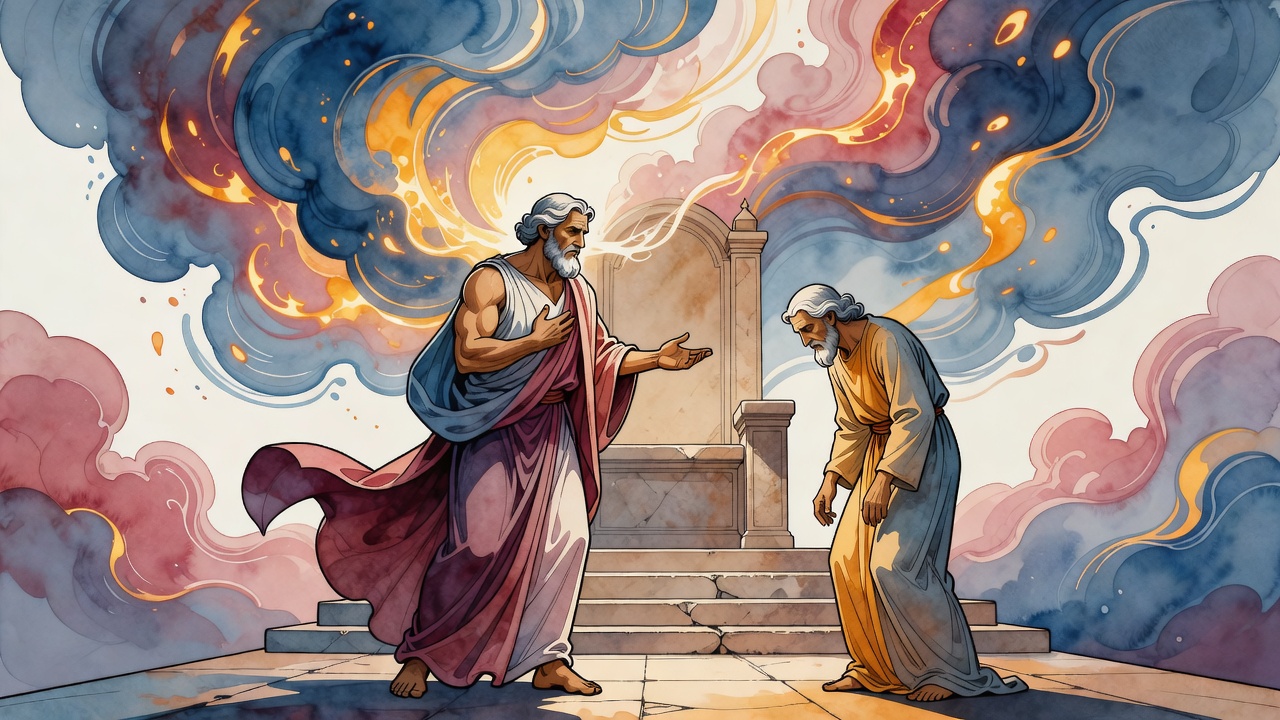
Simeon walked out of the back room alive and his brothers breathed again. They were barely clear of the city when the steward came up the road behind them.

Curated by Arthur · Told by Maggid ·
Table of Contents
  1. The Sentence Judah Carried Home
  2. Bread in Every City
  3. Peace to You, Said the Steward
  4. Why Have You Returned Evil for Good
  5. The Question Nobody Asked at the Pit
Joseph's Steward Accused the Brothers of Repaying Good With Evil Click for full size

The Sentence Judah Carried Home

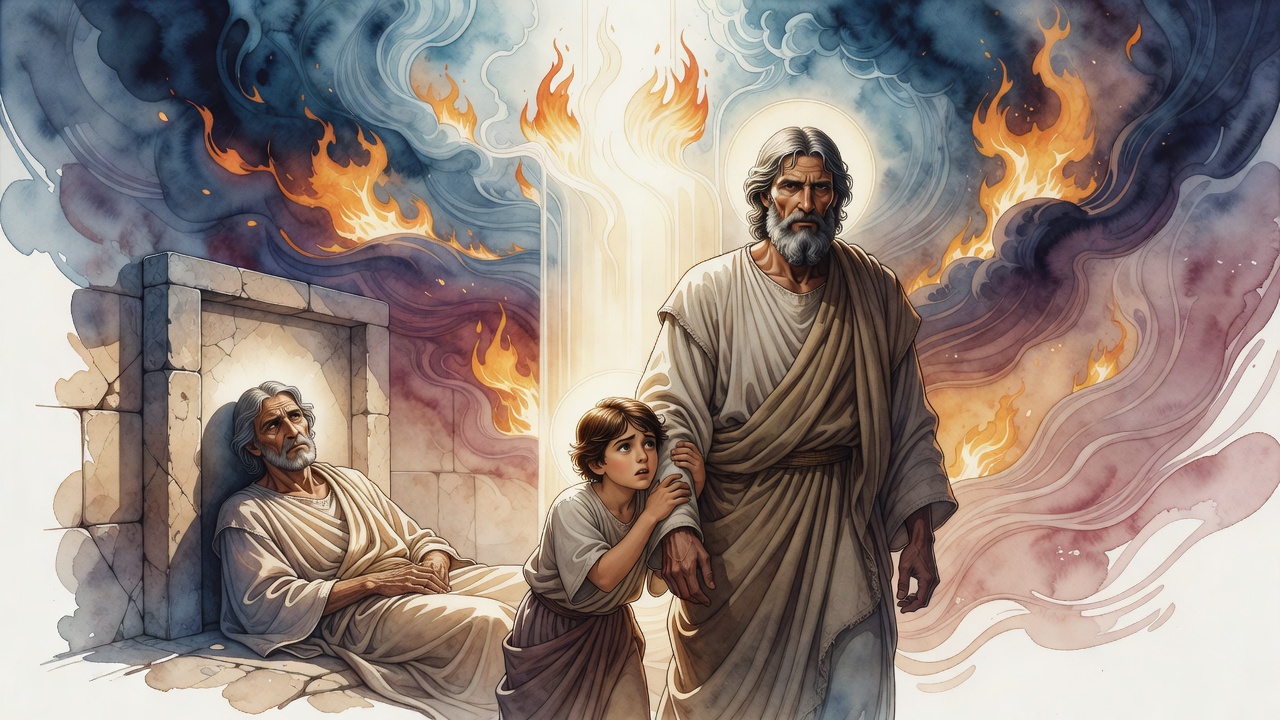
The sacks were light again, and Judah had to say it out loud a second time in front of his father. "The man attesting attested to us. You shall not see the sight of my face unless your youngest brother be with you."

Attesting attested. Not a warning. An oath, doubled the way a court doubles a word to make it hold. Jacob said nothing for a long moment, and into that silence the brothers began defending themselves. "The man demanding demanded about us and about our family. Is your father yet living? Have you a brother? We told him what there was to tell. Could we know he would say, bring your brother down?"

Demanding demanded. The Egyptian had not been making conversation. He had gone through their household name by name, like a man counting sheep he already owned. Reuben had tried to move the old man once and failed. Judah put his own body up as the surety instead, and Jacob, with the last of the grain on the floor of the tent, let Benjamin go.

Bread in Every City

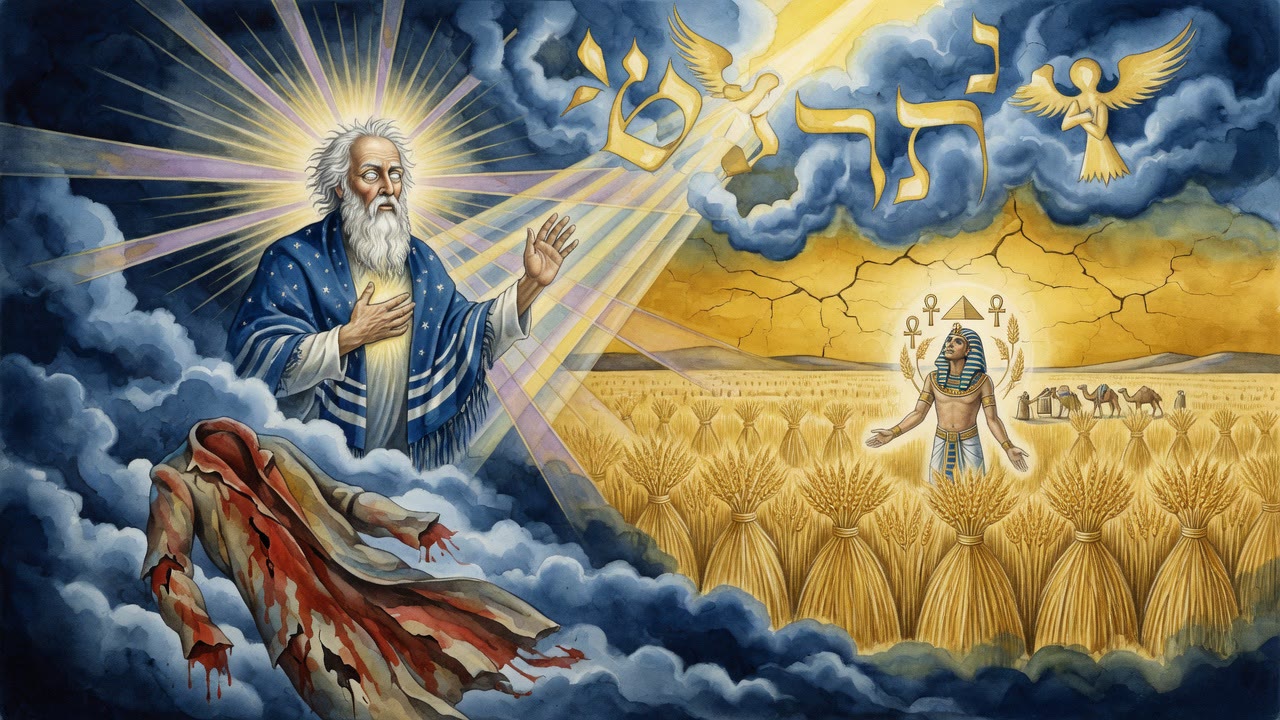
They went down the way everyone went down. Through the seven good years the produce had been gathered under Pharaoh's superintendents and set in the cities to be kept, so that what grew near a city stayed near that city. No single vault held Egypt's life. Every town on the road had its own doors and its own guards, and one man's order stood behind all of them.

Joseph had been in a pit once with nobody near enough to hear him. He had built a country where nobody would be more than a walk from bread. His brothers rode past those granaries for days without once asking whose hand had filled them.

Peace to You, Said the Steward

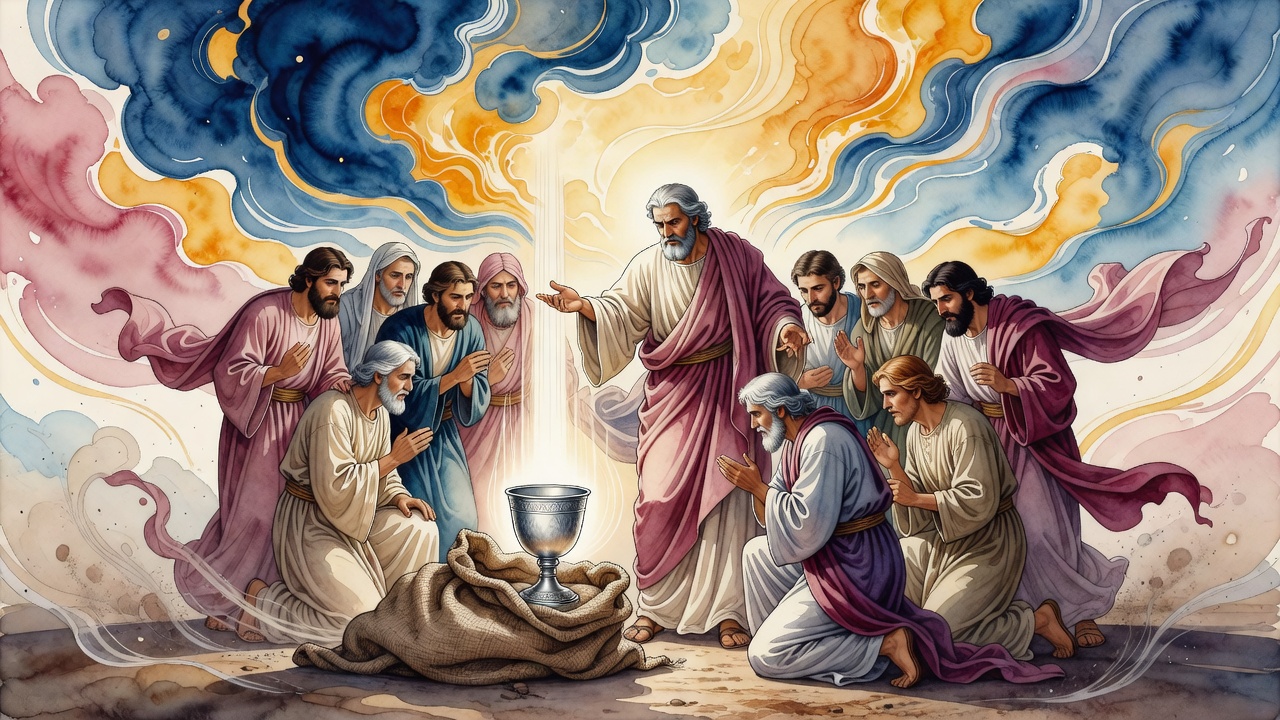
At the house they pushed the silver forward before anyone could accuse them of holding it. Every man's money had come home in the mouth of his own sack the last time, and they had carried it back down in their hands the whole way, like men transporting the evidence against themselves.

The steward would not take it. "Peace to you," he said. "Be not afraid of my lord. Your God and the God of your fathers gave you treasure in your sacks. Your money came to me."

Your God and the God of your fathers. An Egyptian house, an Egyptian officer, and out of his mouth came the phrase a Hebrew child learns at his grandfather's knee. His name was Menasheh, and Joseph had set him over the household. Nobody in the room did the arithmetic.

Then he went into the back and brought out Simeon, held there since the last trip. Simeon came into the light thinner than he had gone in, and his brothers breathed. They washed. They were seated by age, in an order no stranger in Egypt had any way of knowing, and they ate a good meal in the house of a man who was studying them over the rim of a cup.

Why Have You Returned Evil for Good

They had not gone far from the city. The donkeys had not settled into the road yet.

Behind them Joseph turned to Menasheh, whom he had appointed intendant of his house. "Arise, follow after the men. Overtake them and say to them, why have ye returned evil for good?"

The steward closed the distance and put the accusation into their backs at full voice. Why have you returned evil for good. Ten grown men stopped in the road with the dust still coming up around them, and the charge named a theft not one of them could account for.

The Question Nobody Asked at the Pit

It was the wrong crime and the right question. A steward on a horse had just accused them of repaying good with evil, and those words had been waiting twenty-two years for a mouth that would say them where the brothers had to stand and hear it.

A boy had kept his father's flock and carried word between the tents and walked out to Dothan alone because his father asked him to. They had answered that with a cistern, a torn coat dipped in blood, and a price in silver. Nobody had stood in front of them that afternoon and asked why. The question had gone into the ground with him.

Now it came up the road from behind, in Egyptian, from a steward they could not see was their nephew, on behalf of a man they could not see was their brother. Judah heard it. Simeon, three days out of a cell, heard it. Benjamin, who had not been born into any of it, heard it beside them.

They lowered every sack to the ground there in the road to prove themselves innocent, and while their hands worked at the ropes the sentence kept going around behind their ribs. Evil for good. Evil for good. Behind them the grain sat in its local vaults in every city, exactly where one man had ordered it kept, and the famine that had driven them down into Egypt had walked them to within arm's reach of the only person alive with the right to ask.


← All myths
From the tradition

Sources

5 sources

The texts behind this telling. Some cards carry a translation of the source; others are our own retelling of it, and each card says which. Every card links out to the original.

Targum Pseudo-Jonathan on Genesis 41:35Targum Pseudo-Jonathan on Genesis

Retold in our words. Read the original at the link below.The Targum of Jonathan ben Uzziel, trans. J. W. Etheridge, London, 1862 · Public Domain

There is a quiet engineering decision tucked inside Joseph's plan that the Torah narrates in a single breath but the Targum lingers on. Targum Pseudo-Jonathan on (Genesis 41:35) describes the process: collect "all the produce of those good years that are coming," gather it "under the hand of Pharoh's superintendents," and then, crucially, "set the produce in the cities to be kept."

Distributed storage, not a single silo

Joseph does not centralize the grain in one monumental royal warehouse. He distributes it. Every city becomes its own granary. The later verse (Genesis 41:48) clarifies the principle: "the produce of the fields which were round about a city he laid up therein." Grain grown near a city stayed near that city. The logic is brilliant. It reduces transport costs, protects against single-point failure (fire, vermin, theft), and ensures that when the famine hit, every population center had local reserves. The Aramaic paraphrase, which reached its final form in the seventh or eighth century CE, preserves this detail because it mattered: a famine plan is only as good as its last mile.

The takeaway

Abundance hoarded in one place is a single target. Joseph's wisdom was to scatter the surplus so that no village was more than a short walk from its own salvation.

Full source
Targum Pseudo-Jonathan on Genesis 43:3Targum Pseudo-Jonathan on Genesis

Retold in our words. Read the original at the link below.The Targum of Jonathan ben Uzziel, trans. J. W. Etheridge, London, 1862 · Public Domain

Judah steps up with the reminder. Targum Pseudo-Jonathan on (Genesis 43:3) records his words to Jacob: "The man attesting attested to us saying, You shall not see the sight of my face unless your youngest brother be with you."

The doubled verb

The Aramaic paraphrase, whose final redaction belongs to the Land of Israel around the seventh or eighth century CE, preserves the Hebrew's emphatic construction, ha'ed he'id, "attesting attested." In biblical Hebrew, doubling a verb intensifies it. Judah is saying that Joseph did not merely warn them; he swore. He testified. He made the condition absolute and formal. The Egyptian ruler's demand was not a bargaining position. It was a locked door.

Judah takes over from Reuben

Notice what has shifted. In Genesis 42, it was Reuben who tried to negotiate with Jacob and failed. Here in Genesis 43, Judah begins the argument. This is the same Judah who had originally proposed selling Joseph to the Ishmaelites (Genesis 37:26-27). The rabbinic tradition in Bereishit Rabbah 85:2, a commentary on Genesis compiled in the Land of Israel around the fifth century CE, reads Judah's emergence as leadership as the beginning of the Messianic line, the line that will run through his descendant David (Ruth 4:18-22) and beyond. The brother who once failed Joseph is now the brother who will save Benjamin.

The takeaway

Leadership in the Torah often emerges from the person who has the most to atone for. Judah's voice rises in this chapter because he needs it to.

Full source
Targum Pseudo-Jonathan on Genesis 43:7Targum Pseudo-Jonathan on Genesis

Retold in our words. Read the original at the link below.The Targum of Jonathan ben Uzziel, trans. J. W. Etheridge, London, 1862 · Public Domain

The brothers were defending themselves. Targum Pseudo-Jonathan on (Genesis 43:7) preserves their explanation: "The man demanding demanded (to know) about us, and about our family, saying Is your father yet living? Have you a brother? And we informed him according to the word of these things. Could we know that he would say, Bring your brother down?"

Another doubled verb

The Aramaic paraphrase, which took its final form in the Land of Israel around the seventh or eighth century CE, preserves the emphatic Hebrew construction: sha'ol sha'al, "demanding demanded." Joseph had not asked casually. He had interrogated them about their father, about whether brothers still lived, about the structure of the family. The rabbinic tradition in Bereishit Rabbah 91:10, compiled in the Land of Israel around the fifth century CE, notes how pointed the questions were, precisely the questions a long-lost sibling would ask, dressed up as the questions a suspicious vizier would ask.

We answered according to the word of these things

The brothers' defense is essentially: we could not have lied. The Egyptian ruler was asking for specifics, and we gave him specifics. The implicit claim is that their honesty was itself the problem. If they had been more evasive, Benjamin would not now be required. But honesty, once spoken, becomes binding. The truth about their family composition is now the exact lever Joseph is using against them.

Could we know?

The final question, could we know that he would say, Bring your brother down?, is both defense and lament. They could not have anticipated the demand. They answered the questions they were asked. And yet, the rabbinic tradition notes, this is the first time in the Joseph cycle that the brothers are held accountable for their own truthful words. Truth, too, has consequences.

The takeaway

Sometimes the truth we tell in one moment becomes the test we are given in the next. Honesty does not release us from the story it writes.

Full source
Targum Pseudo-Jonathan on Genesis 43:23Targum Pseudo-Jonathan on Genesis

Retold in our words. Read the original at the link below.The Targum of Jonathan ben Uzziel, trans. J. W. Etheridge, London, 1862 · Public Domain

The steward's reply is the gentlest sentence in all of Genesis 43. The brothers have just thrust their silver forward, insisting on their innocence. And the steward, Menasheh, in the Targum's identification, Joseph's own son, answers with four words of startling calm.

"Peace to you," he says. "Be not afraid of my lord. Your God and the God of your fathers gave you treasure in your sacks: your money came to me. And he brought out Shimeon to them" (Genesis 43:23). So Targum Pseudo-Jonathan preserves it.

Read the theology tucked into the middle of the sentence. Your God and the God of your fathers. Menasheh, raised in an Egyptian palace by an Egyptian mother, speaks the covenantal phrase that any Hebrew child would recognize, Elokei avoteichem, the God of your fathers. How does an Egyptian steward know it? Because Joseph raised him in it. Behind the mask of Egyptian officialdom, a Jewish grandchild is speaking a Jewish blessing.

Then Simeon walks out of the back room. He has been held hostage since the previous trip, mentioned in (Genesis 42:24). Now he appears, alive, uninjured, reunited with his brothers. The narrative had nearly forgotten him. The Targum does not. Simeon's release is stitched quietly into the larger scene because every piece of the broken family must be collected before the full revelation.

"Peace to you" is not merely manners. It is the Targum's way of telling us: the reunion has already begun, even though no one has yet been named.

Full source
Targum Pseudo-Jonathan on Genesis 44:4Targum Pseudo-Jonathan on Genesis

Retold in our words. Read the original at the link below.The Targum of Jonathan ben Uzziel, trans. J. W. Etheridge, London, 1862 · Public Domain

The brothers are barely out the city gate. The donkeys have not yet settled into their travel rhythm. Then a shout comes from behind them.

"They had not gone far from city, when Joseph said to Menasheh whom he had appointed the intendant of his house, Arise, follow after the men, overtake them and say to them, Why have ye returned evil for good?" (Genesis 44:4). So Targum Pseudo-Jonathan frames the pursuit.

The phrase madua shilamtem ra'ah tachat tovah, why have you returned evil for good, is the prosecutorial heart of the whole Joseph narrative. It is the question his brothers should have been asked, and should have asked themselves, twenty-two years earlier when they threw him into the pit. He fed his father's flock. He carried news. He obeyed his father's instruction. And they returned his good with a pit, a bloodied coat, and slavery in Egypt.

The same sentence comes flying back at them from behind, spoken by a steward they cannot see is their nephew, on behalf of a vizier they do not know is their brother. The Hebrew Bible is, among other things, a book that knows how to return exact phrasing to its rightful moment.

The Targum lets the accusation land without softening it. Joseph is not being cruel. He is staging the exact question that should have been asked the day he was sold. So that this time, his brothers can answer it not with silence but with their bodies. Judah, in the speech that follows in (Genesis 44:18-34), will finally provide the answer Joseph waited two decades to hear: take me instead.

Full source