5 min read

Chananiah Burned 300 Jugs of Oil to Save Ezekiel

The rabbis nearly voted to suppress the Book of Ezekiel. One sage locked himself away with 300 jugs of oil and refused to stop until the book was safe.

Curated by Arthur · Told by Maggid ·
Table of Contents
  1. The Night the Rabbis Came Closest to Burning a Prophet
  2. Three Hundred Jugs of Oil
  3. The Wheels That Survived
  4. The Dry Bones and the Faithfulness That Kept Them
Chananiah Burned 300 Jugs of Oil to Save Ezekiel Click for full size

The Night the Rabbis Came Closest to Burning a Prophet

The debate had been building for years, and when it finally came to a head, the target was not a foreign text or a pagan document. It was the Book of Ezekiel, one of Israel's greatest prophets, whose visions of the chariot, the dry bones, and the rebuilt Temple had shaped Jewish mysticism for centuries. The problem was not the visions. The problem was the law.

Tractate Shabbat and Tractate Chagigah in the Talmud record what happened. Several passages in Ezekiel appeared to contradict the written Torah directly. The priestly rules Ezekiel described for the future Temple did not match the rules Moses set down in Leviticus. A seven-day sacrifice in Ezekiel lacked the context that the text of Moses provided. The rabbis had kept Ecclesiastes, with its skeptical edges, and they had kept the Song of Songs, with its breathless sensuality. But Ezekiel had pushed things to the edge. The outcome was genuinely uncertain. Suppression was not an idle threat. A book that could not be reconciled with Torah could be ruled unfit to read.

Three Hundred Jugs of Oil

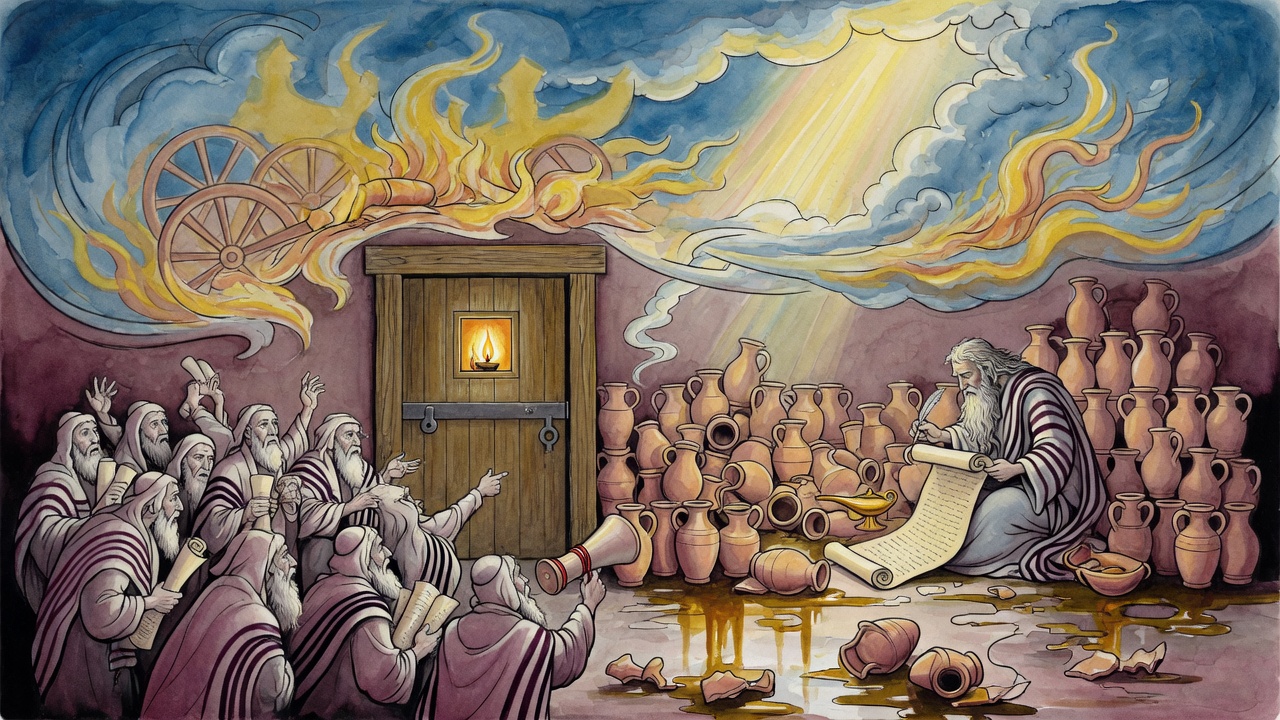
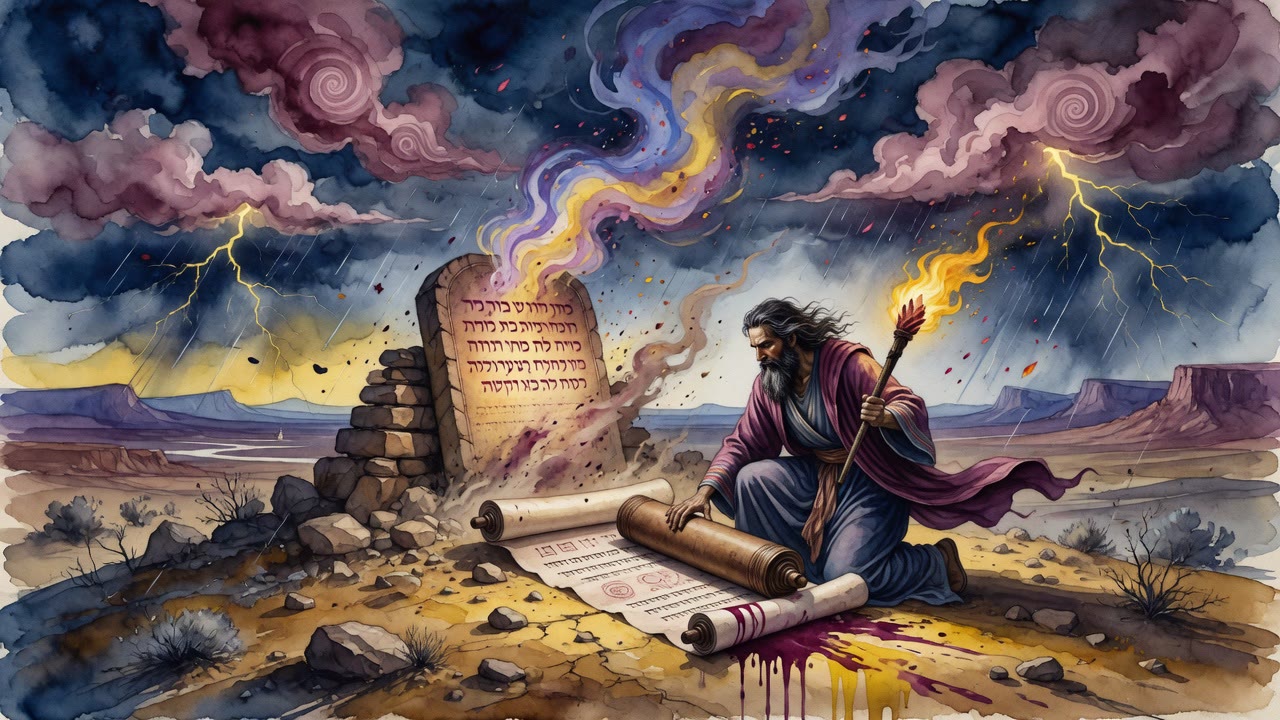
Chananiah ben Chizkiyah refused to let that happen. What he did was not heroic in the dramatic sense. He did not argue before a tribunal or make a speech. He bought three hundred jugs of oil, went to his upper chamber, locked the door, and worked. The three hundred jugs were not a metaphor. They were the fuel for the lamps that let him read and write through the nights, as many nights as it took to reconcile every apparent contradiction in the book, one by one, until the text was safe and the vote could not go against it.

Rav Yehuda, quoting Rav in the Talmud, issued what amounts to a blessing on the man: "Remember that man for good. Chananiah ben Chizkiyah. For had he not hidden the book of Ezekiel, they would have suppressed it." The phrase "hidden it" carries weight in this context. Chananiah hid himself with the book, sealing them both away from interruption until the work was done. The legend counts this as one of the most consequential acts of textual preservation in the history of Jewish letters.

The Wheels That Survived

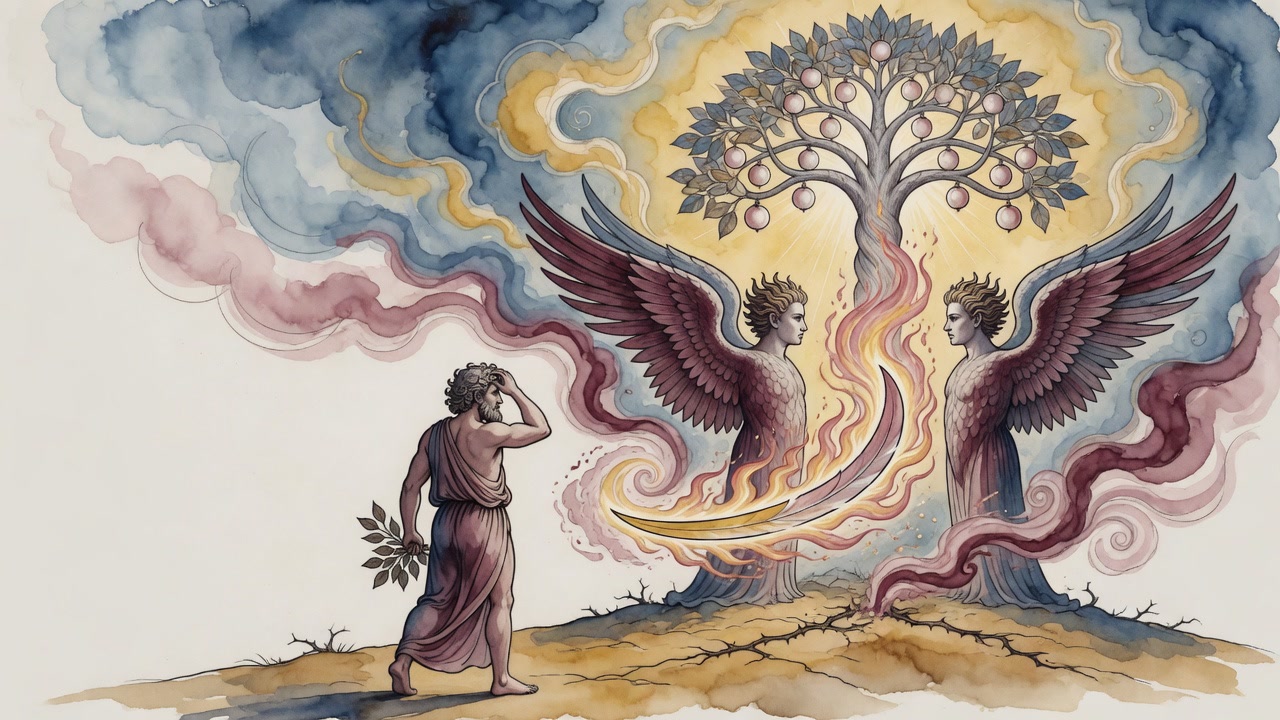
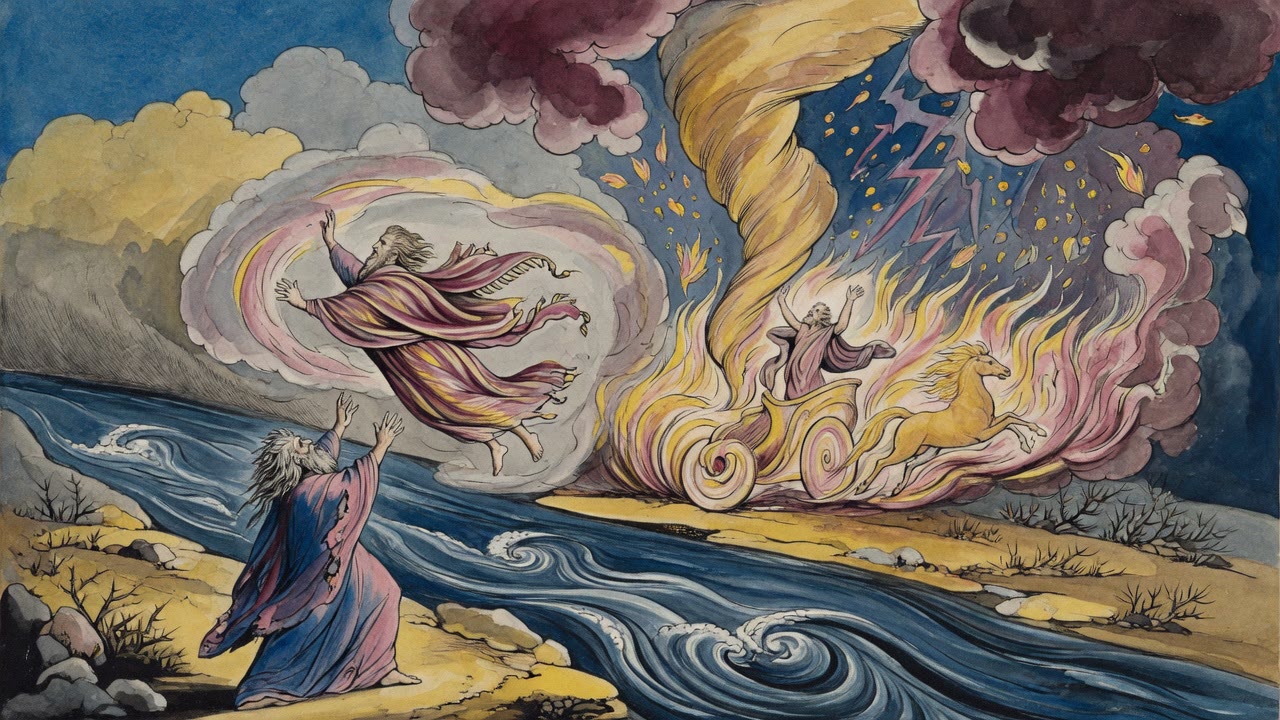
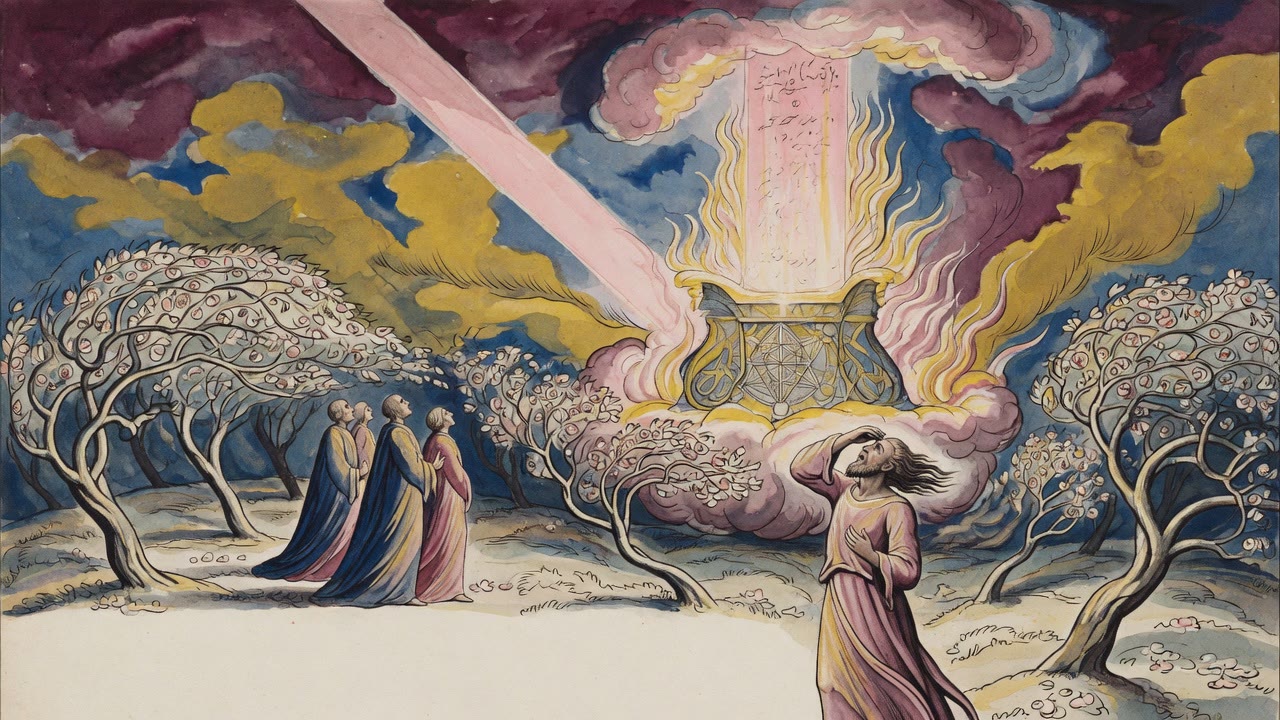
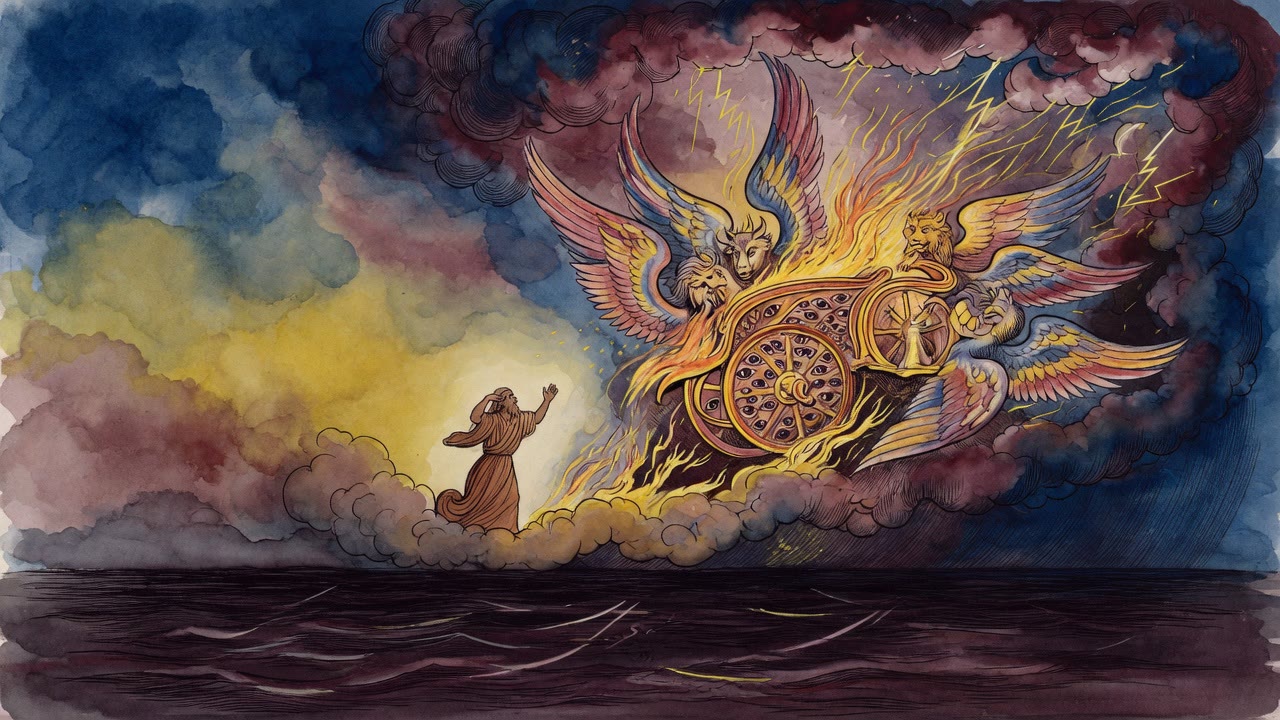
What Chananiah saved was not just forty-eight chapters of prophecy. He saved the vision of the chariot, the merkavah, the four-faced beings with wheels of fire that had become the foundation of Jewish mystical speculation. The opening chapter of Ezekiel was the text that licensed the entire Merkavah (the divine chariot) tradition: centuries of mystics who sought direct encounter with the throne of God, the Heikhalot literature, the later Kabbalistic frameworks that built on the imagery of divine light descending through levels of reality. Without Ezekiel 1, none of that architecture exists.

The Tikkunei Zohar, the thirteenth-century Kabbalistic expansion, read Ezekiel's vision of the wheel beside the living creatures as a map of Hebrew vowel points, finding within the chariot's geometry a theory of divine speech and cosmic structure. The wheel within the wheel was the segol and the tzerei, the dots beneath the letters by which God's word is given breath and form. Ezekiel's vision had become so integrated into the mystical anatomy of creation that losing it would have been like losing the key to a language.

The Dry Bones and the Faithfulness That Kept Them

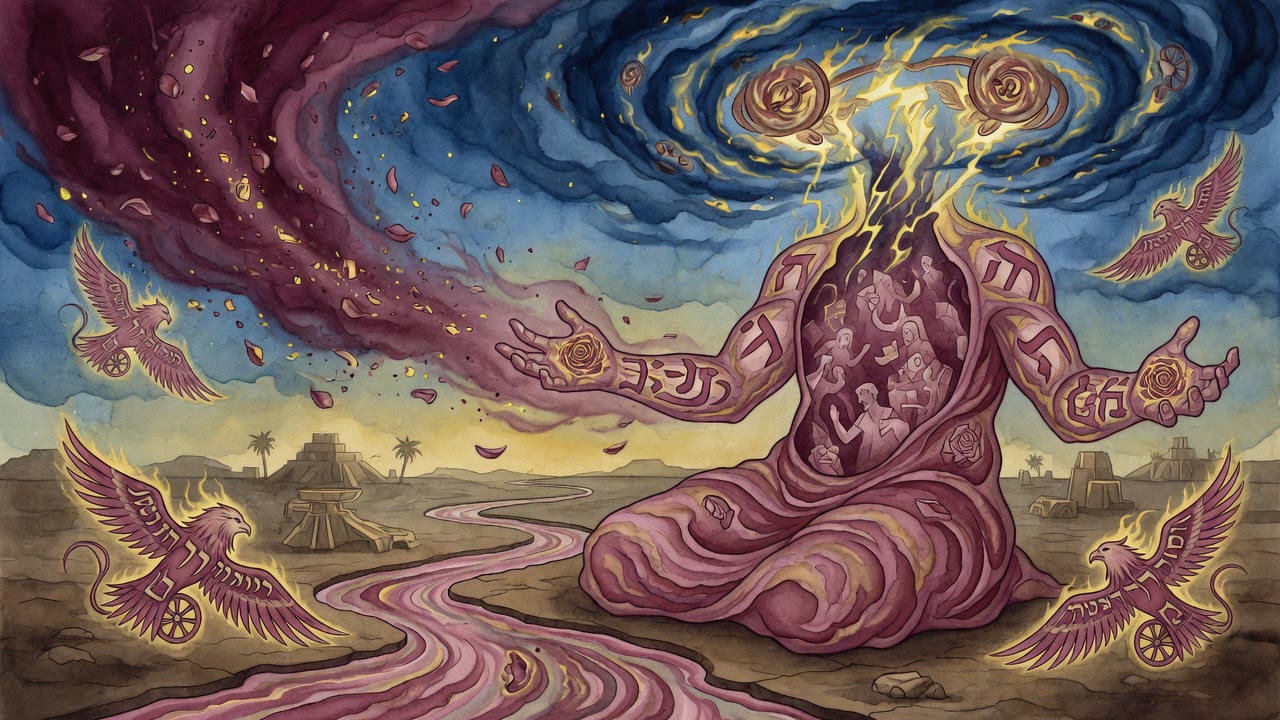
The third strand of the Ezekiel tradition is the one that cuts deepest: the valley of dry bones in Ezekiel 37, where God asks the prophet whether these bones can live, and Ezekiel answers with the only honest reply available - "You know." The bones reassemble, sinew and flesh and breath return, and an entire nation of dead rises to its feet. The legend that grew around this vision, preserved in Ginzberg's synthesis of rabbinic tradition, held that the prophecy was not merely symbolic. Ezekiel performed the resurrection himself. He prayed over those bones, and they came back, and then they died again. They were not the permanent resurrection that would come at the end of days. But they had been dead, and they had lived, and Ezekiel had been the one standing in the valley asking God to breathe into them.

Hananiah, Mishael, and Azariah, the three companions who survived Nebuchadnezzar's furnace, appear in this tradition as part of the same moment. The legend holds that some of those raised by Ezekiel were among the survivors of Babylon's furnace, carrying in their bodies the double mark of divine intervention. They had not burned. They had not stayed dead. Their survival was proof of the same principle: that what God had pronounced alive would not stay defeated.


← All myths
From the tradition

Sources

2 sources

The texts behind this telling. Some cards carry a translation of the source; others are our own retelling of it, and each card says which. Every card links out to the original.

Tikkunei Zohar 40:11Tikkunei Zohar

Retold in our words. Read the original at the link below.Sefaria-hosted English translation · CC-BY

Jewish mysticism, especially the Zohar, that foundational text of Kabbalah, is filled with exactly that feeling. back the curtain on a small but fascinating passage from Tikkunei (spiritual repair) Zohar 40, a section known for its deep dives into symbolism.

Vowel points. Sounds wild. it gets even more interesting.

The passage starts with a quote from the Book of Ezekiel (1:15): "And behold one wheel on the earth next to the 'angelic-beasts' (ḥayot).." Now, these aren't just any wheels and beasts. The Tikkunei Zohar connects this verse to something far more abstract. It's referring to the segol (ֶ), a vowel point in Hebrew that looks like three dots arranged in a triangle under a letter. This segol, The tzerei is another vowel point, two dots side-by-side under a letter.

Already feeling a bit lost? Don't worry! We’re diving into layers of symbolic meaning here.

The passage then brings in another verse, this time from Genesis (1:16): "..the two great luminaries.." and connects it to the ophanim. Ophanim (אופנים) are often translated as "wheels" or "whirlwinds," and in mystical tradition, they represent a high order of angels. The text says, "And so it is in the midst of the ophanimshureq (וּ)." The shureq is yet another vowel point, a dot inside the letter vav.

Think of it like this: one ophan above, one ophan below, and between them is the "Middle Pillar." This Middle Pillar is a core concept in Kabbalah, representing balance and harmony.

Then, the passage returns to Ezekiel: "And behold one wheel on the earth.." (Ez. 1:16) – and identifies it as ḥireq (ִ), another vowel point, a single dot under a letter, "which is below."

What does it all mean?

Well, the vowel points in Hebrew aren't just grammatical marks. In Kabbalah, they become symbols, keys to unlocking deeper layers of meaning within the text. They represent different levels of reality, different aspects of the divine. According to the Arizal's Kabbalah, vowel points serve as the "soul" for the letters, which are the "body."

The text concludes with a powerful, almost cryptic statement: "Each 'spark' is a י (Yod), and each 'firmament' is a ו (Vav)." The Yod (י) is the smallest letter in the Hebrew alphabet, representing a point of pure potential, a spark of divine energy. The Vav (ו) is a letter that connects, a link between different realms.

So, what's the takeaway? This short passage from Tikkunei Zohar invites us to see the world not just as it appears on the surface, but as a interplay of interconnected symbols. Even the smallest details – a vowel point, a single letter – can hold profound meaning, connecting us to the divine. Are we brave enough to start turning them?

Full source
Legends of the Jews 10:92Legends of the Jews

Retold in our words. Read the original at the link below.The Legends of the Jews by Louis Ginzberg (1909) · Public Domain

The book of Ezekiel gives us some potent imagery. And Jewish tradition, ever eager to fill in the gaps, expands on the story. to a fascinating, if somewhat gruesome, tale of resurrection, faith, and consequence.

The familiar story centers on Hananiah, Mishael, and Azariah – the three who defied Nebuchadnezzar and emerged unscathed from the fiery furnace. But what happened after that miracle? According to Ginzberg's retelling in Legends of the Jews, it wasn't all celebrations and back-patting. In fact, the story takes a rather dark turn.

Nebuchadnezzar, seemingly impressed but also enraged, confronts the Jews who did bow down to his idol. He accuses them of trying to corrupt his land with their wickedness, pointing out that they worshipped a powerless idol despite their God's proven ability to save. And then, he orders the execution of sixty thousand of them. Sixty thousand! It's a staggering number, a brutal demonstration of power.

Twenty years later, Ezekiel has a vision. God commands him to go to the Valley of Dura, the very place where Nebuchadnezzar erected his idol and massacred so many Jews. Here, God shows Ezekiel a valley filled with dry bones and asks a profound question: "Can I revive these bones?"

Now, Ezekiel's response is… interesting. He doesn't outright say "yes," full of faith and confidence. Instead, he hedges, giving an evasive answer. As we find in Legends of the Jews, this lack of complete faith comes at a price. As punishment, Ezekiel is destined to die in Babylon, denied burial in the sacred soil of Palestine. Ouch.

But back to the bones. God, despite Ezekiel's hesitation, proceeds. He sends dew from heaven, and miraculously, "sinews were upon them, and flesh came up, and skin covered them above" (Ezekiel 37:8). The bodies are reforming, but they're still lifeless.

Then comes the truly awe-inspiring part. God sends winds to the four corners of the earth, winds that unlock the "treasure houses of souls," bringing each soul back to its corresponding body. Imagine that – the cosmic retrieval of individual essences, the perfect fit of spirit and form.

And they all come back to life... almost.

There's one exception. One man remains lifeless. God explains to Ezekiel that this man is a usurer, someone who profited from lending money at exorbitant interest rates. He is deemed unworthy of resurrection. This detail, found in Legends of the Jews, highlights the importance of ethical behavior and the consequences of greed, even beyond the grave.

But that's not all! The people revived by Ezekiel included other specific groups, each with a story. There were the Ephraimites who tried to escape Egypt prematurely, before Moses led the Exodus. There were Jews who defiled the Temple with pagan practices and those who denied the resurrection itself! Talk about a mixed bag.

And then there were the beautiful youths. Ginzberg tells us that these were Jewish boys, captives in Babylonia, whose beauty was so striking that it drove Babylonian women to distraction. Driven by lust, the Babylonian women convinced their husbands to massacre the young men. Even in death, their beauty haunted them. God resurrected these youths as well.

So, what do we take away from this vivid, sometimes disturbing, story? It's a reminder of the power of faith, the consequences of idolatry and unethical behavior, and the enduring hope of resurrection. The image of the Valley of Dura, filled with dry bones brought back to life, speaks to the possibility of renewal, even in the face of unimaginable loss. But it also reminds us that our actions have consequences, not just in this life, but perhaps, according to the legend, in the next as well.

Full source