6 min read

David Begged God to Raise His Hand and Save Israel From Drowning

A strong man carried his son into the river and the current took the boy. David watched four kingdoms rise with that same undertow.

Curated by Arthur · Told by Maggid ·
Table of Contents
  1. Four Kingdoms Rose Like Flood Stages
  2. The Fifth Came With Strength
  3. The Oath Came Back Across the Water
  4. The Snake That Left the Room
  5. The Weak Man Cannot Measure the Strong
  6. The Hand Stayed in the Air

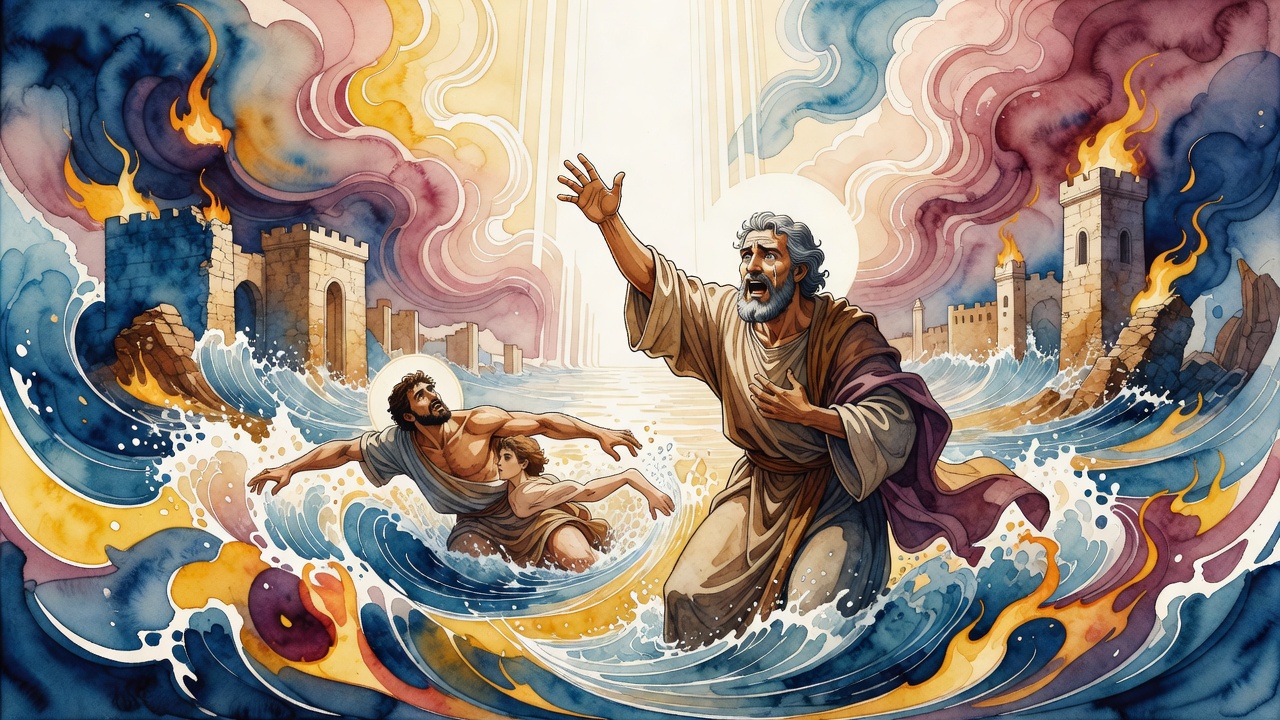
The strong man took his son's hand at the bank and walked into the river. It looked like an easy ford. Halfway across the current thickened, the cord between them went slack, and the boy was downstream before either of them understood that the grip had failed.
David Begged God to Raise His Hand and Save Israel From Drowning Click for full size

He came up once, with air enough for one sentence. "Father, raise your hand and save me from drowning."

Four Kingdoms Rose Like Flood Stages

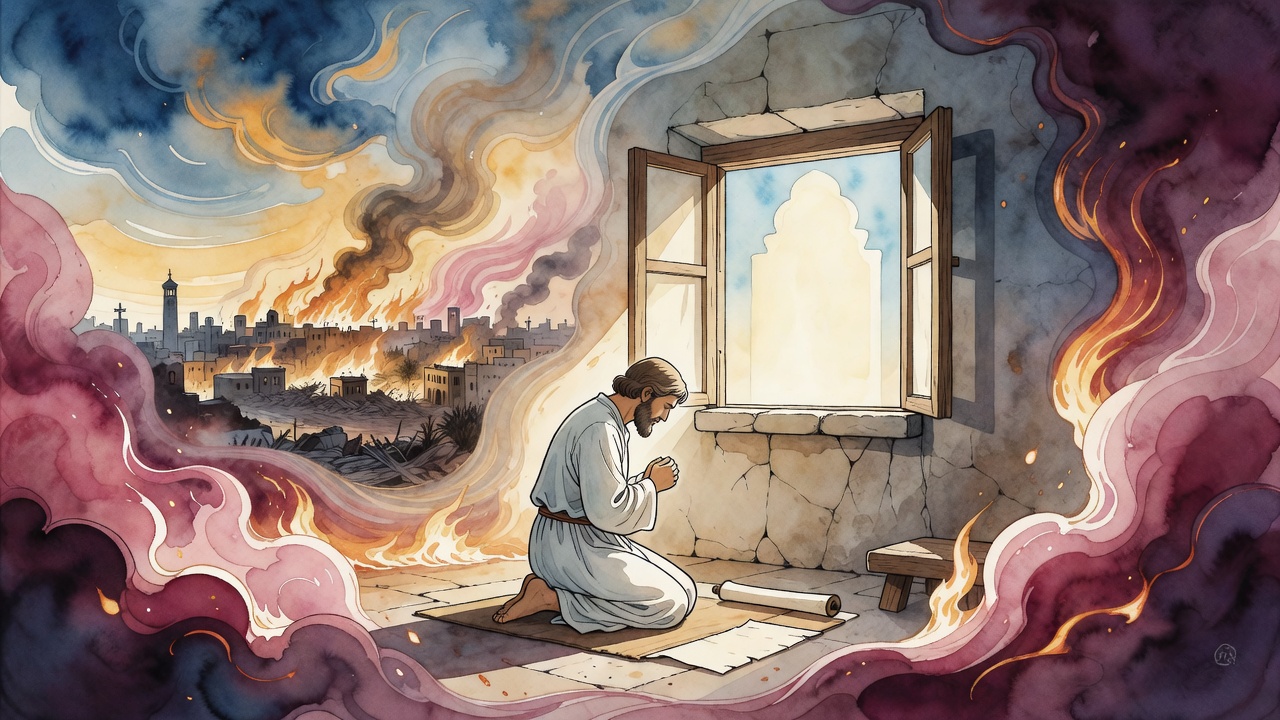
David was not standing on any riverbank. He sat with the spirit on him and watched the kingdoms that would hold Israel down, and they came at him the way water comes at a man who has misjudged a crossing. One rose, and the Holy One stood beside him. A second, and the Holy One stood beside him again. A third. A fourth. Four times David got to his feet inside the vision, and four times he was not standing there alone.

Rabbi Pinchas counted those standings afterward, in the name of Rabbi Oshaya. Five places in the Book of Psalms where David rises. Four of them wear a kingdom's name.

The fifth had no name David recognized.

The Fifth Came With Strength

Gog arrived last and arrived differently. Not a power that rules a while and passes, but one that comes with strength and does not plan to leave. David looked for a second rescuer somewhere in that water and could not find one. The nations roared the way seas roar. Israel was sinking in deep mire where there was no place to stand.

"My Lord," David said, "there is no one to join with her except You."

Then he borrowed the drowning boy's sentence. "Arise, Lord, lift up Your hand."

A king with an army does not usually ask for a hand. David had led men into worse odds than the vision was showing him and had never once needed heaven to reach down into the water after him. This was different. In the vision there was nobody left on the bank.

He knew what made the current so heavy, too. It was not only the armies. Sin thickened the water under Israel until it ran faster than any of them could swim, and David had been in that water himself, in the rooftop hours and in everything that came after, and he knew its temperature. So he asked for two things in one breath, an arm and a memory. Arise, and remember the oath.

The Oath Came Back Across the Water

The answer did not come as thunder. It came as a swearing, the kind a man makes when he intends to be held to it. "As your soul lives, I raise My hand."

The gesture was old. That hand had gone up to heaven before, and later Isaiah would see the public version of it, the hand lifted toward the nations where everyone on both banks could watch it rise. What came attached to it was not the promise of dry ground. When you pass through the waters, I will be with you. Not around them. Through.

The father in the river had never been weak. He had been waiting for the cry that admits the cord is gone.

The Snake That Left the Room

In a study house generations later, Rabbi Elazar ben Pedat set two lines of a psalm side by side and would not let his students step over the join. To Him who alone does great wonders. And immediately after it, in the same breath of praise, to Him who made the great lights.

Bread belongs at that table beside the splitting of the sea, he said. Nobody survives without the wonder. Nobody survives without supper either.

Then he gave them the snake. A man lies down on his bed in the heat of the afternoon. On the floor under him a snake waits. The man swings his legs over the side, stands, walks out of the room, and the snake goes the other way. That evening he eats, argues with his wife about nothing, sleeps. He will never learn that the room held a decision in it. Only one party to that afternoon can count what happened, and it is not the man.

The Weak Man Cannot Measure the Strong

Two men, Rabbi Elazar went on. One strong, one weak. Ask the weak one to praise the strong one's strength and he will miss in both directions, because he has never carried that weight in his own arms. Only the strong man knows what the strong man lifts.

So who can speak the mighty deeds of the Lord? Not the rescued. They count only the rescues loud enough to hear.

Rabbi Samuel answered him from across the room. Those who sit in Torah day and night, he said. Not because study replaces the shout from the water, but because a man who has spent years inside the verses about oaths and crossings will recognize a hand already raised over a small current, and will have the right sentence in his mouth before the big one arrives.

The Hand Stayed in the Air

Nothing drained out of David's vision. The four kingdoms kept their places in it. Gog still waited at the end of the line with his strength.

What changed was the silence. An arm stood above the surface where a drowning child could see it, and the water had not dropped a finger's width, and the father was still in the river with him. That was the whole of the answer. Not a dry crossing. Company in the wet, and a hand up.

David wrote the standings into his book in order, so that the next generation to go under would know which sentence to shout.


← All myths
From the tradition

Sources

2 sources

The texts behind this telling. Some cards carry a translation of the source; others are our own retelling of it, and each card says which. Every card links out to the original.

Midrash Tehillim 17:8Midrash Tehillim

Retold in our words. Read the original at the link below.Rabbi Mike Feuer, Jerusalem Anthology · CC-BY

The ancient Jewish texts resonate deeply with this feeling, offering glimpses into moments where even David, the legendary king, felt overwhelmed. to a fascinating passage from Midrash Tehillim, a collection of rabbinic interpretations of the Book of Psalms, that speaks directly to this struggle.

Rabbi Pinchas, quoting Rabbi Oshaya, reveals a deeper layer. He says that David, through divine inspiration, envisioned four perilous situations for Israel, each mirroring four kingdoms that would try to dominate them. And in each case, God stood ready to help.

Then comes a fifth, even more intense challenge: the kingdom of Gog. This kingdom, according to the vision, would come against Israel with immense power, demanding that God intervene directly. "Arise, Lord, lift up Your hand," they'd say. David, witnessing this, pleads with God, "My Lord, there is no one to join with her except You."

What does it mean to "Arise, Lord, lift up Your hand?" The Midrash (rabbinic interpretive commentary) uses a beautiful analogy to explain. He holds the boy's hand, guiding him. But as they reach the center, the current intensifies, the rope snaps, and the son is swept away. Desperate, the son cries out, "Father, raise your hand and save me from drowning!"

This powerful image reflects Israel's plight. The four kingdoms, likened to turbulent waters – as (Isaiah 17:12) says, "Woe to the multitude of many people" – threaten to overwhelm them. Israel, as (Psalm 69:3) laments, is "sinking in deep mire, and there is no standing." If not for Ha-Kadosh Barukh Hu (הקדוש ברוך הוא), the Holy One, blessed be He, being with them, they would surely be lost. (Isaiah 43:2) reassures us, "When you pass through the waters, I will be with you."

David, realizing that sin can amplify these threats, turning them into a river's relentless current, cries out, "Arise, O Lord, with Your hand, save me from drowning!" He implores, "Arise, O Lord, remember Your oath" (Psalm 10:12).

And God responds. "As your soul lives," He proclaims, "I raise My hand," echoing the words of (Deuteronomy 32:40), "For I lift up My hand to heaven." And as (Isaiah 49:22) promises, "Behold, I will lift up My hand to the nations."

So what does this all mean for us today? God's hand is there, ready to lift us up. And sometimes, isn't that exactly the kind of reminder we need?

Full source
Midrash Tehillim 106:1Midrash Tehillim

Retold in our words. Read the original at the link below.Rabbi Mike Feuer, Jerusalem Anthology · CC-BY

Midrash Tehillim turns to The Quiet Everyday Miracles Israel Took for Granted.

The Midrash Tehillim, a collection of rabbinic interpretations of the Book of Psalms, dives right into this question in its discussion of Psalm 106. "Hallelujah! Give thanks to the Lord, for He is good; His lovingkindness is everlasting. Who can speak of the mighty deeds of the Lord, or can proclaim all His praises?" (Psalm 106). But it also begs the question: how do we even begin to praise something so vast, so all-encompassing?

As (Psalm 40:6) puts it, "Many wonders and deeds You have done, O Lord my God; none can compare with You. If I were to proclaim and declare them, they are more than can be numbered." It's overwhelming! We're surrounded by the Divine, constantly being supported, but how often do we really see it?

Rabbi Elazar ben Pedat offers a beautiful insight. He connects Psalm 106 with (Psalm 136:4), "'To Him who alone does great wonders, for His lovingkindness is everlasting.' What is written after this? 'To Him who made the great lights, for His lovingkindness is everlasting.'" (Psalm 136:7). What’s the link? Rabbi Elazar argues that providing sustenance – the everyday things we need to survive – is just as miraculous as the dramatic splitting of the Red Sea!: we can’t live without food, just as we couldn't have survived without those monumental miracles.

He then gives a striking example. Imagine someone lying in bed with a snake nearby. The person gets up, and the snake slithers away. Did they even realize they were in danger? Did they recognize the unseen hand that protected them? So often, God’s wonders are subtle, hidden beneath the surface of our daily lives. Only God, he says, truly knows the extent of the miracles performed for us.

It’s like the parable of the strong man and the weak man. The weak man can’t truly appreciate the strong man's power, because he doesn't comprehend its full extent. But the strong man, understanding his own capabilities, can appreciate his own strength. Similarly, how can we, with our limited understanding, truly grasp the full scope of God’s might?

Rabbi Samuel adds another layer to this idea. He asks, "Who can speak of the Lord's praises like us, who are engaged in Torah study day and night?" Or, in another interpretation, "Who can recount such as we, who are occupied with Torah for all our needs?" Those who dedicate themselves to learning and living by the Torah, are perhaps best equipped to recognize and appreciate God's wonders. By immersing ourselves in Torah, we are opening our eyes to the subtle miracles all around us, the miracles woven into the fabric of existence.

So, the next time you find yourself overwhelmed by the vastness of the Divine, remember the snake that slithered away unseen. Remember the daily sustenance that keeps you alive. And remember the power of Torah to open your eyes to the miracles, both big and small, that surround us every single day. Maybe the key to praising God isn't about listing every grand act, but about recognizing the constant, quiet miracles that fill our lives.

Full source