5 min read

David Fought Amalek Two Nights in the Dark

From twilight to the next evening David struck Amalek while God lit his lamp, after Israel was charged to blot that enemy out.

Curated by Arthur · Told by Maggid ·
Table of Contents
  1. Twilight to Evening
  2. My Lamp and Yours
  3. Three Commands
  4. The Horse and the Light

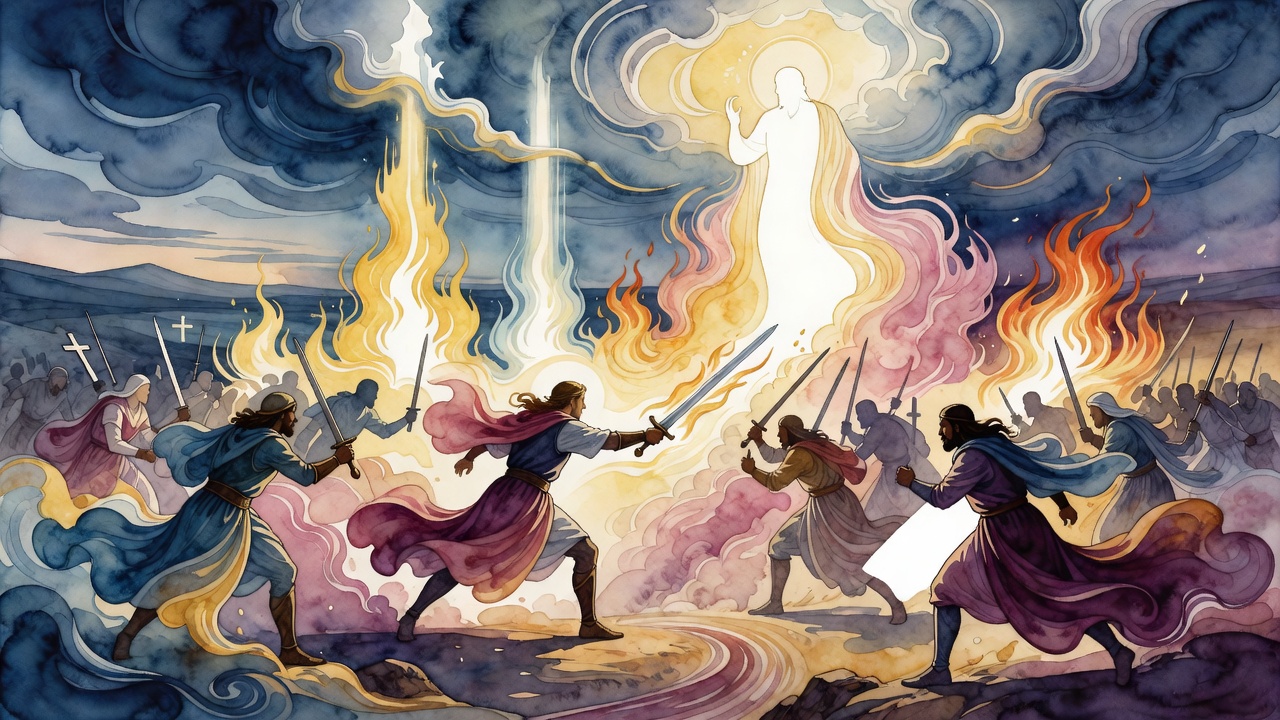
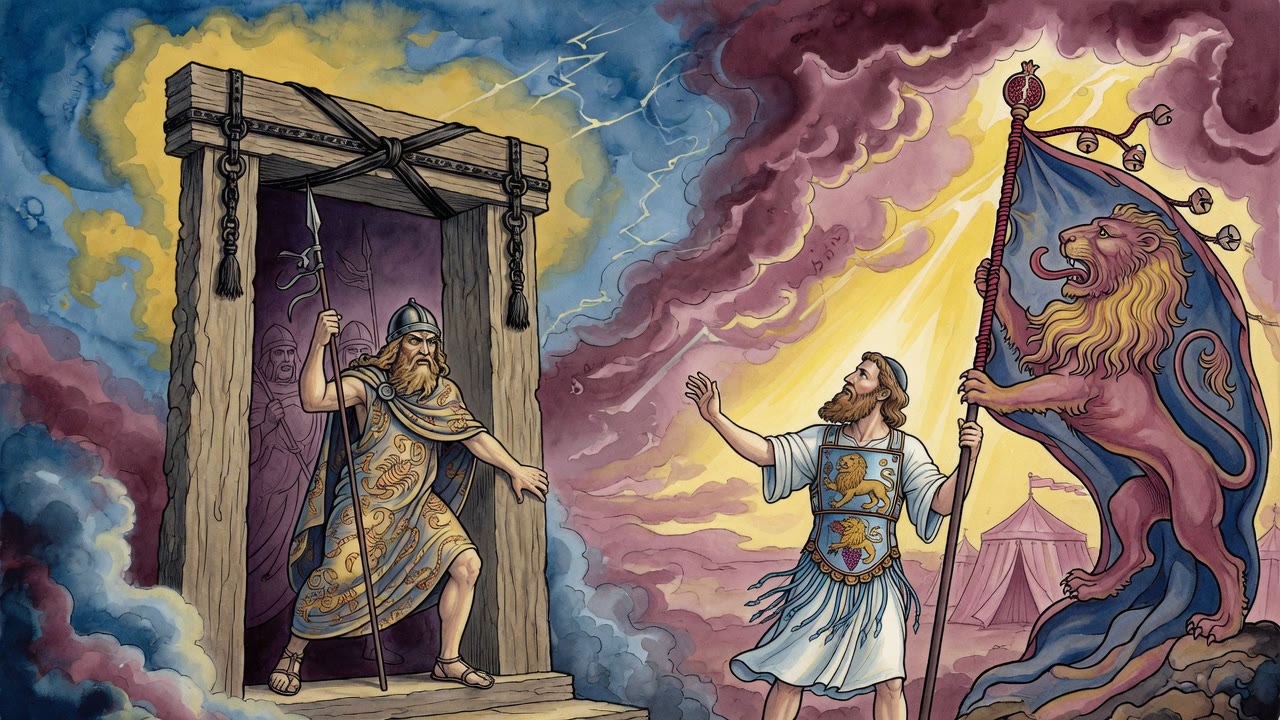
David's arms shook from a fight that refused to end with the sun. From twilight until evening of the next day he struck Amalek, and the dark kept trying to own the field. Men fell. Dust rose. Hours stacked without a clean edge between night and day.

David Fought Amalek Two Nights in the Dark Click for full size

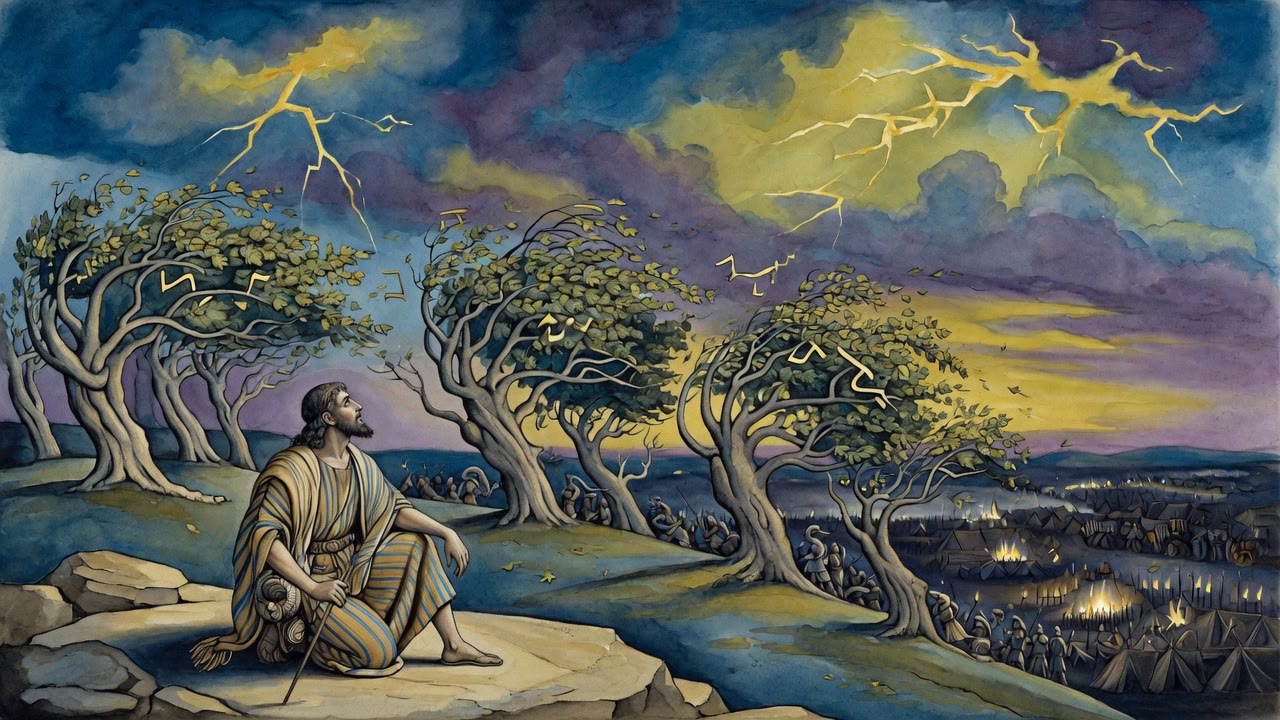
"For You will light my lamp." Not a metaphor first. A battlefield need. Feet had to see rock. Hands had to see necks.

Twilight to Evening

Sweat ran into David's eyes and still he found the next shape to strike. The legion was thick enough to swallow a camp. The lamp of Israel burned because heaven refused to let Amalek finish the night.

This was not a border skirmish. It was two nights and a day of refusing to become prey.

My Lamp and Yours

Bar Kappara heard a bargain. "My lamp is in your hand, and your lamp is in My hand. If you light My lamp, I will keep yours." Lighting God's lamp means keeping commandments when panic is easier. Keeping David's lamp means the Presence does not abandon the man who will not drop the work.

Goodness does not enrich God. The partnership still stands. David fights. Heaven lights. Covenant under pressure, not commerce.

Three Commands

Upon entering the land, Israel received three duties. Appoint a king. Build the Temple. Cut off the seed of Amalek. Kingship without sanctuary drifts. Sanctuary without the fight against Amalek leaves a wound under the altar's shadow.

"You shall blot out" and "I will utterly blot out" stand side by side. After Amalek raises a hand against Jerusalem, called God's throne, heaven claims the final erasing. David later refuses to launder Amalek through a quick conversion story at the edge of Saul's corpse.

The Horse and the Light

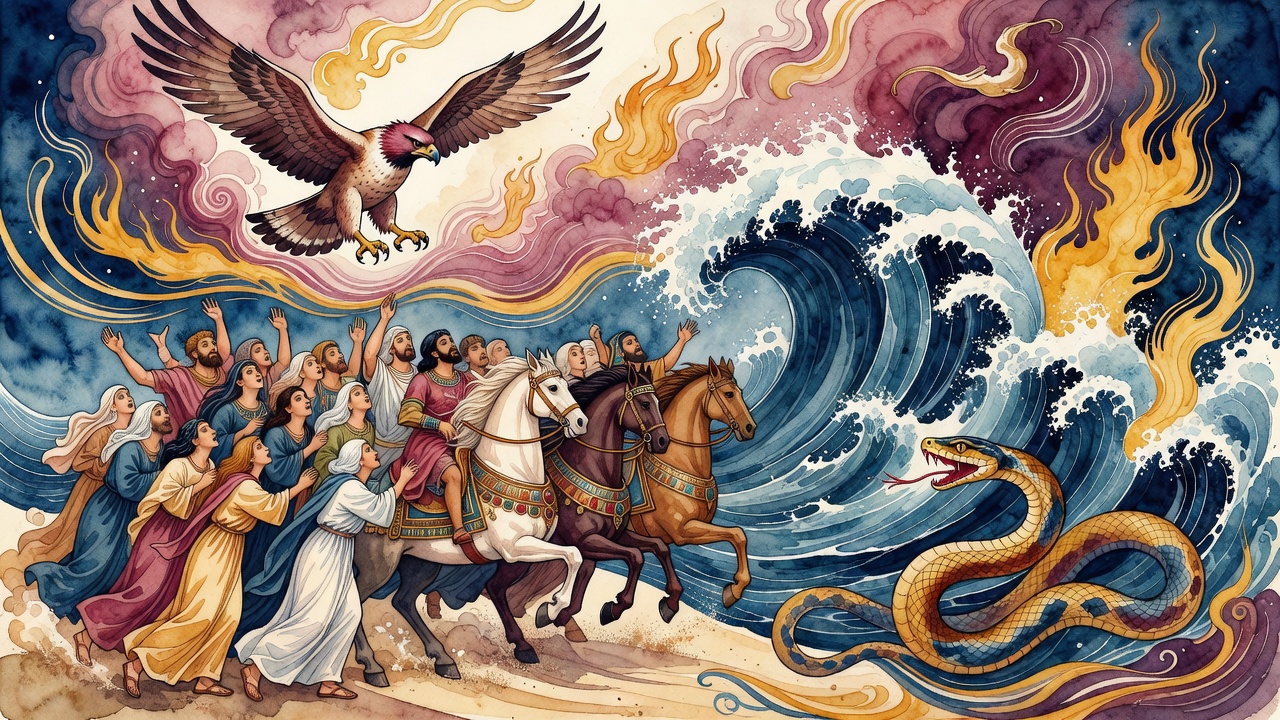
Pharaoh readied horses with pearls and still drowned. The horse is prepared. Salvation belongs to the Lord. David prepared men and steel. The lamp was not forged in Ziklag's smithy.

When the fight broke, the camp was wreckage and the lamp still burned. David wiped blood from his wrist and did not thank his own arm first.

The pressure did not lift for those standing inside this hour. Someone swallowed. Someone clenched a fist around cloth or staff or coin. The next breath decided more than any later summary would admit. What looked like a small refusal or a small courage became the hinge the whole house turned on. Neighbors would argue the details by morning, but the people inside the moment carried the exact weight in their bones.

The pressure did not lift for those standing inside this hour. A throat tightened. Someone clenched a fist around cloth or staff or coin. The next breath decided more than any later summary would admit. What looked like a small refusal or a small courage became the hinge the whole house turned on. Neighbors would argue the details by morning, but the people inside the moment carried the exact weight in their bones.

The pressure did not lift for those standing inside this hour. A sandal scraped stone. Someone clenched a fist around cloth or staff or coin. The next breath decided more than any later summary would admit. What looked like a small refusal or a small courage became the hinge the whole house turned on. Neighbors would argue the details by morning, but the people inside the moment carried the exact weight in their bones.

The pressure did not lift for those standing inside this hour. A child went still. Someone clenched a fist around cloth or staff or coin. The next breath decided more than any later summary would admit. What looked like a small refusal or a small courage became the hinge the whole house turned on. Neighbors would argue the details by morning, but the people inside the moment carried the exact weight in their bones.

The pressure did not lift for those standing inside this hour. A door latch clicked. Someone clenched a fist around cloth or staff or coin. The next breath decided more than any later summary would admit. What looked like a small refusal or a small courage became the hinge the whole house turned on. Neighbors would argue the details by morning, but the people inside the moment carried the exact weight in their bones.

The pressure did not lift for those standing inside this hour. Oil smoke stung eyes. Someone clenched a fist around cloth or staff or coin. The next breath decided more than any later summary would admit. What looked like a small refusal or a small courage became the hinge the whole house turned on. Neighbors would argue the details by morning, but the people inside the moment carried the exact weight in their bones.

The pressure did not lift for those standing inside this hour. A coin rolled and stopped. Someone clenched a fist around cloth or staff or coin. The next breath decided more than any later summary would admit. What looked like a small refusal or a small courage became the hinge the whole house turned on. Neighbors would argue the details by morning, but the people inside the moment carried the exact weight in their bones.


← All myths

From the tradition

Sources

3 sources

The texts behind this telling. Some cards carry a translation of the source; others are our own retelling of it, and each card says which. Every card links out to the original.

Midrash Tehillim 18:22Midrash Tehillim

Retold in our words. Read the original at the link below.Rabbi Mike Feuer, Jerusalem Anthology · CC-BY

King David knew that feeling well. And it's his story, illuminated by the ancient wisdom of Midrash Tehillim (a collection of rabbinic teachings on the Book of Psalms), that offers us a spark of hope.

The verse A simple line. But Midrash (rabbinic interpretive commentary), that beautiful, imaginative way of interpreting scripture, takes it to a whole new level. It asks: What does it really mean for God to light David's lamp?

Rabbi Yehoshua ben Levi dives right into the thick of it. He pictures David facing a massive legion of Amalek, that ancient enemy of the Israelites. Not just a skirmish, not just a border dispute, but a full-blown, two-night-and-a-day battle! As it says in (1 (Samuel 30:1)7), "And David struck them from twilight until evening the next day."

So, here's David, exhausted, outnumbered, fighting in the dark. Who illuminated the night for him? Rabbi Yehoshua ben Levi doesn't hesitate: "The Holy One, blessed be He, illuminated for him." God Himself! That's why the verse says, "For you will light my lamp."

But there's more. Bar Kappara offers another layer to this interpretation. He imagines God saying to David, "My lamp is in your hand, and your lamp is in My hand. If you light my lamp, meaning if you keep my commandments, I will keep yours."

God's light, His presence, His protection – it's all there, but it requires our participation. It requires us to "light His lamp" by upholding the mitzvot (commandments). And in return, God promises to keep our lamp burning bright. As it says in (Psalm 16:2), a verse that is connected to this very idea, we acknowledge that our goodness does not extend to God, but we commit to a path of righteousness nevertheless.

Isn’t that powerful? It’s not just about divine intervention swooping in to solve all our problems. It's about a reciprocal relationship, a sacred agreement. We strive to do what's right, to live according to God's teachings, even when it's difficult, even when it's dark. And in doing so, we invite God's light into our lives, into our struggles, into our world.

Remember that even in the darkest night, a light can be kindled. And remember that you have a role to play in igniting it.

Full source
Midrash Tanchuma, Ki Teitzei 11Midrash Tanchuma

Retold in our words. Read the original at the link below.Townsend 1989 translation of Midrash Tanhuma, S. Buber Recension · CC-BY

(Deut. 25:19:) “And it shall come to pass when the Lord your God grants you rest [… you shall blot out the remembrance of Amalek].” R. Azariah and R. Judah bar Simon said in the name of R. Judah bar Il'ay, “Israel was given three commandments on their entrance to the land: To appoint a king over themselves, as written (in Deut. 17:15), ‘You shall surely place a king over yourself.’ To build the Temple, as written (in Exod. 25:8), ‘And make Me a sanctuary.’ To cut off the seed of Amalek, as stated (in Deut. 25:19), ‘[…] you shall blot out the remembrance of Amalek.’” R. Joshua ben Levi [said] in the name of R. Alexandri, “One text says (in Deut. 25:19), ‘you shall blot out the remembrance of Amalek,’ while another text says (in Exod. 17:14), ‘I will utterly blot out the remembrance of Amalek.’ How are these two texts to be harmonized? Before [the Amalekites] raised their hands against the [heavenly] throne, ‘you shall blot out.’ When they had raised their hands against the [heavenly] throne, ‘I will blot out.’” Can flesh and blood possibly raise its hand against the throne of the Holy One, blessed be He? It is simply because they destroyed Jerusalem, since it is written (in Jer. 3:17), “For at that time they shall call Jerusalem the throne of the Lord.” It is therefore written (in Exod. 17:14), “I will utterly blot out.” And it is stated (Exod. 17:16), “Because a hand is upon the throne of the Lord, the Lord has a war [with Amalek from generation to generation].” It is taught in the name of R. Il'ay: The Holy One, blessed be He, swore an oath and said, “[By] My right hand, [by] My right hand, [by] My throne, [by] My throne, [I swear that] if gentiles come from any of the peoples, them I will accept; but those from the seed of Amalek I will not accept.” And David also acted in this way, as stated (in II Sam. 1:13), “And David said unto the young man who had told him, ‘Where do you come from?’ Then he said, ‘I am the son of an Amalekite proselyte.’” R. Isaac said, “He was the son of Doeg the Edomite.” (II Sam. 1:16:) “Then David said to him, ‘Your blood be upon your own head […].’” [This is what one reads, but] the written text (ketiv) is “Your bloods,” [meaning] You shed a lot of bloods; you killed [the inhabitants of] Nob, the city of priests.(Exod. 17:16:) “From generation to generation.” The Holy One, blessed be He, said, “’From generation to generation,’ I am [keeping] after them (i.e., after the Amalekites) for generations of generations.” R. Eliezer, R. Joshua, and R. Jose differ. R. Eliezer says, “From the generation of Moses to the generation of Samuel.” R. Joshua says, “From the generation of Samuel to the generation of Mordecai and Esther.” And R. Jose says, “From the generation of Mordecai and Esther to the generation of the messianic king, which itself equals three generations.” And where is it shown that the generation of the messianic king equals three generations? Where it is stated (of the messianic king in Ps. 72:5), “Let them fear You as long as the sun endures and as long as the moon, for a generation and generations.” [The singular] generation equals one, [and the plural] generations equals two, for a total of three. R. Berekhyah said in the name of R. Abba bar Kahana, “As long as the seed of Amalek remains alive in the world, it is as though a wing (kanaf) is hiding the [divine] face. When the seed of Amalek has passed from the world, (in Is. 30:20), “your Teacher (i.e., the Holy One, blessed be He,) will no longer be hidden (yikanef).” R. Levi says in the name of R. Hama bar Hanina, “As long as the seed of Amalek is in the world, the [divine] name will not be at peace (literally, whole) and the [divine] throne will not be at peace. When the seed of Amalek passes from the world, the throne will be at peace, and the name will be at peace.” What is the evidence? That which is stated (in Ps. 9:7), “The enemy is no more, in everlasting ruins, [and you have uprooted their cities, their very memory has perished].” What is written after that (in vs. 8), “But the Lord sits [enthroned] forever; He has established His throne for judgment.” Ergo, the name is at peace, and the throne is at peace. Amen, and so may it be His will!

Full source
Midrash Tanchuma, Shoftim 13Midrash Tanchuma

Retold in our words. Read the original at the link below.Townsend 1989 translation of Midrash Tanhuma, S. Buber Recension · CC-BY

When you go out to war and you see horse and chariot, a people more numerous than you (Deuteronomy 20:1): This is what is stated in the verse (Proverbs 21:31), "The horse is readied for the day of battle, but the salvation comes from the Lord." What is [the meaning of] "The horse is ready?" At the time that Israel left Egypt, what is written there? "And it was told to the king of Egypt that the people had fled" (Exodus 14:5). Immediately, "And he tied his chariot, and he took his people with him. And he took six hundred of his picked chariots" (Exodus 14:6-7). Pharaoh stood and dressed all of the horses - and even the common ones - with precious stones and pearls. "And Egypt gave chase to them, etc. all the chariot horses of Pharaoh, his horsemen, and his army" (Exodus 14:9). [This] teaches that not one of them fell ill and not one of them died, and not one of them got tired. Hence it is stated, "all the chariot horses of Pharaoh, etc." "As Pharaoh drew near, the Children of Israel raised their eyes" (Exodus 14:10). At that time, the Children of Israel began to cry out to the Holy One, blessed be He, as it is stated (Exodus 14:10) "and the Children of Israel cried out to the Lord." The Holy One, blessed be He, said, "O My dove, in the cranny of the rocks, hidden by the cliff" (Song of Songs 2:14). To what was Israel comparable at that time? To a dove that fled from in front of a hawk, and came to [hide] behind a rock, but a snake was within [that space already. If] it sought to exit, behold the hawk is at the opening. So [too] was Israel. The sea was increasingly storming against them, the enemy was giving chase behind them and the [wild] animals [were closing in] from the wilderness, and [so] they were surrounded on four sides. And from where [do we know] that there were animals from the wilderness? Since it is stated (Exodus 14:3), "the wilderness enclosed (sagar) them." And "enclosed" is only an expression [indicating] wild animals, as it is stated (Daniel 6:23), "My God sent His angel, who closed (sagar) the mouths of the lions." What did they do? They lifted their eyes to their Father in the heavens and yelled out, as it is stated, "As Pharaoh drew near, the Children of Israel raised their eyes, etc. and the Children of Israel cried out to the Lord." Hence it is written, "O My dove, in the cranny of the rocks."

Full source