Parshat Beshalach5 min read

Israel Trapped Between Hawk, Snake, and Sea

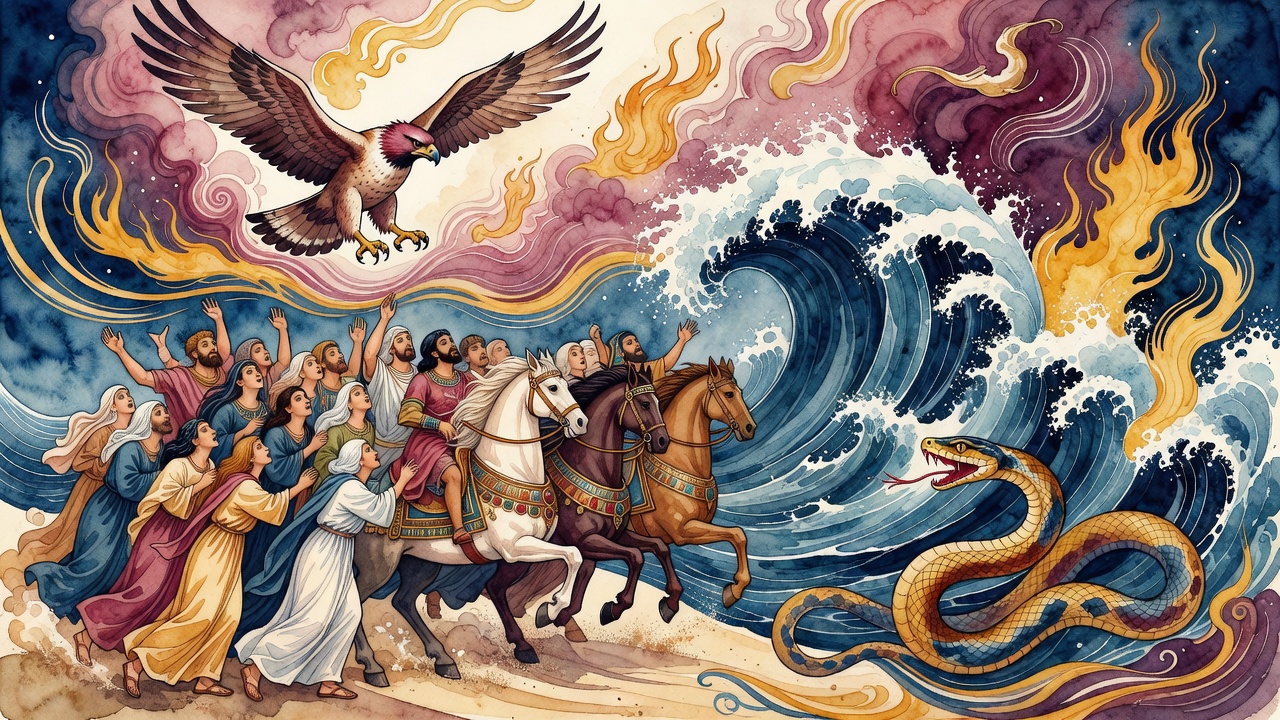
Pharaoh's jeweled horses pressed from behind while the sea rose ahead, and Israel cried out like a dove boxed between hawk and snake.

Curated by Arthur · Told by Maggid ·
Table of Contents
  1. Jeweled Horses
  2. The Dove in the Rock
  3. The Closed Short Road
  4. The Counted Plagues

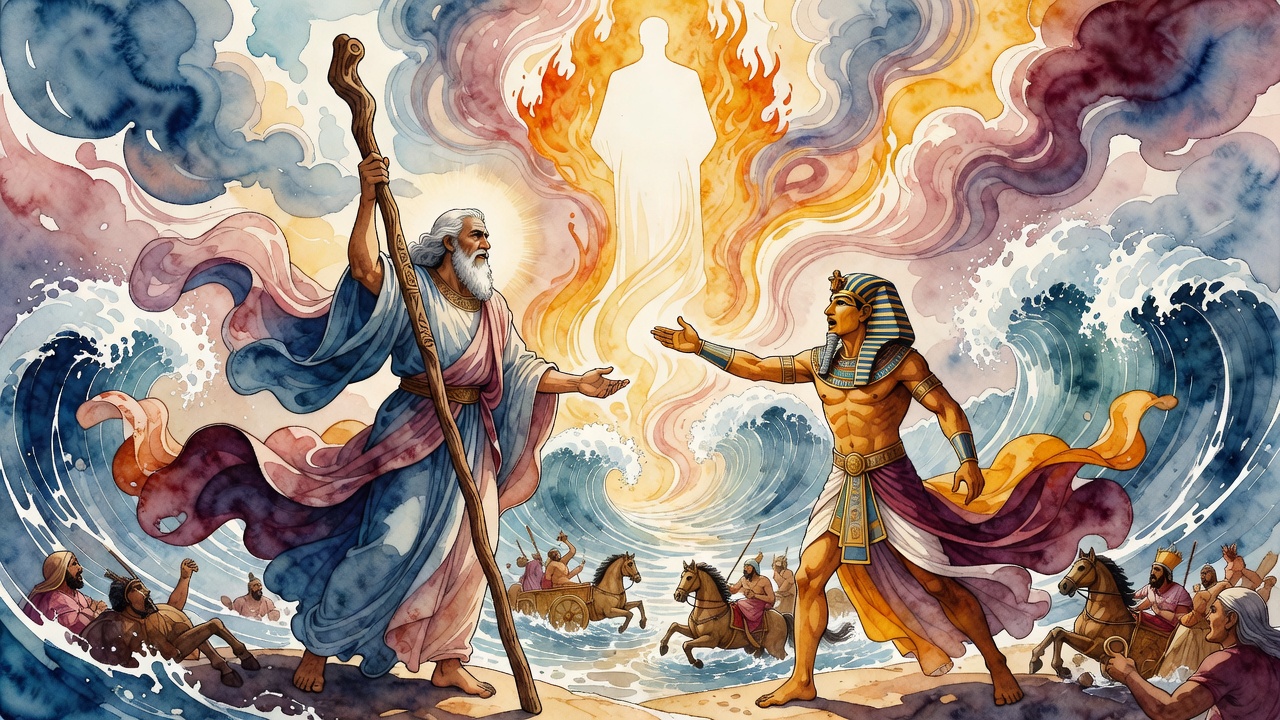
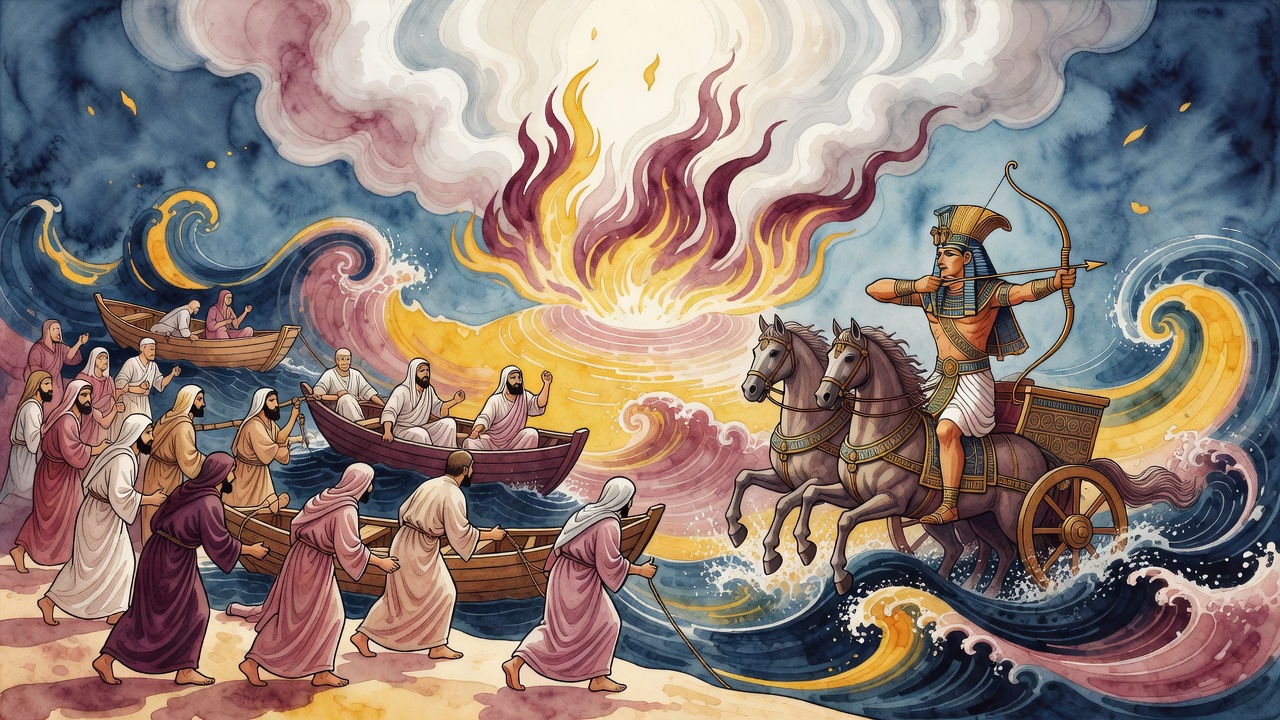
Pharaoh dressed even the common horses in precious stones and pearls. Six hundred picked chariots rolled, and not one horse fell sick or tired. The chase came on clean and glittering, and Israel turned to see Egypt pouring down the shore road.
Israel Trapped Between Hawk, Snake, and Sea Click for full size

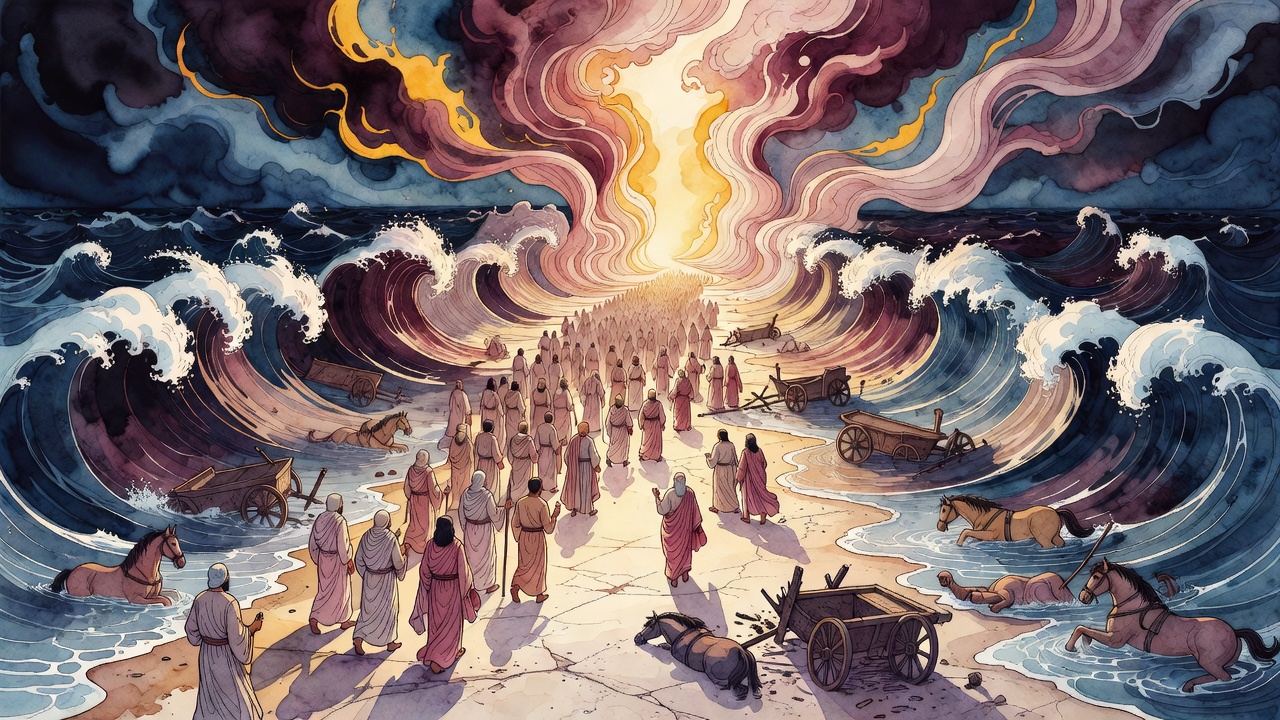
Ahead, the sea rose. Behind, the chariots closed. From the wilderness, beasts pressed in. The people were boxed on four sides, and their throats opened before their feet could choose a path.

Jeweled Horses

Pharaoh's vanity rode with him. Pearls on horse-heads. Iron under them. The proverb says the horse is prepared for the day of battle, but salvation belongs to the Lord. Egypt proved the first half with unbroken flanks and jewelry that would still glitter under water later.

Israel's children clung to skirts that smelled of brick dust. Sand stuck to damp ankles. Freedom was hours old and already looked like a trap.

The Dove in the Rock

The Holy One named them a dove in the cranny of the rocks. A hawk waited at the mouth. A snake already owned the hollow. Exit meant the hawk. Stay meant the snake. That was Israel between Pharaoh and the deep.

They cried out without a plan. God heard the thrash of a bird in a snare. The water did not calm at once. The horses did not stumble at once. First the people had to feel that no human exit remained.

The Closed Short Road

The coastal road toward the Philistines would have been shorter. God refused it. Along that way lay bones of Ephraimites who had tried to leave Egypt too soon and been cut down. Fresh free slaves stumbling over cousins' bones might have turned back before the first camp.

Even on the long desert road they muttered about appointing a head and returning to Egypt. If panic lived that loud on the winding path, the short road would have poured them home to slavery by afternoon. Redemption is a body learning not to bolt.

The Counted Plagues

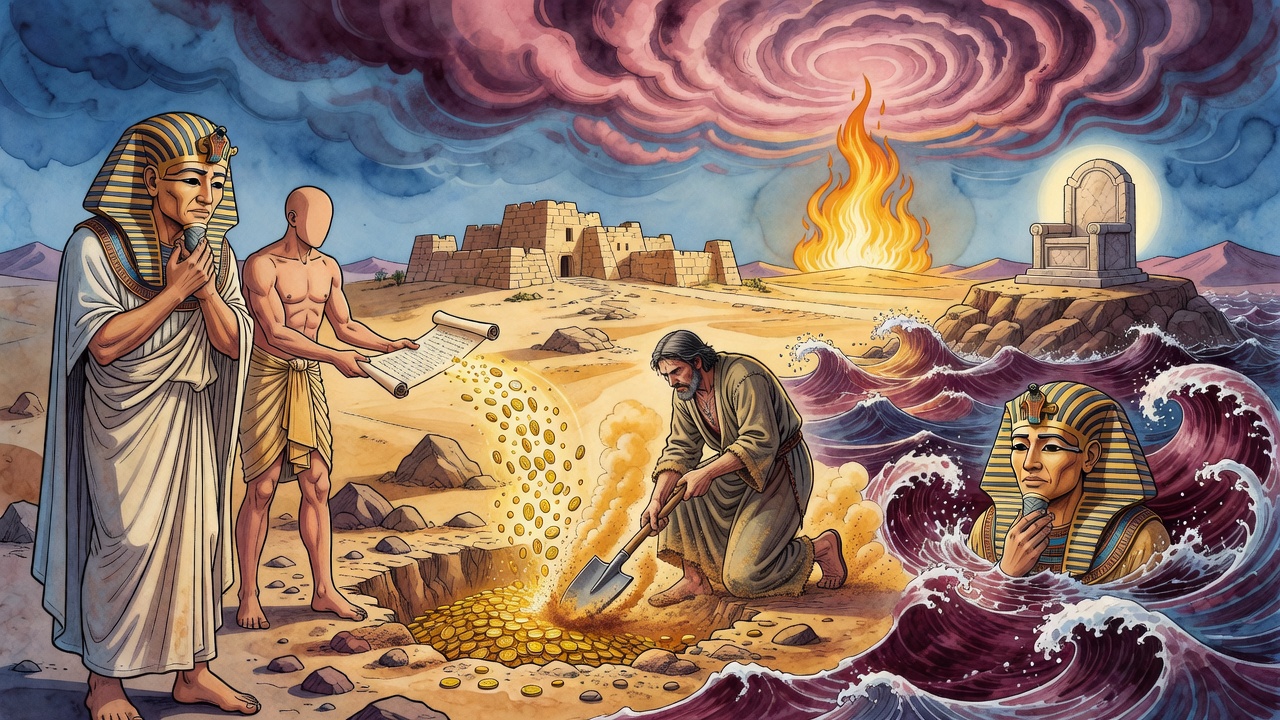
Long before the chariots glittered, a promise to Abraham had numbered Egypt's judgment. Not ten blows only. Two hundred and fifty plagues in the Aramaic telling. Oppression recorded. Counter-blows reserved. Liberty afterward with great riches.

Standing between sea and hawk, Israel could not see the ledger. They only saw water and spears. They yelled because cleverness had run out. The sea would split. The horses would drown with their pearls. The wilderness would become a school instead of a grave.

The pressure did not lift for those standing inside this hour. Someone swallowed. Someone clenched a fist around cloth or staff or coin. The next breath decided more than any later summary would admit. What looked like a small refusal or a small courage became the hinge the whole house turned on. Neighbors would argue the details by morning, but the people inside the moment carried the exact weight in their bones.

The pressure did not lift for those standing inside this hour. A throat tightened. Someone clenched a fist around cloth or staff or coin. The next breath decided more than any later summary would admit. What looked like a small refusal or a small courage became the hinge the whole house turned on. Neighbors would argue the details by morning, but the people inside the moment carried the exact weight in their bones.

The pressure did not lift for those standing inside this hour. A sandal scraped stone. Someone clenched a fist around cloth or staff or coin. The next breath decided more than any later summary would admit. What looked like a small refusal or a small courage became the hinge the whole house turned on. Neighbors would argue the details by morning, but the people inside the moment carried the exact weight in their bones.

The pressure did not lift for those standing inside this hour. A child went still. Someone clenched a fist around cloth or staff or coin. The next breath decided more than any later summary would admit. What looked like a small refusal or a small courage became the hinge the whole house turned on. Neighbors would argue the details by morning, but the people inside the moment carried the exact weight in their bones.

The pressure did not lift for those standing inside this hour. A door latch clicked. Someone clenched a fist around cloth or staff or coin. The next breath decided more than any later summary would admit. What looked like a small refusal or a small courage became the hinge the whole house turned on. Neighbors would argue the details by morning, but the people inside the moment carried the exact weight in their bones.

The pressure did not lift for those standing inside this hour. Oil smoke stung eyes. Someone clenched a fist around cloth or staff or coin. The next breath decided more than any later summary would admit. What looked like a small refusal or a small courage became the hinge the whole house turned on. Neighbors would argue the details by morning, but the people inside the moment carried the exact weight in their bones.


← All myths
From the tradition

Sources

3 sources

The texts behind this telling. Some cards carry a translation of the source; others are our own retelling of it, and each card says which. Every card links out to the original.

Midrash Tanchuma, Shoftim 13Midrash Tanchuma

Retold in our words. Read the original at the link below.Townsend 1989 translation of Midrash Tanhuma, S. Buber Recension · CC-BY

When you go out to war and you see horse and chariot, a people more numerous than you (Deuteronomy 20:1): This is what is stated in the verse (Proverbs 21:31), "The horse is readied for the day of battle, but the salvation comes from the Lord." What is [the meaning of] "The horse is ready?" At the time that Israel left Egypt, what is written there? "And it was told to the king of Egypt that the people had fled" (Exodus 14:5). Immediately, "And he tied his chariot, and he took his people with him. And he took six hundred of his picked chariots" (Exodus 14:6-7). Pharaoh stood and dressed all of the horses - and even the common ones - with precious stones and pearls. "And Egypt gave chase to them, etc. all the chariot horses of Pharaoh, his horsemen, and his army" (Exodus 14:9). [This] teaches that not one of them fell ill and not one of them died, and not one of them got tired. Hence it is stated, "all the chariot horses of Pharaoh, etc." "As Pharaoh drew near, the Children of Israel raised their eyes" (Exodus 14:10). At that time, the Children of Israel began to cry out to the Holy One, blessed be He, as it is stated (Exodus 14:10) "and the Children of Israel cried out to the Lord." The Holy One, blessed be He, said, "O My dove, in the cranny of the rocks, hidden by the cliff" (Song of Songs 2:14). To what was Israel comparable at that time? To a dove that fled from in front of a hawk, and came to [hide] behind a rock, but a snake was within [that space already. If] it sought to exit, behold the hawk is at the opening. So [too] was Israel. The sea was increasingly storming against them, the enemy was giving chase behind them and the [wild] animals [were closing in] from the wilderness, and [so] they were surrounded on four sides. And from where [do we know] that there were animals from the wilderness? Since it is stated (Exodus 14:3), "the wilderness enclosed (sagar) them." And "enclosed" is only an expression [indicating] wild animals, as it is stated (Daniel 6:23), "My God sent His angel, who closed (sagar) the mouths of the lions." What did they do? They lifted their eyes to their Father in the heavens and yelled out, as it is stated, "As Pharaoh drew near, the Children of Israel raised their eyes, etc. and the Children of Israel cried out to the Lord." Hence it is written, "O My dove, in the cranny of the rocks."

Full source
Yalkut Shimoni on Torah 227:4Yalkut Shimoni on Torah

Translation of the source text.Torat Emet (Yalkut Shimoni) · CC-BY-NC

Another interpretation: so that they would not see the bones of their brothers thrown about in Philistia and turn back. Another interpretation: so that they would not turn back on their tracks. And the matter is an argument from minor to major: if when He led them around by a crooked road they still said (Numbers 14:4), "Let us appoint a leader and return to Egypt," how much more would they have said this had He brought them by the direct way. Another interpretation: "when they see war" (Exodus 13:17) refers to the war of Amalek, as it is said (Numbers 14:45), "Then the Amalekite and the Canaanite came down."

Full source
Targum Pseudo-Jonathan on Genesis 15:14Targum Pseudo-Jonathan on Genesis

Retold in our words. Read the original at the link below.The Targum of Jonathan ben Uzziel, trans. J. W. Etheridge, London, 1862 · Public Domain

The Hebrew of (Genesis 15:14) promises judgment on the nation whom they shall serve. Targum Pseudo-Jonathan gives the judgment a number that has startled readers for centuries.

Two hundred and fifty plagues.

Not ten. Two hundred and fifty.

Where does the figure come from? The rabbis of the Targum tradition arrived at it by compounding the ten plagues of Exodus with layered expansions, each plague branching into more strikes at sea and in the wilderness. The precise math matters less than the theological message. The Lord's accounting is not casual. Every blow that would fall on Abraham's children in Egypt is already being catalogued, and the counter-blows are already pre-weighed and reserved.

Then the Targum finishes the promise: and afterwards they shall go forth into liberty with great riches.

Suffering, judgment, deliverance, and plunder, in that order. The Maggid hears the shape of every Jewish redemption in miniature here (Genesis 15:14). Oppression is not ignored. It is recorded. And when the reckoning comes, it comes with precision, two hundred and fifty items on a ledger. And the freed people walk out not empty-handed but laden. Moses will one day lead them past pyramids carrying the silver of their captors, and the whole audit was written up in advance, here, in a vision Abraham had at sundown.

Full source