5 min read

The Walls of Water Stood Three Hundred Miles to Each Side

Israel walked between walls of water three hundred miles to each side. Egypt named God too late. The waves returned and not one soldier remained behind.

Curated by Arthur · Told by Maggid ·
Table of Contents
  1. Three Hundred Miles of Wall
  2. Light in the Dark Before the Sea
  3. Egypt Names God Too Late
  4. Not One Left
  5. What the Child Carries Into the Wilderness

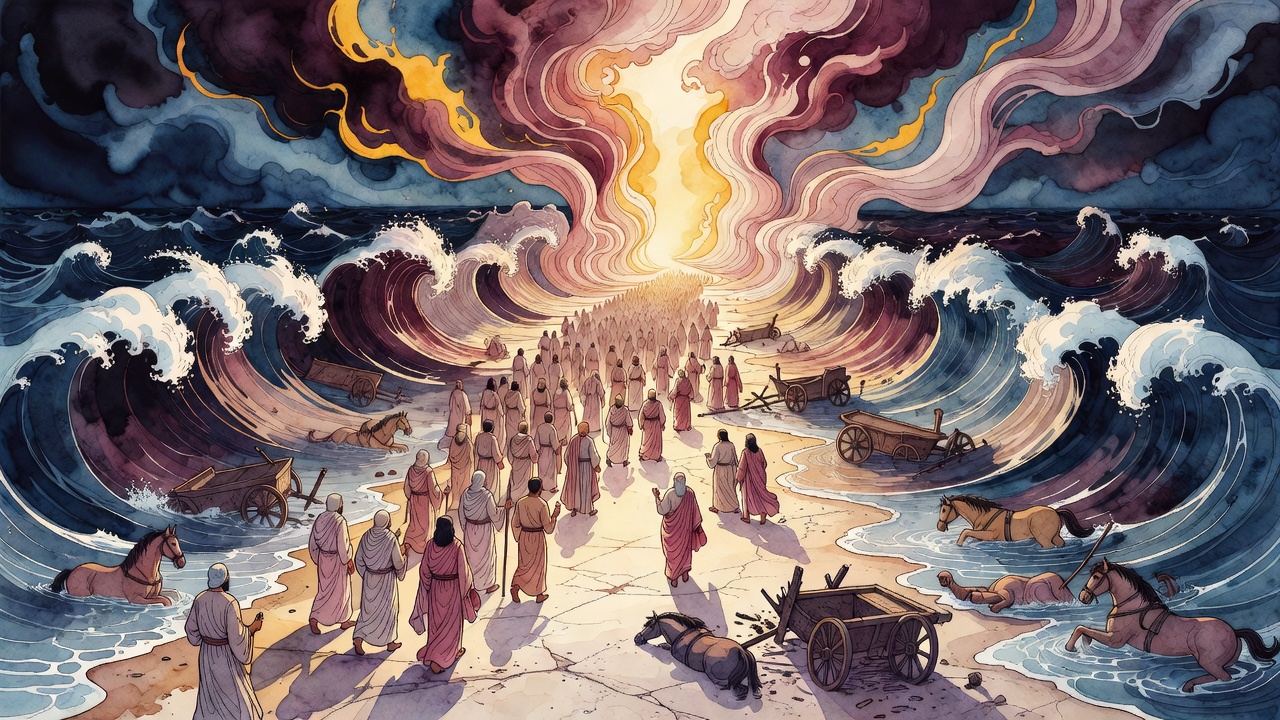
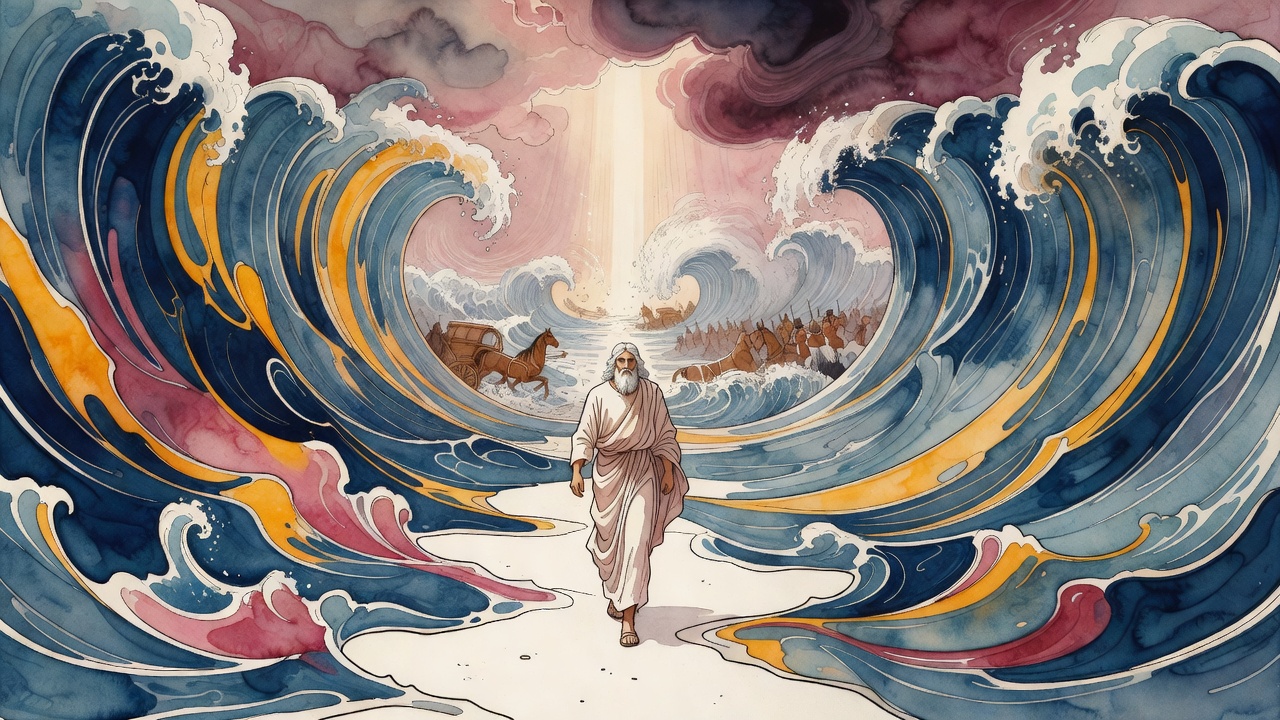
The child looked right and saw water standing like a cliff. She looked left and saw the same. Under her feet the seabed held as firm as a road. Somewhere in the frozen wall a fish hung as if painted there, mouth open on a world that had stopped making sense.
The Walls of Water Stood Three Hundred Miles to Each Side Click for full size

Three Hundred Miles of Wall

The Torah says the waters were a wall on Israel's right and left (Exodus 14:22). The Aramaic gives the wall a measurement that refuses comfort. Three hundred miles on the right. Three hundred miles on the left. You cannot see the end of the miracle. You cannot force it into a tidy metaphor. The water holds vertical. The ground holds horizontal. The people walk between two oceans that have forgotten how to fall, and the air in the corridor tastes of salt and stunned silence.

This is not a narrow creek parted for a postcard. It is vertigo turned into a highway for a nation that still had brick dust under its nails.

Somewhere in the middle of the corridor a man stopped walking and put his palm against the water wall. It did not yield. It did not splash. It held like frozen glass with living things inside it, and he pulled his hand back as if he had touched a throne. Ahead, the far shore waited with desert light. Behind, the mouth of the path still framed Egypt's last mistake pouring in like a dark river of chariots.

Light in the Dark Before the Sea

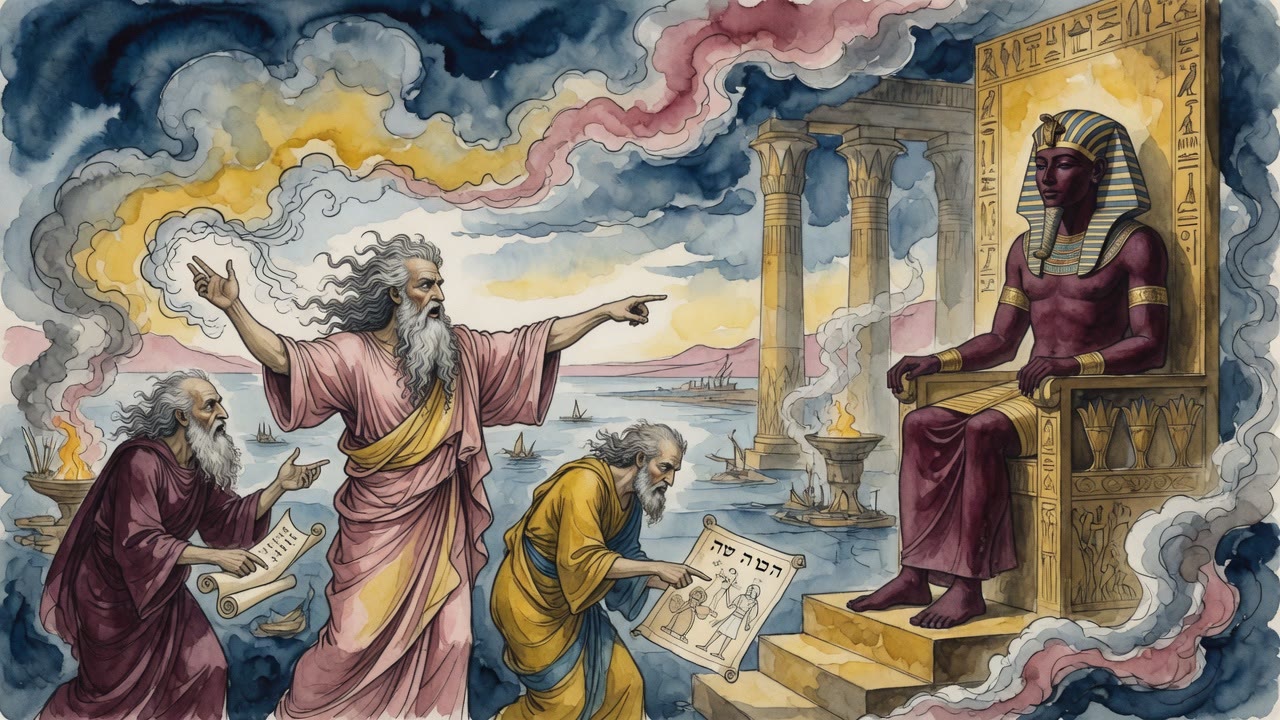
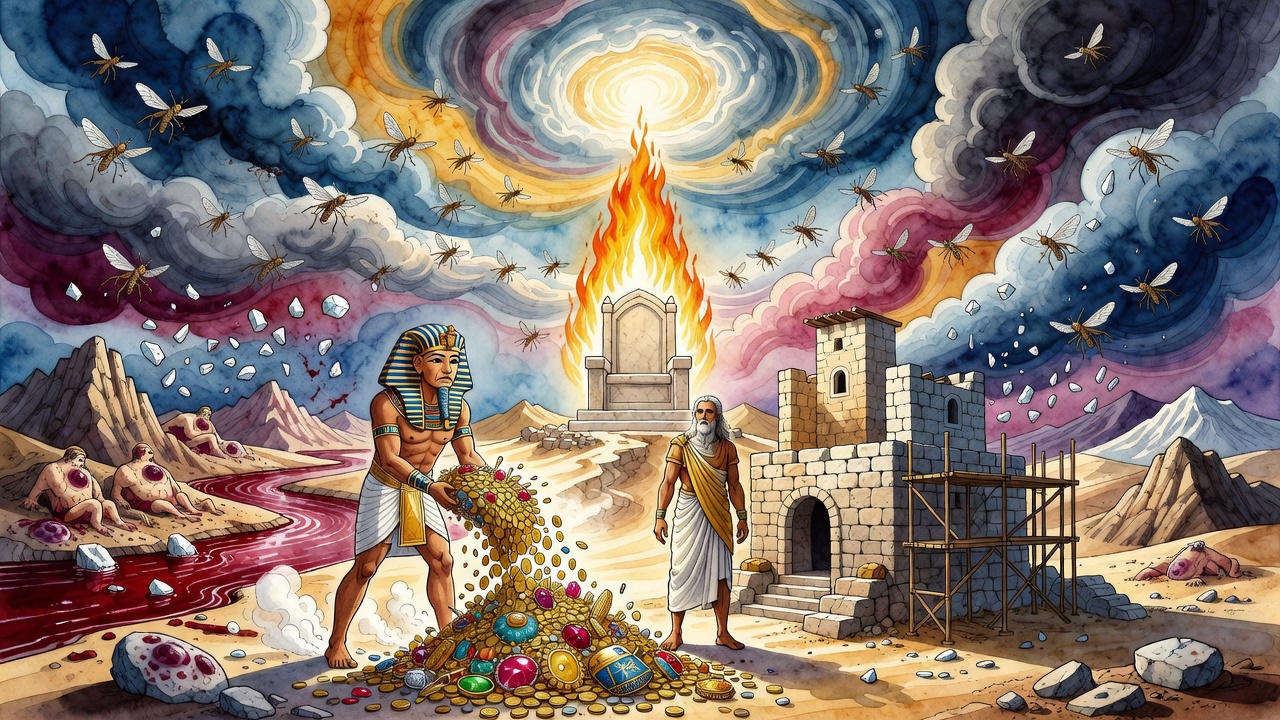
Days earlier, darkness had pinned Egypt for three days. No man saw his brother. No one rose from his place. The houses of the oppressors sat like sealed boxes. Among the sons of Israel there was light, enough to bury their dead with dignity and enough for the righteous to sit with the precepts of the Law while Pharaoh's house sat frozen. The Targum says the light also sorted the camp. The wicked among Israel who would not leave were taken in those days so Egypt could not later claim the God of the Hebrews struck His own without distinction. The righteous used the hours to study. The plague of darkness was also a plague of revealing. Egypt learned what it was. Israel practiced what it might become under a different master.

Then the road opened through water, and the sorting continued on a larger stage with chariots for an audience.

Egypt Names God Too Late

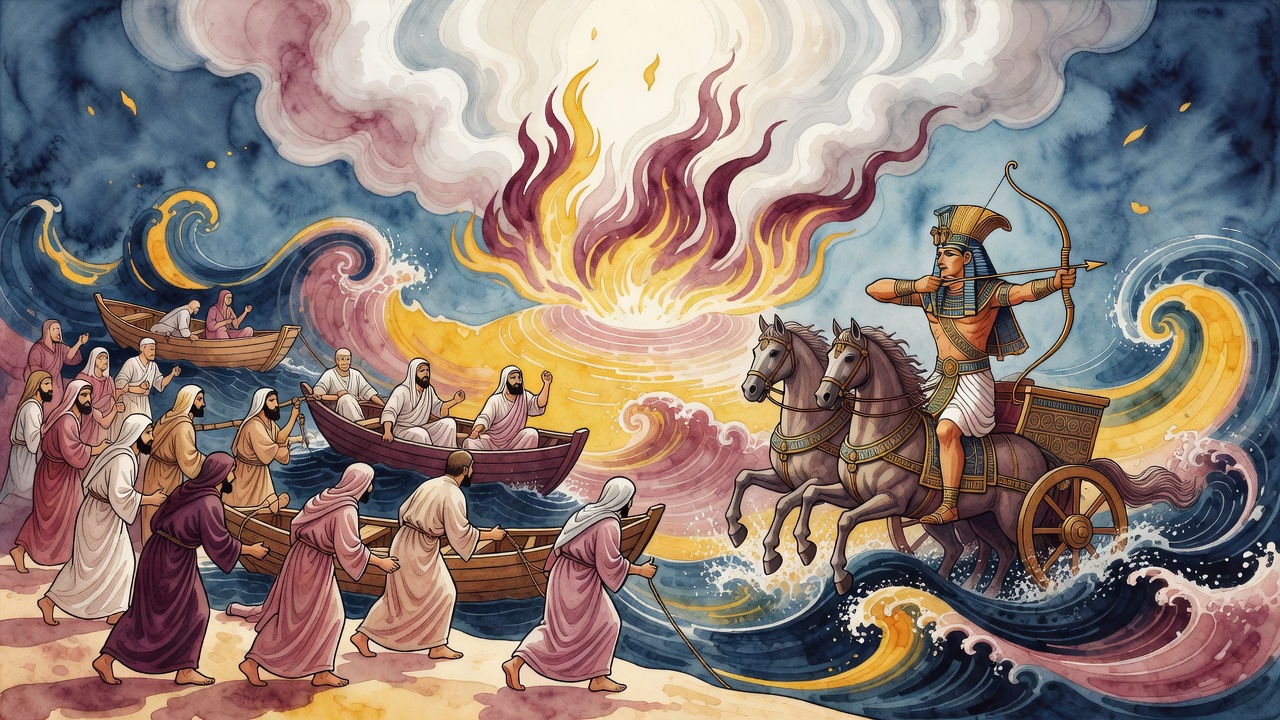
Chariot wheels broke, or in the Targum's alternate reading grew rough, gouged so they would barely turn. Drivers whipped animals that could not pull a host through a miracle aimed against them. The corridor that had been a road for slaves became a trap for masters. Only then did the Egyptians speak the name they had fought through ten plagues and a night of death.

"This is the Lord fighting for them," they said, too late for the confession to buy an exit. Throughout the blows Pharaoh had mouthed repentance and hardened again, treating apology as a weather tactic. At the bottom of the sea there was no room left for reversal. Truth recognized when escape is impossible is still truth. It no longer delivers. It only testifies.

Not One Left

The waves returned. They covered chariots, horsemen, and all Pharaoh's host that had gone in after Israel. Not one among them was left (Exodus 14:28). The Targum underlines the totality without soft edges. Four hundred years of slavery, ten plagues, a night of terror, a pursuit, a split sea, and then stillness. No surrender ceremony. No last negotiation under a white cloth. A sea that had been a road became a sea again, with an army under it and a silence above it that taught the survivors how final freedom can sound.

When Israel turned toward the desert, no one remained behind them to chase. Some endings must be total so a freed people can stop looking over their shoulders every hour of the march.

Mothers counted heads. Children asked if the water would fall. No one had an answer that fit ordinary weather. They had only the next step, and the next, and the command that had made a road where roads do not belong. When the last of Israel climbed the far bank, the air changed. The miracle still stood for a breath, a highway open behind them like a dare. Then the walls remembered they were sea, and the dare ended in a single collapsing roar that erased the pursuit and left only wet sand and a people who would never again be only slaves in their own minds.

What the Child Carries Into the Wilderness

The child who walked between the walls would grow old telling the height she could not measure. She would remember light in Goshen while Egypt sat blind. She would remember the moment the water forgot its temporary mercy toward the pursuers. She would not remember a fair fight. She would remember a God who made a road and then closed it, who taught a nation to walk and then taught it that some enemies do not get a second chase.

The measurements are not for engineers. They are for awe that refuses to shrink into a lesson small enough for a classroom without salt on the tongue.


← All myths
From the tradition

Sources

4 sources

The texts behind this telling. Some cards carry a translation of the source; others are our own retelling of it, and each card says which. Every card links out to the original.

Targum Pseudo-Jonathan on Exodus 14:22Targum Pseudo-Jonathan on Exodus

Retold in our words. Read the original at the link below.The Targum of Jonathan ben Uzziel, trans. J. W. Etheridge, London, 1862 · Public Domain

The Targum Pseudo-Jonathan on (Exodus 14:22) gives the sea-splitting a measurement. The Torah says the waters were "a wall on their right and on their left." The Targum specifies: three hundred miles on the right, three hundred miles on the left.

A wall six hundred miles wide? The image is not meant to be photographed. It is meant to be felt. Israel is not walking through a narrow passage with puddles on either side. They are walking through a canyon whose walls stretch beyond the horizon in both directions.

"The waters were congealed like a wall." The Aramaic word suggests something frozen or solidified, not moving, not dripping, not threatening. A suspended ocean.

"upon the ground", the Targum is careful about this too. The seabed is not mud, not silt, not the slippery floor of a drained sea. It is solid ground, as firm as a paved road. The miracle is doubled: the water holds up vertically, the earth holds firm horizontally.

What does the Targum accomplish by giving us the number? It converts awe into vertigo. You cannot see the top of those walls. You cannot see where they end. You are surrounded by frozen ocean for as far as the eye can reach, and somehow you are walking on dry ground.

Takeaway: the Targum teaches that when a miracle is truly a miracle, the measurements stop being reasonable. And that is how you know.

Full source
Targum Pseudo-Jonathan on Exodus 14:25Targum Pseudo-Jonathan on Exodus

Retold in our words. Read the original at the link below.The Targum of Jonathan ben Uzziel, trans. J. W. Etheridge, London, 1862 · Public Domain

The Targum Pseudo-Jonathan on (Exodus 14:25) gives the Mizraee a final moment of clarity. Their chariot wheels are broken. Or in the Targum's alternate reading, made rough, gouged so that they can barely turn. The drivers whip the animals forward. The wheels grind. The chariots lag behind.

Then, too late, they finally understand. "Let us flee from the people of the house of Israel; for this is the Word of the Lord who fought for them in Mizraim."

The Targum places the recognition on their own lips. The Egyptians, mid-drowning, name the Memra, the Word of the Lord, as the power behind the plagues they had endured and the catastrophe they are now entering. They had seen the plagues as ten bad harvests or ten freak accidents. At the Sea, inside the broken chariots, they finally see the plagues as a single agent: this God. His people.

The pattern is devastating. Throughout the plague narrative, Pharaoh said after each blow, "I have sinned, the Lord is righteous". And then hardened his heart again. Now, at the bottom of the sea, there is no more opportunity for a reversal. The Egyptians confess the truth at the moment it cannot save them.

The Targum's theological point is stark. Repentance that comes only when escape is impossible is not repentance. It is the verdict speaking through the condemned.

Takeaway: the Targum teaches that truth recognized too late is still truth, but it no longer delivers.

Full source
Targum Pseudo-Jonathan on Exodus 14:28Targum Pseudo-Jonathan on Exodus

Retold in our words. Read the original at the link below.The Targum of Jonathan ben Uzziel, trans. J. W. Etheridge, London, 1862 · Public Domain

The Targum Pseudo-Jonathan on (Exodus 14:28) closes the account of the Egyptian army with a single unforgiving sentence. "The waves of the sea returned, and covered the chariots, and the horsemen and all the host of Pharoh who had gone in after them, into the sea, not one among them was left."

Not one. The Targum, following the Hebrew "lo nishar bahem ad echad," insists on the completeness. No survivor crawls back to Egypt. No messenger returns to Pharaoh's court. The army that marched out with six hundred choice chariots simply vanishes beneath the water.

Rabbinic tradition asks a pointed question: what about Pharaoh himself? In one midrashic reading, he is the single exception, spared so he can testify to the power of the God of Israel. In another, he dies with the rest. The Targum's phrasing here does not specify; it simply underlines the totality.

The silence of the sea afterward is part of the theology. Four hundred years of slavery, ten plagues, a night of terror, a pursuit, a splitting of waters. And it all ends in stillness. No battle cry. No surrender. Just a sea that had been parted and is now a sea again, with an Egyptian army somewhere beneath its surface.

The Targum is saying: the generation that enslaved Israel is finished. The chapter is closed. When Israel turns to face the desert, there is no one left behind them to chase.

Takeaway: the Targum teaches that some endings must be total, so that the people being freed can stop looking over their shoulders.

Full source
Targum Pseudo-Jonathan on Exodus 10:23Targum Pseudo-Jonathan on Exodus

Retold in our words. Read the original at the link below.The Targum of Jonathan ben Uzziel, trans. J. W. Etheridge, London, 1862 · Public Domain

The Targum Pseudo-Jonathan on (Exodus 10:23) reveals a secret buried in the ninth plague that the plain Torah only hints at.

"No man saw his brother, and none arose from his place three days. But among all the sons of Israel there was light, that the wicked among them who died might be buried, and that the righteous might be occupied with the precepts of the law in their dwellings."

Two different Egypts existed in those three days. The Egyptian Egypt, paralyzed, blind, unable to stand. And the Israelite Egypt, where every home was lit.

The Aramaic paraphrase, preserved in the Targum attributed to Yonatan ben Uzziel, adds two astonishing details. First: some of Israel's own wicked were dying during this time, and the darkness gave the righteous cover to bury them. Which wicked? The midrashic tradition tells us, the Jews who had assimilated so deeply into Egyptian life that they had refused to leave when the Exodus began. The Lord took them during these three days so that Egypt would not later say, "Look, these Jews died in our plagues too, proving their God was powerless."

Second: the righteous used the three days to study Torah. Mit'askin b'pikudei oraita, occupied with the precepts of the Law. While Egypt sat frozen in blindness, Israel studied.

The Maggid teaches: the plague of darkness was also a plague of sorting. Egypt was shown what it was. Israel was shown what it could become. And the work of becoming a Torah people began in the very shadow of Pharaoh's throne.

Full source