5 min read

David the King Who Wrote That He Was Lonely

David commanded armies and composed half the Psalms. Then he wrote that he was lonely and afflicted. The rabbis explained what kind of lonely a king can be.

Curated by Arthur · Told by Maggid ·
Table of Contents
  1. The Psalm That Did Not Match the Life
  2. The Loneliness of Being the One Who Answers
  3. What the Bloodline Carried
  4. Before Goliath
  5. The Temple He Could Not Build but Planned Anyway

The Psalm That Did Not Match the Life

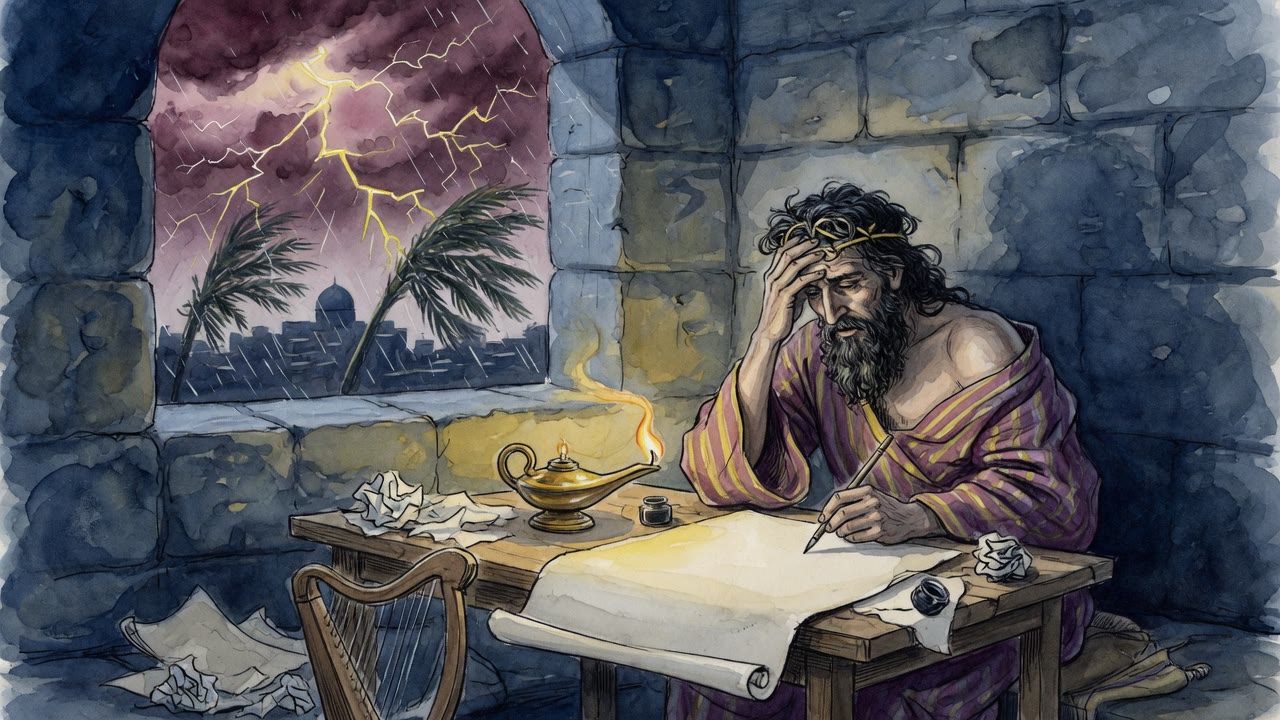
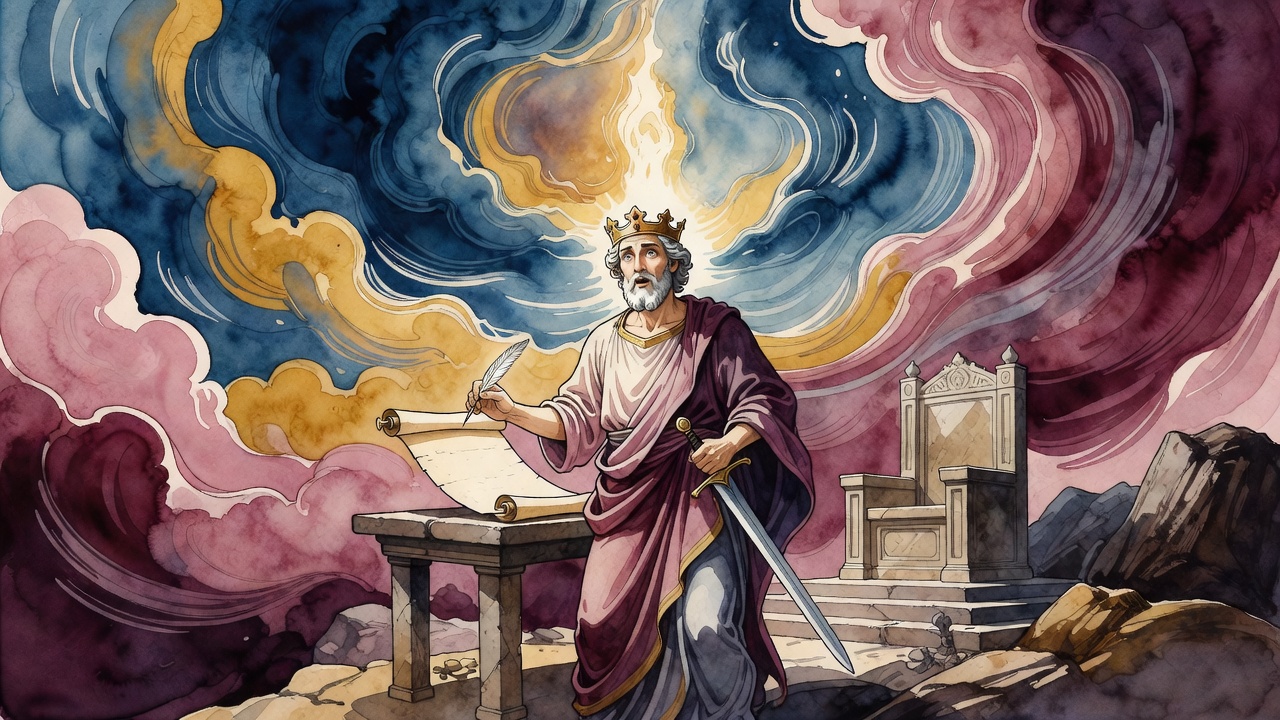
Turn to me and be gracious to me, for I am lonely and afflicted. Psalm 25 says this. The man who wrote it was the seventh son of Jesse, chosen directly by God when God found fault with all six brothers before him. He had killed Goliath at an age when most men were still learning to fight. He had united Israel's tribes. He had composed songs that would be sung for three thousand years. He commanded the largest army in the region.

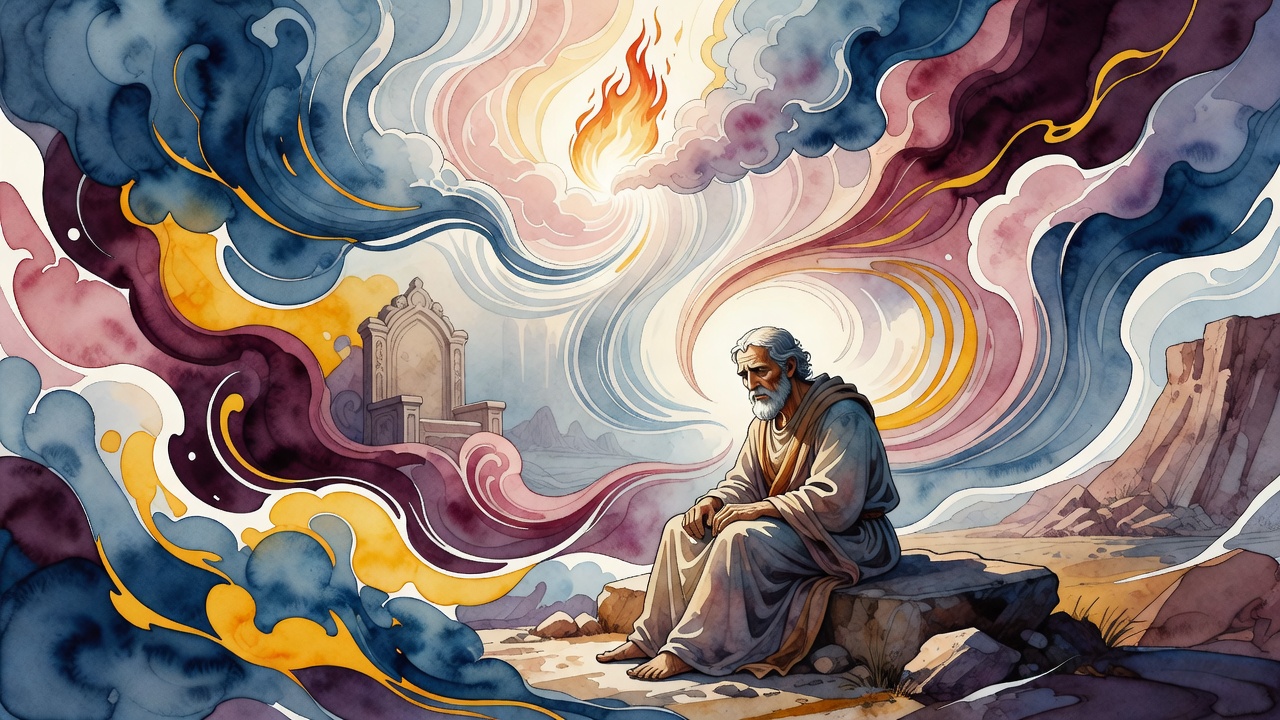
The rabbis looked at the man and looked at the verse and asked what kind of loneliness this was, because it was clearly not a shortage of company.

The Loneliness of Being the One Who Answers

Midrash Tehillim, the rabbinic commentary on the Psalms, found the answer in a verse from Chronicles: David was the ruler over all Israel. Not one of the rulers. Not a ruler among other rulers. The Midrash read the singularity as the definition of the loneliness. There was no one above him to appeal to, no one beside him who shared the same kind of responsibility, no one who could sit with him at the level where the decisions were made and feel the weight of what they cost.

A man with four hundred thousand soldiers under his command had no peers. Peers were the thing that prevented loneliness in the ordinary sense. The king's loneliness was the loneliness of having no peer. He was asking God to turn to him because God was the only one who could sit beside him at that altitude.

What the Bloodline Carried

Bereshit Rabbah, the Palestinian midrash on Genesis, traced David's covenant back to Abraham. The verse from Genesis 15 where Abraham divided the animals at God's instruction, and divided them in the middle, was read by Rabbi Joshua as the moment when the covenant that would eventually reach David was established. The animals cut in half, the pieces separated, the space between them where God passed: this was the structural act that bound Abraham's descendants to divine protection across generations.

David understood his own position within that lineage not as personal achievement but as inherited covenant. He was the fruit of something planted before his family existed as a family. The loneliness he expressed in Psalm 25 was partly the loneliness of understanding how large the thing was that you were standing inside of, and how small you were by comparison.

Before Goliath

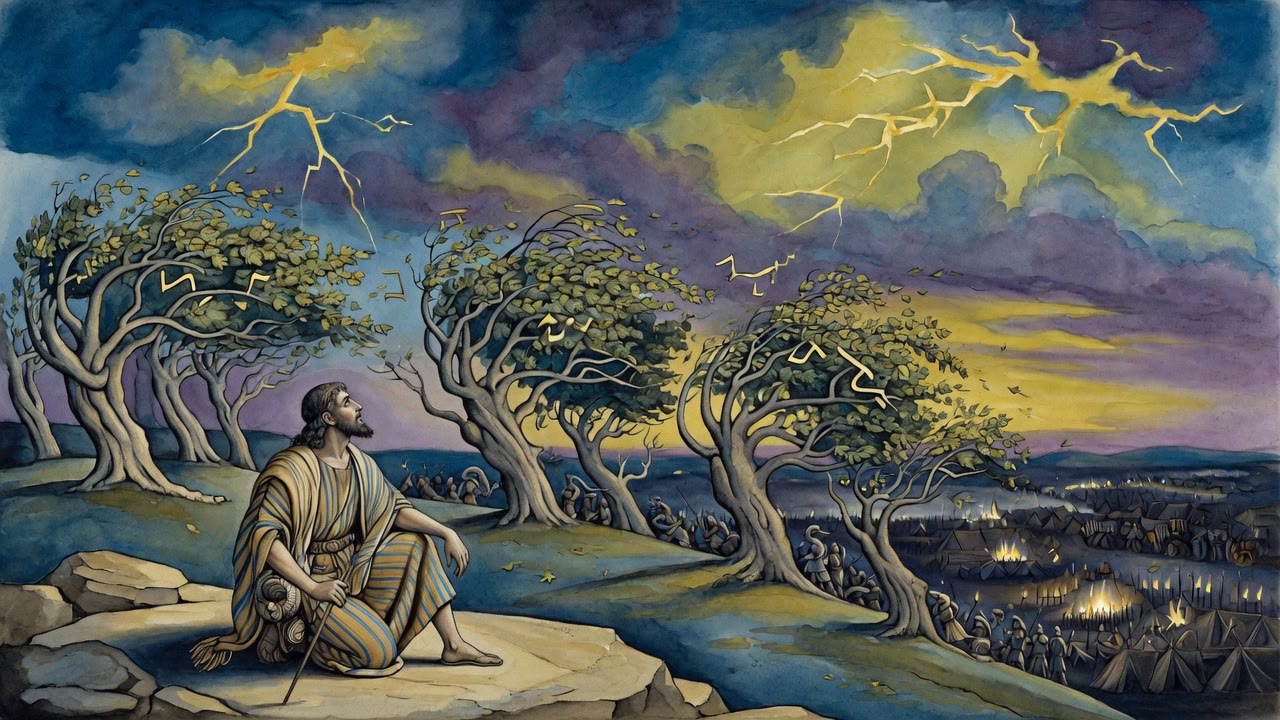
Ginzberg's account of the battle with Goliath preserved a detail about David that the plain text of Samuel does not quite contain. David, in the tradition, understood Goliath's challenge differently than the armies did. Goliath had been standing in the valley shouting for forty days. Israel's army had been too frightened to respond. David looked at the situation not as a military problem but as a theological one: this uncircumcised Philistine was reproaching the armies of the living God.

The argument David made to Saul before entering the field was not that he was a good fighter. He had killed a lion and a bear to protect his sheep, but his argument was not about his fighting ability. It was about the nature of the contest: God would not permit this to continue. His confidence came from a reading of the situation rather than a self-assessment. That same quality, a confidence rooted in theology rather than personal strength, ran through every Psalm he wrote, including the one about loneliness.

The Temple He Could Not Build but Planned Anyway

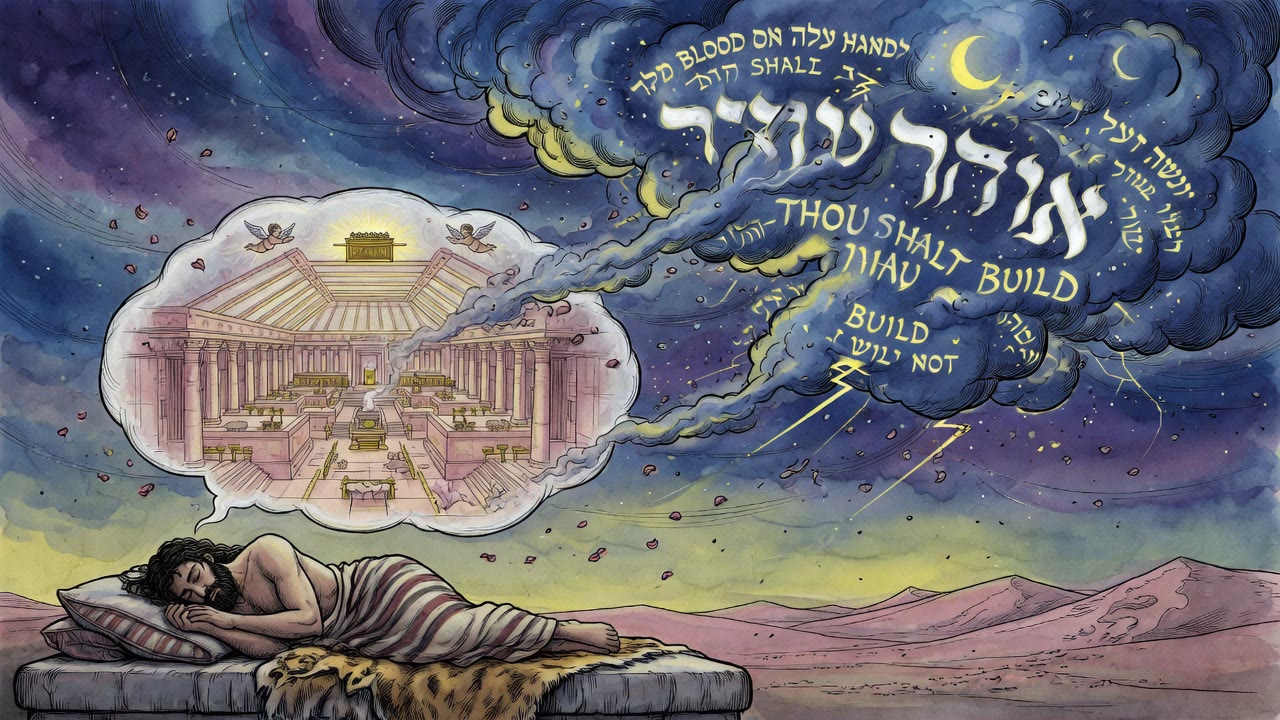
David dedicated everything he had accumulated to the Temple he would not be permitted to build. The gold and silver that poured in when the people gave willingly, the donations that surpassed what was needed, David's joy at that moment was the joy of a man who had been told he could not do the central thing he wanted to do and had found the way to do its preconditions so thoroughly that whoever came after him would be able to do it easily.

Rav Huna, in Bereshit Rabbah, noticed that the people's joy and David's joy at the Temple donations were described separately in Chronicles. The people rejoiced because they had given. David rejoiced because they had given wholeheartedly. He was watching his people do something noble, and the watching was its own kind of gift, separate from what they were giving. That joy, next to the loneliness in Psalm 25, told the full picture of what it meant to be David.


← All myths

From the tradition

Sources

5 sources

The texts this telling draws on, in full. Open a card to read inline, or expand it for a wider, quieter read.

Midrash Tehillim 25:15Midrash Tehillim

King David knew that feeling all too well. In Psalm 25, he cries out: "Turn to me and be gracious to me, for I am lonely and afflicted." But wait a minute, was DAVID, the king, really lonely and poor?

The text seems to contradict itself, doesn't it? After all, (1 (Chronicles 7:1)5) tells us David was the seventh son – hardly someone abandoned or forgotten. And (2 (Samuel 22:2)8) proclaims, "You save an afflicted people, but your eyes are on the haughty to bring them down." So, what's going on here?

The beauty of Midrash Tehillim, a collection of rabbinic interpretations on the Book of Psalms, is that it doesn't shy away from these contradictions. Instead, it dives deeper, searching for a richer understanding.

Midrash Tehillim offers a powerful explanation: David isn't lamenting his material poverty or physical solitude. He's speaking to the immense responsibility of leadership. He says to God, "Since I have been appointed king over Your people, their eyes are upon me, and my eyes are upon You, for they are many and I am alone against them." As king, David was the focal point of his entire nation. Everyone looked to him for guidance, for strength, for answers. He carried their hopes, their fears, their burdens. And in the face of such overwhelming responsibility, he felt profoundly alone. He was surrounded by people, yes, but the weight of leadership separated him. "Therefore," the Midrash (rabbinic interpretive commentary) concludes, "I am lonely and afflicted."

It’s a loneliness born not of isolation, but of singular accountability. It’s the loneliness of the CEO, the single parent, the community leader – anyone who carries a disproportionate burden for others.

The passage continues: "My enemies see me and they multiply, hating me with unjustified hatred." The Midrash then poses a pointed question: If ESAU hated JACOB because he felt Jacob had stolen his birthright, at least there was a semblance of a legal claim, a basis for the conflict. But what had David done to warrant the hatred of the barbarians and the Antonites?

The question hangs in the air. Was it simply the jealousy and resentment that often accompany power? Was it the inherent conflict between the righteous and the unrighteous? Or was it something deeper, something connected to David's unique relationship with God and his role as the shepherd of his people?

Perhaps the "unjustified hatred" stems from the very fact that David was chosen, that he stood as a beacon of faith and justice in a world often shrouded in darkness. His enemies hated him not for what he did, but for who he was, for what he represented.

This passage from Midrash Tehillim reminds us that even those who appear powerful and surrounded by support can experience profound loneliness and affliction. It invites us to look beyond the surface, to recognize the burdens that others carry, and to offer compassion and understanding. It also reminds us that standing for something righteous often brings unwarranted animosity.

And maybe, just maybe, it encourages us to turn our own eyes towards something greater than ourselves, just as David did, finding solace and strength in a connection that transcends the loneliness of leadership and the weight of the world.

Full source
Pirkei DeRabbi Eliezer 28:6Pirkei DeRabbi Eliezer

Here, Rabbi Joshua offers a powerful insight into a well-known scene from (Genesis 15:10). You remember the one: "And he took him all these, and he divided them in the midst." Abraham, following divine instructions, gathers several animals and… well, divides them.

Gruesome. But Rabbi Joshua sees something much deeper here. He says that "Were it not for the fact that he divided them, the world would not have been able to exist." The act of division, of separating these creatures, is what allows the world to continue. Why? Because, according to Rabbi Joshua, it weakened their strength. By separating them, Abraham neutralized a powerful, perhaps destructive, force. He then brought "each part against its corresponding part," creating a counter-balance.

It’s a powerful image, isn’t it? This idea that creation itself requires a constant balancing act, a management of opposing forces.

What about the young pigeon? The verse tells us, "But the bird he divided not." Why was the pigeon spared? Rabbi Joshua explains that there was no other bird there, so Abraham left the pigeon alive. It makes sense when you read it literally, but the text is about to go in a fascinating, allegorical direction.

Then comes the unexpected twist: "The bird of prey came down upon them to scatter them and to destroy them." Now, who or what is this "bird of prey?" Rabbi Joshua equates it with David, the son of Jesse! He bases this connection on a verse from (Jeremiah 12:9): "Is mine heritage unto me as a speckled bird of prey?"

Why would David, the sweet singer of Israel, be compared to a bird of prey? It seems jarring, doesn't it? Perhaps the point is that even the most righteous figures, the heroes of our tradition, embody complex and sometimes contradictory qualities. The bird of prey, like David, represents strength, perhaps even a necessary aggression to protect what is sacred. David, after all, was a warrior king.

So what can we take away from this midrashic (rabbinic interpretive commentary) interpretation? Perhaps it's a reminder that the world is a complex and often contradictory place. That balance is not a static state, but a constant process of division and reconciliation. And that even our heroes are not immune to the darker aspects of human nature. It invites us to see the world not in simple black and white, but in all its messy, complicated, and ultimately beautiful shades of gray.

Full source
Legends of the Jews 4:30Legends of the Jews

A reader can imagine them as these larger-than-life figures, all might and no moral compass. But what if their greatness actually lay in their unwavering commitment to justice?

Take David, for example. We know him as the fearless warrior, slayer of Goliath, the king who united Israel. But as Ginzberg tells us in Legends of the Jews, David wasn't just bold; he was profoundly just. Disregarding the ancient covenants? Unthinkable!

Before heading off to war with the Arameans and the Philistines, David did something remarkable. He convened the Sanhedrin, the high court, instructing them to meticulously investigate the claims of these nations. He wasn't going to shed blood without understanding the historical and legal basis for conflict.

What did the Sanhedrin discover? The Philistines, it turned out, were essentially imposters. Their claim to the treaty made with Isaac was bogus. They weren't descended from the original Philistines who had entered into that agreement. Nope, they were Johnny-come-latelies, immigrants from Cyprus who arrived on the scene long after the ink had dried on the ancient pact. Their claims were deemed "utterly unfounded."

But the Arameans? Their situation was different. They did have a historical connection to the region. However, they had forfeited their rights to considerate treatment. How? Through aggression. The Zohar reminds us that actions have consequences, and violating the covenant is a serious matter.

Think back to Balaam, the "Aramean" prophet who was hired to curse the Israelites. And then there was Cushan-rishathaim, the Aramean king who oppressed Israel in the time of Othniel (Judges 3:8). Time and again, they chose conflict, attacking and waging war against the Israelites. As we find in Midrash Rabbah, these actions had lasting repercussions.

So, what does this tell us? David's commitment to justice wasn't just a nice add-on to his warrior persona. It was fundamental to his leadership. He understood that true strength lies not just in military might, but in unwavering adherence to ethical principles. It’s a powerful reminder that even in times of conflict, justice and righteousness must prevail. It's not enough to be strong; we must also be just.

Full source
Midrash Tehillim 30:1Midrash Tehillim

Midrash Tehillim, a collection of rabbinic interpretations on the Book of Psalms, dives deep into this idea. In one particular passage (Midrash Tehillim 30), it explores the connection between the earthly Temple in Jerusalem and its celestial counterpart.

Rav Ḥisda makes a bold statement: "There is no difference between the Sanctuary of the tribe below and the Sanctuary of the tribe above." In other words, the Temple here on Earth corresponds precisely to the Temple in Heaven. It suggests a profound link, a cosmic blueprint where our sacred spaces mirror the divine realm.

This idea raises some fascinating questions. What does it mean for our prayers, our rituals, our very connection to God? If the Temple below reflects the Temple above, then our actions here have repercussions in the celestial spheres.

Rabbi Abba then explores Psalm 84, verses 9-11, seeking deeper meaning. "O God, the Lord of hosts; hear my prayer; give ear, O God of Jacob. Selah. Behold, O God our shield, and look upon the face of Your anointed. For a day in Your courts is better than a thousand elsewhere; I would rather stand at the threshold of the house of my God than dwell in the tents of wickedness." Powerful words. Rabbi Abba interprets "O God, the Lord of hosts" as a reference to the source of divine communication, the place where the dibbur, the Divine Utterances, issue forth into the world. As it says in (Isaiah 2:3), "For out of Zion shall go forth the law, and the word of the Lord from Jerusalem." Zion, Jerusalem, these are not just physical locations; they are points of connection, conduits for divine energy.

The passage continues, quoting (Psalm 68:6): "God in His holy dwelling place, is a father of the fatherless, and a judge of the widows. God settles the solitary in a house; He leads out the prisoners into prosperity; but the rebellious dwell in a parched land." This verse paints a picture of God as a protector, a provider, and a just ruler. The "holy dwelling place" reinforces the idea of a sacred space, a place where divine justice and compassion reside.

So, what are we to make of all this? This short passage from Midrash Tehillim offers a glimpse into a worldview where the earthly and the heavenly are intimately connected. It suggests that our actions, our prayers, and our very presence in sacred spaces have cosmic significance. Maybe, just maybe, by tending to the "Sanctuary below," we are also tending to the "Sanctuary above."

It leaves you wondering, doesn't it? What other connections are we missing between our world and the divine? And how can we live our lives in a way that honors that connection?

Full source
Bereshit Rabbah 70:2Bereshit Rabbah

The verse in question comes from (1 Chronicles 29:9): “The people rejoiced in their donation, because they donated to the Lord wholeheartedly, and King David too rejoiced with great joy.” Rav Huna, quoting Rav Idi in Bereshit Rabbah 70, points out that the people were happy because their donation – their mitzvah – was successful. They gave with a full heart. And that's when something interesting happens.

David doesn’t just celebrate with them; he blesses God. The verse continues, “David blessed the Lord before the eyes of the entire congregation [and David said: Blessed is the Lord, God of Israel our father]…” But notice something. Why does he say “God of Israel our father” and not “God of Abraham, Isaac, and Israel”? It’s a subtle difference, but a powerful one. Rav Huna says it’s because David is ascribing the vow – the initial impulse to give – to the one who began with it first: Israel.

Rabbi Yehuda chimes in with another, even more direct prooftext, straight from the Torah. We find it in (Numbers 21:2), which tells us, "Israel took a vow.." But look closely at the Hebrew. It could say “vayidru”, plural, meaning all of Israel took a vow. But that's not what it says. Instead, it says “vayidar”, singular. Rabbi Yehuda argues that this is not accidental; it specifically refers to Israel the elder, Jacob himself.

Full source