Parshat Mishpatim5 min read

Do Not Taunt a Convert About Idols or the Taste of Swine

The Mekhilta forbids reminding a convert of idols and swine, because Israel were strangers too, and harming him trespasses against God.

Curated by Arthur · Told by Maggid ·
Table of Contents
  1. The Market Taunt
  2. Two Prohibitions
  3. Egypt in the Mouth
  4. Trespass Aimed Upward

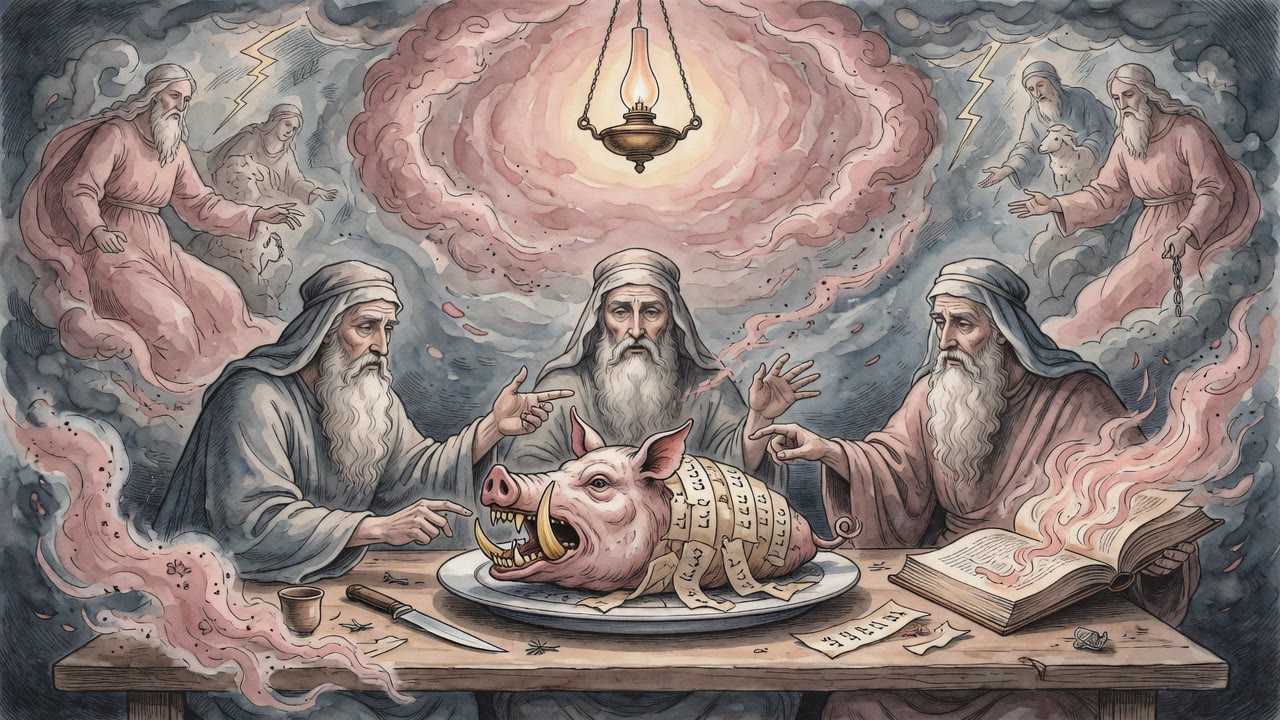
The convert stood in the market arguing a price, and the Israelite's mouth went for the easy knife. "Yesterday you worshipped the deity of Nevo, and the flesh of swine is still between your teeth, and you would dare contend with me!"
Do Not Taunt a Convert About Idols or the Taste of Swine Click for full size

Buyers went quiet. A scale chain ticked. The Torah had already banned this exact moment.

The Market Taunt

The convert's past was dragged into daylight as if conversion were a permanent stain. The insult was shaped to shrink a person in public. Fair argument over price remained open. War with old gods was closed.

Humiliation is not justice. The market knows the difference even when a mouth pretends not to.

Two Prohibitions

"A stranger you shall not afflict and you shall not oppress him." Afflict means verbal mistreatment. Oppress means cheating in coin and contract. Speech and money. Mouth and hand.

Both tell a convert he will never fully arrive. Both are forbidden as if the verse were written for this square.

Egypt in the Mouth

The retort is ready. "For you were strangers in the land of Egypt." Every Israelite descends from outsiders. Mock the convert and you spit on your own grandparents' dust.

The Mekhilta asks for memory with teeth. Remember brick and taskmasters. Refuse to become a small Pharaoh of the tongue.

Trespass Aimed Upward

A sin against a person is also a trespass against the Lord. Converts take refuge in His shadow. Their names are dear as wine of Lebanon on the altar. Rob a convert and it is as if you robbed a native-born.

The taunt is not only cruelty between humans. It is aimed upward. Better the coin weighed clean and the person left whole.

The pressure did not lift for those standing inside this hour. Someone swallowed. Someone clenched a fist around cloth or staff or coin. The next breath decided more than any later summary would admit. What looked like a small refusal or a small courage became the hinge the whole house turned on. Neighbors would argue the details by morning, but the people inside the moment carried the exact weight in their bones.

The pressure did not lift for those standing inside this hour. A throat tightened. Someone clenched a fist around cloth or staff or coin. The next breath decided more than any later summary would admit. What looked like a small refusal or a small courage became the hinge the whole house turned on. Neighbors would argue the details by morning, but the people inside the moment carried the exact weight in their bones.

The pressure did not lift for those standing inside this hour. A sandal scraped stone. Someone clenched a fist around cloth or staff or coin. The next breath decided more than any later summary would admit. What looked like a small refusal or a small courage became the hinge the whole house turned on. Neighbors would argue the details by morning, but the people inside the moment carried the exact weight in their bones.

The pressure did not lift for those standing inside this hour. A child went still. Someone clenched a fist around cloth or staff or coin. The next breath decided more than any later summary would admit. What looked like a small refusal or a small courage became the hinge the whole house turned on. Neighbors would argue the details by morning, but the people inside the moment carried the exact weight in their bones.

The pressure did not lift for those standing inside this hour. A door latch clicked. Someone clenched a fist around cloth or staff or coin. The next breath decided more than any later summary would admit. What looked like a small refusal or a small courage became the hinge the whole house turned on. Neighbors would argue the details by morning, but the people inside the moment carried the exact weight in their bones.

The pressure did not lift for those standing inside this hour. Oil smoke stung eyes. Someone clenched a fist around cloth or staff or coin. The next breath decided more than any later summary would admit. What looked like a small refusal or a small courage became the hinge the whole house turned on. Neighbors would argue the details by morning, but the people inside the moment carried the exact weight in their bones.

The pressure did not lift for those standing inside this hour. A coin rolled and stopped. Someone clenched a fist around cloth or staff or coin. The next breath decided more than any later summary would admit. What looked like a small refusal or a small courage became the hinge the whole house turned on. Neighbors would argue the details by morning, but the people inside the moment carried the exact weight in their bones.

The pressure did not lift for those standing inside this hour. A staff tip bit dirt. Someone clenched a fist around cloth or staff or coin. The next breath decided more than any later summary would admit. What looked like a small refusal or a small courage became the hinge the whole house turned on. Neighbors would argue the details by morning, but the people inside the moment carried the exact weight in their bones.


← All myths

From the tradition

Sources

2 sources

The texts behind this telling. Some cards carry a translation of the source; others are our own retelling of it, and each card says which. Every card links out to the original.

Mekhilta Tractate Nezikin 18:1Mekhilta DeRabbi Yishmael

Retold in our words. Read the original at the link below.Mechilta, translated by Rabbi Shraga Silverstein · CC-BY

(Exodus 22:20) commands: "And a stranger you shall not afflict and you shall not oppress him." The Mekhilta identifies two distinct prohibitions within this verse. "You shall not afflict" refers to verbal mistreatment, taunting, insulting, or reminding the convert of his former life. "You shall not oppress" refers to financial mistreatment, cheating the convert in business dealings.

The verbal prohibition is illustrated with a vivid example. Do not say to a convert: "Yesterday you worshipped the deity of Nevo, and the flesh of swine is still between your teeth, and you would dare contend with me!" This taunt weaponizes the convert's past against him. It treats his former life as a permanent stain rather than a chapter that has been closed.

The Mekhilta then adds a warning: if you taunt the convert, he can taunt you right back. How? "For you were strangers in the land of Egypt." Every Israelite descends from people who were once outsiders in a foreign land. The convert's vulnerability mirrors Israel's own historical experience. Anyone who mocks a convert's foreign origins opens himself to the same critique, your ancestors were foreigners too.

This teaching grounds the convert's protection not in abstract ethics but in shared history. Israel knows what it feels like to be a stranger. That memory creates a permanent obligation to treat converts with dignity, because every Israelite's family was once exactly where the convert is now.

Full source
Bamidbar Rabbah 8:1Bamidbar Rabbah

Retold in our words. Read the original at the link below.The Sefaria Midrash Rabbah, 2022 · CC-BY

Bamidbar Rabbah, a collection of Midrashic (rabbinic interpretive commentary) teachings on the Book of Numbers, tackles this very question, and the answer might surprise you.

The passage begins with a seemingly straightforward verse from (Numbers 5:6): “Speak to the children of Israel: A man or woman, when they will perform any sin of a person, to commit a trespass against the Lord, and that individual shall be guilty.” But as is so often the case, the Rabbis see much more beneath the surface.

Rabbi Abbahu, in a beautiful interpretation, connects this verse to (Hosea 14:8), "Those who dwell in His shadow will return." He says this refers to proselytes – converts – who "come and take refuge in the shadow of the Holy One, blessed be He." They are not just accepted, but cherished.

The connection goes even deeper. The verse in Hosea continues, "They will give life to grain." The Midrash interprets "grain" as an allusion to the Talmud. Just as grain nourishes the body, the Talmud nourishes the soul (Etz Yosef, Maharzu). And "will blossom like the vine" refers to Aggadah, the storytelling and wisdom traditions, which are considered sweet like wine. This suggests that converts are not just recipients of Jewish wisdom, but active participants in its growth and flourishing!

The text continues, "Their repute is like the wine of Lebanon." The Holy One, blessed be He, says that the names of proselytes are as dear as the wine poured as a libation on the altar. But why Lebanon? Because, the Midrash explains, Lebanon "whitens [malbin] the sins of Israel like snow," echoing (Isaiah 1:18): "If your sins will be like scarlet, they will be whitened as snow." Converts, in a sense, help to purify and elevate the entire community.

Rabbi Shimon ben Yoḥai adds that Lebanon is associated with joy: "all the hearts [halevavot] are joyous in it," as in (Psalms 48:3), "Beautiful in its view, joy of all the world." The Rabbis offer another reason, linking it to I (Kings 9:3): "My eyes and My heart [velibi] will be there always." Lebanon, and by extension, converts, are close to God's heart.

The Midrash then draws a parallel between the treatment of native-born Israelites and converts. Just as the Torah outlines restitution for wrongs committed against an Israelite in (Leviticus 5:21), so too does it emphasize the importance of fair treatment of converts. If someone robs a convert, it's as if they robbed an Israelite. The same language of sin, trespass, guilt, and restitution applies to both. The passage emphasizes that the same rules and protections apply equally to both groups.

We find that the same consequences of sin apply in both cases: "A person who shall sin… commit a trespass against the Lord… and that individual shall be guilty," and so on. The message is clear: converts are not second-class citizens. They are fully integrated into the covenant.

Bamidbar Rabbah teaches us that converts are not merely welcomed into the Jewish community, but are considered vital and cherished members. They are likened to grain and vines, essential for nourishment and growth. They help to purify and bring joy to the community. They are just as important as those born into the tradition. It’s a powerful reminder that Judaism isn't about bloodlines, but about embracing a way of life and being welcomed with open arms.

Full source