5 min read

Each Ear Heard God's Voice at Its Own Strength

At Sinai the fire spoke one Word, yet a child, an elder, and a warrior each survived a different measure of the same sound.

Curated by Arthur · Told by Maggid ·
Table of Contents
  1. One Mouth, Many Measures
  2. The Challenge in the Study Hall
  3. Sea Path and River of Fire
  4. What Planting Has to Do With Fire
  5. The Sound That Did Not End

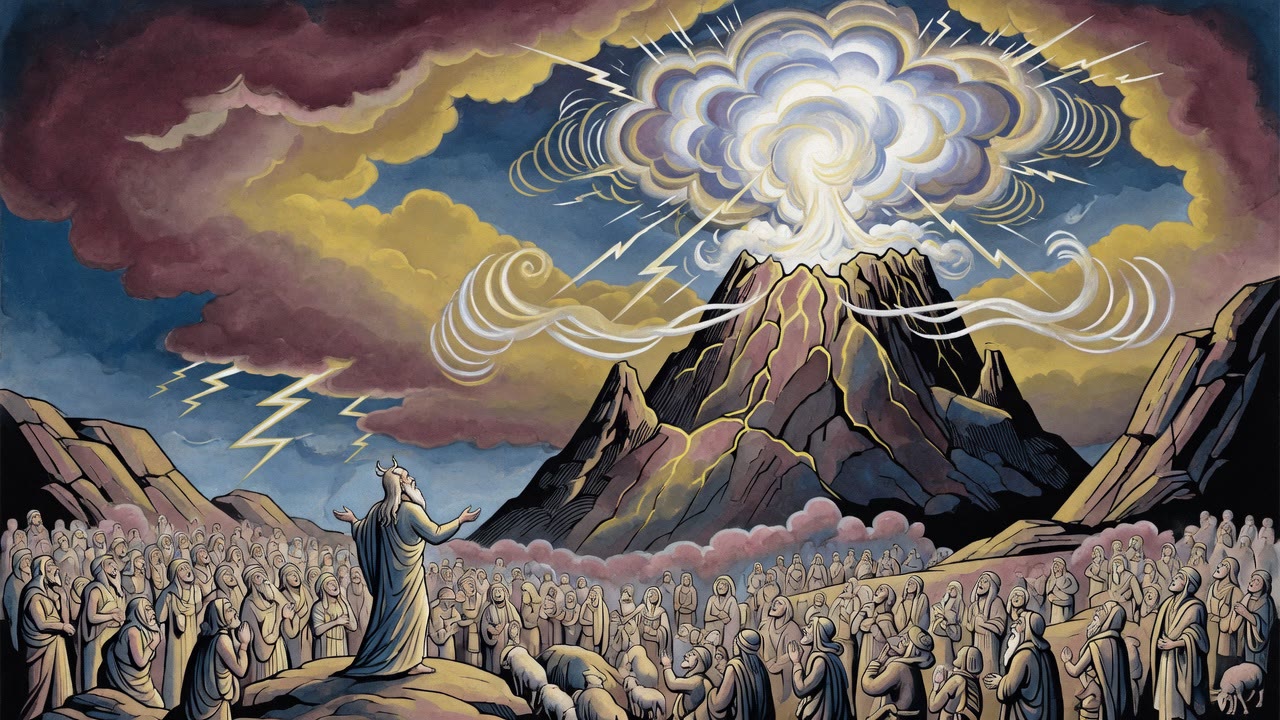
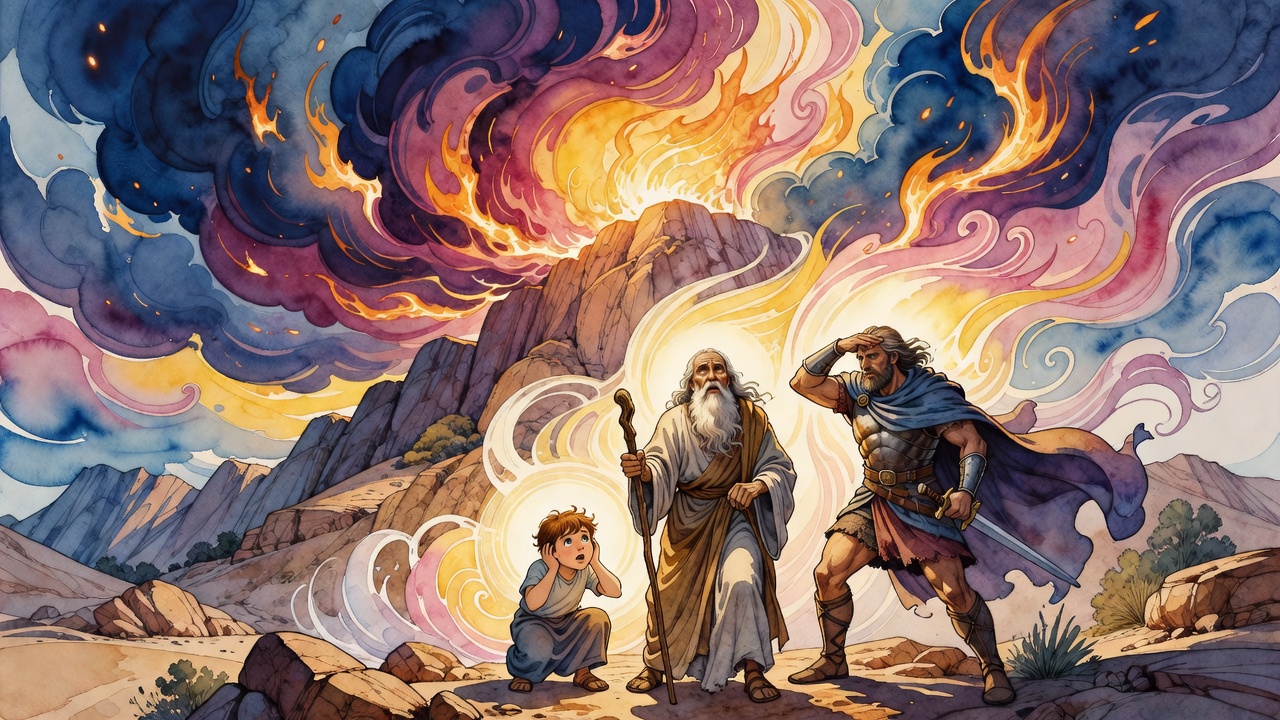
Israel stood at the foot of the mountain while the fire still climbed, and every throat went dry before the first word landed.
Each Ear Heard God's Voice at Its Own Strength Click for full size

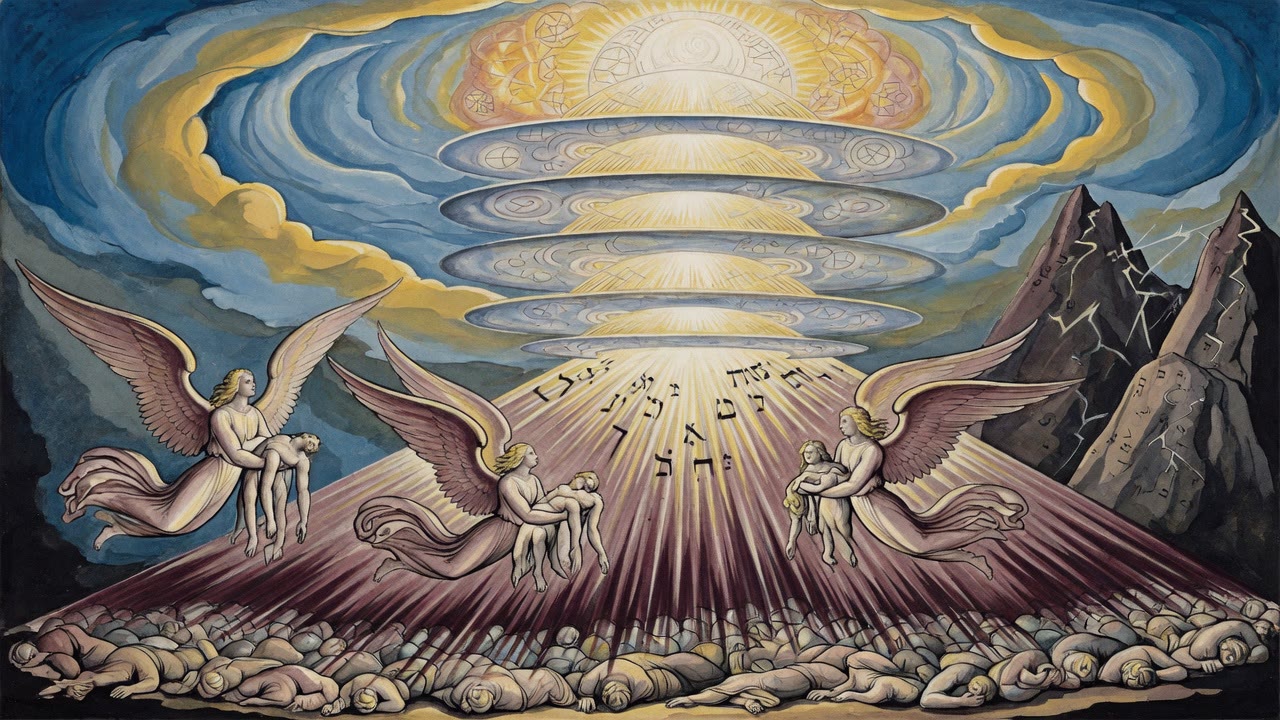
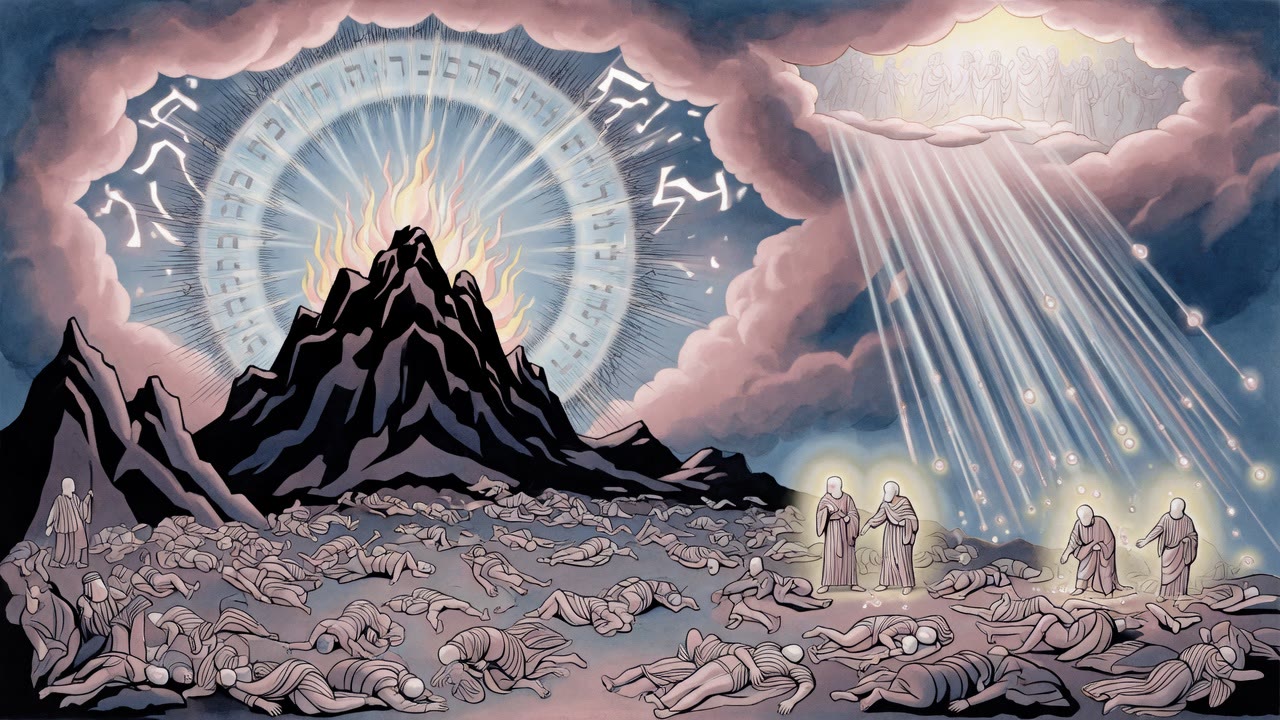
The mountain smoked. The air thickened. Children pressed faces into their mothers' skirts. Warriors who had left Egypt with swords found their knees soft. Elders who had carried memories of brick and whip covered their ears and still heard. From the midst of the fire a voice moved, and the people who heard it did not die. That alone should have ended every easy story about what power sounds like.

One Mouth, Many Measures

If the voice had come at full force, the world would have cracked. A Psalm names the danger: the voice of the Lord is with might, not with His might alone, but with the might of each listener. A young man heard a sound that matched the strength still left in his arms. An old woman heard a sound that matched the slow patience of her years. A child heard something small enough to enter without burning the house of the mind. The same Word. Different rooms.

No one in the crowd could later prove that the others had heard exactly the same thing. They only knew they had lived. Deuteronomy would ask the question for every generation after: has any people heard the voice of God speaking from the fire and lived? The answer at Sinai was a field of shaking bodies who somehow still stood upright.

The Challenge in the Study Hall

Centuries later, in a room far from the mountain, questioners cornered Rabbi Simlai. The verse used the name Elohim, a form that can sound plural. "Are there many gods in the world?" they asked, sharp as hooks. Simlai answered with grammar. The verse says medaber, speaking, singular, not medaberim. One speaker. One fire. His disciples groaned. They said he had rebuffed the questioners with a smashed reed, clever and thin.

Then Rabbi Levi stepped into the gap. He refused to leave the matter as a language trick. If Torah had said the voice came with the full might of Heaven, no creature would have survived the hearing. The mercy was the measure. God did not lower the truth. God lowered the volume to the size of each ear. After the many sounds faded, the Holy One still said, "I am the Lord your God," singular, so no one would mistake variety for a committee of divinities.

Sea Path and River of Fire

Later sages pressed a harder problem. "You shall follow the Lord your God," the verse commands. But God's path is through the sea and through mighty waters. Who walks there without drowning? "You shall cleave to Him," the same line continues. Daniel saw a throne of sparks and a river of fire flowing before the Ancient of Days. Who clings to a consuming fire and keeps flesh on bone?

The mountain at Sinai already answered half the riddle. Following is not swimming the divine sea barefoot. Cleaving is not diving into the river of flame. The people who stood under the Word did not become angels. They became listeners calibrated to stay human and still hear. The rest of the walk would be measured the same way: not by storming Heaven, but by carrying what a human frame can hold without lying about the fire.

What Planting Has to Do With Fire

Rabbi Yehuda took the problem down to the ground. From the beginning, God planted a garden in Eden. When Israel entered the land, the command was to plant. The path through the sea is God's alone. The river of fire is God's alone. The garden is where a mortal hand can act like the first Gardener without pretending to be the Gardener. A seed in soil is not a throne of sparks. It is still the only following most bodies can survive.

At Sinai the fire spoke. In the field a hoe answers. Between them runs the whole discipline of Israel: receive a voice that would kill you if it came unmeasured, then spend a lifetime doing work that looks small next to that fire and still belongs to it.

The Sound That Did Not End

When the cloud lifted and the mountain stopped smoking, the people did not carry a single identical memory of pitch and volume. They carried a shared survival and a shared claim. One God had spoken. Many capacities had received. That is why the questioners of Simlai could not win by counting letters of Elohim, and why the disciples needed more than a smashed reed. The real defense was the scene itself: a nation that lived through a voice that should have ended them, each ear intact at its own strength.

The fire did not ask permission. It only chose not to erase the listeners. Everything after that day is a people trying to walk after a God whose footsteps are ocean and flame, with hands that know how to plant.


← All myths
From the tradition

Sources

2 sources

The texts behind this telling. Some cards carry a translation of the source; others are our own retelling of it, and each card says which. Every card links out to the original.

Shemot Rabbah 29:1Shemot Rabbah

Retold in our words. Read the original at the link below.The Sefaria Midrash Rabbah, 2022 · CC-BY

The book of Deuteronomy (4:33) asks a pretty profound question: “Has a people heard the voice of God [Elohim] speaking [medaber] from the midst of the fire, as you heard, and lived?” It’s a thought. How could anyone survive hearing the actual voice of God?

This very question, or rather the plural form of the word "God" (Elohim) in the verse, once sparked a debate with some… well, let’s call them questioners. Rabbi Simlai, a sage of the Talmudic era, was challenged by those who suggested that the use of Elohim, a plural term, implied the existence of multiple gods. They asked him, point blank: "Are there many gods in the world?"

Rabbi Simlai, ever sharp, countered with a clever linguistic parry. He pointed out that the verse doesn't say medaberim, the plural form of "speaking," but rather medaber, the singular. Tricky. But his disciples weren’t entirely convinced. They basically told him, "Rabbi, you dodged the question! What's the real answer?" They felt his response was flimsy, like "rebuffing them with a smashed reed," as the text puts it.

Enter Rabbi Levi, who offered a far more compelling interpretation. He explained that if the Torah had said, “The voice of the Lord is with His might,” the world couldn’t have survived. The sheer force would have been too much. Instead, as (Psalm 29:4) says, “the voice of the Lord is with might” – with the might of each individual.

In other words, everyone heard the voice of God according to their own capacity. The young men heard it in a way that resonated with their strength, the elders in a way that suited their wisdom, and even the children understood it in their own innocent way. The voice was tailored, personalized, calibrated to each listener.

As we find in Shemot Rabbah, the Holy One, blessed be He, said to Israel: "Do not believe that because you heard many voices, perhaps there are many gods in the heavens, but rather, know that I am the Lord your God," as it is stated in (Deuteronomy 5:6): “I am the Lord your God.” Each person experienced the revelation at Sinai in a deeply personal and meaningful way. God didn't just blast a single, monolithic message; He communicated in a way that everyone could grasp, internalize, and connect with.

Perhaps it's a reminder that our understanding of the divine is always filtered through our own experiences, perspectives, and capacities. Maybe it means that the most powerful messages are the ones that speak directly to our hearts, in a language we can truly understand. And maybe, just maybe, it means that even though we may hear different voices, we can all still recognize the one God speaking to us.

Full source
Vayikra Rabbah 25:3Vayikra Rabbah

Retold in our words. Read the original at the link below.The Sefaria Midrash Rabbah, 2022 · CC-BY

He begins with a verse from Deuteronomy (13:5): “You shall follow the Lord your God.” But then he asks, how can mere mortals like us truly follow the Divine?

After all, as the Psalms (77:20) tell us, God’s path is through the sea, through mighty waters! Are we supposed to part the oceans and walk in those footsteps? And then there's the second part of that verse: “And you shall cleave to Him.” Cleave to God? Is that even possible?

Rabbi Yehuda continues, reminding us that scripture describes God as a consuming fire (Deuteronomy 4:24). Daniel (7:9-10) elaborates, depicting God's throne as sparks of fire, with a river of fire flowing before Him. So, are we really supposed to cozy up to that?

It seems impossible. But that's where the beauty of the teaching comes in.

The answer isn't about literal imitation. How do we do that? By looking at the beginning.

Rabbi Yehuda points out that from the very beginning of creation, God engaged in planting. Genesis (2:8) tells us, “The Lord God planted a garden in Eden.”

What does that mean for us? Well, Rabbi Yehuda connects this to another verse: "When you will come into the land and plant." The act of planting, of nurturing, of creating something beautiful and life-giving, is how we can emulate God.

It’s not about fiery thrones or parting seas. It’s about the simple act of planting a seed, of contributing to the world’s growth and beauty. It’s about creation, sustenance, and hope.

So, maybe we can't literally follow God's path through the sea, or cleave to a consuming fire. But we can follow the Divine example by engaging in acts of creation, of kindness, of nurturing. And that, perhaps, is the most meaningful way to draw closer to the Holy One, blessed be He.

What will you plant today?

Full source