Parshat Vayishlach5 min read

Esau Meets Angel Camps on the Road to Jacob

Iron armor, horsemen, and chariots block Esau's path. Every company answers with one name, Jacob, until the hunter begins to fear the brother he came to crush.

Curated by Arthur · Told by Maggid ·
Table of Contents
  1. The Road Fills with Iron
  2. The Hunter Who Once Spat on a Birthright
  3. Jacob Names the Face of Angels
  4. Edom's Long Shadow
  5. Two Camps, One Mercy
Esau Meets Angel Camps on the Road to Jacob Click for full size

The Road Fills with Iron

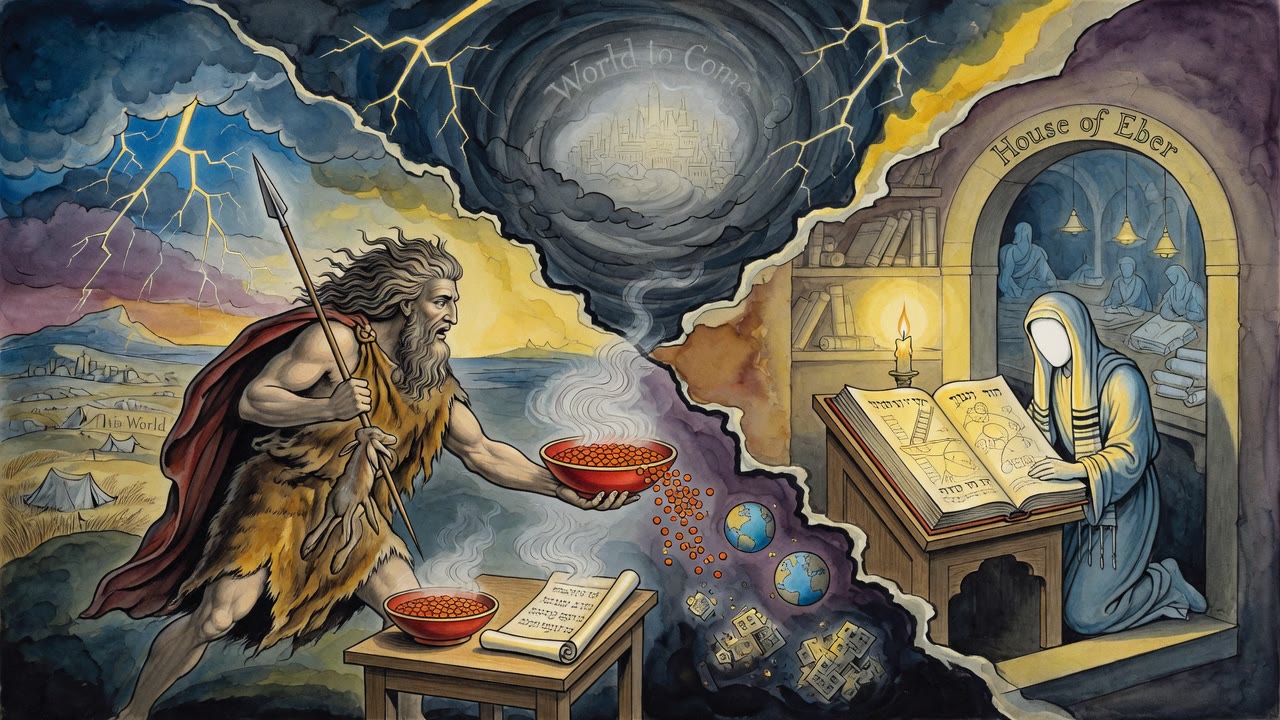
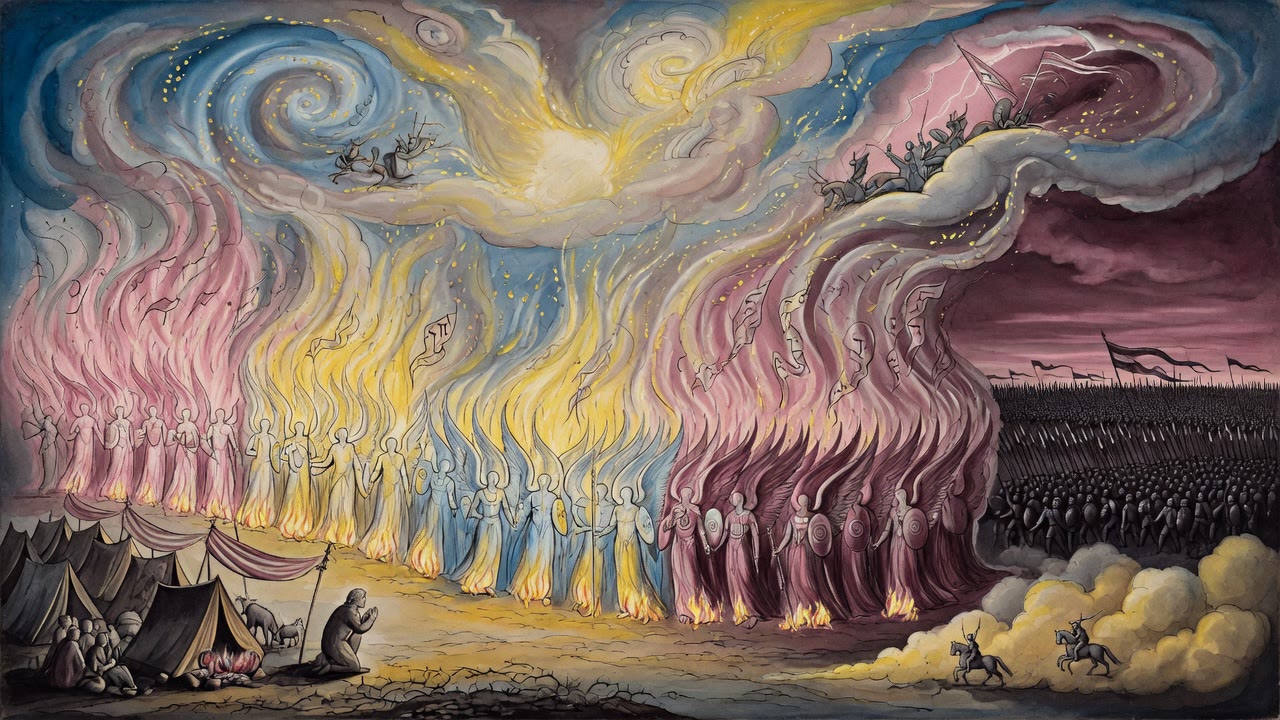
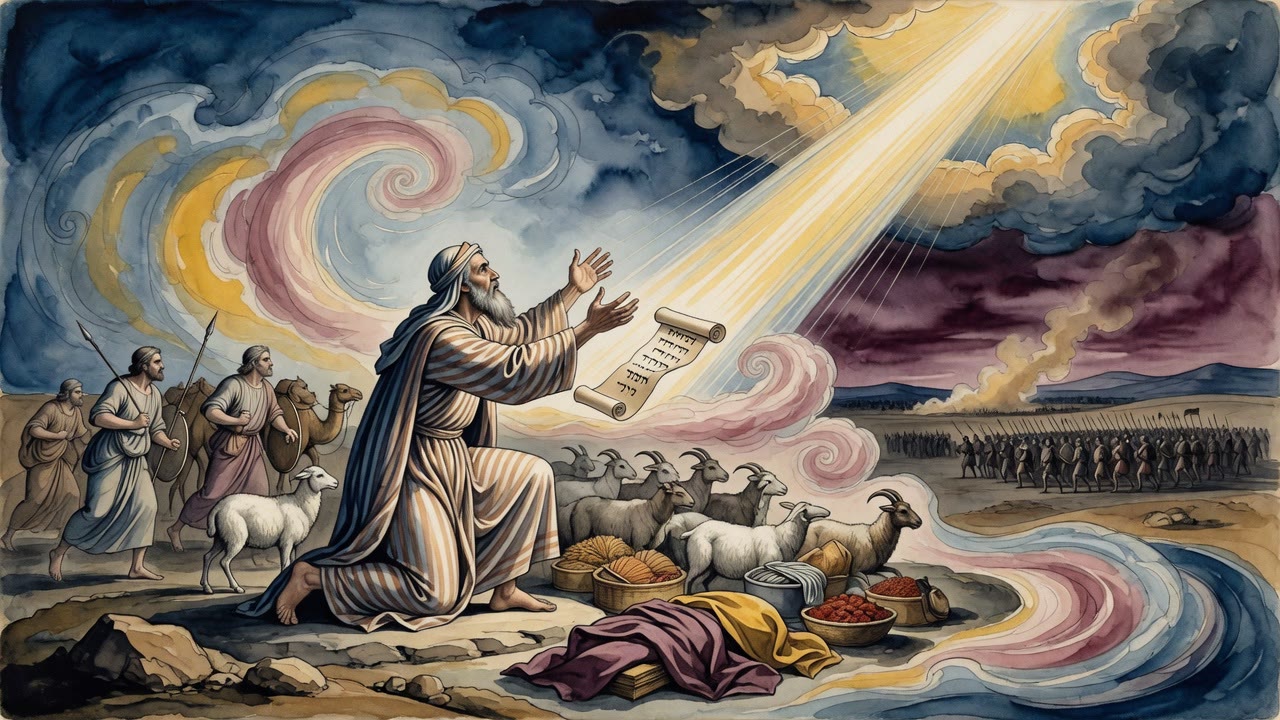
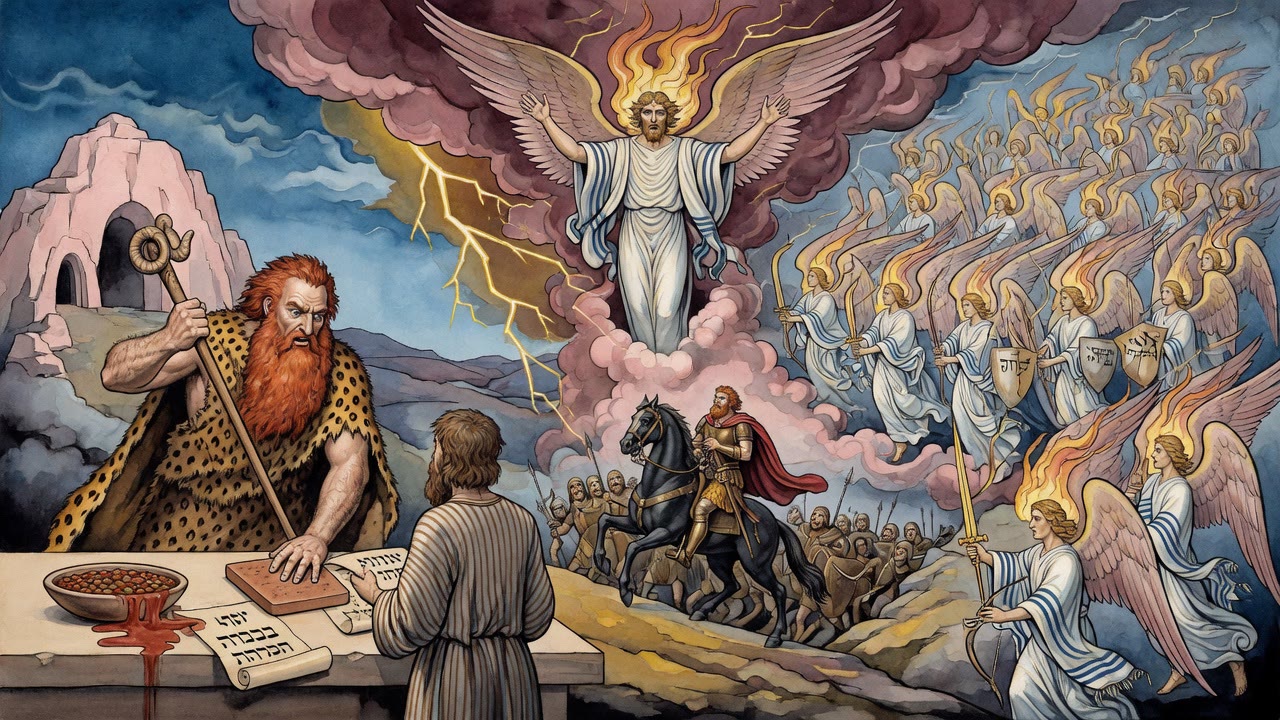
Esau comes south with four hundred men and a memory that still tastes like a stolen blessing. He has lived by the bow and the field. He sold a birthright for a bowl when hunger was loud, and later he swore to kill when the smell of that sale returned as a brother's triumph. Now the dust of his company rises, and the first obstacle is not Jacob's thin line of flocks. It is a wall of ministering angels in iron armor, standing as if the road itself has grown a army.

Who are you with? Esau demands. Jacob, the armored ones answer, as if that name alone were a password and a warning. Esau pushes on and meets horsemen. Who are you with? Jacob. He meets chariots. Who are you with? Jacob. The road that should have been empty of power is crowded with companies, myriads upon myriads, the kind of host the psalmist numbered as chariots of God in thousands (Psalm 68:18). The place will be called Maḥanayim, two camps, because heaven has doubled itself around the man Esau still plans to finish with his own hands.

The Hunter Who Once Spat on a Birthright

Esau remembers the red stew and the shrug with which he let the firstborn portion go. He hated the blood of covenant service when it asked for patience, and he preferred the blood of game when it filled the pot. The birthright asked for a long memory of altars and a place in the line of promise. He chose the bowl. Years of building power in the hills of Seir have not erased the bargain. They have only made him stronger in the body and poorer in the claim he threw away for a single meal.

Now the angels will not let him pretend the quarrel is only between two brothers over a father's last words. Every answer names Jacob. The field-man who once measured worth in venison is forced to measure a camp he did not raise and cannot count, even with four hundred spears at his back.

Jacob Names the Face of Angels

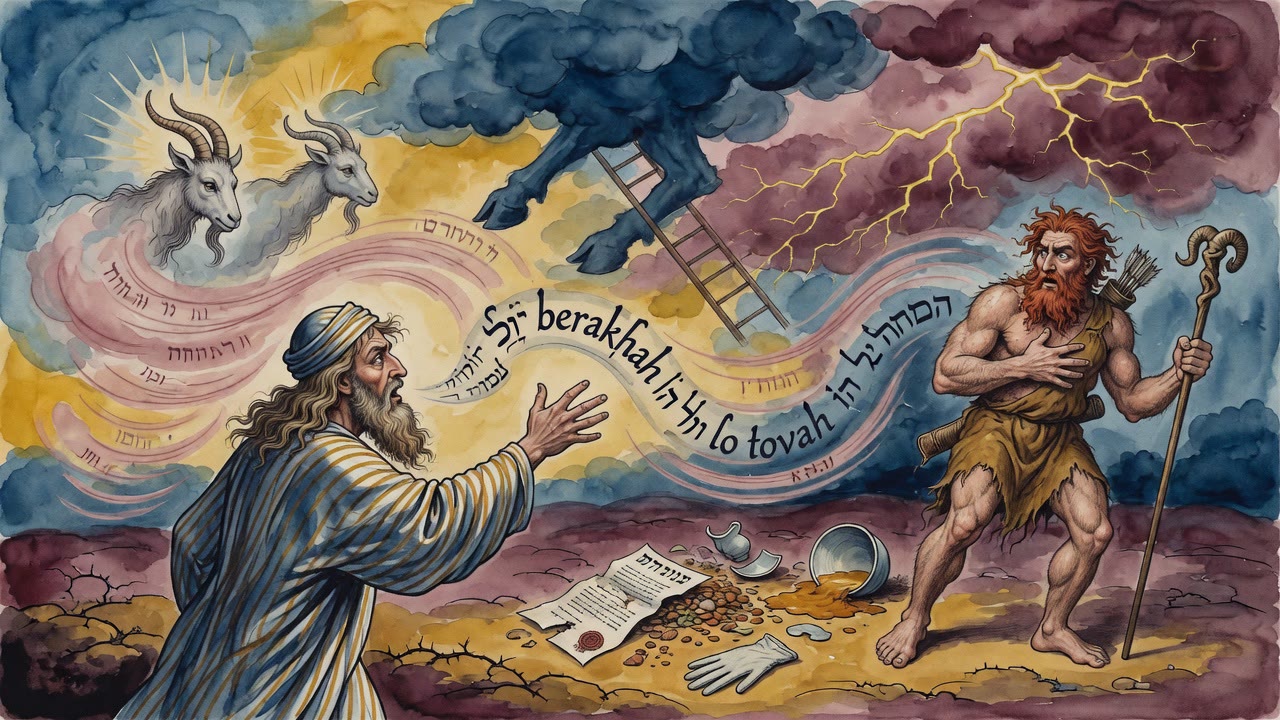
When the brothers finally stand within speaking distance, Jacob does not open with a sword. He has already sent gifts in waves across the distance. He has already split his people so that if one camp is struck, the other may flee. He has already spent a night wrestling until a hip went out of joint and a new name entered the world at the ford. At the meeting he bows, and he speaks a sentence that lands like a blade wrapped in silk and oil.

Seeing your face, he tells Esau, is like seeing the face of angels (Genesis 33:10). The word can mean God, judges, or the shining ones of the upper camp. Esau hears what Jacob wants him to hear. This brother has walked among powers Esau met on the road. This brother speaks as if the King Himself has invested him with glory. A man who plans murder at a table changes his mind when the guest mentions the palace kitchen by name. Esau, hearing the Holy One folded into the flattery, feels his will to finish the old revenge go slack in his hands.

Edom's Long Shadow

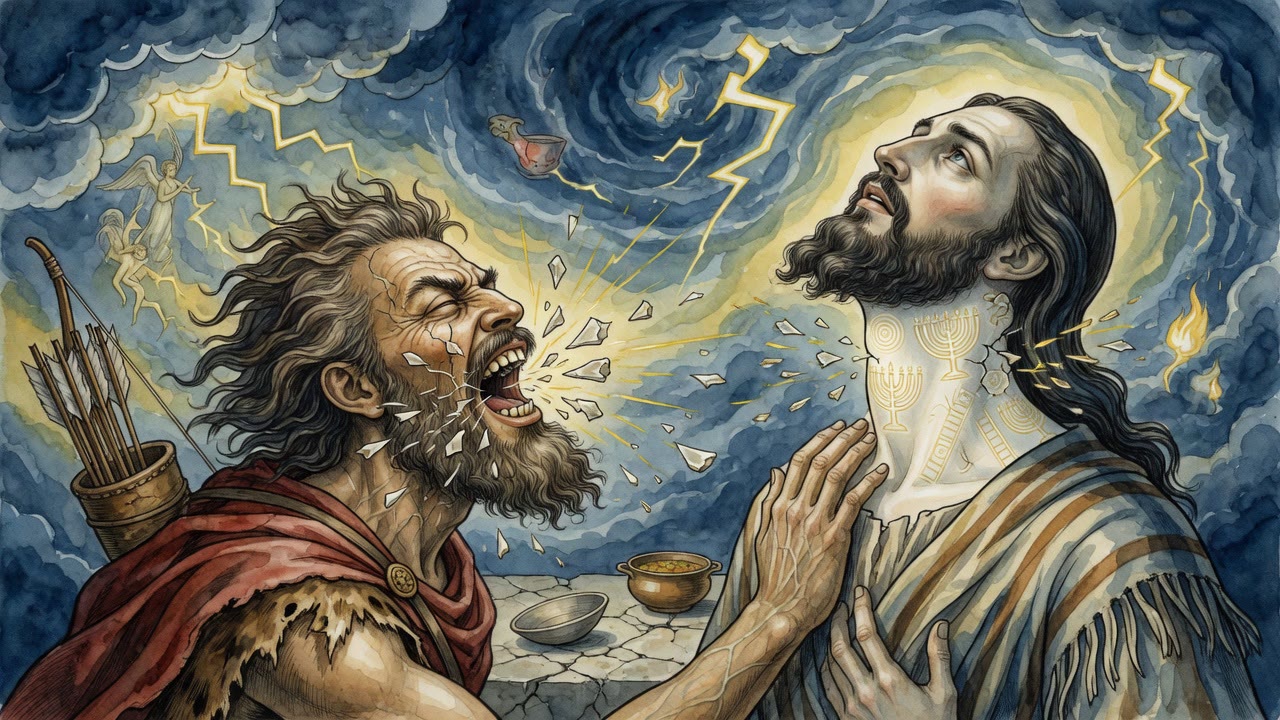
The peace of that hour is real and thin. Esau will still become a nation that later midrash calls terrible, a beast of empire whose dread fills the prophets and makes the nations shake. From Esau's own line will come Eliphaz, who once rebuked suffering Job without mercy, and from that same hard house will come, in another age, a convert named Obadiah whose entire scroll is a sentence against Edom. The Holy One, the teachers say, will not leave Esau's account to a random avenger. He will settle it Himself, and He will sometimes raise the mouth of judgment from inside the very people being judged.

On the road of Maḥanayim, that future is only a rumor in the armor and the chariot wheels. What matters now is that Esau's four hundred look small beside the companies that claimed Jacob's name without raising a human sword. The hunter who despised a birthright discovers that heaven did not despise the brother who carried it away into the night.

Two Camps, One Mercy

Jacob names the place and keeps moving. He will not settle under Esau's eye or share a long road that could turn again into a trap. Esau turns toward Seir with a kiss that may be sincere and may be strategy. The text leaves teeth and tears close enough to confuse anyone who wants a simple ending. Between them the angel camps dissolve back into invisibility, their work for the hour complete and their iron no longer needed on that stretch of dust.

What remains is the knowledge forced on both men. Jacob is not alone when he is most afraid. Esau is not free to treat a covenant bearer as mere prey on an open road. The path between them filled with iron, horses, and chariots so that a family wound would not become an unmarked grave in the hills of Canaan before the tribes were born.


← All myths
From the tradition

Sources

3 sources

The texts behind this telling. Some cards carry a translation of the source; others are our own retelling of it, and each card says which. Every card links out to the original.

Bereshit Rabbah 75:10Bereshit Rabbah

Retold in our words. Read the original at the link below.The Sefaria Midrash Rabbah, 2022 · CC-BY

Bereshit Rabbah turns to Jacob Wrestled the Angel and Limped at Sunrise.

Hold onto your hats, because According to Bereshit Rabbah, a collection of rabbinic homilies on the Book of Genesis, this "camp of God" wasn’t just a few tents and some friendly faces. Think two thousand myriads – that's tens of thousands – of ministering angels. As (Psalm 68:18) puts it: “The chariots of God are myriad, thousands upon thousands of companies."

The text continues: "He called the name of that place Maḥanayim." Maḥanayim is Hebrew for "two camps," and the Rabbis ask, "Why were there two camps?" Well, it teaches us that Jacob was given four thousand myriads of ministering angels! They weren't just hanging around either. They showed up like a king’s army, some clad in iron armor, some on horseback, and others riding in chariots. Imagine the spectacle!

Picture Esau approaching. He encounters the iron-clad angels and asks, "Who are you with?" "Jacob," they reply. Then he meets the horsemen, and gets the same answer. Finally, he confronts the angels in chariots, and again, the answer is "Jacob." As it says later, in (Genesis 33:8), Esau asks: “For whom do you intend this entire camp that I met?”

Jacob wasn't just relying on divine muscle, though. He was playing a psychological game. Bereshit Rabbah suggests that Jacob would mention the name of the Holy One, blessed be He, to Esau, to scare and frighten him.

This brings us to a powerful moment in (Genesis 33:10), where Jacob says to Esau: “As I have seen your face, as the sight of the face of angels [elohim].” Elohim, of course, is one of the Hebrew names for God, but it can also refer to angels or judges. Jacob is essentially telling Esau that seeing his face is like seeing the face of the divine.

The Rabbis bring a fantastic analogy to explain this. Imagine someone invited to a meal, but the guest learns that the host is plotting to kill him. So, the guest says, "This dish tastes just like something I had in the king's palace." The host, suddenly worried, thinks, "He knows the king?" and backs down from his murderous plan.

That’s what Jacob was doing! When he said to Esau, "As I have seen your face, as the sight of the face of angels [elohim]," the wicked Esau thought, "The Holy One, blessed be He, brought him to all this glory? I will no longer be able to overcome him." Jacob’s words, infused with the implied power of the divine, disarmed Esau more effectively than any army could.

It’s more than just a tale of sibling rivalry and divine intervention. It's a reminder that sometimes, facing our fears requires a combination of faith, strategy, and a little bit of chutzpah. And maybe, just maybe, we all have a camp of angels watching over us, even when we can't see them.

Full source
Midrash Tanchuma Buber, Toldot 4:5Midrash Tanchuma Buber, Toldot

Translation of the source text.Midrash Tanchuma (Buber), Public Domain, on Sefaria · CC-BY-SA

Another interpretation of "Surely you have hated blood" (Ezekiel 35:6): Now Esau hated blood. His father blessed him through blood, and he trusted in blood, as it is said, "And by your sword you shall live" (Genesis 27:40). Yet Scripture says to him, "Surely you have hated blood" (Ezekiel 35:6), rather, that he hated the life of a person, which is placed within his body. Therefore he said, "What use is this birthright to me?" (Genesis 25:32).

Full source
Midrash Tanchuma Buber, Vayishlach 8:2Midrash Tanchuma Buber, Vayishlach

Translation of the source text.Midrash Tanchuma (Buber), Public Domain, on Sefaria · CC-BY-SA

Woe to the kingdom of Esau when the Holy One, blessed be He, sees its deeds and rises up to exact punishment from it. We find that with Egypt, when the Holy One, blessed be He, punished them, He punished them at the time of waking, as it is said, "And it came to pass in the morning watch" (Exodus 14:24). And concerning Assyria, what is written? "And the angel of the Lord went out and smote the camp of Assyria" (II Kings 19:35). With Media, it was through Mordecai and Esther. With Greece, it was through Mattathias and his sons. But concerning Edom, the Holy One, blessed be He, said: there is no creature that will exact punishment from it; I Myself will exact punishment from it. From where? As it is said, "The vision of Obadiah. Thus said the Lord God concerning Edom: We have heard tidings from the Lord" (Obadiah 1:1).

Said Rabbi Berechiah: What did Obadiah see that he should exact punishment from Edom? He saw that the Holy One, blessed be He, repays reward to those who love Him; to those who hate Him, how much more so. And the Holy Spirit speaks through Eliphaz the Temanite: "Then Eliphaz the Temanite answered and said: If one ventures a word with you, will you be wearied?" (Job 4:1-2). Eliphaz said to Job: Behold, you say, "Why am I not like Abraham?" Thus you said, "He has cast me into the mire, and I have become like dust and ashes" (Job 30:19). You suppose that He equates you with him. Said Rabbi Berechiah: Invert the verse and expound it: "And I have become like dust and ashes", and He judges you like the generation of the dispersion, of whom it is written, "And the brick served them as stone" (Genesis 11:3). "He has cast me into the mire", Eliphaz said to him: Are your deeds like Abraham's? Abraham was tested with ten trials and stood firm in all of them, and you in one trial! "If one ventures a word with you, will you be wearied? Behold, you have instructed many" (Job 4:2-3).

You used to comfort all who suffered afflictions. When a blind man came to you, you would say to him: the Holy One, blessed be He, already knew what He was destined to do when He blinded that man; and you would comfort him and say to him: if you were building a house and did not wish to open windows, who could protest against you? So the Holy One, blessed be He, is destined to be glorified through you, as it is said, "Then the eyes of the blind shall be opened" (Isaiah 35:5). When a deaf man came to you, you would comfort him and say to him: if you wished to make a jug and did not wish to make ears for it, who could protest against you? So the Holy One, blessed be He, is destined to be glorified through you, as it is said, "And the ears of the deaf shall be unstopped" (Isaiah 35:5). To the lame you would say, "Then shall the lame man leap as a hart" (Isaiah 35:6), and you would comfort him. "Your words have upheld him that was falling" (Job 4:4). But now that it has touched you, you are dismayed: "But now it is come unto you, and you are wearied" (Job 4:5). "Is not your fear of God your confidence?" (Job 4:6), because you said: I am a righteous man, so why does He afflict me? And have you ever in your days seen a righteous man perish? "Remember, I pray you, who that was innocent ever perished?" (Job 4:7). Noah, who was righteous, escaped from his generation; Abraham escaped from the furnace; Isaac escaped from the slaughtering knife; Jacob escaped from the angel; Moses escaped from Pharaoh's sword. "Remember, I pray you, who that was innocent ever perished?", Israel He delivered from Egypt and destroyed the Egyptians. "According as I have seen, they that plow iniquity and sow trouble reap it" (Job 4:8). And what became of them? "By the breath of God they perish" (Job 4:9), as it is said, "You blew with Your wind, the sea covered them" (Exodus 15:10). So too all the wicked who are destined to arise: "The roaring of the lion and the voice of the fierce lion" (Job 4:10).

Job said to him: Look now at your father Esau! He said to him: I have no business with him, "The son shall not bear the iniquity of the father" (Ezekiel 18:20). "The old lion perishes for lack of prey" (Job 4:11), this is Esau, who perishes for lack of deeds. "And the whelps of the lioness are scattered" (Job 4:11), these are his chieftains. Job said to him: And you, what is it for you? "Now a word was secretly brought to me" (Job 4:12), I am a prophet; I have no business with him, only to reprove you. "In thoughts from the visions of the night" (Job 4:13). The Holy One, blessed be He, said to Job: My servant, in a vision you were reproved; I will raise up from you a prophet who will exact punishment from your father's house in a vision, as it is said, "The vision of Obadiah." For Rabbi Shmuel bar Nachmani said: What did Obadiah see that he prophesied only against Edom? Rather, the Holy One, blessed be He, said: Esau grew up between two righteous ones and did not learn from their deeds, while Obadiah dwelt between two wicked ones and did not learn from their deeds; let Obadiah come and exact punishment from Esau. Therefore, "The vision of Obadiah." And what is written in his prophecy? "And the house of Jacob shall be a fire, and the house of Joseph a flame, and the house of Esau for stubble, and they shall kindle in them and devour them; and there shall be no survivor to the house of Esau, for the Lord has spoken" (Obadiah 1:18).

Full source