Parshat Vayishlach6 min read

Esau's Teeth Broke on Jacob's Ivory Neck

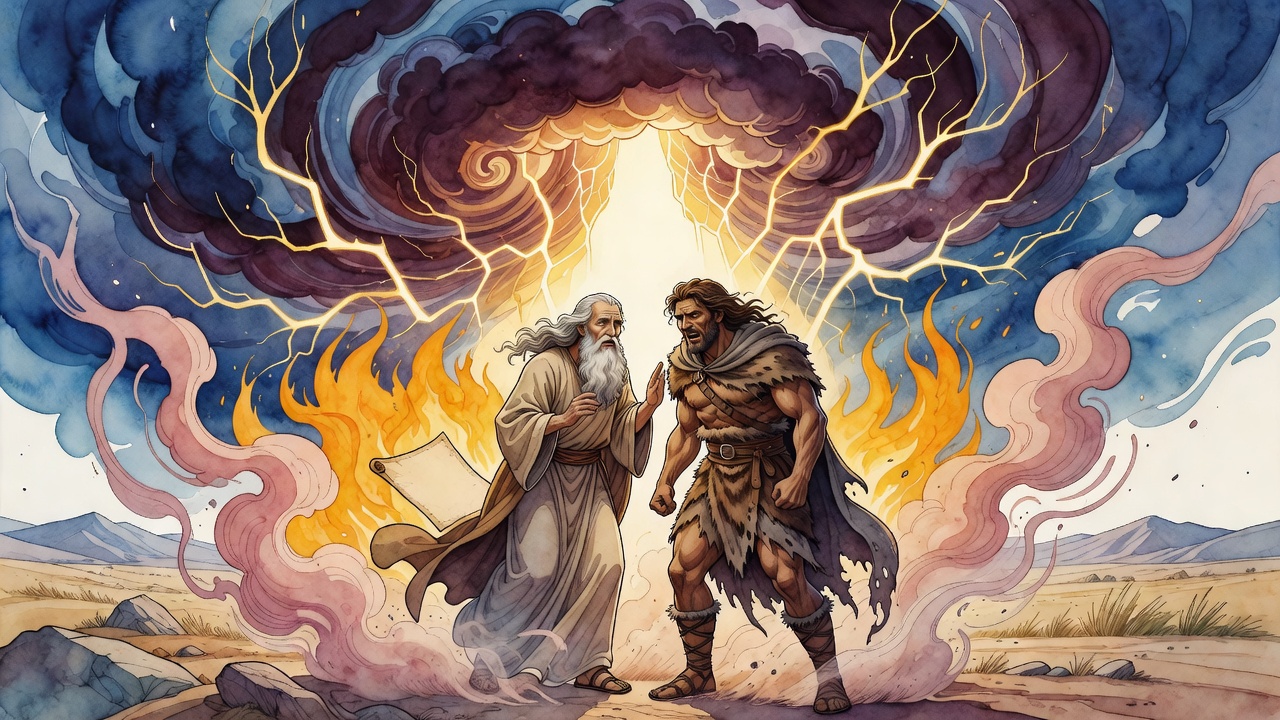
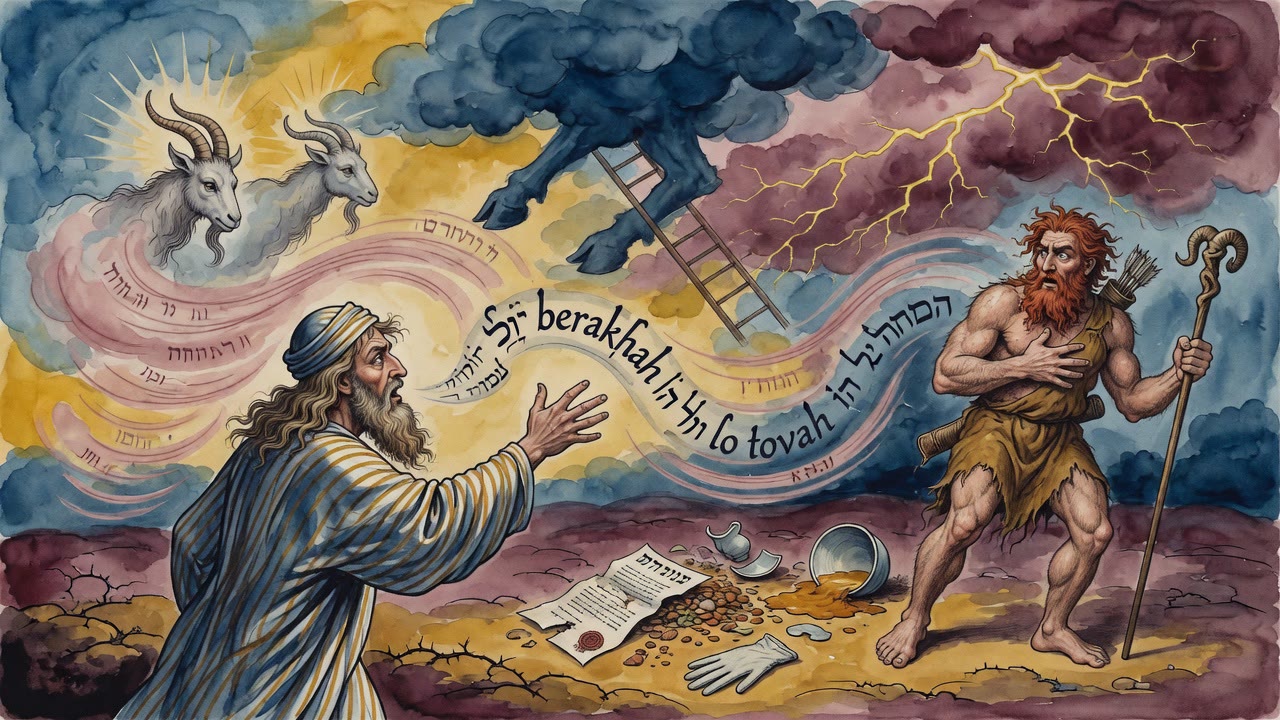
Esau lunged to bite his brother to death, but Jacob's neck hardened like ivory, and the hunter howled while his own teeth cracked.

Curated by Arthur · Told by Maggid ·
Table of Contents
  1. Four Hundred Men and a Soft Neck
  2. The Fox Who Forgot His Fables
  3. When the Neck Turned to Ivory
  4. Wolf and Ram Still Howling
Esau's Teeth Broke on Jacob's Ivory Neck Click for full size

Four Hundred Men and a Soft Neck

Esau did not come with a bow alone. He came with four hundred men, dust rising behind them like a second army, and a vow already dry on his tongue. He would not kill Jacob from a distance. He would not waste an arrow on a brother who had stolen a blessing in a tent that still smelled of stew and goat hair. He would bite him. He would suck the blood from the throat that had spoken in their father's hearing and taken what the firstborn hunter believed was his by bone and birth order.
Jacob saw the dust long before he saw faces. Messengers had already numbered the men. Fear did its ordinary work in his gut, then he forced the fear into geometry. He split the camp. He ranked the approach. Handmaids and their children went first. Leah and her children followed. Rachel and Joseph he kept at the rear, farthest from the first blow. Then he changed the plan again and stepped to the front himself. "It is better that they attack me than my children," he said. The sentence was not poetry for later books. It was a body offered as a shield while flocks bleated and children watched a father's back become the border of the world.

Gifts went ahead on the road like soft arguments. Waves of animals meant to arrive in Esau's eyes before Jacob's face did. Jacob still did not trust bribes alone. He had wrestled through a night that left him limping. Dawn found him arranging people the way a general arranges lines, except the enemy wore his own childhood.

The Fox Who Forgot His Fables

Later storytellers compared Jacob's thinning courage to a fox who boasted of three hundred fables that could calm a raging lion. On the road the fox forgot a hundred, then another hundred, then all of them, and told the other beasts to face the king alone. Jacob, too, had meant to stand for everyone. As the line of four hundred closed, the certainty thinned. Each wife, each child, each servant would have to approach the danger with whatever mercy heaven still held for their particular name.

Joseph, small and sharp-eyed, disobeyed the order that set his mother last with no cover. He moved to stand before her beauty, as if he already understood what a man like Esau might do with his eyes before he did anything with his teeth. The rear of the column became a second front of love and fear. Jacob saw it and did not correct the boy. Some disobedience is already midrash in the making.

The handmaids went forward knowing they were weather vanes. If Esau's passion for women rose first, the legend says, Jacob hoped the first rank would buy him seconds to harden a defense for Leah and Rachel. Seconds are a currency fathers spend when they have no better coin. The whole arrangement smelled of fox-wisdom and failure at once.

When the Neck Turned to Ivory

The brothers met on ground that remembered their mother's two pregnancies fighting in one womb. Esau did not wait for the full theater of greeting. Hatred has its own etiquette, and his etiquette was teeth. He lunged for Jacob's throat the way a wolf lunges for a ram. Midrash paints them locked and howling, one for prey and one for the next attack that must surely come.

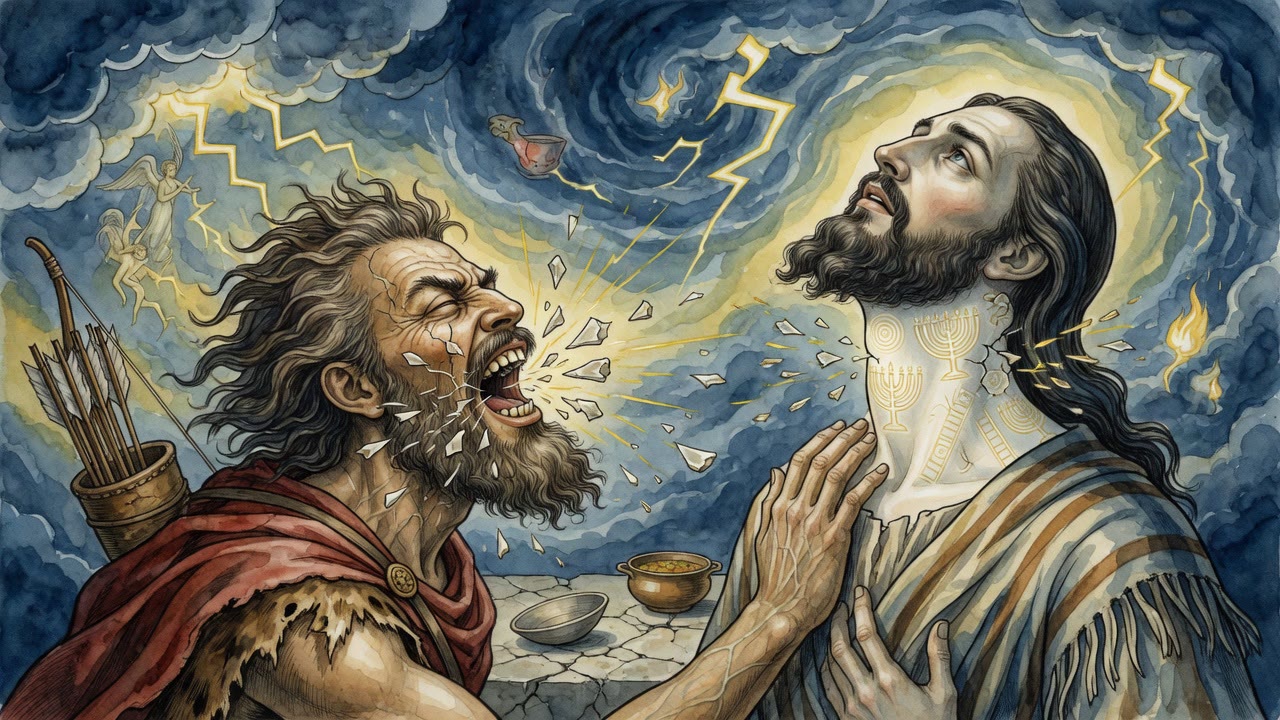
Jacob's neck, in that instant, hardened like ivory. Esau's teeth found no soft life to drink. They found a surface that answered force with force, a sudden mineral refusal. The hunter of the field, who had vowed intimacy of violence, ended with cracked teeth and a mouth full of failure. He bawled. The sound was not the cry of a clean battlefield death. It was the cry of a man whose revenge had broken on the body he meant to empty.

Jacob, still terrified, felt no triumph. A neck that can turn to ivory once may need to turn again, and Esau's eyes did not promise rest. The four hundred men shifted, waiting for a signal that pain had not yet translated into orders. Between the brothers, blood that had almost been swallowed stayed inside one body by a miracle that left both men uglier and alive.

Wolf and Ram Still Howling

The tradition refuses to tidy the moment into a clean win. The wolf howls because he cannot finish the kill. The ram howls because he expects another charge. Mercy and terror share the same breath. Jacob's gifts and bows and carefully ranked family had bought time. The ivory neck bought a life. Neither erased the years of stolen blessing or the blood Esau still tasted in imagination when he closed his mouth on broken ivory.

When the dust settled into something like greeting, the brothers held each other with arms that remembered other uses. Four hundred men waited for a signal that never came. The field that had almost become a slaughterhouse became a place of half-reconciliation, the kind that leaves both men knowing the next meeting will need new armor. Jacob still limped from the night angel. Esau still rode with a company large enough to end a clan.

Children who had been placed like pieces on a board watched adult bodies decide whether the board would burn. Rachel's boy kept his place before her. Leah's eyes measured distances. Somewhere in the press of animals and men, a vow to bite a brother to death became a story fathers would tell when they wanted children to understand that hatred can break its own teeth.


← All myths
From the tradition

Sources

3 sources

The texts behind this telling. Some cards carry a translation of the source; others are our own retelling of it, and each card says which. Every card links out to the original.

Legends of the Jews 6:201Legends of the Jews

Retold in our words. Read the original at the link below.The Legends of the Jews by Louis Ginzberg (1909) · Public Domain

He wasn't just miffed at his brother Jacob. He was incandescent with rage. Remember, Jacob had received the blessings meant for Esau, and Esau wasn't about to let that go. He wanted revenge, and not just any revenge.

Esau, consumed by his burning anger toward Jacob, swore he wouldn't use some impersonal weapon like a bow and arrow. No, no. He wanted to get up close and personal. He vowed to bite Jacob to death, to suck his very blood! Think about the sheer visceral hatred in that image.

Esau was, according to this legend, doomed to disappointment.

When Esau lunged at Jacob, ready to carry out his gruesome plan, something miraculous happened. Jacob's neck became as hard as ivory. Esau, in his uncontrollable fury, could only gnash his teeth in a helpless rage.

The Midrash (a method of interpreting biblical stories) paints a vivid picture of this struggle. The brothers are compared to a ram and a wolf. The wolf, representing Esau, wants to tear the ram (Jacob) to pieces. But the ram defends himself, driving his horns deep into the wolf's flesh. Both howl in pain. The wolf, because he can't get his prey. The ram, fearing another attack.

Ginzberg, in his Legends of the Jews, recounts how Esau bawled because his teeth were hurt by Jacob's suddenly impenetrable neck. Jacob, understandably, was terrified that his brother would try again.

This image of Esau gnashing his teeth on Jacob's rock-hard neck isn't just a funny image. It's a powerful metaphor. What happens when we try to consume someone with our hatred? What happens when we let rage guide our actions? Do we really wound the other person, or do we end up hurting ourselves in the process?

Esau’s foiled attempt to bite Jacob reveals a profound truth. Sometimes, the armor we wear – even if it's divinely granted, like Jacob's ivory neck – isn't just there to protect us from others. It's there to protect us from the destructive power of hate itself.

Full source
Legends of the Jews 6:199Legends of the Jews

Retold in our words. Read the original at the link below.The Legends of the Jews by Louis Ginzberg (1909) · Public Domain

Legends of the Jews turns to Jacob Arranged His Family with the Beloved Last Before Esau.

He placed the handmaids and their children in the lead, followed by Leah and her children, with Rachel and Joseph bringing up the rear. Like a chess move. And according to the Legends, that's precisely what it was.

The text compares Jacob’s strategy to a fable about a fox and a lion. There once was a time when the king of beasts was furious with his subjects, and the animals were desperate to find someone who could appease him. The fox stepped forward, boasting, "I know three hundred fables that will quell his rage!" Overjoyed, the animals accepted his offer.

On the way to see the lion, the fox stopped short. "I've forgotten one hundred of the three hundred fables," he confessed. "Never mind," the others replied, "two hundred will still do the trick!" A little further on, the fox stopped again. He'd now forgotten half of the remaining two hundred. The animals, still hopeful, reassured him that one hundred fables would be enough.

Then, a third time, the fox halted. This time, he admitted that his memory had failed him completely. He'd forgotten every single fable. His advice? Each animal should approach the king on their own and try to appease his anger as best they could.

Initially, Jacob felt confident enough to face Esau on behalf of everyone. But then, overwhelmed by the impending confrontation, he decided to let each member of his family fend for themselves. He seemed to lose faith in his ability to protect them all, hoping individual appeals might soften Esau's potential wrath.

A moment of fear, of doubt. And is that necessarily a bad thing?

Full source
Legends of the Jews 6:200Legends of the Jews

Retold in our words. Read the original at the link below.The Legends of the Jews by Louis Ginzberg (1909) · Public Domain

The story of Jacob and his reunion with his brother Esau offers a powerful glimpse into just that kind of devotion.

The familiar story is this: Jacob, after years of estrangement, is preparing to meet his brother Esau. This wasn't just a simple family reunion; Esau was coming with four hundred men, a fact that made Jacob understandably nervous, fearing the worst.

So, how did Jacob prepare? He didn't just send gifts ahead, hoping to appease his brother. He thought through every detail of his family's approach. He carefully considered their placement, prioritizing their safety above all else.

The text in Legends of the Jews tells us that Jacob, in his overwhelming paternal love, insisted on going first. "It is better that they attack me than my children," he declared.

Next came the handmaids and their children. Now, this might seem odd to our modern sensibilities, but Jacob had a calculated reason. The text suggests that he feared Esau might be overcome by passion for the women. By placing the handmaids first, Jacob hoped to give himself time to prepare a stronger defense for his wives, Leah and Rachel.

And then, there's the beautiful detail about Joseph and Rachel. Jacob had instructed them to be at the very rear of the group, with Rachel behind Joseph. But Joseph, wise beyond his years, disobeyed his father's order. Why? Because he understood something profound about human nature, about the potential for lust and danger. He knew his mother's beauty and, perhaps, sensed something of Esau's character. So, Joseph, this young boy, bravely walked in front of his mother, shielding her from Esau's gaze.

This young son, acting as his mother's protector. It speaks volumes about his character and the deep love within that family.

What does this little snippet of the Jacob and Esau story teach us? Perhaps it's about the lengths we go to protect those we love. Perhaps it's about the wisdom that can be found even in the youngest among us. Or maybe it's a reminder that even in the face of fear, love and courage can prevail.

Full source