Parshat Toldot6 min read

The Deer Esau Tied to the Tree Kept Vanishing From the Rope

Esau tied the deer to the tree, walked off to hunt more, and came back to a loose rope and bare ground. The kill was gone again.

Curated by Arthur · Told by Maggid ·
Table of Contents
  1. Esau Goes Out Into the Field With His Bow
  2. The Rope Hangs Empty Where the Kill Had Been
  3. He Ties the Knots Tighter and the Deer Still Vanishes
  4. The Accuser Loosens What the Hunter Bound

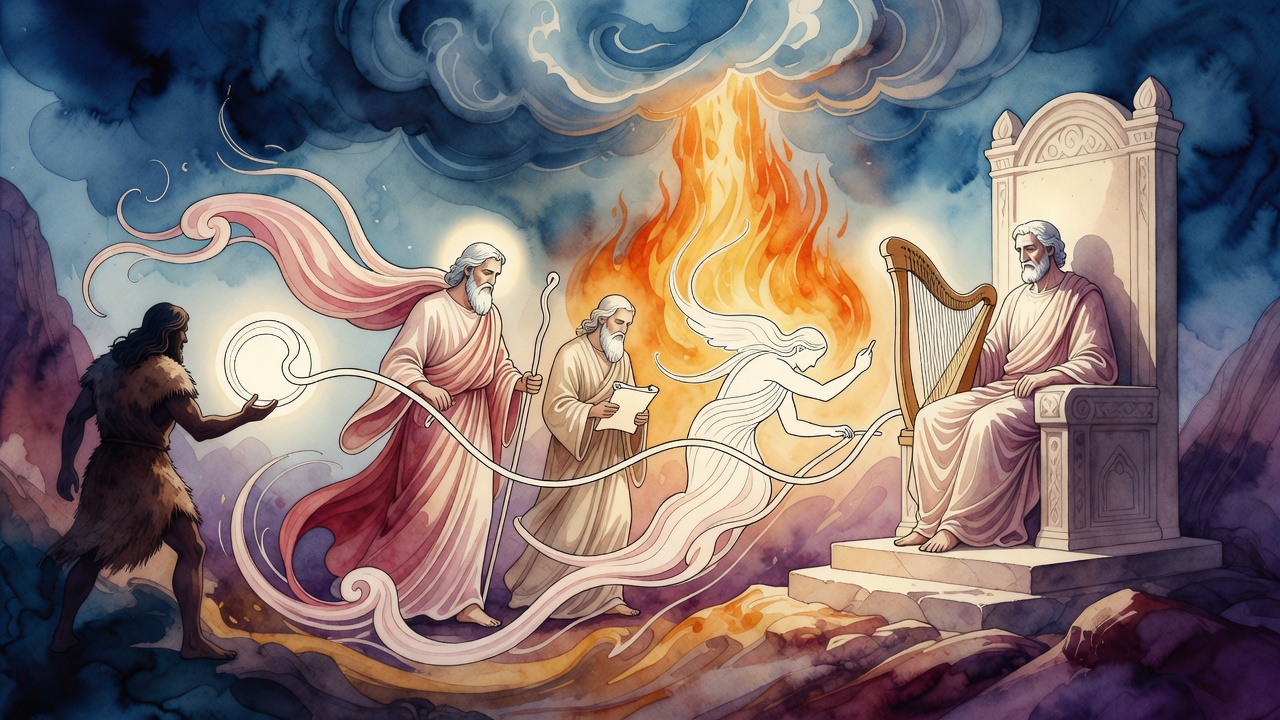
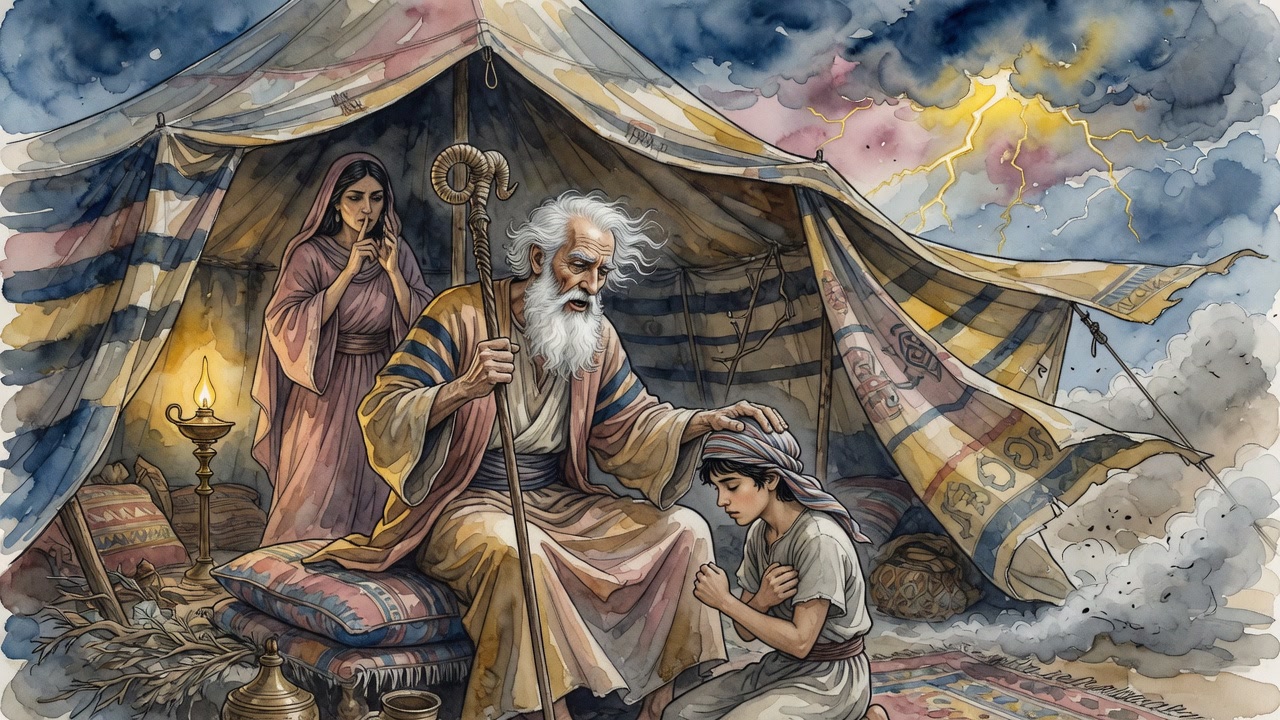
The old man's hands were on the boy's face, reading it the way blind hands read, finding the line of the jaw and the heavy growth at the throat. Isaac had counted his years that morning and arrived at a number that frightened him. His mother had died at one hundred and twenty-three. He did not know whether the days allotted to him followed hers or his father's, and a man who does not know the length of his rope acts before it runs out.
"My son," he said.

"Here am I," Esau answered.

"Take your weapons, your quiver and your bow, and go out to the field, and take me venison; and make me savory meat, such as I love, and bring it to me, that I may eat; that my soul may bless you before I die" (Genesis 27:3-4). The boy was already moving before the sentence ended. He loved his father, and his father loved him, and the love had grown so heavy over the years that it had pressed down on the old man's eyes until the light went out of them. That was the price, the legends would say. A gift blinds the eyes of the wise. Esau's affection was the gift, and it had cost Isaac his sight.

Esau Goes Out Into the Field With His Bow

Esau knew the hills the way he knew his own hands. He knew where the deer came down to drink in the gray hour, where they bedded in the brush at midday, which slope carried his scent away from them and which carried it toward. No man in that country put more meat on a fire. He went down into the field with the bow across his back and the knives at his belt, and the work began the way it always began, with patience and silence and then the snap of the string.

The first deer dropped clean. He bled it, bound its legs, and lashed it to a tree at the field's edge so he could go after a second before the light turned. He pulled the knot tight and tested it with his weight. It held. He left it and went up the slope.

The Rope Hangs Empty Where the Kill Had Been

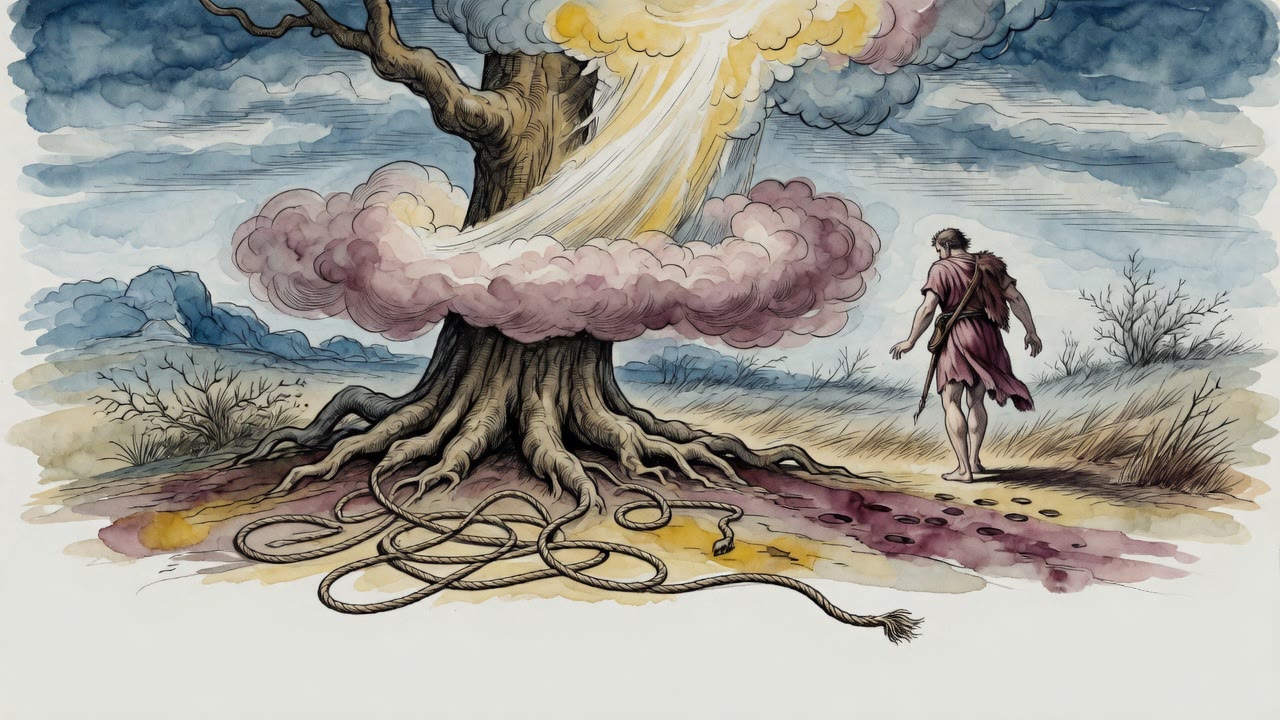
When he came back the rope was still knotted to the tree, and the deer was gone.

He stood over the spot. The ground was scuffed where the animal had lain. The cord hung from the bark exactly as he had tied it, the loop closed, nothing cut, nothing chewed. A deer does not slip a binding it cannot reach and then vanish without dragging the rope behind it. He turned a full circle, reading the dirt for a track and finding none that went anywhere. There was no blood trail. There was no carcass. There was only the empty rope swinging a little in the wind.

He told himself he had tied it badly. He went back up into the hills and took another.

He Ties the Knots Tighter and the Deer Still Vanishes

The second one he bound so tightly the cord cut into the legs. He wrapped it twice, knotted it twice, set his knee against the trunk and hauled until the fibers groaned. He stepped back, looked at the work, and was satisfied that nothing on four legs or two could undo it. Then he went after more game.

Gone. The rope tight, the knots whole, the deer simply not there.

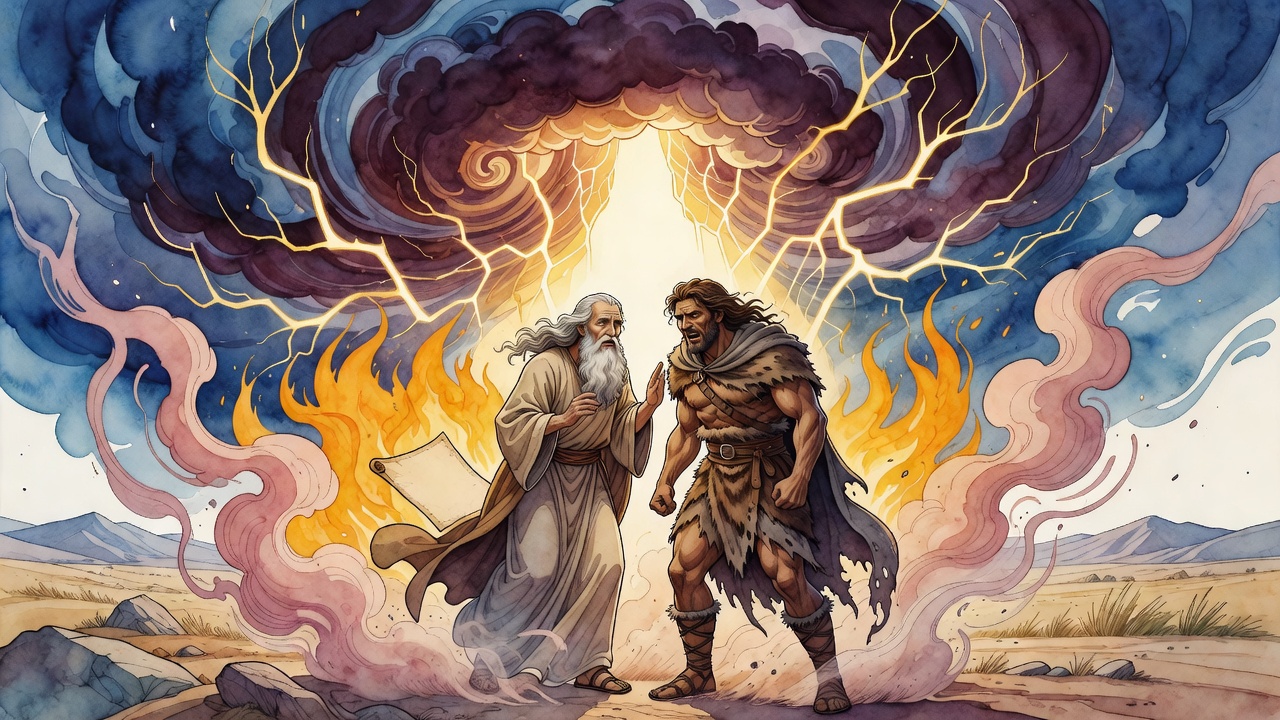
He did it again, and it happened again. The whole afternoon went like this, the best hunter in the country watching his kills disappear from bindings he had set with his own hands. He grew frustrated, then angry, then quietly afraid, because a man who lives by the field trusts the field, and the field had begun to lie to him. He searched the brush. He doubled back on his own steps. He could not find a single one of the animals he had taken. The sun slid down the sky and his quiver did not empty into a single meal, and all the while he had no idea what was working against him, because he was a man of the field and not a man of the unseen, and the unseen was exactly what stood at the tree.

The Accuser Loosens What the Hunter Bound

The one untying the ropes was Ha-Satan, the heavenly accuser. Not a rebel and not an enemy of his master, but a servant carrying out an errand. He had been sent into that field with one task: keep Esau out among the hills until the day's work could be done elsewhere. So each time the hunter walked off, the accuser walked up to the tree, slipped the knot, and set the deer loose to bolt back into the brush. Then he stood aside and waited for Esau to make another kill, and undid that one too. A cosmic game with the hunter as the one who keeps reaching and keeps coming up empty.

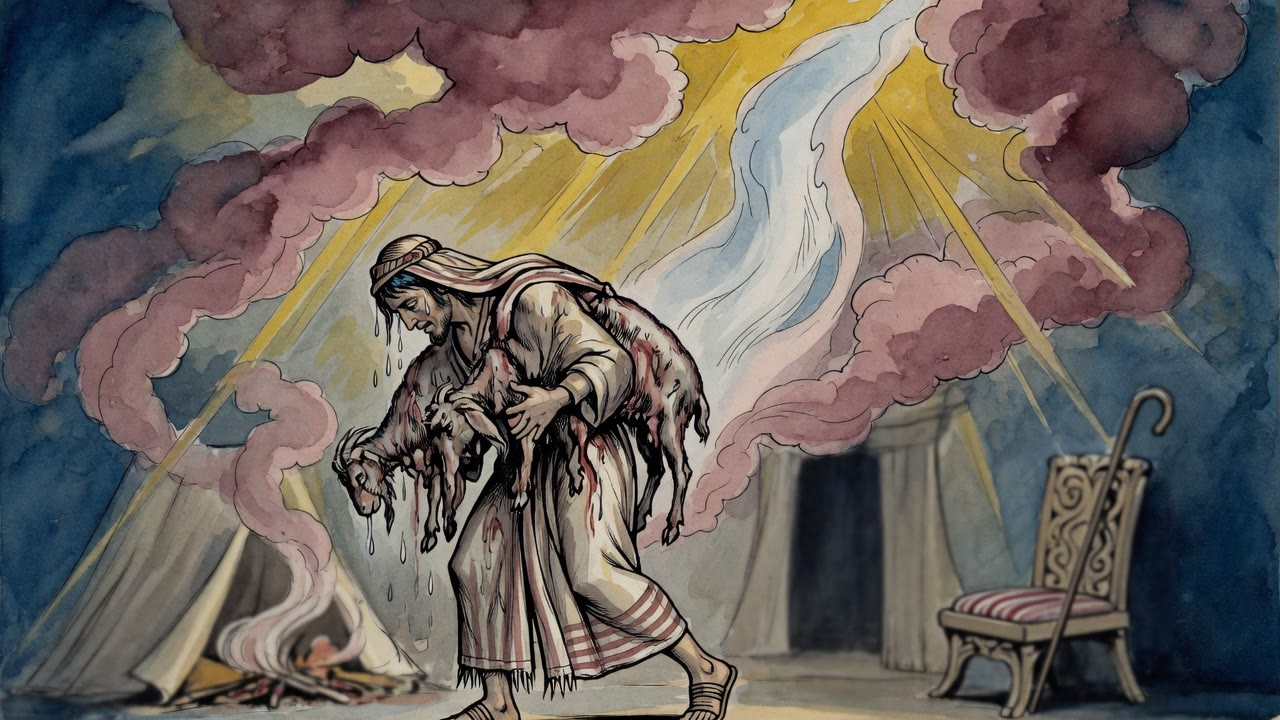
The reason was in the tent. While Esau chased deer that would not stay caught, Rebekah was at the fire with two young goats from the flock, working their meat into the dish the old man loved, the dish he believed only his elder son could bring him. She favored her younger boy. A warning had already passed through that house like a whisper into the grain of the story, that the elder son hid seven abominations in his heart and would in time bring down seven holy places. The blessing was not going to the field. It was going to the tent. The accuser's whole job that afternoon was to hold the door open by keeping the field empty, and a rope that will not stay tied is a very quiet way to hold a door.

By the time Esau gave up and came down out of the hills with whatever he could finally hold onto, the savory meat was already eaten, the hands already laid, the words already spoken over the wrong head. The hunter who never missed had been beaten by a thing he never saw, working knots he had tied himself.


← All myths
From the tradition

Sources

6 sources

The texts this telling draws on, in full. Open a card to read inline, or expand it for a wider, quieter read.

Legends of the Jews 6:56Legends of the Jews

See, Isaac, nearing his end (or so he thought), wanted to bestow his blessing upon his elder son, Esau. All Esau had to do was hunt some game and prepare a tasty meal. Simple enough. Not quite. As Legends of the Jews tells it, God, in his infinite wisdom (and perhaps nudged along by Rebekah, who favored Jacob), decided to throw a wrench into Esau's plans. And that wrench? None other than Satan himself.

Esau, the skilled hunter, finally manages to catch a deer. He binds it securely, confident he's on his way to fulfilling his father's request. But as he chases after more game, Satan swoops in and… poof! The deer is gone. Free as a bird.

Esau, understandably frustrated, tracks down another deer. He captures it, ties it up even tighter this time, and resumes his hunt. But guess what? Satan strikes again! The deer vanishes into thin air. It’s like a cosmic game of hide-and-seek, with Esau as the perpetually frustrated seeker.

Ginzberg's retelling emphasizes the repetitive nature of this divine interference. Again and again, Esau captures, binds, and loses his prey. It must have been infuriating! You can almost picture him throwing his hands up in the air, yelling at the heavens.

But why all the trouble? What was the point of this celestial cat-and-mouse game?

Simple: to buy time. While Esau was busy wrestling with disappearing deer courtesy of Satan, Jacob, aided by his mother Rebekah's cunning plan, was able to step in and receive Isaac's blessing in Esau's stead.

So, the next time you face seemingly insurmountable obstacles, remember Esau and his disappearing deer. Sometimes, the universe has other plans. Sometimes, those plans involve a little divine (or devilish) intervention. And sometimes, all you can do is laugh (or maybe cry a little) and wonder what on earth is going on.

Full source
Book of Jubilees 26:10Book of Jubilees

Book of Jubilees turns to Jacob Disguised in Goatskins Fools Blind Isaac.

Isaac is getting old, his eyesight’s failing. He knows his time is drawing near. So he calls for his eldest son, Esau. “Hunt for me,” he says, "and make me savoury meat, and bring it to me that I may eat and bless thee before the Lord before I die." (Jubilees 26:1). It's a big moment, a patriarchal blessing about to be bestowed.

Rebecca is listening. And Rebecca has a plan.

She loves Jacob more. The text doesn’t explicitly say why here, but the implications are clear. Perhaps she recognized something special in him, a spiritual quality that Esau lacked. Whatever the reason, she's determined that Jacob, not Esau, will receive Isaac's blessing.

So, while Esau is out hunting, Rebecca summons Jacob. "My son," she says, "obey my voice in that which I command thee: Go to thy flock and fetch me two good kids of the goats, and I will make them savoury meat for thy father, such as he loveth, and thou shalt bring (it) to thy father that he may eat and bless thee before the Lord before he die, and that thou mayst be blessed." (Jubilees 26:2-4).

Talk about a power play!

Now, Jacob isn’t exactly thrilled with the idea. He's hesitant, and who can blame him? He knows his father's blind, but not deaf or without a sense of touch. "Mother," he says, "I shall not withhold anything which my father would eat, and which would please him: only I fear, my mother, that he will recognise my voice and wish to touch me." (Jubilees 26:5).

Can you feel the tension? It's a high-stakes gamble. Jacob is afraid of getting caught, of being cursed instead of blessed. But Rebecca, driven by her own agenda, seems willing to do whatever it takes.

Why does this story resonate so deeply? Perhaps it's the universal themes of family dynamics, parental favoritism, and the lengths people will go to secure what they believe is rightfully theirs. Or maybe, it's that nagging question of destiny versus free will. Did Rebecca truly believe Jacob was meant to receive the blessing, or was she simply manipulating the situation to her liking? The Book of Jubilees doesn't offer easy answers. It just lays bare the complexities of human relationships, leaving us to ponder the motivations and consequences of their choices.

Full source
Legends of the Jews 6:52Legends of the Jews

His blindness is often remembered as a simple physical ailment, a consequence of old age perhaps. But the legends, oh, they tell a different story. According to Legends of the Jews, that monumental compilation by Rabbi Louis Ginzberg, Isaac’s blindness was, in a way, self-inflicted. It was the price he paid for his love for Esau.

He "justified the wicked for a bribe, the bribe of Esau's filial love.” He favored Esau, despite Esau's. well, let's just say complicated moral compass. And the "bribe" of Esau's affection blinded him, literally. There's a powerful verse that says, "A gift blinds the eyes of the wise," and Ginzberg uses this to explain the origins of Isaac’s blindness. Was Isaac’s love for Esau a "gift" that kept him from seeing his son's true nature?

Isaac's blindness, this very affliction, actually became a blessing in disguise. Can you imagine? It shielded him from the shame of being known as the father of the wicked Esau. People wouldn’t point and whisper. He was spared that particular pain.

Perhaps even more significantly, his blindness allowed Jacob to receive the blessing meant for Esau. If Isaac's sight had been perfect, he wouldn’t have been tricked. He would have recognized Jacob immediately.

Think of it: God, in a way, orchestrated the whole thing. The legends paint a picture of divine intervention, a cosmic chess game where even Isaac's weakness becomes a strength. As Legends of the Jews elegantly puts it, God treated Isaac like a physician treats a patient who craves wine but can't have it. The physician gives him warm water in the dark, pretending it's wine, just to offer some solace.

Was God tricking Isaac? Maybe. Was God using Isaac’s weakness to fulfill a greater plan? Absolutely. Sometimes, it seems, our limitations are not roadblocks, but rather detours leading us to unexpected, yet divinely ordained, destinations. The most fascinating thing about the Torah is that the characters within are deeply flawed, just like us, and yet, they are the vehicles for God’s grand plan for humanity.

Full source
Legends of the Jews 6:53Legends of the Jews

Isaac, son of Abraham, certainly did. As Isaac neared the age his mother Sarah had reached when she passed – 123 years old – he began to contemplate his own mortality. It’s a natural thing, isn't it? The tradition teaches that we should prepare for death when we approach the age at which our parents departed this world.

Isaac realized he didn't know whether his own lifespan would mirror his mother's or his father's. So, what did he decide to do? He resolved to bless his elder son, Esau, before death could snatch him away.

He calls for Esau. “My son,” Isaac says.

Esau answers, “Here am I.” But here’s where things get interesting.

the verse says – and I love this – that the Ruach (spirit) Hakodesh, the holy spirit, intercedes. It’s as if a divine voice whispers a warning directly into the narrative! The voice says, "Though he disguises his voice and makes it sound sweet, put no confidence in him. There are seven abominations in his heart. He will destroy seven holy places."

Seven! A powerful number in Jewish tradition. What are these places? The text lists them: the Tabernacle, the sanctuaries at Gilgal, Shiloh, Nob, and Gibeon, and, most tragically, the first and the second Temple in Jerusalem. These places, each a locus of connection between humanity and the Divine, were destined for destruction at the hands (or through the lineage) of Esau. Isaac, contemplating his mortality, wants to bestow a blessing. But the holy spirit interrupts, revealing a dark future connected to the very son he intends to bless. It’s a potent reminder that even in moments of profound personal reflection, the threads of history, destiny, and divine will are intricately interwoven. What are the implications of this divine interruption? What does it mean for free will? And what does it mean for the future of the Jewish people? Perhaps those questions are best left for another time, another cup of coffee, and another fascinating dive into the Legends of the Jews.

Full source
Targum Pseudo-Jonathan on Genesis 27:31Targum Pseudo-Jonathan on Genesis

The Targum Pseudo-Jonathan offers a theological explanation for why Esau arrived late and empty-handed. "The Word of the Lord had impeded him from taking clean venison; but he had found a certain dog, and killed him, and made food of him, and brought to his father" (Genesis 27:31).

A dog. Not a clean animal. Not a kosher animal. The Targum is saying that Esau's meal was, by the standards of later Torah law, ritually forbidden. The contrast with Jacob's two kosher kids could not be sharper.

The Memra stops the hunt

Pseudo-Jonathan's phrase, the Word of the Lord had impeded him, is quietly astonishing. It means Esau was not merely slow. He was actively blocked. Every deer he approached disappeared. Every trap came up empty. The Memra itself, the active Divine Word, was clearing the field so that Rebekah's plan could finish first.

This reading reframes the whole moral architecture of the episode. The rabbis were uncomfortable with the idea that Jacob's blessing was stolen. By adding this line, Pseudo-Jonathan shifts the weight: Heaven itself participated. Rebekah's stratagem succeeded not because she was cleverer than Isaac but because the Divine Will held Esau's bow back.

A dog for a blessing

The rabbis never forgot the symbolism. Jacob brought the Pesach offering. Esau brought a dog. One son lived by the clean and the sanctified. The other settled, at the last minute, for whatever his hands could grasp. In the Targum's reading, this was not chance. It was a test. And it revealed what Esau had always been.

The takeaway: what you bring to the altar at the last minute shows what you value. Pseudo-Jonathan's Esau brings a dog, and receives exactly the blessing that remains.

Full source
Midrash Tanchuma Buber, Toldot 10:2Midrash Tanchuma Buber, Toldot

(Genesis 27:4–5:) "And make me delicacies," etc.; "And Rebekah was listening," etc.; [And Esau went to the field]. Since he would catch and bind them, and the angel would go and release them and drive them off, again he would catch them, and the angel would release them. And why so? Only in order to roll along the hours until Jacob should go, so that he might go and prepare and come in to his father and eat and receive the blessings. Therefore (Genesis 27:5): "And Esau went to the field to hunt game to bring."

Full source