Parshat Toldot5 min read

Four Armies of Angels Rode Ahead of Jacob

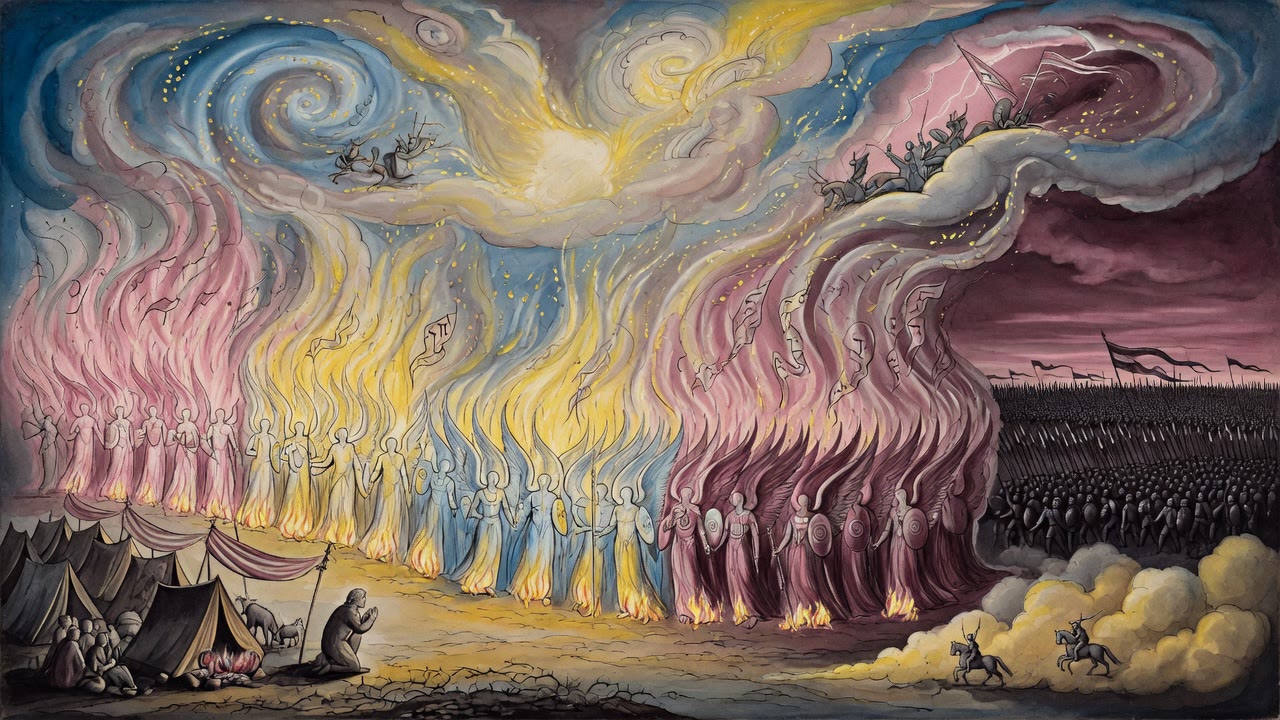
When Esau marched out with four hundred armed men, he didn't know that four companies of angels had already taken positions between him and his brother.

Curated by Arthur · Told by Maggid ·
Table of Contents
  1. Twenty Years and Four Hundred Men
  2. What Rode Ahead of the Gifts
  3. The Arrangement That Revealed Jacob's Heart
  4. The Embrace That Ended Twenty Years

Twenty Years and Four Hundred Men

Jacob had spent twenty years in Laban's house learning what it felt like to be at another man's mercy. He had been cheated on wages, tricked into a marriage he had not agreed to, and worked in exhausting labor through summer heat and winter frost. He had survived it. He had come out the other side with twelve children, two wives, two concubines, massive flocks, and the kind of careful patience that only twenty years of hard dealing can build into a man. And now, on the road home, he received word that his brother Esau was riding out to meet him with four hundred armed men.

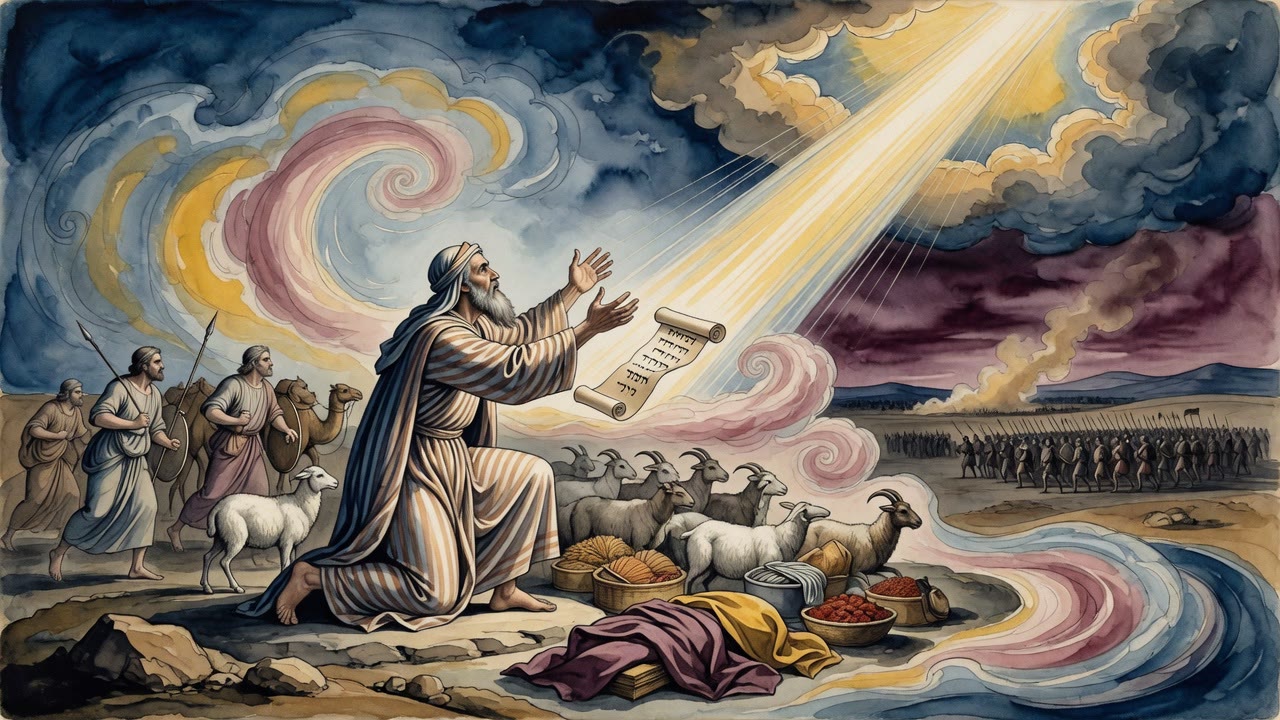
The Torah says Jacob was terrified, and no interpreting tradition has ever softened that detail. He was afraid. He divided everything he had into two camps so that if one was destroyed, the other might escape. He prayed with a specificity that exposed exactly what he feared: Esau striking the mothers and the children together. He sent gifts on ahead, wave after wave of livestock arranged to arrive in staggered intervals, each group preceded by a servant saying that these animals were tribute from Jacob to his brother Esau. He was buying time, buying goodwill, buying anything he could reach.

What Rode Ahead of the Gifts

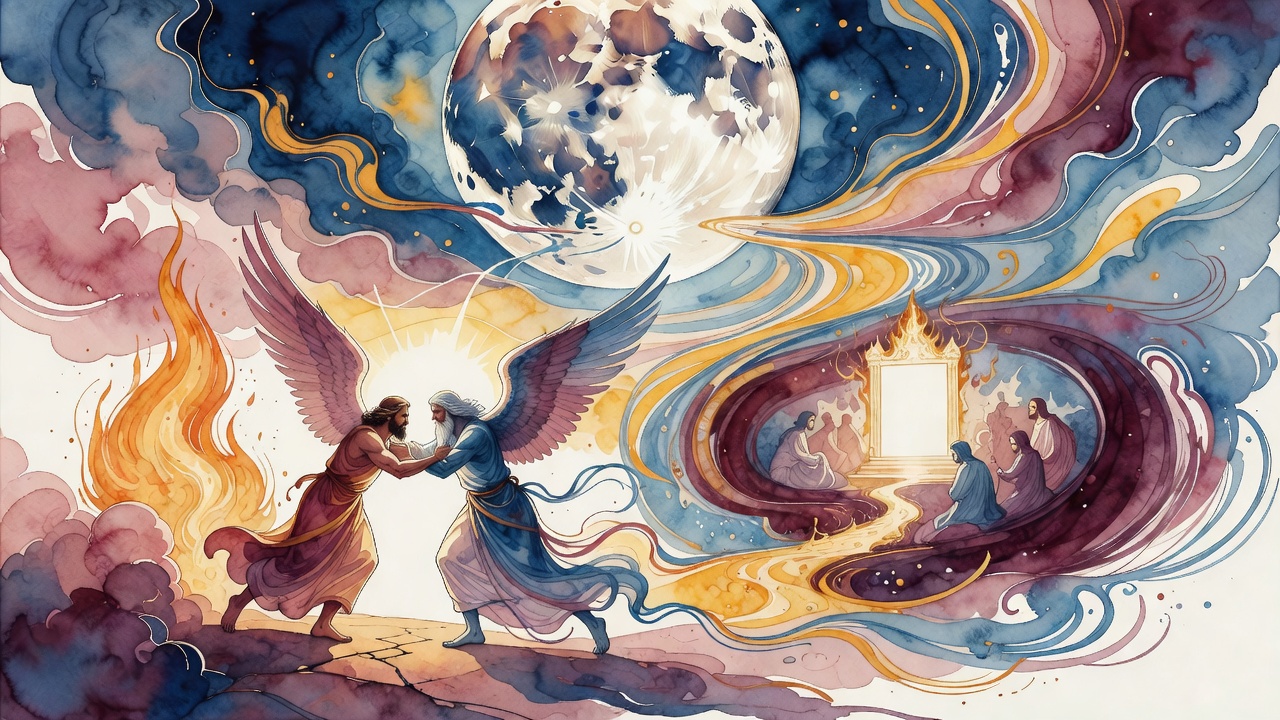
The Book of Jasher, which fills in the silences of Genesis with stories the Torah's text leaves in shadow, records that Jacob's human preparations were not the only things moving on that road. God sent four companies of angels to stand between Jacob and his brother. Four armies, positioned ahead of the procession, invisible to Esau and his men but present in the way that divine protection is present: not as a wall but as a pressure, a weight, a presence that shifts the terms of the encounter without showing itself.

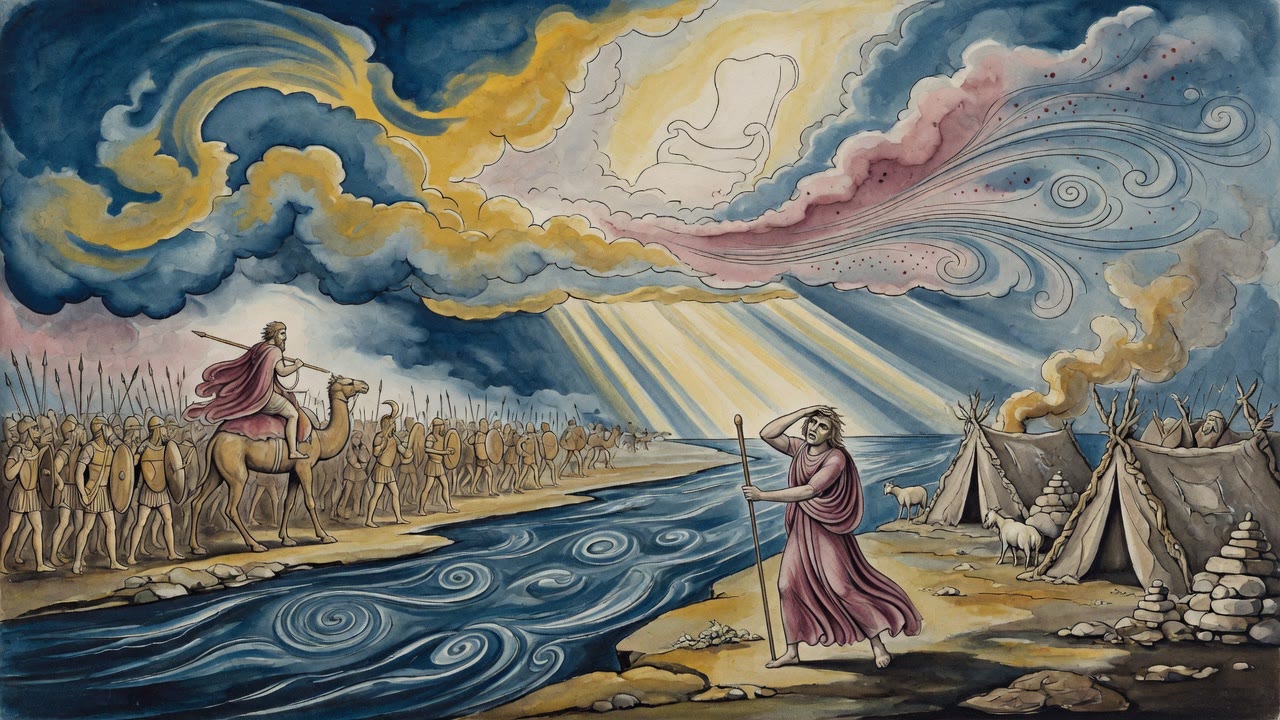
Esau had not ridden out against an ordinary man. He had ridden out against his brother, who had wrestled an angel through an entire night and held on until the angel renamed him. The sun rose on Jacob's crossing of the river with unusual brightness that morning, the Legends of the Jews records, with the brilliance it had carried at the moment of creation. That light burned Jacob's limp from his thigh and scorched Esau and his men with its intensity. The meeting that had threatened to be a slaughter was already being shaped by forces Esau could not count.

The Arrangement That Revealed Jacob's Heart

Targum Pseudo-Jonathan, the expansive Aramaic translation of the Torah, takes the moment Jacob saw Esau and adds precision to the terror. Four hundred men of war. Not retainers, not a traveling party, not an honor guard. An army. Jacob had been right to be afraid.

His response was immediate and tactical. He divided the children among their mothers: the handmaids and their children first, Leah and her children behind them, Rachel and Joseph at the rear. The arrangement preserved what he loved most in the place of greatest protection. It was also, Bereshit Rabbah observes, a moment that revealed exactly where Jacob's heart had always been, whatever he had tried to tell himself about loving all his wives equally.

The arrangement was also practical in the way that desperate arrangements can be practical. A single mass can be surrounded. Distributed into separate groups, at least some portion of the family would survive the first strike. Jacob had used the same logic the night before when he split his camps: if one falls, let the other escape. He was doing the arithmetic of loss, calculating which grief was survivable.

The Embrace That Ended Twenty Years

Esau ran. That is the word Genesis uses, and none of the expansions change it: he ran to Jacob and embraced him and fell on his neck and wept. Whatever Esau had intended when he set out with four hundred armed men, something had changed by the time he arrived. The angels had done their work. The burning sun had done its work. Twenty years of separation had done its work.

Bereshit Rabbah preserves a debate about whether Esau's tears were genuine or performance, whether his kiss was sincere or a disguised attack. Some read the word for kissing as carrying a dot that transforms it into something ambiguous, even violent. Jacob survived it either way. The meeting that had threatened to undo everything became an embrace, and the four hundred armed men turned around and rode back to wherever they had come from. The angels, who had ridden ahead in their four companies, returned to wherever angels return to when the crisis passes.


← All myths

From the tradition

Sources

8 sources

The texts this telling draws on, in full. Open a card to read inline, or expand it for a wider, quieter read.

Jasher 32Book of Jasher

The story doesn't end there, and the Book of Jasher, a fascinating and often overlooked text, fills in some of the blanks..

After twenty long years with Laban, Jacob is finally heading back to Canaan. He sends messengers ahead to Esau, who is living in the land of Seir. But this isn't a triumphant return; Jacob approaches his brother with supplication. He instructs his messengers to tell Esau not to think that their father's blessing has actually benefited him. "I've been with Laban all this time," he says, "and he cheated me repeatedly!" As we see in verse 5, he only acquired wealth through God's mercy. Essentially, Jacob wants to assure Esau he's not flaunting any ill-gotten gains.

Esau's response? Not exactly welcoming. He acknowledges that Jacob prospered with Laban, but accuses him of fleeing without telling Laban, and reminds Jacob that he supplanted him twice. "Now, therefore, I have this day come with my camps to meet him, and I will do unto him according to the desire of my heart." Those aren't exactly words of brotherly love, are they?

The messengers report back to Jacob that Esau is coming to meet him with four hundred men. Understandably, "Jacob was greatly afraid and he was distressed." He turns to the Lord in prayer, reminding God of His promises: "O Lord God of my fathers, Abraham and Isaac… unto thee do I give this land and thy seed after thee… and in thee and in thy seed shall all the families of the earth be blessed" (verse 17). Jacob pleads for deliverance, even acknowledging his own possible unworthiness, as we see in verse 22: "And if there is no righteousness in me, do it for the sake of Abraham and my father Isaac." It’s a raw, honest prayer born of fear and desperation.

Before we move on, it's worth noting how Jacob's prayer echoes earlier promises made to his ancestors. This emphasizes the continuity of the covenant and the importance of divine faithfulness.

So, what does Jacob do? He divides his people and flocks into two camps, hoping that if one is attacked, the other might escape. During the night, he instructs his servants and prepares for the worst. But here's where the story takes a fascinating turn: The Lord hears Jacob's prayer and sends three angels to intervene.

These aren't your fluffy, winged cherubs. These angels appear to Esau and his men as two thousand warriors on horseback, complete with war instruments. They terrify Esau and his men, shouting, "Surely we are the servants of Jacob, who is the servant of God, and who then can stand against us?" (verse 32). Esau, understandably shaken, claims Jacob is his "lord and brother," whom he hasn't seen in twenty years and only came to see him. The angels reply that only because Jacob is Esau's brother, they won't kill them all. This happens not once, but four times, with different camps of angelic warriors appearing. By the fourth encounter, Esau is understandably terrified.

What's particularly interesting here is the portrayal of divine intervention. God doesn't simply wave a magic wand. Instead, He sends a powerful display of force, playing on Esau's fear and insecurity. It's a reminder that divine protection can manifest in unexpected ways.

Now, subdued, Esau meets Jacob in peace. Jacob, not taking any chances, prepares a lavish gift for his brother: hundreds of livestock, strategically divided into droves. He instructs his servants to emphasize that they are Jacob's servants and that this is a gift for Esau.

But before the grand reunion, another pivotal event occurs. Jacob sends his family and possessions across the brook of Jabuk (Jabbok). He is left alone, and wrestles with a "man" until daybreak. The text says the hollow of Jacob's thigh was out of joint through wrestling with him. We read, "At the break of day the man left Jacob there, and he blessed him and went away, and Jacob passed the brook at the break of day, and he halted upon his thigh." The Book of Jasher doesn't explicitly identify the man as an angel or divine being, but the outcome and the blessing strongly suggest a supernatural encounter. This struggle, and the resulting limp, become a symbol of Jacob's transformation and his new name, Israel, which means "he who struggles with God."

Finally, the brothers meet. Jacob bows down seven times before Esau. But something has shifted. Verse 55 tells us: "And the fear of Jacob and his terror fell upon his brother Esau… and Esau's anger against Jacob was turned into kindness." God has softened Esau's heart. The brothers embrace and weep. Esau accepts Jacob's gifts, though initially hesitant.

Esau offers to travel with Jacob to Seir. Jacob demurs, claiming his children and flocks are too delicate for a swift journey. He promises to follow later, but secretly intends to go to his father's house in Canaan. The chapter ends with Esau returning to Seir and Jacob continuing toward Canaan.

So, what can we take away from this encounter? It's a story of fear, supplication, divine intervention, and, ultimately, reconciliation. Jacob, despite his past actions, is protected and blessed. Esau's anger is diffused. While their relationship may not be fully healed, a potential disaster is averted. The Book of Jasher offers a glimpse into the complexities of family dynamics and the power of prayer, even in the face of seemingly insurmountable odds. It leaves us pondering on the themes of forgiveness, divine intervention, and the enduring power of family ties.

Full source
Bereshit Rabbah 75:13Bereshit Rabbah

Bereshit Rabbah turns to Jacob's Terror Before Meeting Esau With Four Hundred Men.

The scene is set. Jacob, returning to his homeland, learns that his estranged brother Esau is approaching with four hundred men. Understandably, Jacob is terrified. As (Genesis 32:9) tells us, he cries out: "If Esau will come upon the one camp, and smite it, the remaining camp will escape." He then pours out his heart to God, reminding Him of His promise: "Go back to your land and your birthright, and I will benefit you" (Genesis 32:10).

It's in Jacob's plea for deliverance that the midrash truly shines. "Deliver me, please, from the hand of my brother, from the hand of Esau, for I fear him, lest he come and smite me, mother, and children, alike" (Genesis 32:12). Bereshit Rabbah seizes upon the phrase "lest he come and smite me, mother and children alike" to reveal a profound understanding of Jacob's fear.

The midrash imagines Jacob pleading with God: "Master of the universe, it is written in Your Torah: 'A bull or a sheep, it and its offspring you shall not slaughter on one day' (Leviticus 22:28). If this wicked one comes and eradicates my children and their mothers as one, the Torah scroll that You are destined to give on Mount Sinai, who will read it?"

Isn't that a powerful image? Jacob isn't just worried about his own skin. He's thinking generations ahead. He understands that his family is the vessel through which the Torah will be transmitted. If Esau wipes them out, who will be left to carry on God's word? It's a plea for the future of Judaism itself!

Then, Jacob attempts to appease Esau by sending him a lavish gift. "And Jacob slept there on that night, and he took from what he had as a present for his brother Esau" (Genesis 32:14). The midrash notes that Jacob’s intention was "to blind his eyes," referencing the verse "As the bribe will blind the eyes of the wise" (Deuteronomy 16:19). But who are these "wise" that can be blinded? According to the midrash, they are none other than the Edomites, Esau's descendants! As it is stated in (Obadiah 1:8), "I will eliminate the wise from Edom and understanding from the mountain of Esau."

The details of the gift are meticulously listed: "Two hundred female goats and twenty male goats, two hundred ewes and twenty rams" (Genesis 32:15), followed by "Nursing camels and their offspring thirty, forty cows and ten bulls, twenty female donkeys and ten male donkeys" (Genesis 32:16). What a menagerie!

But it's not just the quantity of the gifts that matters, but how they are arranged. "He placed them in the charge of his servants, each drove by itself; he said to his servants: Go ahead of me, and maintain a distance between one drove and the other drove" (Genesis 32:17). The midrash asks, what does it mean to "maintain a distance"?

Here, Bereshit Rabbah offers a beautiful interpretation. Jacob is praying, "Master of the universe, if troubles will befall my descendants, do not bring them one after another, but rather, create distance for them between their troubles." He's not asking for a life free of hardship, but for the strength and resilience to endure, with breathing room between crises.

Finally, as Jacob sees Esau approaching, he turns to God in prayer. "At that moment, Jacob lifted his eyes and saw that Esau was coming from afar, and he directed his eyes heavenward, wept, and requested mercy from before the Holy One blessed be He." The midrash concludes with the comforting promise that God heard Jacob's prayer and promised to deliver him and his descendants from all their troubles, "as it is stated: 'The Lord will answer you at a time of trouble; the name of the God of Jacob will fortify you' (Psalms 20:2)."

So, what can we take away from this deep dive into Jacob's pre-encounter jitters? Perhaps it's the reminder that even our greatest patriarchs faced moments of intense fear and vulnerability. Or maybe it’s the comforting thought that even in the face of overwhelming odds, prayer and a plea for resilience can make all the difference. Jacob's story reminds us that we, too, can find strength in our relationship with God and in the hope for a future where troubles, even if they come, are spaced apart enough for us to catch our breath and carry on.

Full source
Legends of the Jews, VI. Jacob, The Meeting Between Esau And JacobLegends of the Jews

The Torah tells us that after wrestling with an angel all night, Jacob was left with a limp. But that wasn't the end of the story! According to Legends of the Jews by Ginzberg, the sun rose with unusual intensity that day, shining with the brilliance it had during creation. This powerful sunlight healed Jacob, but it also scorched Esau and his men!

Jacob, ever the strategist, had prepared for anything. He divided his family into groups, placing the handmaids and their children first, then Leah and her children, and finally, Rachel and Joseph at the rear. Ginzberg compares this to a fable of a fox trying to appease a lion – a clever, if somewhat desperate, attempt to mitigate potential disaster. Jacob knew this meeting could go south quickly. He even went ahead of everyone else, thinking it better that he be attacked first, rather than his children.

There's this fascinating detail: Joseph, despite being told to stay behind his mother, positioned himself in front of Rachel. Why? Because, as Ginzberg explains, Joseph knew his mother's beauty and his uncle's potential lustful intentions and wanted to protect her. It's a small detail, but it speaks volumes about the family dynamics at play.

What about Esau? He arrived vowing to bite Jacob to death! But something strange happened. The Zohar tells us that when Esau tried to bite Jacob's neck, it turned as hard as ivory, leaving Esau frustrated and defeated. The brothers were like a ram and a wolf, each howling in their own way – Esau in pain, and Jacob in fear.

Then, Esau asks about a mysterious army he encountered on his way to meet Jacob. This army, made up of countless warriors, attacked Esau until he revealed that Jacob was his brother. According to Legends of the Jews, this was no ordinary army – it was a host of angels, sent to protect Jacob. It’s a reminder that forces beyond our understanding may be at work in these pivotal moments.

Jacob, attempting to appease his brother, offered gifts – a tenth of his cattle, pearls, precious stones, even a falcon. But the animals, loyal to Jacob, refused to go to Esau, leaving only the weak and lame behind. When Esau initially declined the gifts, Jacob insisted, saying, "I have seen your face as I have seen the face of angels, and you are pleased with me." It's a calculated compliment, meant to invoke awe and perhaps remind Esau of Jacob's encounter with the divine.

According to Legends of the Jews, Jacob wanted Esau to believe he had intercourse with angels. Why? Because it was actually Esau's angel that Jacob wrestled and defeated!

Jacob even paid Esau a large sum for his share of the Cave of Machpelah (the burial place of the patriarchs and matriarchs). Esau, focused on earthly wealth, readily accepted the gold. Jacob, however, understood the true value lay in the Holy Land itself.

And here’s a powerful prophecy tucked into the narrative: Jacob foresees that his descendants will suffer at the hands of Esau's descendants. But he also declares that this dominion is temporary, lasting until the Messiah arises from his own lineage. As Legends of the Jews puts it, this will happen when all nations rise against the kingdom of Edom, often associated in rabbinic tradition with Rome and later oppressive empires, and the Messiah will claim his kingship.

The story concludes with Jacob settling in Shechem. He buys land, builds an altar, and teaches Torah. But there's a subtle warning at the end. After Jacob declares himself "lord of all earthly things," God rebukes him, foreshadowing future troubles for his daughter Dinah. It's a reminder that even in moments of triumph, humility is essential.

So, what do we take away from this complex encounter? It’s a story of sibling rivalry, divine intervention, strategic maneuvering, and prophetic vision. It reminds us that even in the face of fear and uncertainty, faith, family, and a connection to the divine can guide us through. And that sometimes, even the most strained relationships can find a path, however winding, toward some form of coexistence.

Full source
Targum Pseudo-Jonathan on Genesis 33:1Targum Pseudo-Jonathan on Genesis

Jacob lifted his eyes and saw what he had feared for twenty years: Esau, and with him four hundred men of war (Genesis 33:1). Targum Pseudo-Jonathan does not soften the number. Four hundred is an army.

Jacob's response was immediate and tactical. He divided the children among Leah, Rachel, and the two concubines, Bilhah and Zilpah. Four mothers, thirteen children (eleven boys and Dinah, with Benjamin still unborn), split into groups.

Why split the family?

The rabbis noticed that Jacob did not place them in a single mass. A single mass can be surrounded. Divided, at least part of the family might survive. It is the same logic he had used the night before when he split his camps, if Esau attacks one, the other may escape (Genesis 32:9).

The arrangement also revealed something about Jacob's heart. The order he chose, concubines first, then Leah and her children, then Rachel and Joseph, was not random. It was a ranking. The deepest love went to the back, the safest position. Every father has such a ranking, though few are ever forced to make it visible. Jacob was forced.

The takeaway: in the hardest moments, our priorities stop hiding.

Full source
Yalkut Shimoni on Torah 131:6Yalkut Shimoni on Torah

"Deliver me, I pray" (Genesis 32:12) - deliver me, I pray, from the hand of my brother, who comes against me with the strength of Esau. "Lest he come and strike me, mother together with children" - yet You Yourself said, "You shall not take the mother together with the young" (Deuteronomy 22:6).

Another interpretation: And You Yourself said, "I will surely do good with you" (Genesis 32:13) - "do good" in your own merit, "do good" in the merit of your fathers.

"Two hundred she-goats" (Genesis 32:14-16). From here is derived the conjugal duty stated in the Torah: two hundred she-goats require twenty he-goats; two hundred ewes require twenty rams; thirty nursing camels with their young, and thirty more in calf; forty cows require ten bulls; twenty she-donkeys require ten he-donkeys.

Full source
Midrash Tanchuma Buber, Vayishlach 7:1Midrash Tanchuma Buber, Vayishlach

(Genesis 32:25:) "And Jacob was left alone." What is written above the matter? "And Jacob feared greatly, and he was distressed." When the Holy One, blessed be He, saw how Jacob was in anguish, Rabbi Berekhyah said: He sent four companies of angels to wage war with Esau all night. The first company came; it said to them, "To whom do you belong?" They said to him, "We are the children of Isaac," and they began striking him. He said to them, "We are of the children's children of Abraham"; they began striking him. When they said, "We are the brothers of Jacob," they began leaving them: "For the sake of the honor of Jacob we will leave you." This is "And Jacob was left alone."

And Jacob did not know how many miracles the Holy One, blessed be He, had done with him. He did nothing; but when he came in the morning, Esau his brother said to him, "What is all this camp which I met?" (Genesis 33:8). It is not written here "which I saw," but rather "which I met." And Jacob did not know that the Holy One, blessed be He, had sent him angels; rather, he supposed that he was occupied with that present which he had sent him. Therefore he said to him, "to find favor in the eyes of my lord" (ibid.). And when the Holy One, blessed be He, saw that he was afraid, He sent him Michael to make strife with him. What did the angel do to him? He appeared to him in the likeness of a shepherd, as it is said, "And a man wrestled with him, etc.," "and he saw that he could not prevail against him, etc.," "and he said, Send me away, etc." (Genesis 32:25, 26, 27).

Full source
Targum Pseudo-Jonathan on Genesis 33:2Targum Pseudo-Jonathan on Genesis

Targum Pseudo-Jonathan speaks plainly about what many readers would rather leave implicit (Genesis 33:2). Jacob "placed the concubines and their sons foremost." And the Targum even preserves his reasoning: "If Esau comes to destroy the children and abuse the women, he will do it with them, and meantime we will arise and encounter him in fight."

The front of the line was the most dangerous position. Jacob put Bilhah and Zilpah, the handmaids, and their sons there. Behind them came Leah and her children. Behind them, the safest position of all, came Rachel and Joseph.

The honesty of the Targum

The ancient translator did not flinch from making Jacob's calculation visible. It was a real moral cost, the handmaids and their sons were family too, and yet they were positioned as the first to absorb any violence. The Targum does not pretty it up or turn it into something noble. It says: this is what happened, this is what he was thinking, and Scripture expects you to sit with it.

The rabbis later wrestled with this ordering. Some defended Jacob on grounds of battle strategy. Others noted it quietly and moved on. The later tragedies of the family, the story of Joseph's brothers, the bitterness between the tribes, may have roots in this single morning's decision.

The takeaway: fear exposes the order of our loves, and sometimes what it exposes is hard to look at.

Full source
Bereshit Rabbah 76:3Bereshit Rabbah

The Torah itself offers some pretty practical advice about diversifying your.. well, everything?

It's tucked away in Bereshit Rabbah, a collection of rabbinic interpretations of the Book of Genesis. Specifically, Bereshit Rabbah 76. Here, the rabbis are unpacking the verse, "He divided the people..." referring to Jacob as he prepares to meet his brother Esau after years of separation (Genesis 32:8).

The rabbis see in Jacob's actions a lesson in good conduct, in smart planning. The idea? Don't concentrate all your resources, all your people, all your hopes in one place. Spread them out. Why? Because if disaster strikes one area, something. Or someone, will survive.

It's a bit like the old saying, "Don't put all your eggs in one basket." If the basket falls, you lose everything. But if you have multiple baskets.. well, you get the idea.

The text gives us another example, this time from the Book of Kings. Remember Ovadiah, the righteous servant of King Ahab? When Jezebel was hunting down prophets of God, Ovadiah hid a hundred of them. But he didn’t cram them all into one cave. No, he hid fifty men in one cave, and fifty in another (I Kings 18:4). Same principle! Spread the risk.

And the rabbis in Bereshit Rabbah drive the point home with Jacob's own words: "If Esau will come upon the one camp, and smite it, the remaining camp will survive" (Genesis 32:9). It's a plan born of fear, sure, but also of wisdom.

But here's where it gets really interesting. The rabbis take this idea beyond the literal battlefield and apply it to the Jewish people's dispersion. "If Esau will come upon the one camp, and smite it – these are our brethren in the south," the text says, referring to the Land of Israel. "The remaining camp will survive – these are our brethren in the Diaspora."

Wow.

Rabbi Hoshaya adds another layer. Even though those in the Diaspora "survived," they still fast on Mondays and Thursdays on behalf of their brethren in the Land of Israel. So, even in safety, they maintain a connection, a shared destiny, a sense of responsibility.

What does this all mean for us today? I think it's a reminder that resilience isn't just about physical survival. It's about diversifying our efforts, our resources, and even our hopes. It's about recognizing that we're all interconnected, that what happens in one place affects us all. And it's about remembering to support each other, even when we're not directly threatened.

Maybe next time we're facing a challenge, we can channel a little bit of Jacob’s wisdom, a little bit of Ovadiah's foresight, and remember: don't put all your eggs in one basket. And don't forget to check in on the other baskets, too.

Full source