5 min read

Ezekiel Rolls Onto His Side for Israel's Sin

God orders Ezekiel to lie on his left side, then his right, until the prophet's body becomes a bed for the guilt of Israel and Judah.

Curated by Arthur · Told by Maggid ·
Table of Contents
  1. The Floor Becomes an Altar
  2. Right Side for Judah
  3. Holy Ones in the Hand
  4. Five Eras and a Waiting God
  5. Dust That Hints at Return
Ezekiel Rolls Onto His Side for Israel's Sin Click for full size

The Floor Becomes an Altar

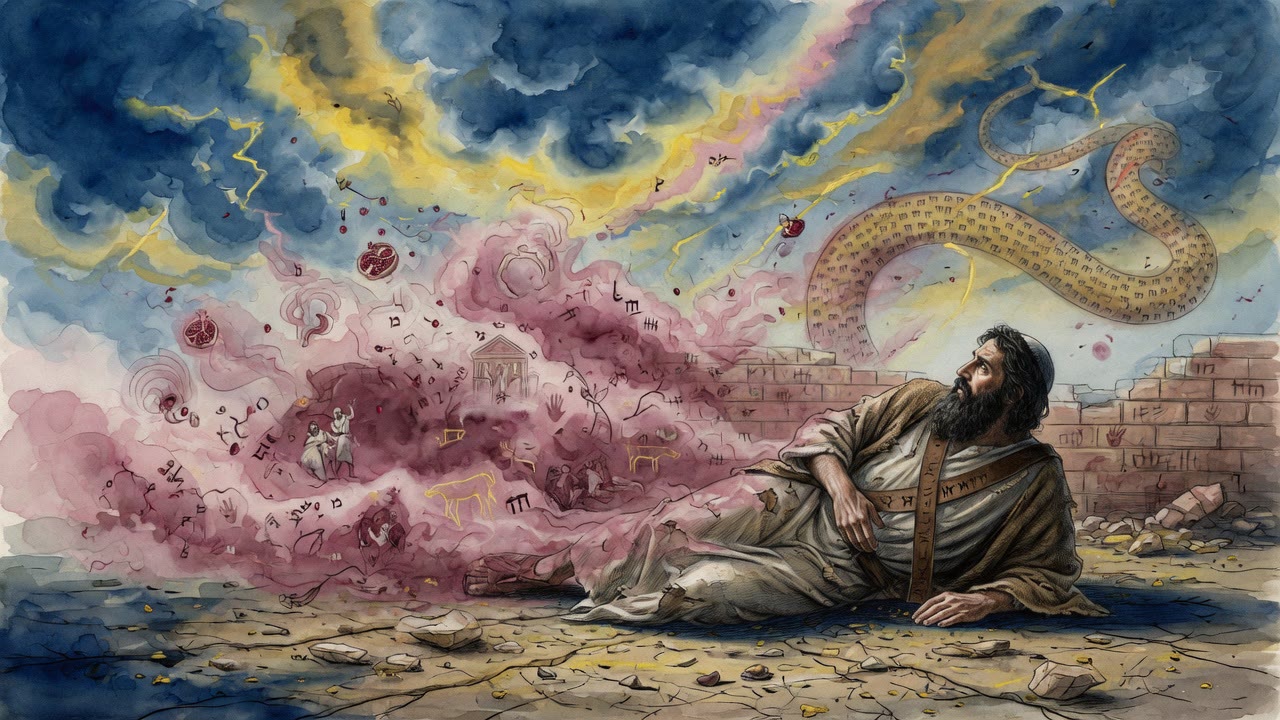
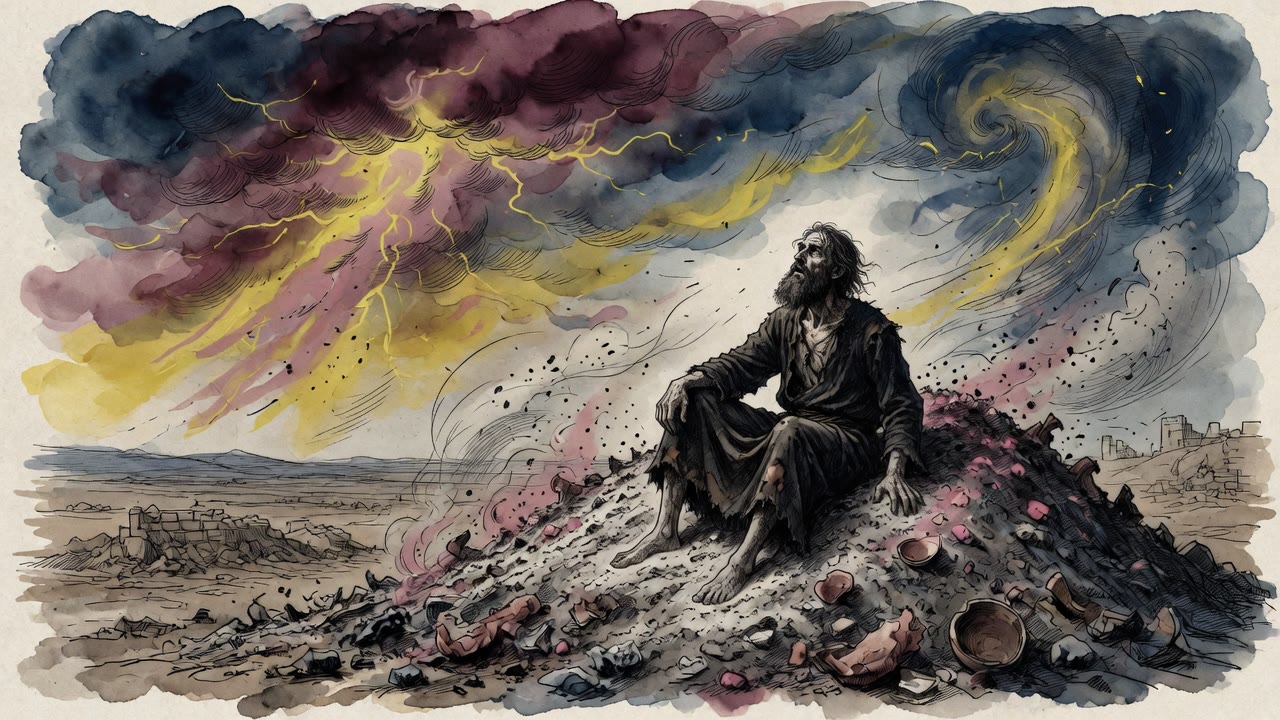
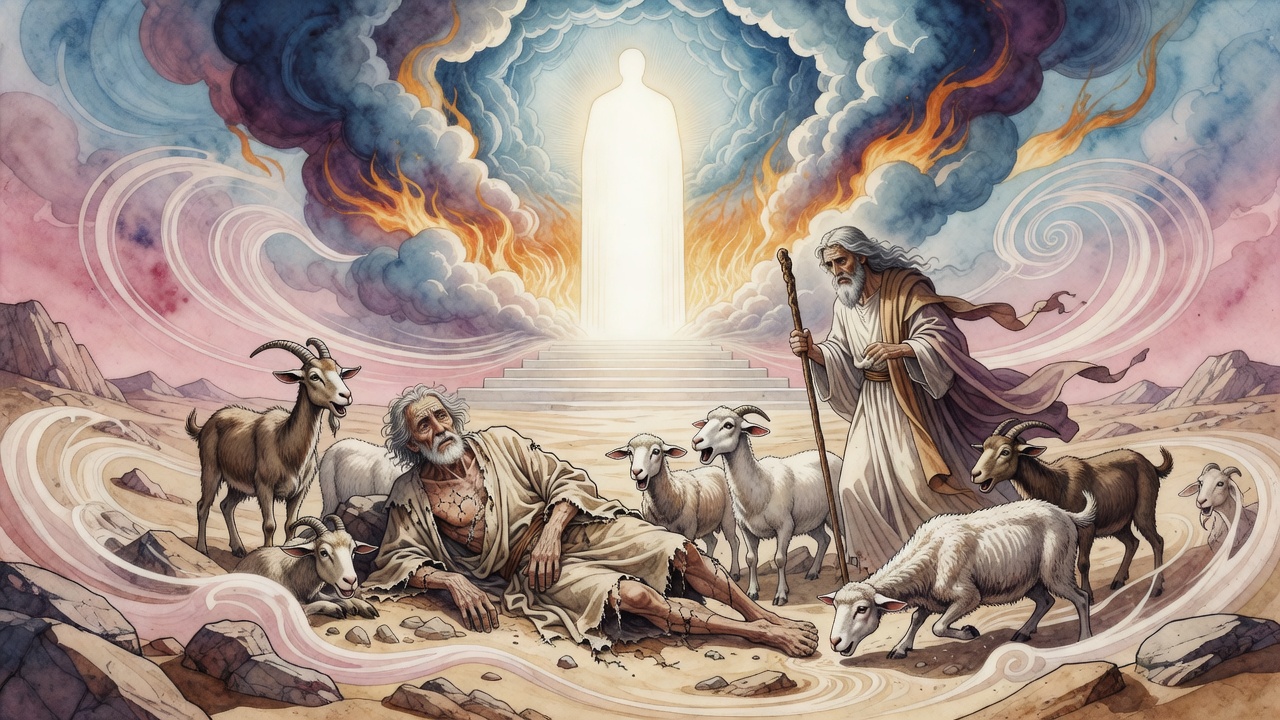
Ezekiel lowered himself onto his left side because Heaven had counted the years of Israel's guilt and needed a body to hold them. Stone pressed his ribs. Dust filled his mouth. He did not choose the posture for theater. God had spoken, and the prophet's limbs became a ledger.

Days stacked. Nights crawled. He bore iniquity the way a man bears a beam he cannot set down.

Right Side for Judah

When the count for Israel closed, the command turned him. Right side now. Judah's years poured into the same bones. Neighbors who passed the prophet's house whispered. Some mocked. Some looked away because watching a holy man become a sponge for national failure is harder than watching a siege wall crack.

Ezekiel kept his face toward the word that had put him there. He was not performing penance for applause. He was planted at God's feet with the rest of the great ones who make themselves hostages for Israel.

Holy Ones in the Hand

"All His holy ones are in Your hand," the old blessing says, and the teachers heard leaders who offer their own safety first. They plant themselves low. They take the anger aimed at the people onto their own skin. They bear the words of God the way porters bear sacks that bruise the shoulder. Na'aseh v'nishma is not a slogan for them. It is a yoke accepted before comfort is asked.

Ezekiel's silence on the floor taught louder than many sermons. Leadership, in this register, means lying still while Heaven writes the cost of a people across one man's days.

Five Eras and a Waiting God

History, another teacher said, runs in five great spans. Creation to the Flood. Flood to wicked Manasseh. Manasseh to the Second Temple's rebuilding. From that house forward to the son of David and a Temple that will not fall. Then the day that is wholly Sabbath, when God alone is exalted. Between the eras the Holy One waits for Israel more fiercely than a father waits for a son, counting exile years and still kissing His people from a distance.

Ezekiel's body belonged to the middle of that long road, when temples could still burn and prophets still had to become signs.

Dust That Hints at Return

Why was Adam driven from Eden while the animals stayed? Because only the speaking, studying human is held to account. Why does Scripture say "to dust you shall return" rather than simply "go"? Because return hints that the dead will rise. The letter bet opens the Torah with blessing, not the alef of curse. Living waters will yet leave Jerusalem when the Lord stands on the Mount of Olives, and the Name will be one.

Ezekiel rolled once more in the dark and felt the years shift. He was one hostage among many. The eras kept walking toward a Sabbath he would not see with those eyes, yet his ribs had already paid a portion of the fare.

Children threw pebbles near his wall and were pulled away by mothers who feared prophecy the way they feared open wells. A priest from the old order came once, cleared his throat, and asked whether the sign was metaphor. Ezekiel did not answer. Metaphor does not bruise a hip bone against stone for numbered days.

He counted breaths when he could not count years. Left side: the north's failures, the politics that dressed themselves as wisdom, the calves and the compromises. Right side: Judah's polished sins, the ones committed with better vocabulary. His body did not sort them by elegance. Guilt has weight either way.

At night he dreamed he stood up and the iniquity stayed on the floor in the shape of a man. Morning returned him to the shape. God was not cruel for sport. God was making a visible math for a people who had stopped believing invisible consequences. If a prophet could become a bed for sin, then sin was no longer an abstract sermon topic.

Far from his street, history kept its five long strides. Floodwaters. Manasseh's altars. A second house raised and later threatened. A future house promised without end. An endless Sabbath. Ezekiel could not see all five eras from the floor, yet he felt their pressure the way a man under a beam feels the whole roof. The Holy One's waiting was not idle. It was the tension in every prophet's spine.

When the days completed, he rose shaking. His legs had to relearn vertical life. Someone offered water. He drank like a man returned from a private exile. The sign was finished; the reality it pointed to was not. Siege would still come. Exile would still teach its grammar. But a few who had watched him would never again say that leadership means only speaking from a high seat.

He washed the dust from his side and found a bruise map of the nation. "Holy ones in Your hand," he murmured, not as poetry, as job description. Then he took up the next command Heaven would not let him refuse, because hostages do not get to choose when the term ends.


← All myths
From the tradition

Sources

2 sources

The texts behind this telling. Some cards carry a translation of the source; others are our own retelling of it, and each card says which. Every card links out to the original.

Sifrei Devarim 344:6Sifrei Devarim

Retold in our words. Read the original at the link below.Sifrei by Rabbi Shraga Silverstein · CC-BY

In Jewish tradition, this isn't just a feeling; it's sometimes a calling.

Sifrei Devarim, in its unique way, shines a light on the incredible self-sacrifice of Israel’s great leaders. It speaks of them in the context of (Deuteronomy 33:3), "And all of his holy ones are in Your hand.." But who are these "holy ones?"

The verse reads, "These are the great ones of Israel, who make themselves hostages for Israel.." Hostages. These aren't just figureheads; they are individuals who are willing to put themselves in harm's way, to become vulnerable, for the sake of their people.

The text then references the prophet Ezekiel, and his dramatic, almost unbelievable act of bearing the iniquity of the house of Israel. As we read in (Ezekiel 4:4-6), God commands him to lie on his left side to bear the iniquity of Israel, and then on his right side to bear the iniquity of Judah. Can you imagine? Ezekiel literally embodies the sins of the people, taking them onto himself. The Sifrei Devarim uses this powerful image to illustrate the role of these "holy ones."

"And they planted themselves at your feet.." This phrase is so evocative. It suggests humility, submission, but also unwavering loyalty. Even when they are bearing the brunt of the anger and animosity directed at the Jewish people, they remain steadfast.

And why do they do it? The text provides a powerful answer: "They bear Your words." They take upon themselves the yoke of Your fear. This isn't about seeking glory or recognition. It's about a deep, abiding commitment to God and to His teachings. It's about living by the words of (Exodus 24:7): "All that the L-rd has spoken, we shall do and we shall hear" – Na'aseh v'nishma – a complete acceptance of God’s will.

The "yoke of fear" might sound intimidating, but in this context, yokeol in Hebrew – represents accepting God's commandments and living a life dedicated to His service. It's not about being afraid of God, but about having a profound respect and reverence for the divine. These leaders embrace this responsibility, understanding that true leadership means serving something greater than oneself.

So, the next time you hear about a leader, ask yourself: Are they truly serving the people? Are they willing to put themselves on the line for the greater good? Are they bearing the weight of responsibility with humility and a deep commitment to something beyond themselves? Perhaps, they too, are striving to be among these "holy ones," planted firmly at the feet of something greater.

Full source
Tanna Debei Eliyahu Rabbah 31:3Tanna DeBei Eliyahu Rabbah

Translation of the source text.Tanna debei Eliyahu Rabbah, Warsaw 1880 · Public Domain

From the creation of the world until the generation of the Flood, thus far the first era. From the generation of the Flood until the generation of Manasseh, the second era. The generation of Manasseh, to what may it be compared? To a king of flesh and blood who arose and gathered all his servants and gave authority into the hands of them all, and went out with them to the field. And when they went to the field they found a certain man buried in a rock. They seized him by his feet and drew him out of the rock, and his face was scorched. They began to blow into his nostrils and to rub his face, and they kept blowing into his nostrils and rubbing his face until he spoke many words before them. And when he had multiplied his words before them, immediately they threw down the staffs of authority from their hands to the ground and said: From the place where they fell, let them never rise from there again, as it is said, "And they shall go into the caves of the rocks and into the holes of the earth, before the terror of the LORD and before the glory of His majesty, when He arises to shake the earth mightily. In that day a man shall cast away his idols of silver and his idols of gold, which they made for him to worship, to the moles and to the bats, to go into the clefts of the rocks and into the crevices of the cliffs, before the terror of the LORD and before the glory of His majesty, when He arises to shake the earth mightily. Cease from man, in whose nostrils is breath, for of what account is he?" (Isaiah 2:19-22).

And from the generation of Manasseh until the Second Temple was built, the third era; thus three thousand four hundred and eight years. And from when the last Temple was built until it was destroyed, four hundred and twenty years. And from when the last Temple was destroyed until now, behold, nine hundred years. And from when the last Temple is rebuilt until the days of the son of David, when the Temple will be built that shall not be destroyed forever, this is the fourth era. And from the days of the son of David until the world is destroyed and abolished, and "the LORD alone shall be exalted in that day" (Isaiah 2:11), the day that is wholly Sabbath, this is the fifth era.

My Father who is in heaven, it is revealed and known that You sit and wait for Israel, when the days of the son of David will arrive, and You find among Israel some who are masters of Scripture and some who are masters of Mishnah, some who are masters of honest business dealing. I call heaven and earth to witness concerning me that the Holy One, blessed be He, sits and waits for Israel more than a father waits for his son and a wife for her husband, that they should repent so that He may redeem them and build for them the Temple that shall never be destroyed, and that there may again stand before Him two rows of ministering angels who stand before Him and recite song before Him. The one row that stands before Him sanctifies His name every day continually, from the rising of the sun until its setting, and says, "Holy, holy, holy is the LORD of hosts; the whole earth is full of His glory" (Isaiah 6:3). The second row that stands before Him sanctifies His name every day continually, from the setting of the sun until its rising, and says, "Blessed be the glory of the LORD from His place" (Ezekiel 3:12). And what does "from His place" teach? Only that the creatures do not see Him, for even the ministering angels do not see Him, for even the holy living creatures who bear His throne of glory do not see His glory.

House of Israel, I have atoned for them in all their dwelling places. From when Israel went out of Egypt until they entered the land was forty years; how much did the Holy One, blessed be He, embrace them, and how much hug them, and how much kiss them. And from when they entered the land until the First Temple was built, four hundred and forty years, the hand of the Holy One, blessed be He, was stretched out over them to save them from every foe and enemy. And likewise from when the First Temple was destroyed until the last Temple was built, seventy years, His hand was stretched out over them to save them from every foe and enemy. And likewise from when the last Temple was destroyed until now, nine hundred years, how much He embraces them, how much He hugs them, how much He kisses them.

From here onward, even if we and our children and our children's children should stand, and we had a mouth full of song like the sea, and our tongue full of glad cry like the multitude of its waves, and our lips full of praise like the breadth of the firmament, and our hands spread out like the eagles of the sky, and our feet swift like the hinds, we would not be able to thank You, O LORD our God and God of our fathers, and to bless Your name, for even one of the thousand thousand thousands and myriad myriads of the miracles and good things that You did with us. And in the time to come, how greatly will the Holy One, blessed be He, light up the faces of the righteous, that they shall be like the first era. A parable, to what may the matter be compared? To a king of flesh and blood who sent to his servants and members of his household that he was coming to them with horses and horsemen and many troops, that they should prepare for him a fine and pleasant tent so that he might come and dwell with them in their quarter. When his servants and the members of his household heard this, immediately they too went out to meet him with horses and horsemen and many troops with them, and they said to him that they had already prepared for him a fine and pleasant tent so that he might come and dwell with them in their quarter. But if they did not do so, that they did not go out to meet him with joy and did not prepare for him a fine tent, immediately the king drives them out. Therefore it is said, "And He drove out the man" (Genesis 3:24).

And why is it not said, "And He drove out the cattle, and He drove out the beast and the birds"? Rather, I call heaven and earth to witness concerning me that the cattle, beast, and bird do not speak and do not read and do not repeat, and therefore Scripture made it depend on the man; therefore it is said, "And He drove out the man." What does it say above it? "Thorns also and thistles shall it bring forth to you, and you shall eat the herb of the field; in the sweat of your face shall you eat bread, until you return to the ground, for out of it were you taken; for dust you are, and to dust shall you return" (Genesis 3:18-19). When the Holy One, blessed be He, said to Adam, "Thorns also and thistles shall it bring forth to you, and you shall eat the herb of the field," all his limbs trembled. The Holy One, blessed be He, said to him: Since your limbs have trembled, you shall eat bread, as it is said, "In the sweat of your face shall you eat bread," until "and to dust shall you return."

It does not say "to dust shall you go," but rather "and to dust shall you return." From here is a hint to the resurrection of the dead from the Torah; therefore it is said, "and to dust shall you return." And how is the letter bet different from all the twenty-two letters, that with it the Holy One, blessed be He, created His world, as it is said, "In the beginning [Bereshit] God created the heavens and the earth" (Genesis 1:1)? Was it not fitting to say only "God created in the beginning"? What then does "In the beginning God created" teach? Rather, go and learn from this child whom today they open with and say to him alef, bet, and tomorrow they say to him bet, alef. And from whom do you learn? Learn from the blessings and curses stated in Deuteronomy; therefore the Torah was first stated with a bet, bet and alef, alef, as it is said, "In the beginning God created [the heavens]" (bet, then alef). And another reason: the Torah is stated first with bet, which is a word of blessing [berakhah], and not stated first with alef, which is a word of the curse of "cursed" [arur]. And if you say, is it not written with a bet, "She weeps sorely [bakhoh tivkeh]" (Lamentations 1:2)? It is also stated with an alef, "How [eikhah] she sits solitary" (Lamentations 1:1), and the curse of "cursed."

And all the righteous who stand at the resurrection of the dead in the days of the son of David shall never again return to their dust forever, as it is said, "And it shall come to pass that he who is left in Zion and he who remains in Jerusalem shall be called holy, everyone who is written for life in Jerusalem" (Isaiah 4:3). And where do they go? Rather, at the hour when the Holy One, blessed be He, receives the face of the righteous in the time to come, they shall come before Him like sons before a father, and like servants before their master, and like disciples before their teacher, as it is said, "Behold, a day comes for the LORD... And the LORD shall go forth and fight against those nations... And His feet shall stand in that day upon the Mount of Olives, which is before Jerusalem on the east, and the Mount of Olives shall be split in its midst toward the east and toward the west... And you shall flee as you fled before the earthquake... And the LORD my God shall come, and all the holy ones with You. And it shall come to pass in that day that there shall not be light, but cold and frost; and it shall be one day which is known to the LORD, not day and not night, but it shall come to pass that at evening time there shall be light. And it shall come to pass in that day that living waters shall go out from Jerusalem, half of them toward the eastern sea and half of them toward the western sea; in summer and in winter shall it be. And the LORD shall be king over all the earth; in that day the LORD shall be one and His name one" (Zechariah 14:1-9).

And so may it be Your will before You, O LORD our God and God of our fathers, that You show us the rebuilding of Jerusalem speedily in our days. Amen.

Full source