The Firstborn of Ham Died in Egypt's Tents on Plague Night
A Cushite trader sleeps under an Egyptian roof when the tenth plague comes. The firstborn of Ham dies in Egypt's tents, far from his own land.
Table of Contents
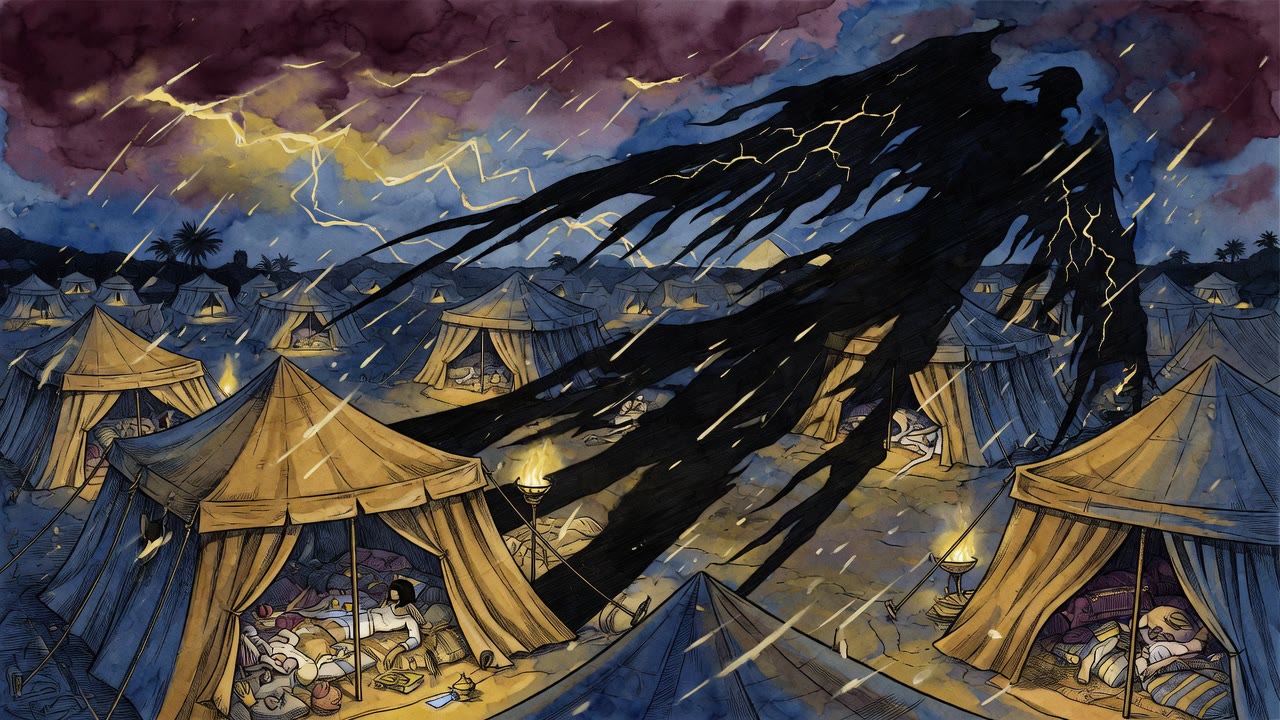
The lamp guttered low in a borrowed room near the river, and a young man lay awake on a mat that was not his own. His name does not survive, only his line. He was a firstborn, the eldest of a Cushite household that had come north for trade, and he had bedded down that night under an Egyptian roof in an Egyptian street, his pack of goods stacked against the wall, his thoughts on the road home in the morning.
 Click for full size
He was not Egyptian. He had never lifted a brick for Pharaoh. He had heard, in the markets, the talk of strange disasters in the land, water turned foul, hail that flattened the flax, a darkness so thick men could not find the door. He told himself none of it touched him. He was a guest, a passing merchant, a son of Ham by way of Cush, far from the quarrel between this kingdom and its slaves.
A Guest Under an Egyptian Roof
Outside, the city had gone quiet in a way that felt wrong. No dogs. No watchman's call. The young man pulled his cloak higher and listened to the breathing of the household around him, the Egyptian family who had taken his coin and given him a corner. Somewhere a child stirred and settled. The lamp went out on its own, the oil spent, and the dark came down complete.
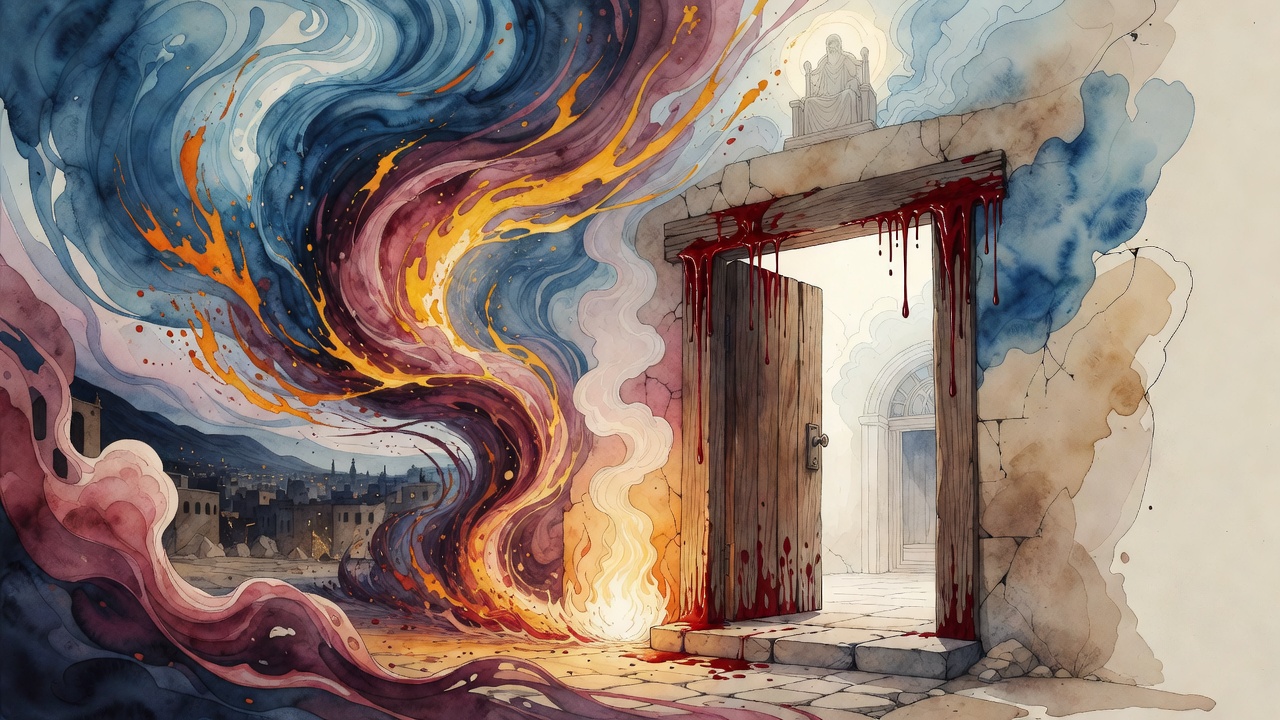
He did not know that a line had been drawn that night, and that he had laid his body on the wrong side of it. He thought the line ran between Egyptian and foreigner, between the man who owned slaves and the man who only sold cloth. The line did not run there. It ran around the land itself, around every wall and roof and threshold inside the borders of Egypt, and he had walked inside that border days ago without knowing it was a noose.
The Measure Comes Due
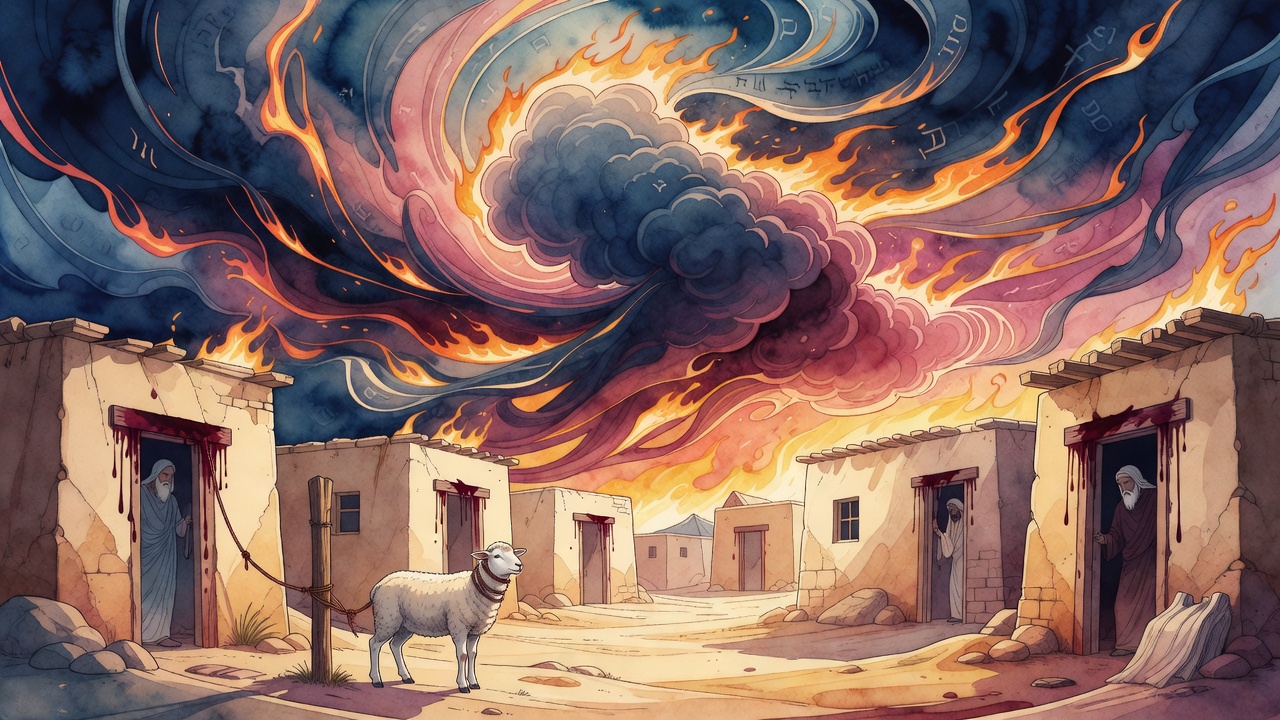
The thing that moved through Egypt that night had a reckoning to keep, and the reckoning was old. The Egyptians had once schemed to drown the sons of the slaves, to cast the newborn boys into the water and choke a people in its cradle. So the blow that came now fell on sons. On the eldest of every house, the first fruit of every man's strength. The crime had been measured against children, and the answer was measured back, weight for weight, the eldest for the youngest, a firstborn for a firstborn (Exodus 12:29).
The young Cushite had drowned no infants. He had schemed nothing. But he was the firstborn of his father's house, and his father's house, for this one night, stood inside Egypt. The judgment did not stop at the doorpost to ask a man his nation. It asked only where he slept.
Death Does Not Check the Lineage
It moved down the street he had walked that afternoon. It entered the house where he had eaten. It passed the master of the household, then the master's eldest, then the servant girl's eldest at the millstone, then the prisoner's eldest in the lockup (Exodus 11:5). It did not skip the guest room because the guest was a foreigner. The young man felt the cold of it the way you feel a shadow cross the sun, and then he felt nothing, and the eldest son of a Cushite trader lay still on a borrowed mat in a city that was not his home.
By morning the wailing rose from every quarter, and it was not only Egyptian grief. In the foreign streets, in the merchants' lodgings, among the men of Cush and Put and the scattered children of Ham who had come to Egypt for work, for trade, for refuge, the same cry went up. The eldest were gone. They had counted on the border to protect them and the border had betrayed them, because the border was the very thing that condemned them.
The Tents of Ham
Long after, a singer of Israel set the night to verse, and he chose his words with terrible care. He could have said the blow fell on the tents of Egypt. He did not. He sang that God struck down every firstborn, the first fruit of their strength, in the tents of Ham (Psalms 78:51). Not the tents of Egypt. The tents of Ham.
That single shift held the whole secret of the young Cushite's death. Ham was not only the father of Egypt. He was the father of Cush, of Put, of Canaan, a whole spread of nations branching from one man who had once failed to honor his own father Noah and carried a shadow down his line (Genesis 9:22). To say the tents of Ham instead of the tents of Egypt was to widen the doorway of death until it took in every son of Ham who happened to be sheltering in that land. The Cushite trader was a son of Ham. He died under the verse that named his ancestor, not his crime.
What the Border Decided
So the clean story, the one told at every spring table, holds a hidden room. Egyptian firstborn died and Israelite firstborn lived, that much is sung plainly. Between those two lines lay a third kind of sleeper, the foreigner, the guest, the man of another nation under an Egyptian roof, and he was not spared. The hand that fell did not weigh citizenship. It weighed ground. Whoever lay inside the land of Egypt that night, of whatever blood, lay inside the judgment of the land. The young Cushite had thought himself a bystander. The geography knew otherwise.
← All myths