Parshat Bo5 min read

The Night God Leapt Across Egypt's Doorways

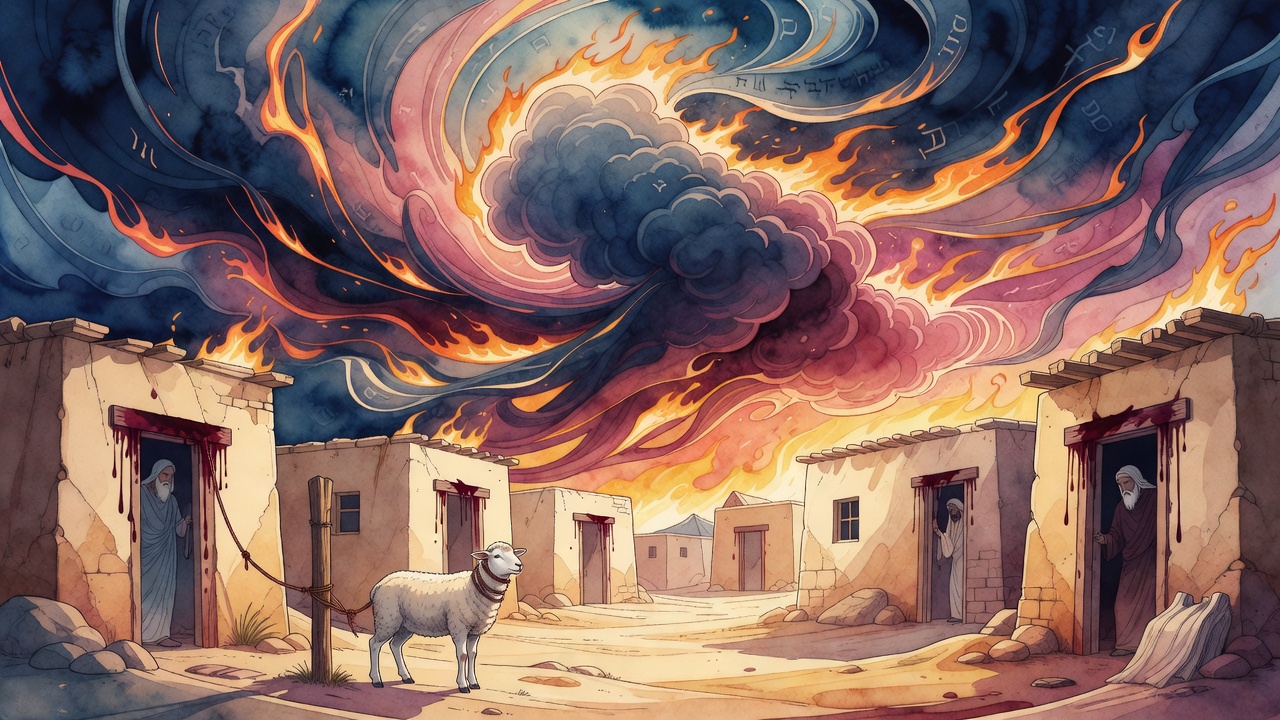
Israel tied the lamb in the yard for four days where every Egyptian could see it. Then God came through Egypt that night in person, not by angel.

Curated by Arthur · Told by Maggid ·
Table of Contents
  1. The Names Survived Egypt
  2. The Lamb Had to Be Tied Where Everyone Could See
  3. God Did Not Delegate This Night
  4. God Saw the Blood of the Binding
  5. He Was Leaping Between the Houses
The Night God Leapt Across Egypt's Doorways Click for full size

The Names Survived Egypt

Four hundred years in Egypt, and the sons of Jacob came out still called by the names they had entered with. Reuven remained Reuven. Shimon remained Shimon. Not Egyptian versions of themselves. Not assimilated sounds that carried the old names faintly inside them. The names crossed into exile and crossed back out.

The Mekhilta asks how we know this, and the answer is in the numbers. When the sons of Jacob first went down to Egypt they were called by their Hebrew names. Generations later, when the wilderness census was taken, the same tribal names appear unchanged. Names that could have faded in four hundred years of bondage did not. The empire could command labor. It could not rename the covenant out of the people.

The language held as well. Joseph revealed himself to his brothers in Hebrew, the holy tongue. Moses and Aaron came before Pharaoh identifying themselves as servants of the God of the Hebrews, naming Israel by their language rather than their geography. The tongue survived too.

The Lamb Had to Be Tied Where Everyone Could See

Four days before freedom, God told Israel to take the Passover lamb and tie it. Not to purchase it quietly and keep it indoors. To tie it in public, in the courtyards, in view of their Egyptian neighbors, for four full days. Egypt revered the lamb. This was not a private act of preparation. It was a four-day declaration that the God of Israel outranked the symbols of Egypt.

The Israelites understood the risk. They came to Moses with their fear: "will we slaughter the abomination of Egypt before their eyes and they not kill us?" Moses did not dismiss the fear. He reframed it. If God could protect them during the most provocative part, the four days of holding and displaying a sacred animal in an empire that revered it, then the slaughter itself would be manageable. The waiting was the test. If they could hold fast through the wait, the act would follow.

God Did Not Delegate This Night

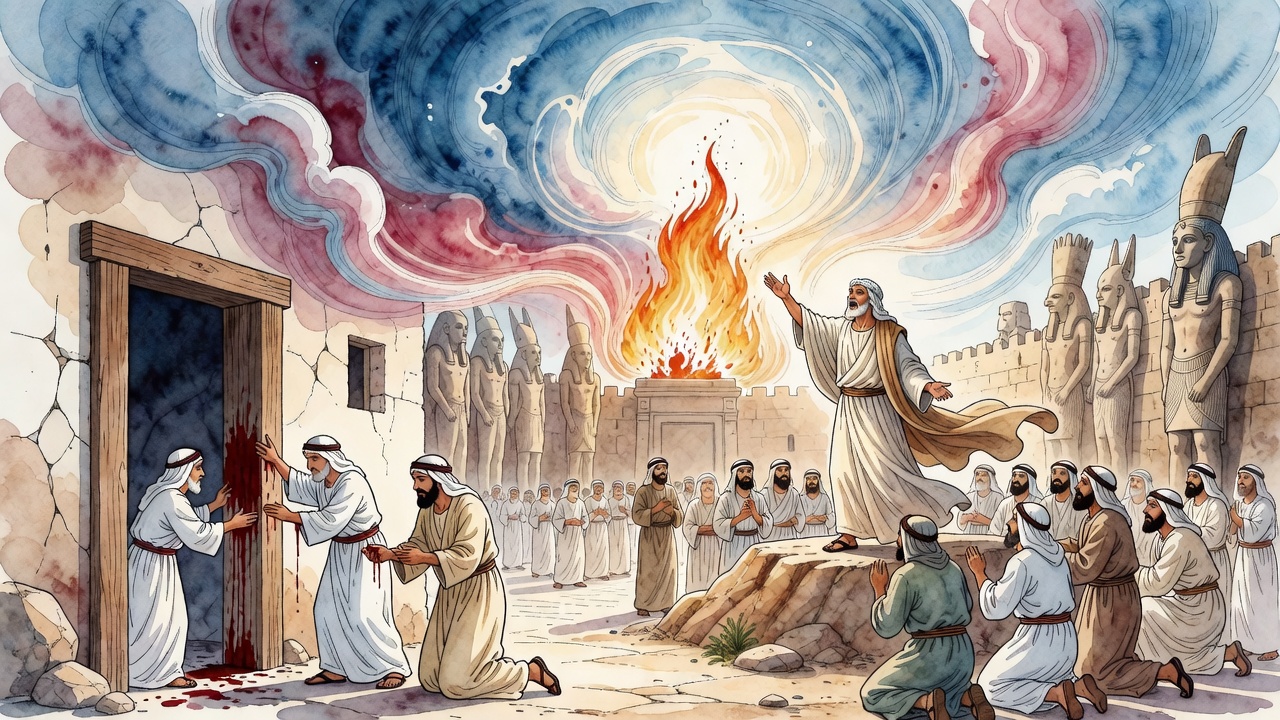
The tenth plague was unlike the others. An angel had blocked Balaam's path. An angel had struck the camp of Sennacherib. Surely God sent an angel for the tenth plague as well. The Mekhilta says no. The text of Exodus is precise: the Lord himself smote every firstborn in the land of Egypt. Not through a seraph, not through a messenger, not through an angel. God said: "I and not an angel. I and not a seraph. I and not a deputy. I am the Lord."

There is a theology compressed into this insistence. The night that broke Egypt was too important to delegate. The power of redemption was not borrowed or divided. It was direct. The God who had heard the groaning of the slaves in the brickfields was the same God who walked through Egypt that night, and what walked through was not a representative.

God Saw the Blood of the Binding

When God said he would see the blood on the doorposts, the Mekhilta offers a stunning alternative reading. The blood God saw was not only the blood of the Passover lamb. It was also the blood of the Binding of Isaac. Abraham had called the place of the Binding the Lord will see. That verb, see, created a bridge across generations. The merit of Isaac's willingness to be offered, performed centuries before, was what God saw when he passed over the Israelite homes on Passover night. The lamb's blood was a sign pointing back to a deeper sign.

He Was Leaping Between the Houses

Rabbi Yoshiyah read the Hebrew word that gives Passover its name and refused the usual translation. "Do not read it as he passed over," he said. "Read it as he leaped." The image from Song of Songs supported him: the voice of my beloved, behold it comes, skipping over the mountains. And the following verse: behold, he stands behind the wall. God was not a distant force working through a list. He was leaping, moving with urgent joy from one Israelite home to another, shielding each one in sequence, standing behind the wall of each house in turn.


← All myths

From the tradition

Sources

7 sources

The texts behind this telling. Some cards carry a translation of the source; others are our own retelling of it, and each card says which. Every card links out to the original.

Mekhilta Tractate Pischa 5:6Mekhilta DeRabbi Yishmael

Retold in our words. Read the original at the link below.Mechilta, translated by Rabbi Shraga Silverstein · CC-BY

One of the most remarkable claims in rabbinic tradition is that the Israelites preserved their identity throughout centuries of Egyptian bondage by refusing to change their names. The Mekhilta asks a deceptively simple question: how do we know they kept their original Hebrew names?

The proof is elegant. When the sons of Jacob first descended into Egypt, they were called Reuven, Shimon, Levi, and Yehudah (Genesis 46:8-27). Generations later, when the census of the wilderness was taken, those same tribal names appear unchanged (Numbers 1:18). No Egyptian adaptations. No assimilated versions. The names survived intact through four hundred years of slavery.

The Mekhilta strengthens this point with a verse from Jacob's blessing over Joseph's sons: "The angel who redeems me from all evil, bless the lads, and let there be called in them my name and the name of my fathers" (Genesis 48:16). Jacob was not merely asking for a blessing. He was commanding continuity. The angel who guards the family must ensure that the names. And everything those names represent, pass from generation to generation without corruption.

For the rabbis, this was no minor detail. Names carry spiritual identity. To change your name under foreign pressure is to surrender something essential about who you are. The Israelites in Egypt faced every form of oppression imaginable, yet they clung to the names their ancestors gave them. That stubbornness, the Mekhilta implies, is part of what made them worthy of redemption.

Full source
Mekhilta Tractate Pischa 5:7Mekhilta DeRabbi Yishmael

Retold in our words. Read the original at the link below.Mechilta, translated by Rabbi Shraga Silverstein · CC-BY

The Mekhilta identifies one of the hidden miracles of the Egyptian exile: the Israelites never abandoned the Hebrew language. Despite living for centuries among Egyptian speakers, they continued to speak the holy tongue. And this, the rabbis argue, is one of the reasons they merited redemption.

The textual evidence comes from three separate moments in the biblical narrative. First, when Joseph reveals himself to his brothers, the Torah says "the mouth that speaks to you" (Genesis 45:12), which the rabbis understand as meaning Joseph spoke to them in Hebrew, the holy tongue, proving the family still used it. Second, when Moses and Aaron approach Pharaoh, they announce, "The God of the Hebrews revealed Himself to us" (Exodus 5:3), using a term that identifies the Israelites by their language. Third, the Torah recalls that when a survivor of the battle of the kings came to report to Abraham, he found "Avram the Hebrew" (Genesis 14:13), establishing that the designation "Hebrew" was a linguistic and cultural identity stretching all the way back to the first patriarch.

The theological point is striking. The rabbis believed that language preservation was not incidental but essential. A people who keep their language keep their connection to revelation, to prayer, to the words God spoke at creation. Losing your language means losing your ability to hear what God is actually saying. The Israelites held on to Hebrew the way a drowning person holds on to a rope. And that rope pulled them out of Egypt.

Full source
Mekhilta Tractate Pischa 5:8Mekhilta DeRabbi Yishmael

Retold in our words. Read the original at the link below.Mechilta, translated by Rabbi Shraga Silverstein · CC-BY

The Mekhilta raises a question that cuts to the heart of the Passover story: why did God command the Israelites to select the Passover lamb four full days before slaughtering it? Why the wait?

The answer reveals something uncomfortable about Israel's spiritual state in Egypt. According to the Mekhilta, the Israelites had sunk deep into idolatry during their centuries of bondage. This was not a minor lapse. Idolatry, the text explains, is equivalent to transgressing all of the commandments at once, as Scripture indicates: "And if from the eyes of the congregation it were done unwittingly" (Numbers 15:24), a verse the rabbis read as singling out idol worship as the one transgression that carries the weight of every other.

So when the time came for redemption, the Israelites had a problem. They had accumulated no merit. They had nothing to show for themselves spiritually. God, in His mercy, gave them a commandment they could perform immediately, selecting the Passover lamb. But He built in a four-day waiting period, during which the lamb had to be kept and inspected.

Those four days were not about the lamb. They were about the people. The act of selecting an animal that the Egyptians worshipped as a god, tying it to the bedpost in full view of their neighbors, and waiting, that required courage. It required a public break with the idolatry they had absorbed. The four days of "keeping" the lamb were really four days of spiritual preparation, a bridge between slavery and freedom, between the person each Israelite had become in Egypt and the person God needed them to be.

Full source
Mekhilta Tractate Pischa 5:11Mekhilta DeRabbi Yishmael

Retold in our words. Read the original at the link below.Mechilta, translated by Rabbi Shraga Silverstein · CC-BY

Moses told the Israelites to take a lamb for the Passover offering, and they were terrified. The Mekhilta preserves their fearful protest: "Will we slaughter the abomination of Egypt before their eyes and they not kill us?" (Exodus 8:22). The lamb was sacred to the Egyptians. Killing it publicly would be like setting fire to a temple. The Israelites expected a massacre.

Moses did not dismiss their fear. Instead, he reframed it. The Torah says the lamb must be kept "for a keeping", meaning the Israelites had to select the lamb and tie it up for four days before slaughtering it (Exodus 12:21). Moses pointed out that this extended waiting period was itself a test and a sign. If God could protect them during the most provocative part, openly selecting and binding Egyptian sacred animals in full view of their neighbors, then surely He would protect them during the slaughter.

The logic was almost daring. The "keeping" was not just about inspecting the lamb for blemishes, as later halakhah (Jewish religious law) would emphasize. It was a four-day demonstration of divine power. Every day that passed with the lamb tied to an Israelite bedpost and no Egyptian mob forming at the door was proof that God was already intervening. By the time the fourteenth of Nissan arrived and the moment of slaughter came, the Israelites had already witnessed the miracle. They had lived inside it for four days.

The Mekhilta is making a profound point about faith: sometimes God does not remove the danger. He walks you through it slowly enough that you can see His hand at work.

Full source
Mekhilta Tractate Pischa 7:23Mekhilta DeRabbi Yishmael

Retold in our words. Read the original at the link below.Mechilta, translated by Rabbi Shraga Silverstein · CC-BY

When God said "And I shall see the blood" regarding the Passover in Egypt, the Mekhilta offers a stunning alternative reading. The "blood" God would see was not the blood of the Passover lamb at all. It was the blood of the Binding of Isaac.

The connection runs through a verbal link. (Genesis 22:14) records that Abraham "called the name of the place 'The Lord will see.'" The word "see" in both contexts. God seeing the blood in Egypt, and the place where God "will see", creates a bridge between two foundational events in Jewish history. The merit of Isaac's near-sacrifice, performed generations earlier, was what God "saw" when He passed over the Israelite homes.

The Mekhilta brings further support from (1 Chronicles 21:15): "But as He was about to destroy, the Lord saw and He repented Himself of the evil." What did God see at that moment of impending destruction? Again, the blood of the Binding of Isaac. The merit of that ancient act of devotion continued to shield Israel across centuries.

This teaching transforms the Passover from a single historical event into part of a continuous chain of merit. The Israelites in Egypt were not saved solely by their own actions, painting lamb's blood on their doorposts. They were saved because God looked at those doorposts and remembered a father who was willing to offer his son, and a son who was willing to be offered. The blood of the lamb triggered the memory of an even deeper sacrifice.

Full source
Mekhilta Tractate Pischa 7:6Mekhilta DeRabbi Yishmael

Retold in our words. Read the original at the link below.Mechilta, translated by Rabbi Shraga Silverstein · CC-BY

The night of the tenth plague was unlike anything Egypt had ever witnessed. Every firstborn in the land, from the heir of Pharaoh sitting on his throne to the firstborn of the captive languishing in the dungeon, was struck down in a single, terrible moment. But the Mekhilta raises a question that cuts to the heart of how God operates in the world: who actually carried out this devastating act?

One might naturally assume that God delegated. After all, the Torah is full of angels carrying out divine missions. An angel blocked Balaam's path. An angel struck the camp of Sennacherib. Surely God sent an angel or a messenger to handle the grim business of the tenth plague as well?

The Mekhilta says no. Emphatically no. The text of (Exodus 12:29) is precise: "And the Lord Himself smote every firstborn." Not through an angel. Not through a seraph. Not through any messenger whatsoever. God descended into Egypt, into the very heart of impurity. And personally struck every firstborn.

This is a staggering theological claim. The God who is beyond all comprehension, who dwells in unapproachable light, walked through the streets of Egypt that night like a warrior king who refuses to send soldiers when honor demands he fight himself. The Mekhilta is teaching that the Exodus was so foundational, so central to the identity of Israel, that God would entrust it to no one else. The plagues were not bureaucratic, they were personal.

Full source
Mekhilta Tractate Pischa 7:24Mekhilta DeRabbi Yishmael

Retold in our words. Read the original at the link below.Mechilta, translated by Rabbi Shraga Silverstein · CC-BY

Rabbi Yoshiyah offered a creative reading of the Hebrew word "ufasachti", "and I will pass over you", from the Passover narrative. He said: do not read it as "ufasachti" but as "ufasati," from a root meaning to skip or leap. The image is not of God passively passing over Israelite homes but of God actively skipping and leaping between them.

The proof text is breathtaking. (Song of Songs 2:8) describes the beloved: "The voice of my Beloved, behold, it comes, skipping over the mountains." And the following verse continues: "Behold, He stands behind the wall." The rabbis read this as a poetic depiction of what happened in Egypt on that terrible night.

God was not a distant force methodically working through a list of houses. He was leaping, moving with joyful urgency from one Israelite home to the next, shielding each one personally. The image is intimate and dynamic. Like a lover rushing to meet the beloved, God bounded over the rooftops of Egypt, His presence darting between the homes of His people.

This reading transforms the Passover from a grim night of judgment into something far more complex, a night that was simultaneously terrifying for Egypt and tender for Israel. While the angel of death moved through Egyptian homes, God Himself was skipping like a bridegroom across the homes of His people, personally ensuring that no harm would touch them.

Full source