Parshat Bo4 min read

Blood Hidden Inside Where Only God Could See

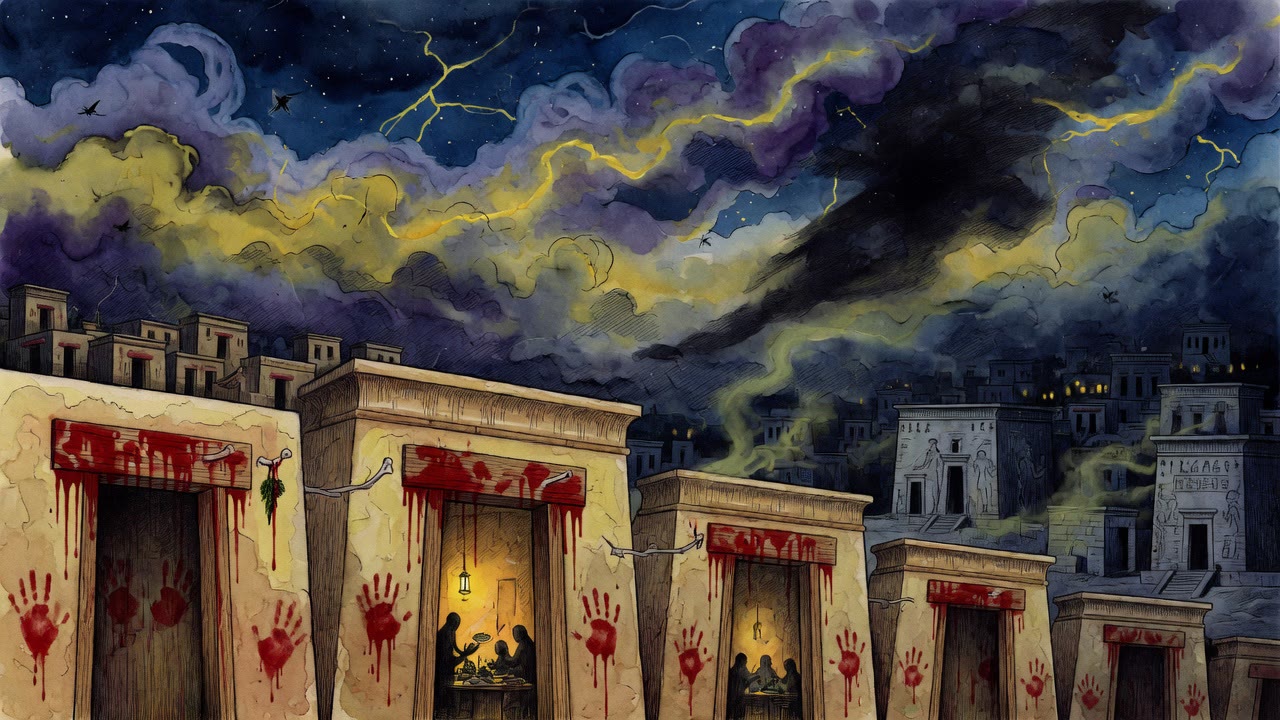
Rabbi Yishmael put the mark on the inside of the doorframe. No neighbor could count the painted houses, and no Egyptian ever saw one.

Curated by Arthur · Told by Maggid ·
Table of Contents
  1. Moses Walked Out Past the Last of the Idols
  2. Riverbanks and the Merit of the Fathers
  3. Hyssop, a Basin, and the Inside of the Door
  4. Seen by Me and Not by Others
  5. The Night Nobody Went Out
Blood Hidden Inside Where Only God Could See Click for full size

Moses Walked Out Past the Last of the Idols

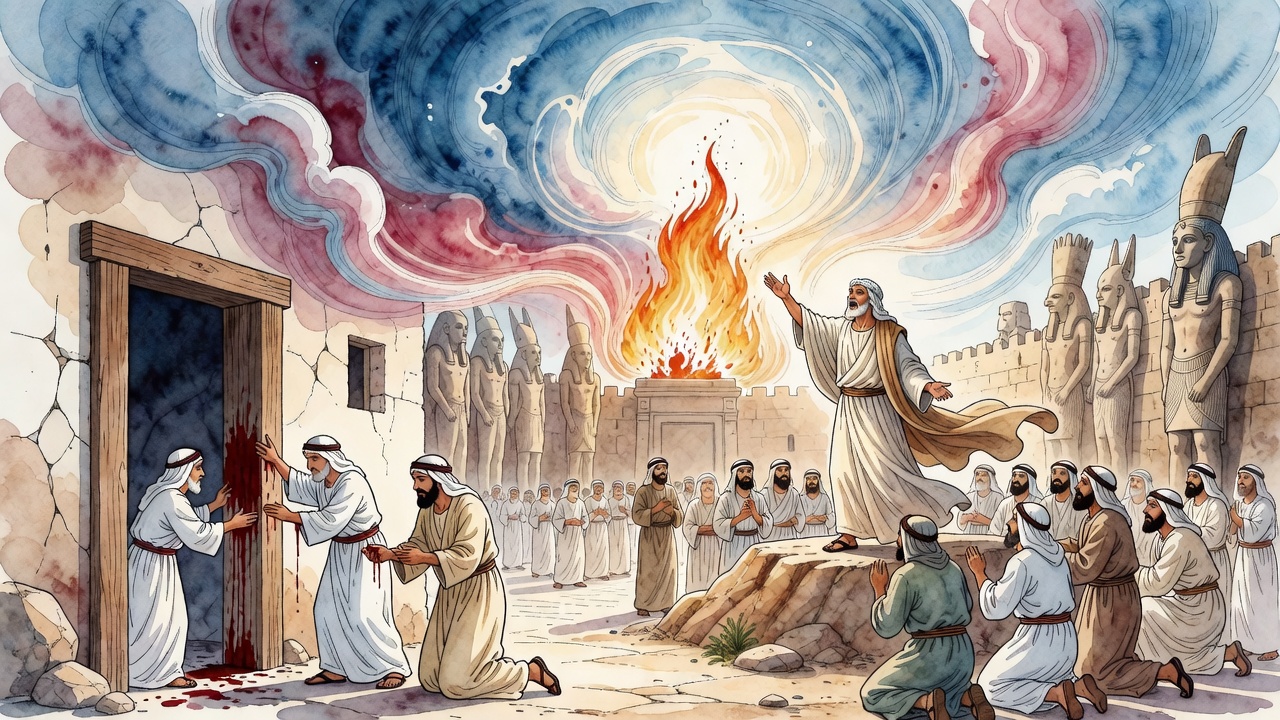
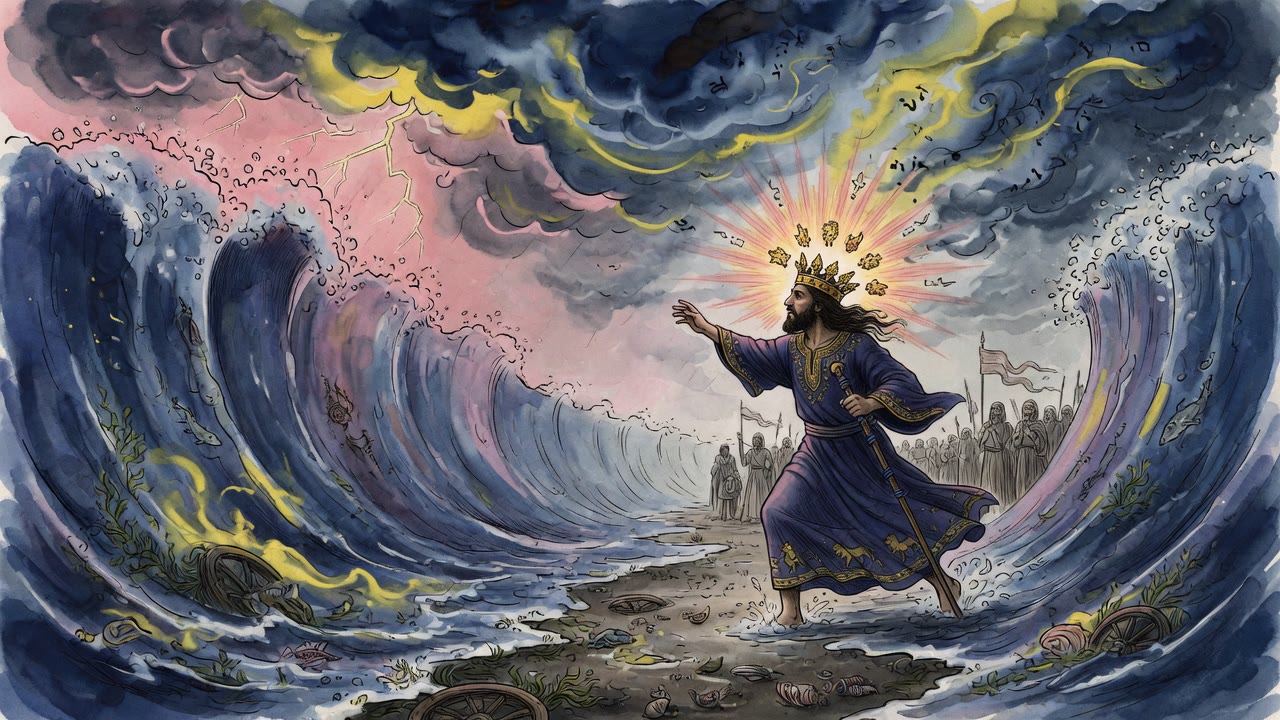
Moses went out through the gates to get the message. He always went out. When he promised to pray about the hail he was careful about it in front of Pharaoh: the moment I have left the city I will spread my hands to the LORD. Not in the throne room. Not in the street.

The streets were the problem. Every corner of that place had something standing on it with a face, and the corners between the corners had shrines.

If a man's prayer, which only has to go up, could not go up from inside those avenues, then a word coming down does not come down into them either. So the laws of the lamb and the blood and the night were spoken to Moses somewhere past the last shrine, with the noise of the city behind him and clean air in front.

This month is for you the beginning of the months.

Riverbanks and the Merit of the Fathers

The same carefulness held long after Egypt was a story people told at a table.

When God spoke to prophets outside the land at all, He did it for the merit of the fathers, and even then only in a clean place, and the clean place always had water in it. Daniel standing by the stream Ulai. Daniel again by the great river, the Tigris. Ezekiel sitting among the exiles at the river Kevar when the heavens opened over him.

Never in the middle of a foreign capital. On a bank, with the water going past.

Hyssop, a Basin, and the Inside of the Door

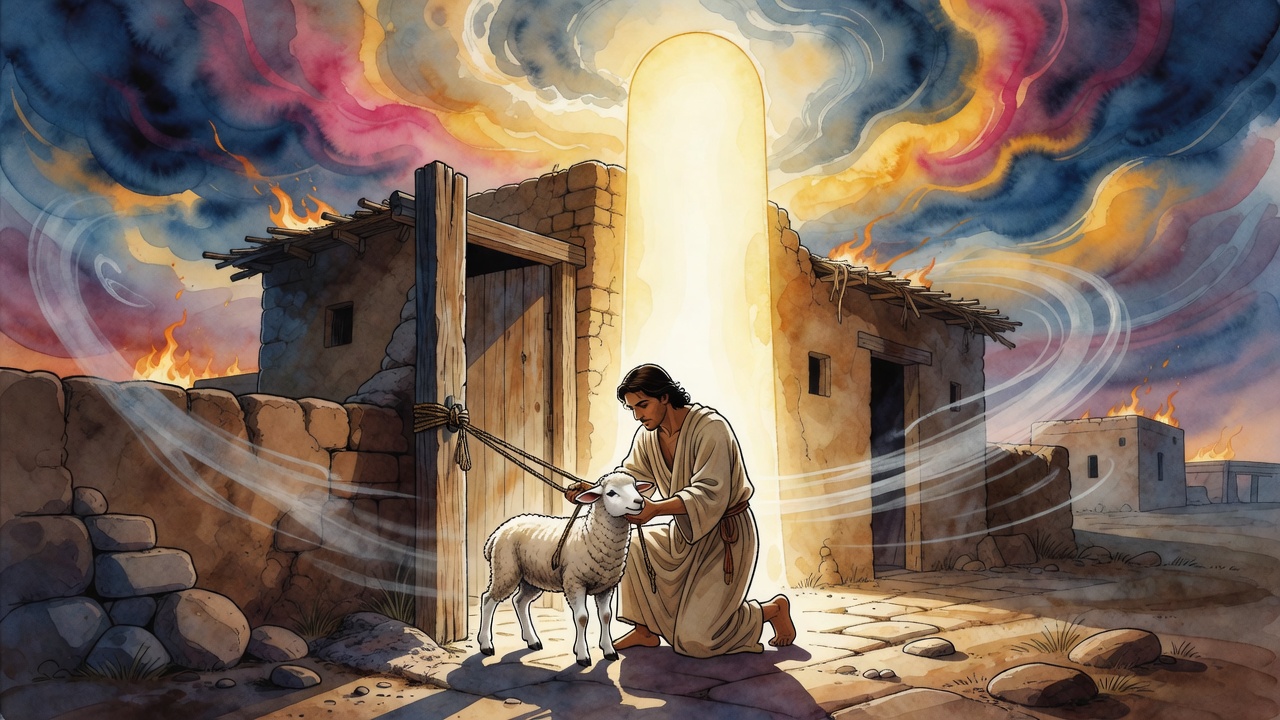
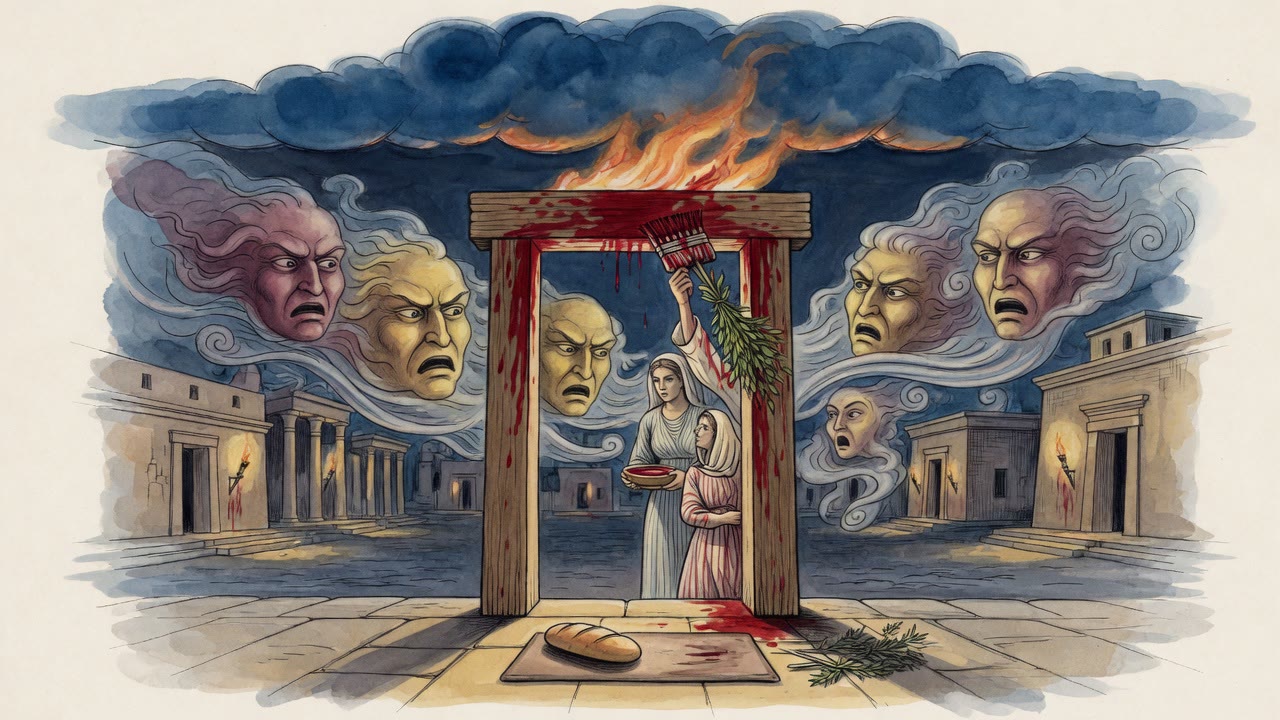
On the fourteenth day every household took its lamb and killed it toward evening. Blood went into a basin set on the ground in the doorway. Somebody tore off a bunch of hyssop and dipped it.

Two doorposts and the lintel. Three strokes.

On which face of the wood, though. That is the whole question, and the households had to answer it before dark.

Seen by Me and Not by Others

Rabbi Yishmael said inside, and he said it on the strength of four words.

And I will see the blood.

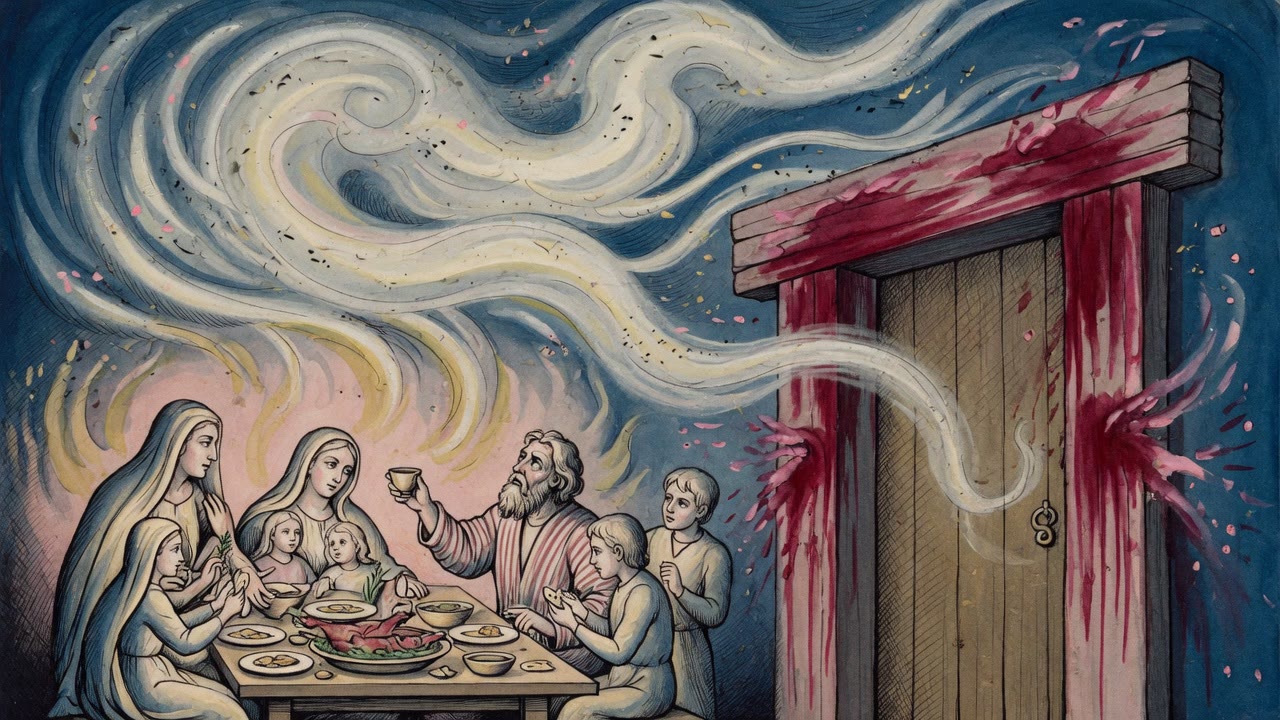
The One who knows what is under a man's ribs does not need to look at anything. If He says He will see it, then it is blood seen by Me and not by others. Inside the frame. On the family's side of the door.

So nothing about it was a signal. No Egyptian walking home from the brickfields could count the painted houses. No overseer could keep a list of who had made the mark and who had not. There was no way for a neighbor to be impressed and no way for a neighbor to inform.

Hands shook over the basin. Hyssop dragged a wet line down the wood facing the room, and the children in that room asked why it was pointing at them and not at the road, and their parents answered with whatever they had left after a lifetime of straw and brick and drowned infants.

The Night Nobody Went Out

Roast it whole. Head, legs, the inside parts. Nothing raw and nothing boiled in water, and nothing left over until morning.

Eat it with flatbread and bitter herbs, with your belt tied, your sandals on your feet and your staff in your hand, and eat it fast.

And none of you go out the door of his house until morning.

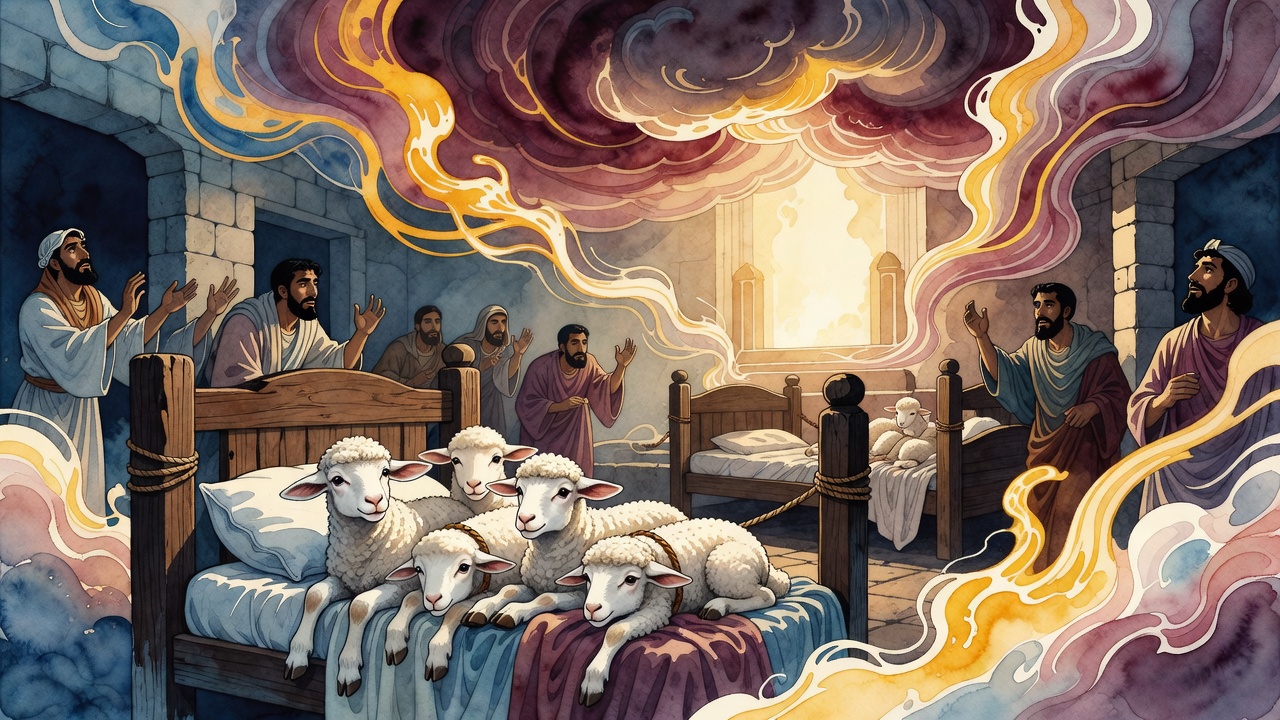
So they stood in their shoes in a shut room, chewing, holding sticks, while the hidden mark dried behind them on the wood. Around midnight the noise started at the palace and worked its way down through the city to the man asleep beside the millstone and the animals in the pens, and there was no house in Egypt without a dead son in it.

Nobody in the house went to the door to look.

By the time the light came up and Pharaoh sent for Moses in the dark, the line on the inside of the frame had gone brown and stiff, and not one person outside that family had ever laid eyes on it.


← All myths
From the tradition

Sources

3 sources

The texts behind this telling. Some cards carry a translation of the source; others are our own retelling of it, and each card says which. Every card links out to the original.

Mekhilta Tractate Pischa 6:3Mekhilta DeRabbi Yishmael

Retold in our words. Read the original at the link below.Mechilta, translated by Rabbi Shraga Silverstein · CC-BY

On the night that would change everything, God told the Israelites to paint blood on their doorframes. But where exactly? On the inside of the doorposts and lintel, or on the outside? The Mekhilta records a debate that reveals two fundamentally different understandings of what the blood was for.

Rabbi Yishmael argues the blood went on the inside. His proof is devastating in its simplicity. God says, "And I will see the blood" (Exodus 12:13). If an omniscient God needs to "see" the blood, it means the blood is not for public display. It is hidden on the interior of the doorframe, visible only to the One who passes through Egypt that night. "Blood which is seen by Me," Rabbi Yishmael concludes, "and not by others."

This reading transforms the entire Passover narrative. The blood was not a flag or a signal meant to warn off a blind destructive force. It was an intimate act of faith between each Israelite household and God. No Egyptian neighbor would see it. No one walking down the street would know which houses were marked. The blood was a private covenant, painted in a place only God would look.

The theological implication is profound. God does not need a sign to know who is faithful. The blood was for the Israelites' benefit, not His. By placing it where only He could see it, they demonstrated that their trust was in Him alone, not in the visible display of their devotion, but in the hidden reality of it. Faith, the Mekhilta suggests, is most powerful when no one else can see it.

Full source
Mekhilta Tractate Pischa 1:8Mekhilta DeRabbi Yishmael

Retold in our words. Read the original at the link below.Mechilta, translated by Rabbi Shraga Silverstein · CC-BY

The Mekhilta on Tractate Pischa examines the opening words of the Passover instructions, (Exodus 12:1) "in the land of Egypt." The rabbis read this geographic note carefully and conclude that the Holy One spoke to Moses outside the city rather than within it. They consider the alternative, that the speech took place in the city itself, and reject it on scriptural grounds. They point to (Exodus 9:29), where Moses says "When I leave the city" he will spread his hands to the Lord in prayer, showing that even prayer was offered only beyond the city limits.

From this the rabbis construct an argument from the lesser to the greater, a kal vachomer. If prayer, which is the lesser matter since it flows upward from man to G-d, was conducted only outside the city, then divine speech, which is the greater matter since it descends from G-d to Moses, certainly was not delivered within the city. The reasoning moves from the modest case to the weightier one, so that what holds for the smaller surely holds for the larger.

The Mekhilta then answers why the city was unfit for such speech. Egypt was full of abominations of idolatry, its streets crowded with idols and the impurity of false worship. A place saturated with idolatry could not serve as the setting for the word of the Lord, and so the revelation that began the laws of redemption was spoken outside its defiled walls.

Full source
Mekhilta Tractate Pischa 1:13Mekhilta DeRabbi Yishmael

Retold in our words. Read the original at the link below.Mechilta, translated by Rabbi Shraga Silverstein · CC-BY

Even when God spoke to the prophets outside the land of Israel, He did so only in the merit of the patriarchs. And even then, only in a ritually clean place near water.

The Mekhilta marshals three biblical proofs to establish this remarkable pattern. Daniel received his vision "by the stream Ulai" (Daniel 10:4). In another passage, Daniel was "by the great river, the Tigris" (Daniel 10:4). And Ezekiel received the word of God "by the river Kevar" (Ezekiel 1:3). In every case, prophecy outside the Holy Land occurred beside flowing water.

Why water? The rabbis understood water as a symbol of purity and spiritual receptivity. A body of flowing water represented a clean, uncontaminated space, the closest approximation to the sanctity of the land of Israel that could be found in exile. God would not simply appear anywhere in the diaspora. Even His mercy toward the prophets abroad had conditions. The location had to be worthy of divine speech.

This teaching carried a bittersweet message for Jews living in exile. On one hand, it affirmed that God had not completely abandoned His people outside the Holy Land. He still spoke to prophets in foreign territories. On the other hand, it underscored that such communication was exceptional, conditional, and always tied to the ancestral merit of Abraham, Isaac, and Jacob. Prophecy in exile was a concession, not the norm.

Full source