Parshat Vayikra5 min read

He Pressed Both Hands Between the Horns and Spoke

In the north of the courtyard the owner leaned on the offering, named his sin aloud, and learned that no agent could lean in his place.

Curated by Arthur · Told by Maggid ·
Table of Contents
  1. Hands That Cannot Be Borrowed
  2. The Bird That Comes as a Gift
  3. Gates That Stay Open for Thanks
  4. First Fruits on the Road
  5. After the Hands Lift

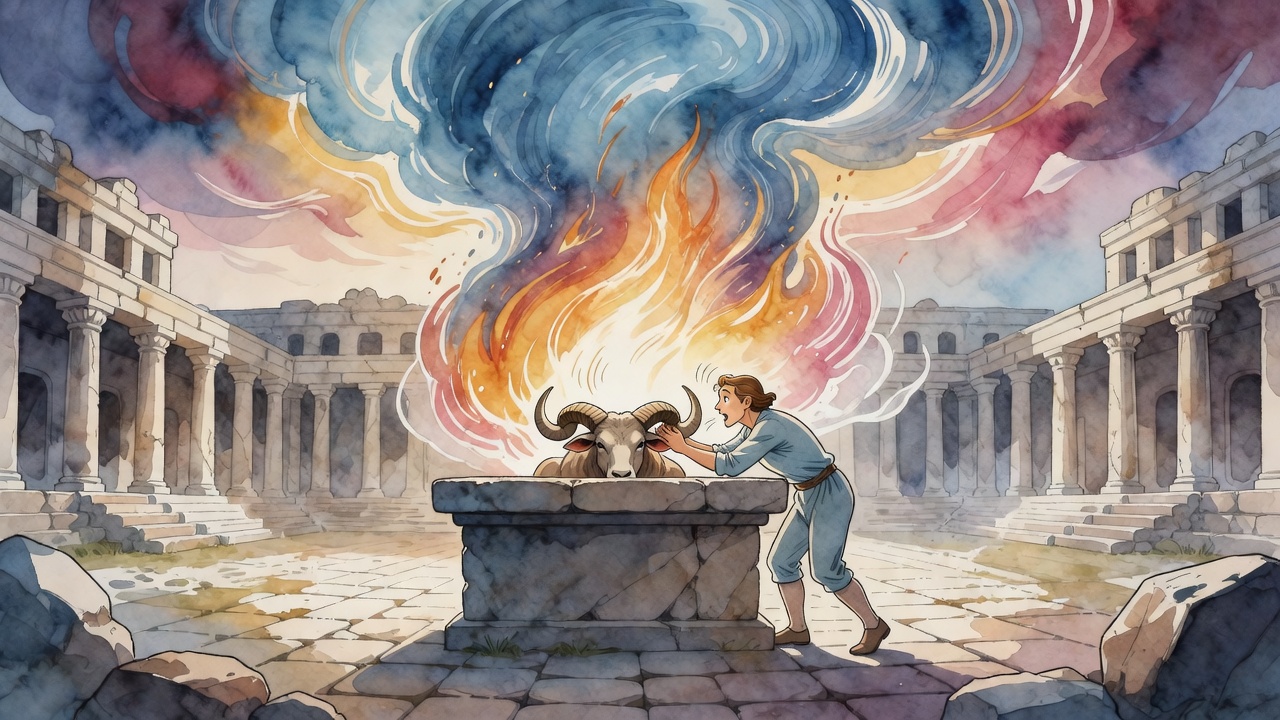
The animal stood in the north of the courtyard, face to the west. The owner stood behind it, facing the same way, and pressed both hands down between the horns. Nothing came between skin and hide. The heat of a living creature rose into his palms.

He Pressed Both Hands Between the Horns and Spoke Click for full size

Then he spoke. Over a sin offering he named the sin. Over a guilt offering, the guilt. Over a burnt offering, Rabbi Yose the Galilean said, the duties left undone toward the poor, the gleanings and forgotten sheaf and corner he failed to leave. Rabbi Akiva heard neglected positive commands and prohibitions a person can still repair by acting.

Hands That Cannot Be Borrowed

The verse says "his hand." Not a slave's hand. Not an agent's. Not even his wife's, though she is counted as his own self. The hands that took the benefit of the wrong must be the hands that lean. Giving cannot be delegated when the gift is a confession wearing an animal's body.

The press is not theater. It is ownership of the story told upward.

The Bird That Comes as a Gift

When a person brought two birds, one as a sin offering and one as a burnt offering, Rava saw a problem. Without repentance no sacrifice helps, for the sacrifice of the wicked is an abomination (Proverbs 15:8). With repentance the sin offering already wins pardon before the person rises from his place. What work remains for the second bird?

Rava answered that the burnt offering is a gift. Not part of the bargain for forgiveness. What a person brings afterward, out of love, once the relationship is mended. Rabbi Shimon cast it as a courtroom. The sin offering enters first like a defense attorney who softens the judge. Only after pardon does the gift walk through the door. You do not present a gift to a king while he is still angry. First reconciliation. Then affection.

Gates That Stay Open for Thanks

"Enter His gates with thanksgiving, and His courts with praise." Rabbi Pinchas in the name of Rabbi Levi taught that other sacrifices may cease, but the sacrifice of thanksgiving will never end. Prayer of thanks and the thanksgiving offering both keep speaking. Jeremiah heard a voice of joy and the sound of those who bring thanksgiving to the Lord's house (Jeremiah 33:11). The reason under the song is simple and endless. The Lord is good. His lovingkindness endures.

After the lean and the naming, the heart that has been let off the hook still has a further motion. Thanks is not the payment for pardon. It is the life that continues once the case is closed.

First Fruits on the Road

A farmer walks toward Jerusalem with baskets of first fruits, bikkurim. Some may bring the fruit who cannot recite the full declaration "which You have given me," because ownership and agency do not fully sit in their hands: a caretaker, a bondsman, a messenger, and others the Sifrei lists. The fruit can still rise. The formula waits for a mouth that can truly say "mine" under God.

Two placings are required. One while speaking. One while bowing. The road ends in a double gesture: words and the body folded.

After the Hands Lift

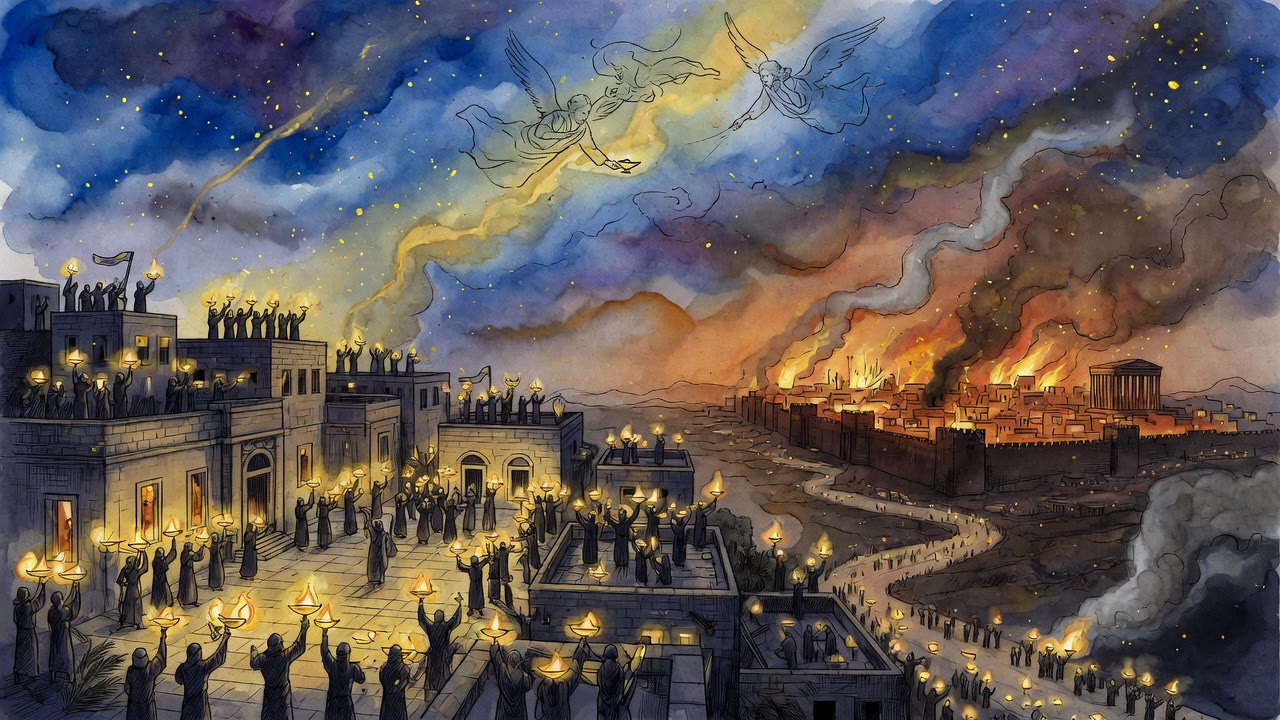
When the owner finally lifts his hands from the horns, the animal still stands a moment in the west-facing light. Confession has left his mouth. A second gift may follow later, free of negotiation. Gates somewhere still take thanksgiving when every other altar grows quiet. A farmer somewhere still learns whether his mouth can claim the fruit he carries.

The Torah's offering system is often read as blood and smoke. Here it is also weight in the palms, a name spoken without a middleman, and the difference between being pardoned and wanting to give.

The north side of the courtyard is not a random stage direction. It places the owner and the animal in a shared direction, west toward the Holy, so the lean is not a sideways bargain. Confession rides the same axis as the gift of the body about to be given.

When Rabbi Yose the Galilean hears the burnt offering as unpaid debts to the poor, the offering system suddenly includes the corner of a field and a sheaf left for gleaners. Akiva's reading keeps the repair of neglected commands in view. Either way the hands press down on more than an animal. They press down on a life that has failed someone smaller.

Rava's gift-bird after the advocate-bird keeps love from being confused with bribery. A king still angry is not ready for presents. A person still unrepentant is not ready for smoke. Order is theology here. First the case. Then the freely given thing.

The farmer on the road with first fruits learns a parallel lesson about speech. Some may carry what they cannot fully claim in the formula. Ownership and agency are not decorations on gratitude. They are the conditions under which certain words become true. Two placings, speaking and bowing, keep the body honest about who is giving and to whom.


← All myths

From the tradition

Sources

4 sources

The texts behind this telling. Some cards carry a translation of the source; others are our own retelling of it, and each card says which. Every card links out to the original.

Yalkut Shimoni on Torah 436:9Yalkut Shimoni on Torah

Translation of the source text.Torat Emet (Yalkut Shimoni) · CC-BY-NC

(Leviticus 1:4) Our Rabbis taught: How does one perform the laying-on of hands? The sacrificial animal stands in the north with its face to the west, and the one laying on hands stands in the east with his face to the west. He places his two hands between the two horns of the animal, provided that nothing interposes between him and the animal. He makes confession: over a sin offering, the iniquity of the sin offering; over a guilt offering, the iniquity of the guilt offering; and over a burnt offering, the iniquity of failing in the gleanings, the forgotten sheaf, the corner of the field, and the tithe of the poor [the unfulfilled positive commands the burnt offering atones for]. These are the words of Rabbi Yose the Galilean. Rabbi Akiva says: a burnt offering comes only for a positive command and for a negative command that has been transformed into a positive one. On what point do they disagree? Rabbi Yirmiyah said: they disagree about the prohibition of eating carrion. One master holds it is a full-fledged negative command, and the other master holds it is not a full-fledged negative command. Abaye said: all agree that the prohibition of carrion is a full-fledged negative command, and here they disagree about the verse "you shall leave them" (Leviticus 19:10). One master holds "you shall leave" implies from the outset, and the other master holds it implies now.

What is the difference between a private altar and a communal altar? The laying-on of hands, slaughter in the north, the placing of blood all around, the waving, and the bringing near. Rabbi Yehudah says: there is no meal offering on a private altar; also priestly service, the garments of ministry, the vessels of ministry, the pleasing aroma, a partition for the blood, and the washing of hands and feet. But the matters of time, leftover sacrifice, and impurity are equal in both. Laying-on of hands, as it is written "before the LORD" and "he shall lay his hand"; slaughter in the north, as it is written "on the side of the altar northward" (Leviticus 1:11); blood all around, as it is written "and the sons of Aaron the priests shall dash" and so on; waving, as it is written "and he shall wave"; bringing near, as it is written "and he shall bring it near to the altar" (Leviticus 2:8). Rav Sheshet said: according to the one who holds there is a meal offering on a private altar, there are bird offerings on a private altar; according to the one who holds there is no meal offering on a private altar, there are no bird offerings on a private altar. What is the reason? "And they sacrificed peace sacrifices" (slaughtered animals) and not birds, slaughtered animals and not meal offerings. Priestly service, as it is written "and the priest shall dash" (Leviticus 17:6); garments of ministry, as it is written "seven days shall the priest wear them" (Exodus 29:30); vessels of ministry, as it is written "and they shall take all the vessels of ministry"; the pleasing aroma, as it is written "a pleasing aroma to the LORD"; a partition for the blood, as it is written "and the net shall reach to the middle of the altar" (Exodus 27:5); and that one need not have washed hands and feet, as it is written "when they come into the Tent of Meeting they shall wash with water" (Exodus 30:20).

"And he shall lay his hand" his hand and not the hand of his slave, his hand and not the hand of his agent, his hand and not the hand of his wife. Why do I need all of these? They are all necessary. For had the Merciful One written only one, I would have said: this is to exclude a slave, who is not obligated in the commandments, but an agent, who is obligated in the commandments, and a man's wife, who is like himself, let me say he may lay on hands through them. And if it had taught us these two, who are not regarded as his own body, but his wife, who is regarded as his own body, let me say he may lay on hands through her therefore all are necessary.

Full source
Yalkut Shimoni on Torah 474:6Yalkut Shimoni on Torah

Translation of the source text.Torat Emet (Yalkut Shimoni) · CC-BY-NC

"And the second he shall offer as a burnt-offering according to the ordinance" (Leviticus 5:10). Rava said: the burnt-offering is a gift. How so? If there is no repentance, then "the sacrifice of the wicked is an abomination to the LORD" (Proverbs 15:8); and if there is repentance, [why is the burnt-offering needed]? For we have learned: if one transgressed a positive commandment and repented, he does not move from there until he is forgiven. Rather, learn from this that it is a gift. And it was likewise taught: Rabbi Shimon said: Why does the sin-offering come before the burnt-offering? It is like a defense attorney who enters to appease; once the attorney has appeased, the gift enters after him.

Full source
Midrash Tehillim 100:3Midrash Tehillim

Retold in our words. Read the original at the link below.Rabbi Mike Feuer, Jerusalem Anthology · CC-BY

" It's a way of connecting with something bigger than ourselves.

Midrash Tehillim, a beautiful collection of interpretations on the Book of Psalms, dives deep into this very idea, particularly in its exploration of Psalm 100. It all starts with that powerful verse: "Enter His gates with thanksgiving, and His courts with praise." What does it really mean to enter with thanksgiving?

Rabbi Pinchas, quoting Rabbi Levi, offers a stunning insight. He says that while other sacrifices might eventually cease, the "sacrifice of thanksgiving" will never end. Did you catch that? A sacrifice of thanksgiving. It’s not about giving up something physical, but about offering our sincere gratitude. Rabbi Pinchas hangs this idea on (Psalm 56:13), "I will render thanksgiving offerings to You." Note the plural "offerings" – hinting at both prayer and sacrifice as expressions of thanks. for a second. What other rituals have this kind of staying power?

The Midrash (rabbinic interpretive commentary) goes on, drawing a line from (Jeremiah 33:11): "A voice of joy and a voice of gladness… the voice of those who bring thanksgiving to the Lord’s house." This verse paints a vibrant picture of joyful voices offering thanks. It highlights two forms of thanksgiving. First, "behold, the prayer of thanksgiving." And second, "And bring thanksgiving to the house of the Lord," which is the actual sacrifice of thanksgiving.

So, prayer and physical offering, both expressions of the same feeling.

The Midrash then points to the phrase, "Give thanks to Him, bless His name," again highlighting the prayer of thanksgiving. It all culminates in a powerful statement: "For the Lord is good, His lovingkindness endures forever." This isn’t just a nice sentiment; it's the reason for the thanksgiving! The goodness of GOD, the enduring nature of His chesed (lovingkindness), these are the wellsprings from which our gratitude flows.

The Midrash Tehillim is showing us that gratitude isn’t just a feeling, it's an action. It's a continual offering, a sacrifice we make with our hearts and our voices. And, maybe, just maybe, the more we offer that gratitude, the more we open ourselves to receiving even more.

What would it look like to make gratitude your constant companion? A perpetual offering?

Full source
Sifrei Devarim 301:33Sifrei Devarim

Retold in our words. Read the original at the link below.Sifrei by Rabbi Shraga Silverstein · CC-BY

It involves bikkurim (בִּכּוּרִים), the first fruits offering.

You're a farmer in ancient Israel. You've poured your heart and soul into your land, and finally, the first fruits of your harvest are ready. It's a moment of immense gratitude, a tangible connection to the Divine. You'd bring these first fruits to the Temple in Jerusalem as an offering. A beautiful expression of thanks. But, and there's always a "but" in these intricate matters, who exactly was obligated to bring these offerings and, perhaps more importantly, who could recite the accompanying declaration of gratitude?

Sifrei Devarim illuminates this. It states, concerning the verse "which you have given me, O L-rd," that certain individuals could bring the bikkurim, but couldn't recite the formula. Why? Because the phrase "which You have given me" didn't fully apply to their circumstances. According to this ruling, a caretaker, a bondsman (or indentured servant), a messenger, a woman, a tumtum (טֻומְטוּם), – someone whose sex is undetermined – and a hermaphrodite could all bring the bikkurim. But, they couldn't recite the full declaration. Why this distinction?

Well, the commentators believed that the act of reciting the declaration involved a personal claim of ownership and agency. In the cases of a caretaker, a bondsman, or a messenger, their relationship to the land and its produce wasn't one of full ownership. They were acting on behalf of someone else. And regarding women, the commentary reflects a social structure where women's property rights differed significantly. The tumtum and hermaphrodite present different, complex halakhic (Jewish legal) considerations as well, relating to the understanding of self and obligation.

It's not about diminishing their gratitude or piety. It's about the precise legal and social implications embedded within the act of declaration. It’s a reflection of the societal norms and legal structures of the time.

And there’s more! The text goes on to discuss the act of "placing" the bikkurim before G-d. It emphasizes, "Then you shall place it before the L-rd your G-d and you shall bow down before the L-rd your G-d." The repetition of "placing" teaches us that two "placings" are necessary. One, while reciting the formula, and one, while bowing. It wasn't enough to simply set the offering down. There had to be a deliberate act of presentation during the declaration, followed by a physical act of reverence – bowing.

It really makes you think about the layers of meaning behind our actions, even today. What does it mean to truly own something? What does gratitude look like in practice? What does it mean to present ourselves, humbly, before something greater than ourselves?

These are questions worth pondering, long after the first fruits have been harvested.

Full source