6 min read

Heaven Sends a Knife for the Camp Whisperers

The bread came down every morning, so the camp went looking for something else to be angry about. They made sure their voices carried upward.

Curated by Arthur · Told by Maggid ·
Table of Contents
  1. They Were Not Hungry, They Were Hunting
  2. The Man Who Wanted the King to Hear
  3. A Knife With No Hand On It
  4. The Fire Chose the Officers First
  5. The Ruler Who Came In With Prisoners Behind Him
  6. The Last Dish of the Meal
Heaven Sends a Knife for the Camp Whisperers Click for full size

They Were Not Hungry, They Were Hunting

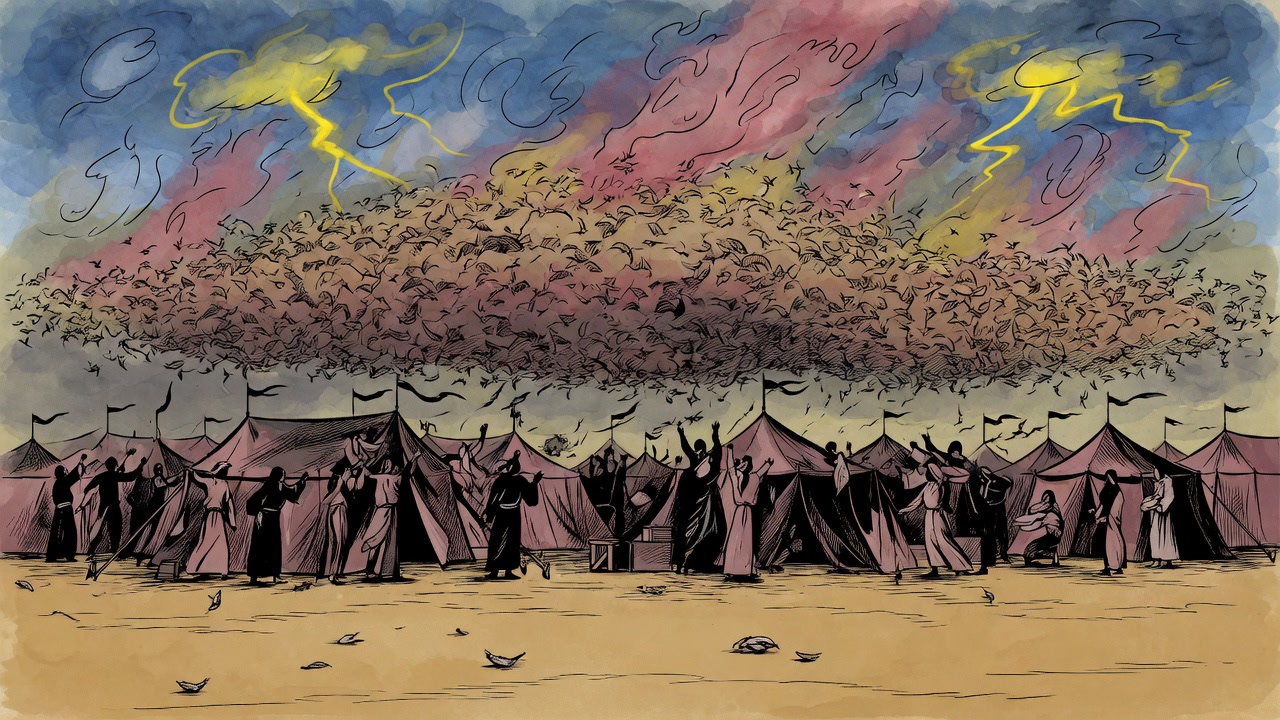
The complaining started before there was anything to complain about. That is the part the sages would not let go of. The camp was fed. Bread came down every morning and lay on the ground under the dew, and the people gathered it and ate it, and then they went looking for something to say.

They were not tired of the food. They were hunting for a doorway.

Israel's king Joram once did the same thing, years later and hundreds of miles north. A letter came asking him to cure a foreign general of leprosy, and Joram tore his clothes down the front and shouted that the man was picking a fight with him. He had wanted a fight for a while. The letter only gave him somewhere to put it. Samson went down to Timnah looking for a woman and looking for a reason, and the tradition says plainly that he was after a pretext against the Philistines, and he found one.

That was the sound in the tents at Taberah. Not hunger. Reconnaissance.

The Man Who Wanted the King to Hear

A man once stood at the roadside cursing the king, and the king was walking past.

His neighbor grabbed his sleeve. "Quiet. He will hear you."

The man pulled his arm free. "Who told you I do not want him to hear?"

Scripture does not say the people complained. It says they complained in the ears of the Lord. They were not muttering into their collars, hoping to get away with it. They pitched their voices to carry. The whole point was that the complaint should arrive.

Smoke from the cookfires hung between the tents. Somebody said Egypt had at least been clear about its terms. Somebody laughed too loudly at a rope's length away. The word for what they were doing sits close to the word for a blow struck with a fist, and Proverbs says that the words of a whisperer go down into the chambers of the belly. The camp had turned itself into a field of whisperers.

A Knife With No Hand On It

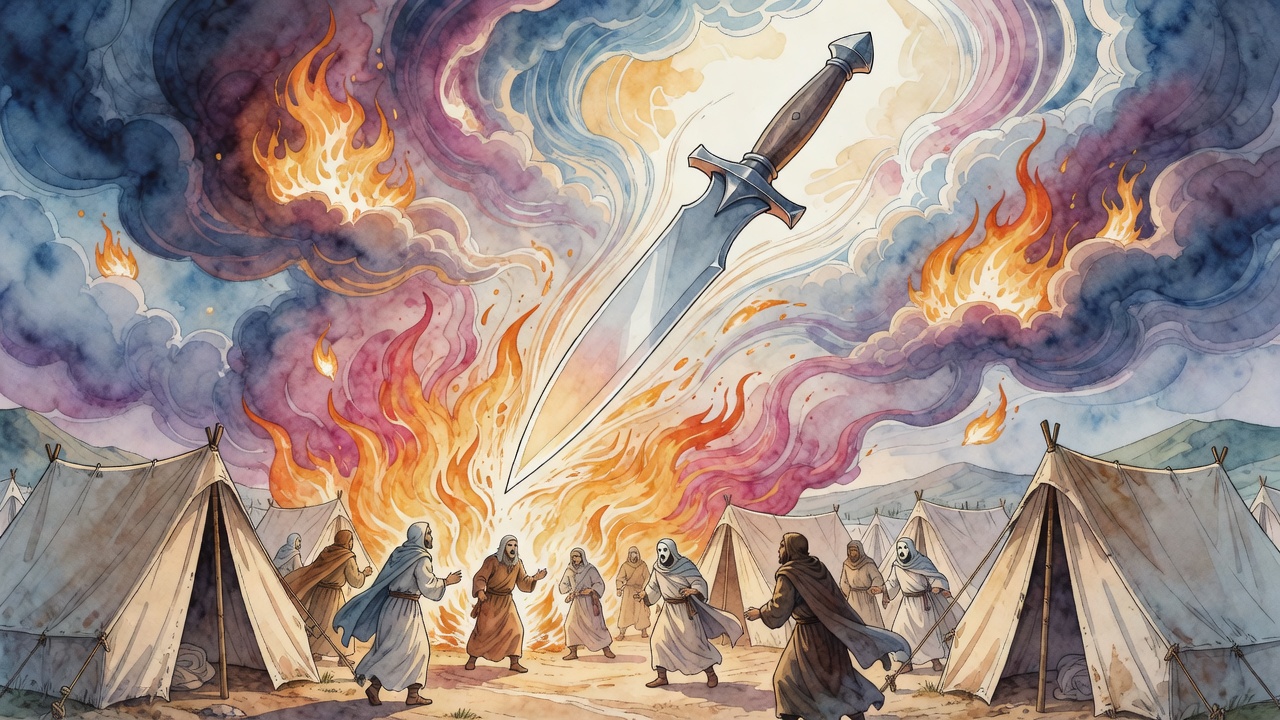
So heaven sends a knife, and it came down and opened them from the inside.

No arm swung it. Nobody saw it fall. Men who had been standing upright a moment earlier folded over their own middles and could not straighten, and the ones beside them stepped back and kept stepping back. The words had gone down into the chambers of the belly exactly as the verse said they would, and the belly had answered.

Egypt's knives had been iron and a smith had made them. This one needed no forge and left no wound anyone could dress.

The Fire Chose the Officers First

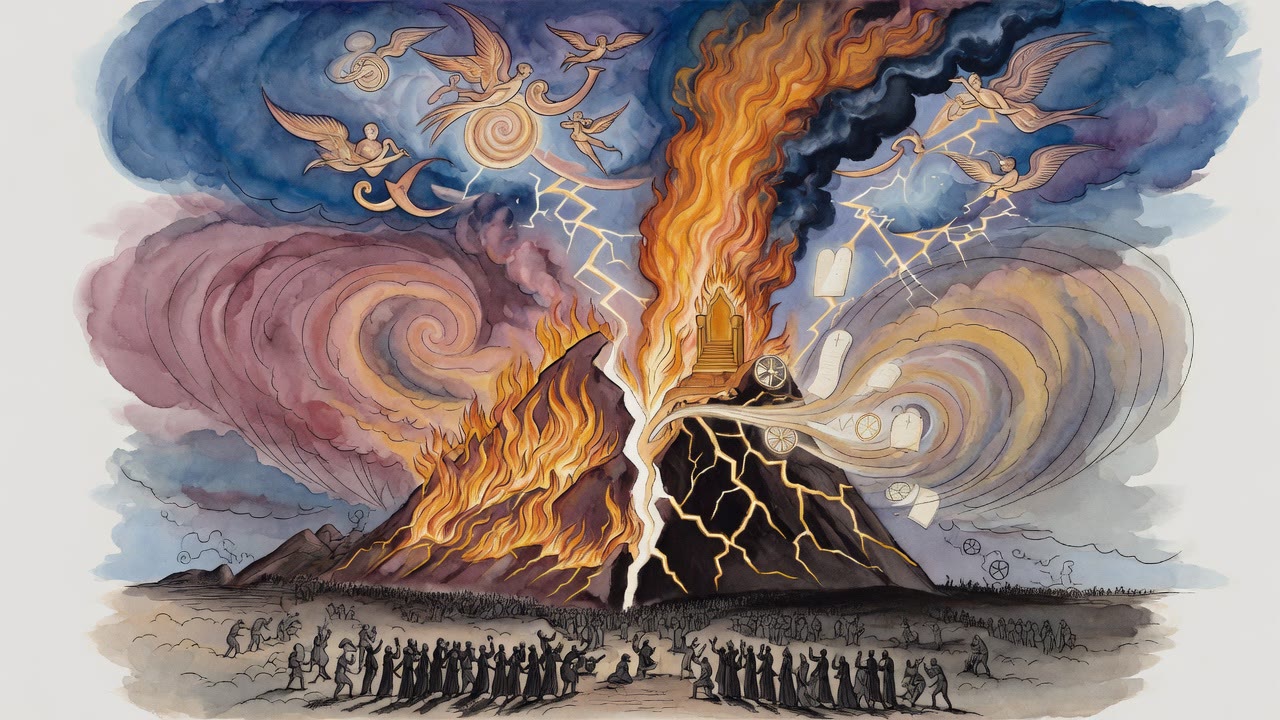
Then the fire.

It came down hard enough that afterward nobody could sort the living from the dead by looking. Men lay in the same postures whether they were breathing or not, and Moses walked through it trying to count.

The fire began at the edge of the camp. Some said that meant the strangers who had come up out of Egypt with Israel, who pitched at the rim because there was nowhere else for them. Others said it meant the officers, the great men, the ones a people makes head and chief over them. Those were the tents at the outer line, where rank is visible from a distance, and those were the tents that burned first.

A title did not slow the fire down. It told the fire where to start.

The Ruler Who Came In With Prisoners Behind Him

A ruler entered a province once with a long line of captured bandits walking behind him in chains.

Two men watched from the roadside. One of them shivered. "That is a terrible man," he said.

The other one shrugged. "You have kept faith with him. You have nothing to be afraid of."

Israel sat through the reading of the offerings and heard how many sins have a sacrifice attached, including the ones a person commits without ever knowing he did it, and the camp went quiet in a different way than it had at Taberah. This time the fear was honest. A man could ruin himself by accident before breakfast.

Moses did not tell them to stiffen their spines. He pointed them at the scroll. This is the law of the burnt offering, of the meal offering, of the sin offering, of the guilt offering, of the ordination offering, and of the peace offering. Learn the road and the chains in the street stop looking like your future.

The Last Dish of the Meal

The peace offering comes last in that list, the way the fruit and nuts come last at a meal, because it has more parts than anything before it. Blood and fats to the altar. Breast and thigh to the priest. Hide and flesh back to the man who brought it. Everyone at the table gets something.

Only a person who is whole may bring it. A man whose relative died that morning and is not yet in the ground cannot. He is standing there with the animal and he is turned away, because grief has taken pieces out of him and there is nothing whole to offer, and pretending otherwise would be its own kind of lie.

Which is the exact thing the camp at Taberah had been doing. They had not lost anyone. They were performing a sorrow they did not have, out loud, at the top of the road, so the King would be sure to hear it. He heard it.


← All myths
From the tradition

Sources

2 sources

The texts behind this telling. Some cards carry a translation of the source; others are our own retelling of it, and each card says which. Every card links out to the original.

Sifrei Bamidbar 85:1Sifrei Bamidbar

Retold in our words. Read the original at the link below.Sifrei by Rabbi Shraga Silverstein · CC-BY

The Torah, in the book of Bamidbar (Numbers), uses a fascinating turn of phrase to describe exactly that kind of spiritual relapse. It says, "And the people were ['vayehi'] as seekers of a pretext" (Numbers 11:1).

Vayehi, that seemingly simple word, "and it was," actually "connotes a return to a previous condition," according to Sifrei Bamidbar. It suggests they were already inclined toward negativity, and this was just a slide back into their old ways. But who were these people? The text doesn’t leave us hanging.

Sifrei Bamidbar tells us that when the Torah says "the people," it often means "the wicked ones." It's like in (Exodus 17:4), when Moses cries out, "What can I do to this people?" or in (Numbers 14:11), "How long will this people provoke Me?" These aren't exactly terms of endearment! But when God calls them "My people," ah, that's a different story. That's when

So, these "people" in Bamidbar 11:1 weren't just complaining; they were actively looking for an excuse to abandon God. The text uses the word "kemithonenim," which it connects to "grumblers," those seeking a pretext to abandon the Lord. Think of it like King Ahab's son, Joram, or even Samson, both of whom were accused of seeking pretexts against others (II (Kings 5:7), Judges 14:4).

But what were they grumbling about? Rabbi Eliezer offers a rather graphic interpretation. He says "kemithonenim" actually connotes "blows," like in (Proverbs 26:22), "The words of a whisperer are as wounds." The text paints a vivid picture: they were like strikers of blows, and a "knife" descended from heaven and split their innards! Ouch! Proverbs (26:22) says it descends "to the recesses of the stomach." A harsh punishment,.

Rabbi Yehudah offers a slightly different take. He suggests "kemithonenim" refers to those who afflict themselves, like in (Deuteronomy 26:14), "I have not eaten thereof in my mourning (be'oni)."

And then Rebbi adds another layer, connecting their "evil" (ra) to idolatry, drawing a parallel to (Deuteronomy 31:29), "For you will do evil in the eyes of the Lord."

But here's where it gets really intense. The text says this happened "in the ears of the Lord." Sifrei Bamidbar emphasizes that the Israelites deliberately wanted God to hear their complaints. Rabbi Shimon offers a powerful analogy: imagine someone cursing the king as the king walks by. When warned to be quiet, the person retorts, "Who told you I don't want him to hear?!" That's the level of defiance we're talking about.

So, God heard, and "His wrath burned in them." Fire descended from heaven, striking them so fiercely that they couldn't distinguish between the living and the dead. But who was hit first? "It devoured 'biktzei' of the camp."

Some say this refers to the proselytes, who were considered muktzim ("cast off") at the edge (katzeh) of the camp. But Rabbi Shimon ben Menassia offers yet another interpretation: biktzei refers to the ketzinim – their officers, their great men, like in (Judges 11:11), "And the people made him head and chief (katzin) over them." The leaders, the ones who should have been setting an example, were the first to fall.

What does all this mean for us today? Perhaps it's a reminder to be mindful of our own complaining. Are we truly seeking solutions, or are we, like those Israelites, simply looking for an excuse to give up? Are we deliberately directing our negativity "in the ears of the Lord," pushing boundaries and testing limits? And are we, like the leaders of the camp, setting a good example for those around us?

Full source
Vayikra Rabbah 9:8Vayikra Rabbah

Retold in our words. Read the original at the link below.The Sefaria Midrash Rabbah, 2022 · CC-BY

The ancient Israelites certainly did. And sometimes, even the best of us can feel that way. It’d be pretty intimidating! One person whispers, "Wow, that ruler is scary!" But another replies, "If you're loyal, you've got nothing to worry about." That little story, that's how Rabbi Aḥa opens up our exploration of Vayikra Rabbah 9. It perfectly sets the scene.

Vayikra Rabbah, by the way, is a Midrash, a collection of rabbinic teachings, on the Book of Leviticus. And Leviticus? Well, it’s full of details about sacrifices and offerings!

So, picture the Israelites hearing all about these offerings, all these ways to atone for sins… especially the unintentional ones. It must have been terrifying! “Oh no,” they might have thought, “I didn't even know I was doing something wrong!”

Moses, ever the reassuring leader, tells them not to fear. His advice? Engage in Torah study. Dive into the wisdom, the teachings, and you'll find you have nothing to fear from these offerings. As it says in (Leviticus 7:37), "This is the Torah for the burnt offering, for the meal offering, for the sin offering, for the guilt offering, for the investiture offering, and for the peace offering." It’s all right there.

And why is the peace offering, the shelamim, mentioned last in that list?

Rabbi Simon has a wonderful analogy. Think of a delicious dish of mixed fruits and nuts served at the end of a meal. Why last? Because it's got so many different elements, so many flavors all coming together.

The peace offering is similar. It involves so many different parties and components. Blood and fats go to the altar, the breast and thigh to the priest, and the hide and flesh back to the owners. Everyone gets a piece!

Rabbi Shimon takes this idea even further. He says that someone who is shalem, complete or whole, brings a peace offering. But someone in acute mourning – someone whose relative died that very day and hasn’t yet been buried – does not bring a peace offering.

Why? Because they're not shalem, not whole in that moment. They’re understandably consumed by grief. It’s a time for mourning, for processing loss, not for offering sacrifices of peace.

So, what does it all mean? Maybe it's a reminder that engaging with our traditions, studying the Torah, isn’t about fear or guilt. It’s about striving for wholeness, for shalem. It’s about finding our place in the community, and understanding our role in the world. And maybe, just maybe, finding a little peace along the way.

Full source