5 min read

Hezekiah Lost Redemption by Keeping Silent

Hezekiah watched Sennacherib fall without a battle, but no song came from his mouth. The rabbis made that silence cost him redemption.

Curated by Arthur · Told by Maggid ·
Table of Contents
  1. The Army Fell Without a Battle
  2. The King Trusted His Torah
  3. Moses Sang When Silence Was Older
  4. The Window Closed Without a Song

By morning, the army was dead.

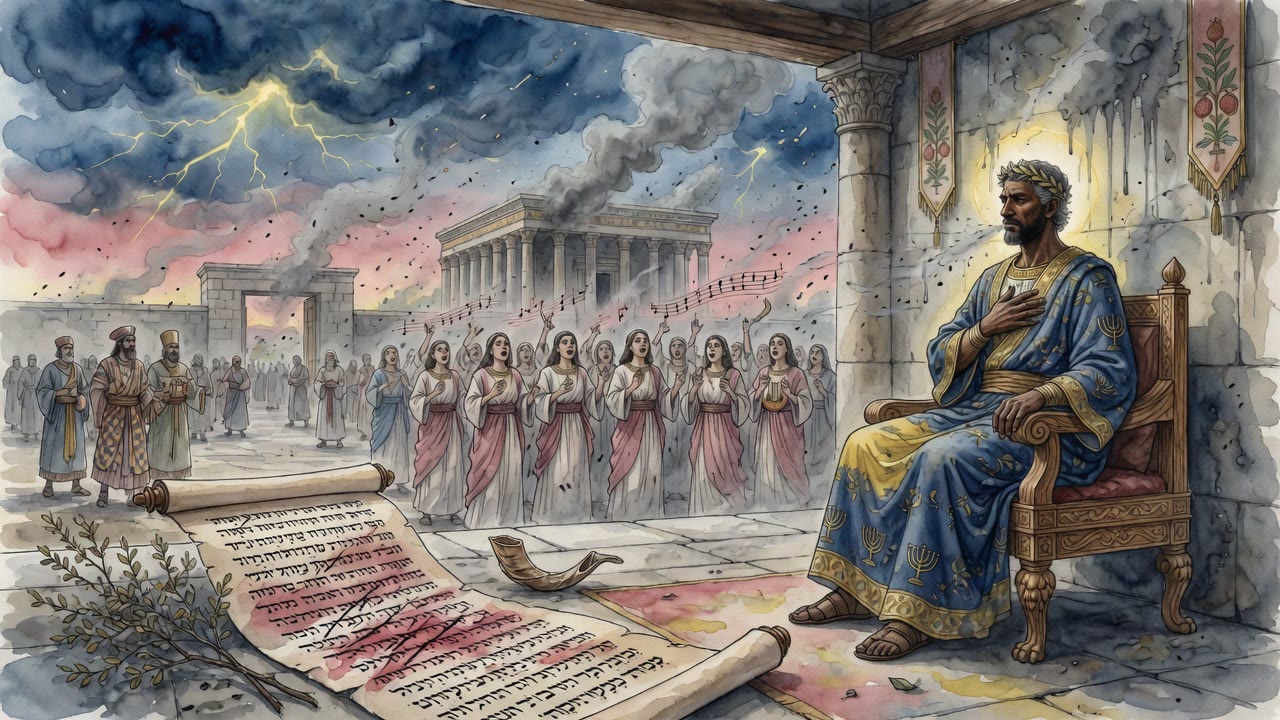
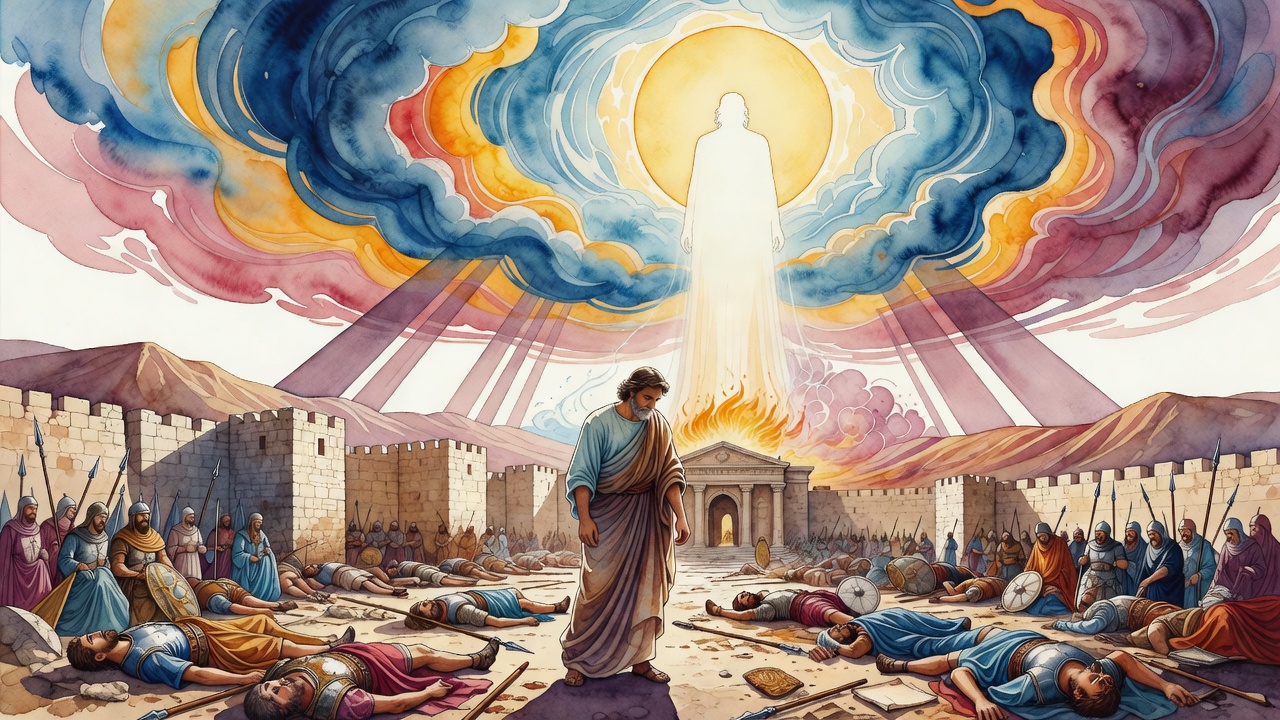
Sennacherib had come against Jerusalem with the weight of empire behind him. Assyria had swallowed kingdoms, broken cities, and taught the world to fear its wheels. Hezekiah did not meet that force in open battle. The city waited. Night covered the Assyrian camp. Then an angel moved through it, and 185,000 soldiers did not rise with the sun.

The miracle had a sound waiting for it. Hezekiah kept silent.

The Army Fell Without a Battle

A victory won by soldiers can be claimed by soldiers. This one could not. No Judean sword made the field quiet. No general of Jerusalem planned the death that came in the night. The deliverance was so clean that it should have forced a song out of the king. A whole empire had been lifted away from the throat of the city.

Shir HaShirim Rabbah imagines the moment as larger than one siege. If Hezekiah had sung, the redemption of history might have arrived. Hezekiah could have become the messianic king, and Sennacherib could have stood in the place of the final enemy. The world had drawn near to an ending, not through battle, but through praise that never came.

The King Trusted His Torah

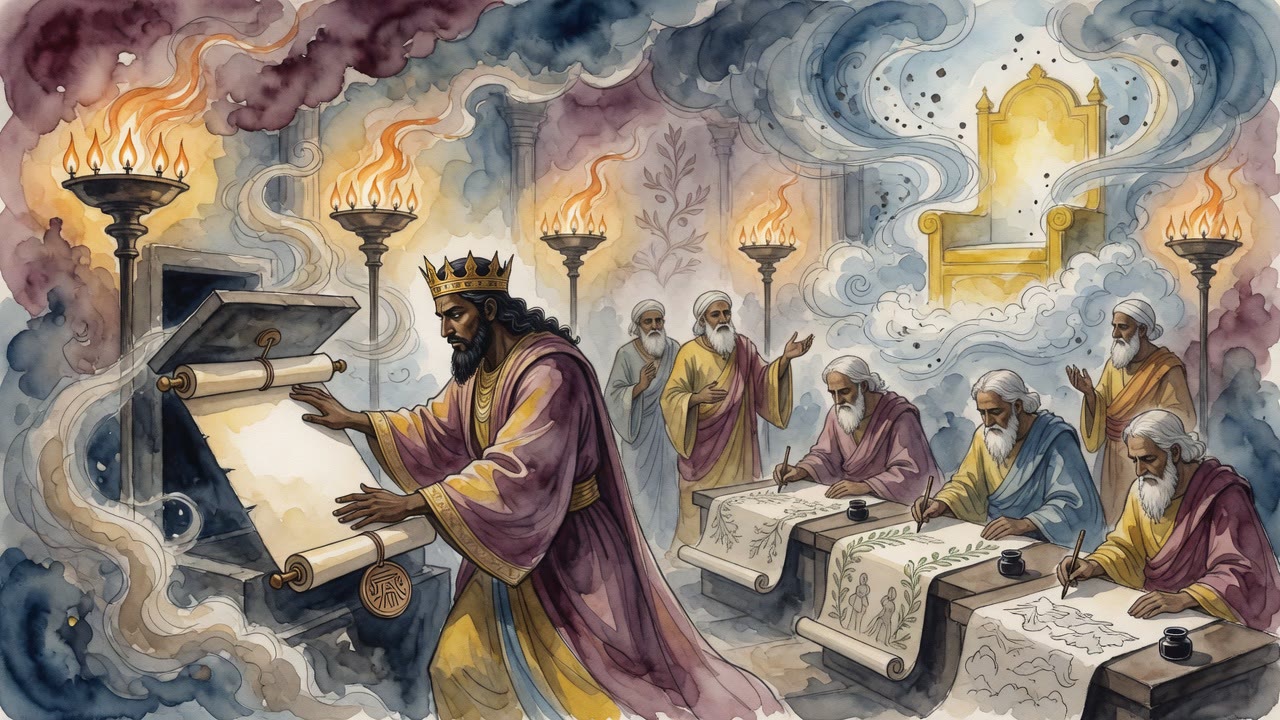
Hezekiah was not a careless king. His father Ahaz had shut the doors of learning, darkened the schools, and left Torah study gasping. Hezekiah reopened them. He demanded study with a severity that sounds almost impossible, and the lamps burned day and night. Children knew laws of purity. Scholars returned to the gates. A country wounded by neglect began to breathe through Torah again.

That success became dangerous. Rabbi Abba bar Kahana gives Hezekiah's defense: the Torah he had spread was enough. The learning of Israel could stand where song should have stood. He had filled the land with study. Must the king also open his mouth in praise?

Heaven's answer was silent and devastating. Torah was not the wrong offering. It was not this offering.

Moses Sang When Silence Was Older

Shemot Rabbah makes the silence sharper by looking backward to the sea. From creation until the Red Sea, the midrash says, no one had sung properly before God. Adam did not sing. Abraham did not sing after the furnace. Isaac did not sing after the knife. Jacob did not sing after the angel or after Esau. The world waited for a human voice to learn what miracle required.

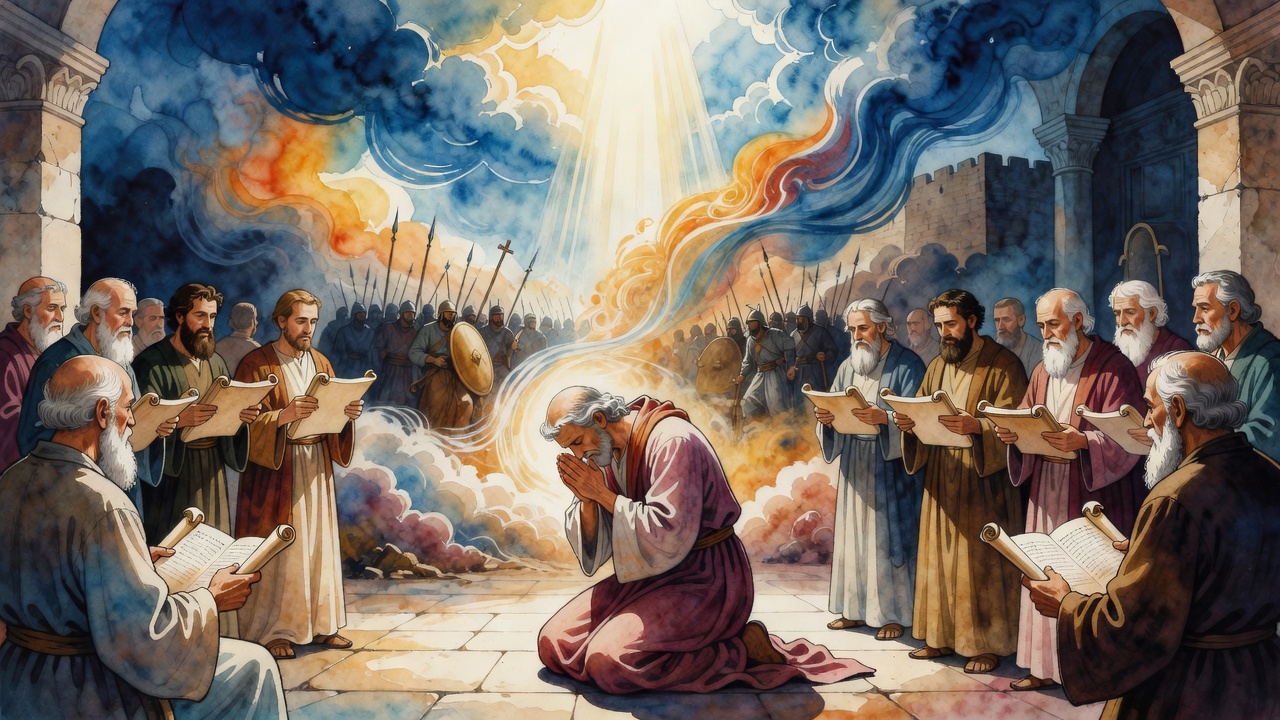
Then Moses and Israel stood with Egypt behind them and the sea broken open before them, and song finally entered history. The mouth answered what the eyes had seen. Praise became not decoration after rescue, but the act that completed rescue.

Hezekiah had that precedent. He knew what a saved people owed the morning.

The Window Closed Without a Song

There are moments when history waits for a single human response. Hezekiah had rebuilt Torah, guarded Jerusalem, and survived the empire no one thought could be stopped. But when the camp of Assyria lay still outside the walls, the king did not become Moses at the sea.

The tragedy is not that Hezekiah lacked merit. It is that merit could not replace voice. A lamp in the study hall does not become a song in the throat. A generation of learning does not sing by itself. Someone has to stand before the impossible morning and say what happened.

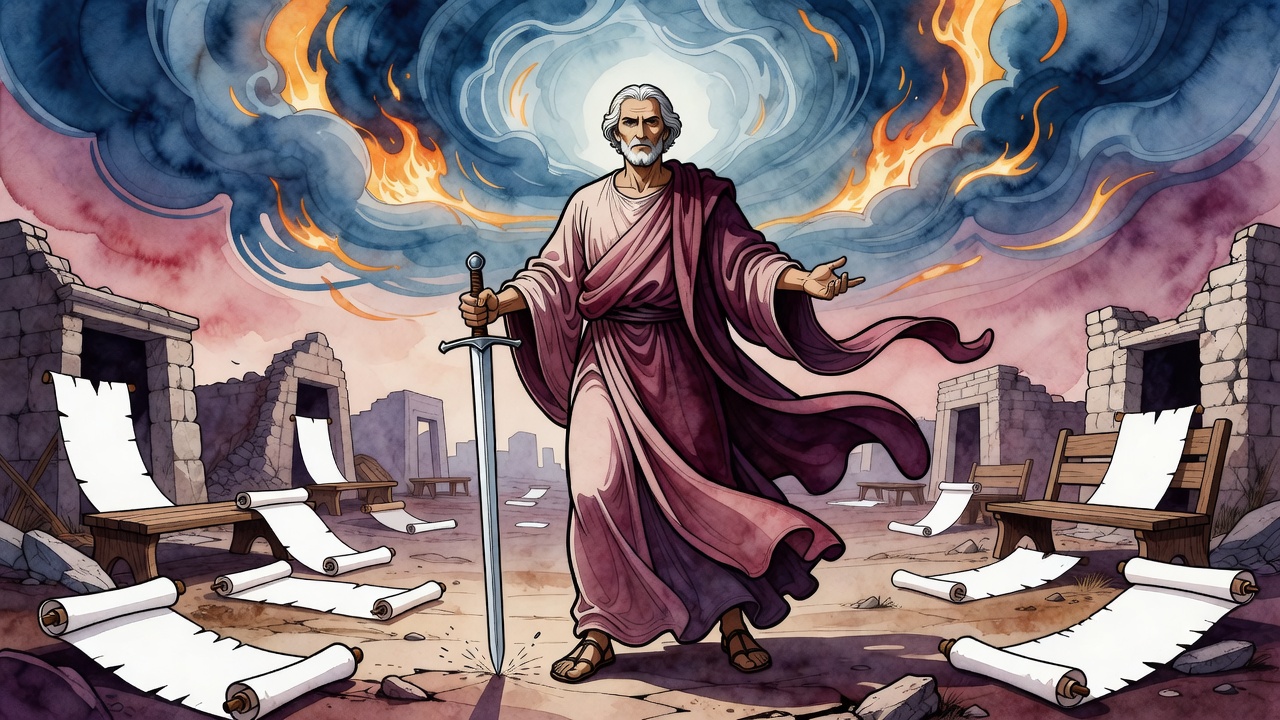
Jerusalem was saved. That alone was mercy. But the greater gate closed. The king who might have carried redemption across the threshold left the threshold unspoken, and the world went on unrepaired, waiting for another song.

By keeping silent, Hezekiah lost the redemption that had come close enough to touch. The people still lived. The city still stood. The Assyrian threat still broke. But the miracle did not become the final song of history, because the saved king let the morning pass without giving it a voice.

He had repaired study, but deliverance asked for an answer of its own. A nation can know Torah and still need to sing when death has passed over its walls. The unsung morning stayed in the record as a warning: even a righteous king can miss the hour that his own righteousness helped bring near.


← All myths

From the tradition

Sources

4 sources

The texts this telling draws on, in full. Open a card to read inline, or expand it for a wider, quieter read.

Shir HaShirim Rabbah 8:3Shir HaShirim Rabbah

It's a story about perspective, gratitude, and maybe even a missed opportunity to usher in... the Messiah!

The passage begins with a verse from Song of Songs, "Look from the peak of Amana" (Song of Songs 4:8). The rabbis, in their beautiful way, see this verse as alluding to the patriarchs. "The peak of Amana" is Abraham, the man who "believed in the Lord" (Genesis 15:6). "From the peak of Senir" is Isaac. And here's a clever bit: just as Senir is hostile to plowing (soneh nir), Isaac only faced one major ordeal in his life – the Binding of Isaac. "And Ḥermon" is Jacob. The text emphasizes that all the good – priesthood, the Levites, the kingship – comes from Jacob. He was the culmination of the patriarchs.

Then the verse shifts to "the dens of lions" – Siḥon and Og, those mighty, haughty kings. Shir HaShirim Rabbah tells us they were so arrogant, they didn't even bother to help each other, despite being only a day's walk apart! And "the mountains of leopards" are the Canaanites, as brazen and shameless as leopards. The text even references (Joshua 8:17), noting how the men of Ai all came out after Israel, showing their audacity.

Here's where the story takes an interesting turn. Rabbi Berekhya, quoting Rabbi Elazar, says it would have been fitting for Israel to sing a song of victory after defeating Siḥon and Og. And similarly, Hezekiah should have sung a song after the downfall of Sennacherib. But, as we read in II (Chronicles 32:25), Hezekiah "did not reciprocate according to the reward bestowed upon him."

Why not? Because "his heart had grown haughty." Now, wait a minute! Hezekiah, a righteous king, haughty? The text clarifies: Hezekiah was too proud to sing a song! He thought his Torah study was enough.

Rabbi Abba bar Kahana explains that Hezekiah believed his Torah study atoned for the lack of song. Rabbi Levi adds that Hezekiah felt recounting God's miracles was unnecessary because they were already known throughout the world – after all, hadn't the sun stood still (II (Kings 20:1)1), displaying God's power to everyone?

Rabbi Yishmael ben Rabbi Yosei, citing Rabbi Abba, even brings in Pharaoh of Egypt and Tirhaka of Kush! They were involved in the miracle of the sun standing still and came to aid Hezekiah. Sennacherib sensed their presence and bound them, but an angel struck Sennacherib’s troops. In the morning, Hezekiah found the kings bound, released them, and they went on to spread the news of God's miracles. (Isaiah 45:14) is then interpreted as referring to these events, with Egypt and Kush ultimately acknowledging God's greatness.

Isaiah, witnessing all this, cries out, "Indeed [akhen] You are God who conceals Himself" (Isaiah 45:15). The text plays on the word akhen, asking, "Where [ekhan] are You hiding, God?" It's a powerful moment of recognizing God's hidden hand even in the midst of miraculous events.

But here's the kicker. Rabbi Yehoshua ben Levi says that if Hezekiah had sung a song after Sennacherib's defeat, he would have become the Messianic king, and Sennacherib would have been the equivalent of Gog and Magog! But he didn't. Instead, he recited (Psalms 20:7)–8, acknowledging God's power and anticipating a future king, "His anointed one [meshiḥo]," implying that he himself wouldn't be the Messiah.

Wow. So, what's the takeaway? Is it about the importance of singing praises? Is it about recognizing God's miracles, even when they seem obvious? Maybe it's about not letting our accomplishments, even righteous ones, blind us to the need for gratitude and humility. Perhaps Hezekiah’s story is a reminder that sometimes, the greatest acts of service are not enough if they are not accompanied by a song of the heart. And perhaps, just perhaps, sometimes singing the right song at the right time can change the course of history.

Full source
Legends of the Jews 9:25Legends of the Jews

The story of King Hezekiah gives us a glimpse.

His father, Ahaz, hadn't exactly been a champion of Jewish learning. In fact, according to the legends, he actively suppressed it! Can you imagine? Academies closed, the study of Torah forbidden… It paints a pretty bleak picture.

Then came Hezekiah.

The Legends of the Jews tells us that Hezekiah made it his mission to undo the damage. Where Ahaz had forbidden study, Hezekiah issued a decree that was, shall we say, rather strongly worded: "Who does not occupy himself with the Torah, renders himself subject to the death penalty." (Ginzberg).

Now, that might sound a bit harsh to our modern ears, but remember the context. He was trying to jolt the people awake, to reignite their passion for learning. And it worked. The academies that had been shuttered were reopened, burning bright day and night. And Hezekiah himself? He made sure the oil lamps stayed lit, quite literally fueling the intellectual revival.

The result? A transformation. Ginzberg continues, describing a generation so well-versed in Torah that you could search the entire land, "from Dan even to Beer-sheba," and not find a single ignoramus (Ginzberg). Imagine that! Everyone, even the women and children, knew the laws of tahor and tamei, clean and unclean (Ginzberg). That’s profound.

And how did God respond to Hezekiah's dedication? According to the tales, he was rewarded with a resounding victory over Sennacherib.

So, what's the takeaway? Perhaps it’s about the power of leadership, the importance of education, or the rewards that come with piety. Or maybe it's about the enduring strength of a people when they commit to learning and understanding their traditions. Whatever it is, Hezekiah's story is a powerful reminder of the impact one person can have on the course of history.

Full source
Shemot Rabbah 23:4Shemot Rabbah

It all starts with the verse, "Then Moses…sang" (Exodus 15:1). The Rabbis connect this to (Proverbs 31:26), "She opens her mouth with wisdom, and the teaching of kindness is on her tongue." But the real kicker? From the moment God created the world, until that very moment at the Red Sea, no one sang a song to God! for a second. Adam, the first human? Silent. Abraham, rescued from the fiery furnace? No song. Isaac, spared from sacrifice? Nope. Jacob, delivered from the angel and Esau? Still nothing. According to this Midrash, all these monumental events passed without a song of gratitude bursting forth. Why?

The Midrash implies that there was something unique about the moment at the Sea. Something that finally unlocked the human capacity for true, unbridled praise. What was it?

Shemot Rabbah continues, noting that God was waiting for these people, the Israelites, to sing. The text then explores the meaning of the Hebrew word az (אָז), which appears in the verse, "Then Moses and the children of Israel sang." Az, As it says in (Psalms 126:2), "Then [az] our mouth will be filled with laughter."

Rabbi Yehuda ben Pazi takes it a step further. He asks, what did Israel see that made them sing with az?

Their answer is powerful: "Initially, this sea was dry land." The generation of Enosh, they explain, angered God with az, as in, "Then [az] they began profaning the name of the Lord" (Genesis 4:26). Because of their actions, God turned the dry land into a sea, enacting retribution. As (Amos 5:8) and 9:6 state, "Who calls the waters of the sea and pours them on the face of the earth."

Now, think about that for a moment. The very sea that was a punishment for earlier transgressions, that very sea was transformed back into dry land, but this time for them, for the Israelites! "The children of Israel went on dry land in the midst of the sea" (Exodus 14:29). They would laud God with az because He transformed the sea into dry land.

The Midrash goes on to say that az also means security, referencing (Proverbs 3:23): "Then [az] you shall walk on your path securely."

So, what does it all mean? The Israelites weren't just singing about a miraculous escape. They were singing about redemption, about the reversal of a curse, about the promise of security on their path forward. They were singing because they understood, perhaps for the first time, the depth of God's unwavering commitment to them.

The Song of the Sea wasn't just a song; it was a testament. A evidence of a people who had finally found their voice, a voice of gratitude, of joy, and of unwavering faith in the face of impossible odds. And perhaps, in finding their voice, they inspired us to find ours as well. How do we sing our thanks, our az, for the miracles in our own lives? That, I think, is the question this Midrash leaves us with.

Full source
Legends of the Jews 9:32Legends of the Jews

Isn't it fascinating how sometimes, even after experiencing incredible miracles, we can still miss the point? Take Hezekiah, for example. Here was a king who witnessed firsthand the power of God, deliverance from seemingly impossible odds… and he didn't sing a single song of praise.

It's almost unbelievable. The story goes that after all the wonders God had performed for him, Hezekiah, well, he just didn't feel the urge to express his gratitude through song. The prophet Isaiah himself urged him to sing praises. But Hezekiah refused!

Why?

He believed that his intense study of the Torah – the first five books of Moses, the very foundation of Jewish law and teaching – was enough. It was a substitute, in his mind, for direct expressions of thanks. He was so devoted, so zealous in his studies, that he felt that was his act of gratitude. (Ginzberg, Legends of the Jews)

But there's more to it. Hezekiah also believed that God's miracles would become known to the world regardless of his personal actions. He had a plan, of sorts.

According to tradition, after the Assyrian army was destroyed, the Jews ventured into the abandoned camps. What did they find? Pharaoh, the king of Egypt, and Tirhakah, the Ethiopian king! These rulers, had rushed to Hezekiah's aid, only to be captured and imprisoned by the Assyrians.

Imagine the scene. Shackled, languishing in irons. And then, rescued by Hezekiah! Upon their liberation, these kings returned to their kingdoms, spreading tales of God's greatness far and wide.

And that's not all.

The vassal troops in Sennacherib's army, also freed by Hezekiah, accepted the Jewish faith. As they journeyed home, they proclaimed the kingdom of God in Egypt and many other lands.

So, Hezekiah thought, "See? God's miracles will be known anyway!" He believed his actions, his release of these captives, would be enough to spread the word. He didn't need to sing a song; he just needed to facilitate the story being told by others.

What does this tell us? Perhaps that even the most righteous among us can sometimes misunderstand the true nature of gratitude. Is it enough to simply study and facilitate, or is there a deeper need to express our appreciation directly? Is our service enough, or does God desire our song, too?

It’s something to ponder, isn’t it?

Full source