5 min read

Israel Climbed From Daughter to Mother in Song

A king first called his girl daughter, then sister, then mother as love grew. Rabbi Elazar mapped that climb onto God and Israel, and earned a kiss.

Curated by Arthur · Told by Maggid ·
Table of Contents
  1. Three Names for One Beloved
  2. What Crown Did Bathsheba Place
  3. Bride Ten Times Over
  4. Love That Will Not Stay One Word

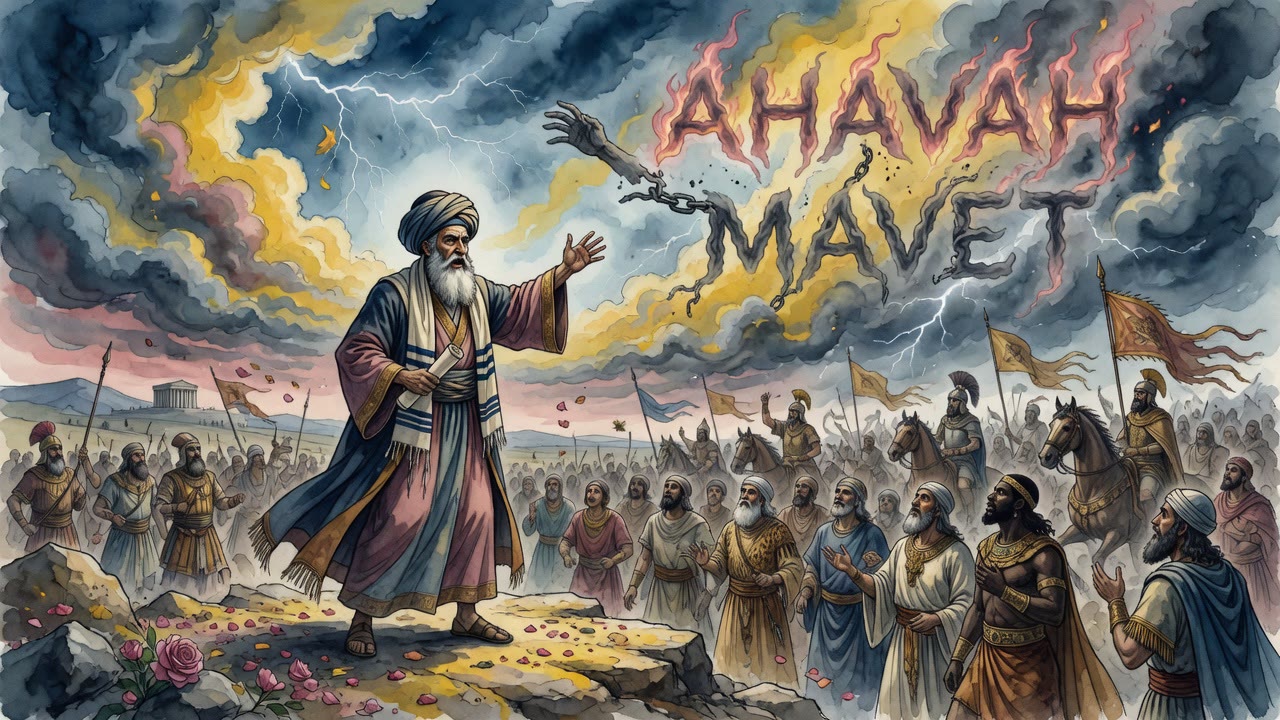
Rabbi Shimon ben Yohai asked Rabbi Elazar ben Rabbi Yosei if he knew what crown Song of Songs meant when it said a mother crowned Solomon on his wedding day (Song of Songs 3:11). Rabbi Elazar did not reach for gold first. He reached for a king and a growing love that kept changing the girl's name.
Israel Climbed From Daughter to Mother in Song Click for full size

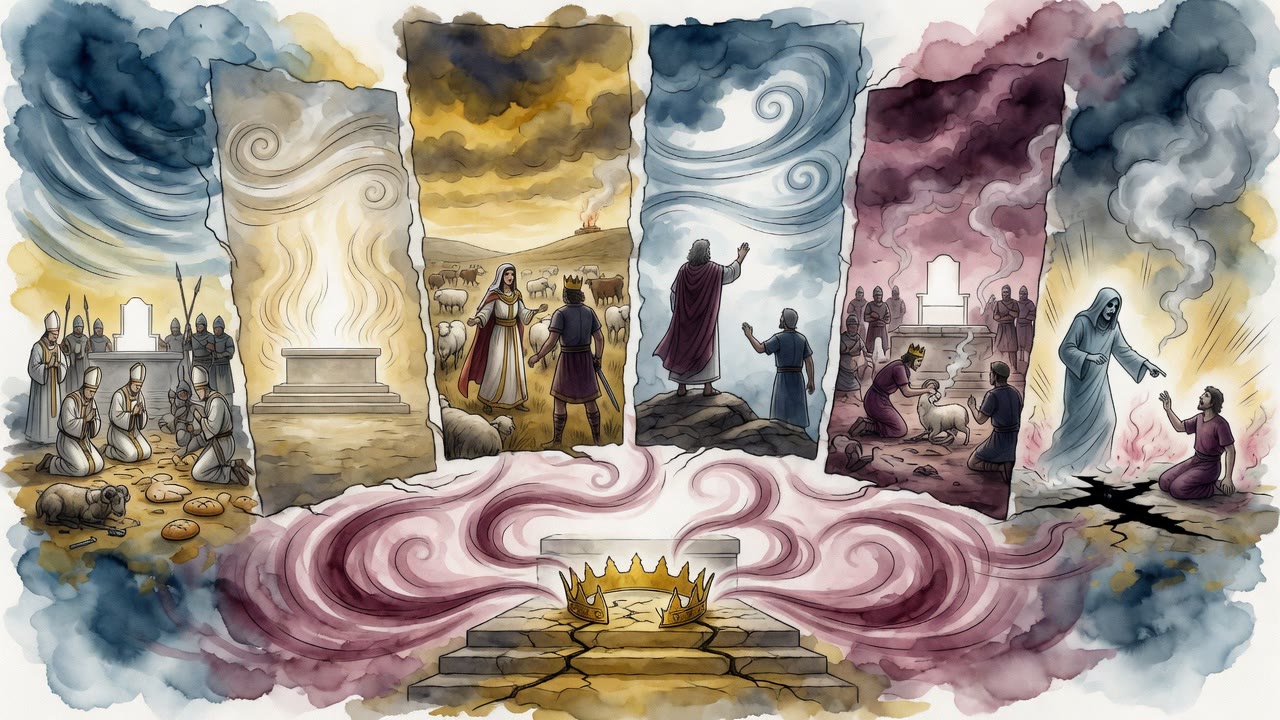
Daughter. Then sister. Then mother. The titles climbed until the father of the parable had no colder word left.

Three Names for One Beloved

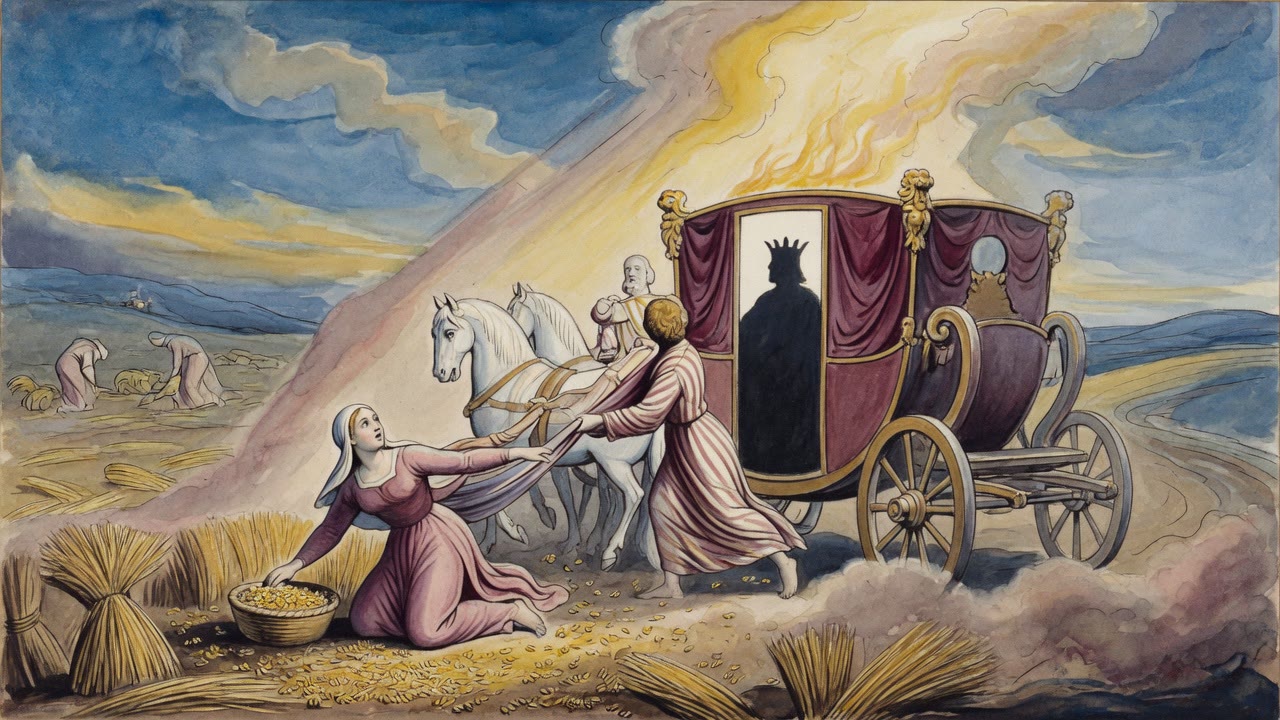
At first the king called her "My daughter." Distance and protection sat in the word. Love thickened. He began to say "My sister," the language of nearness without yet surrendering hierarchy. Love thickened again until he called her "My mother," as if the child had become the source of his own life.

Rabbi Elazar laid the parable over Israel. God calls them daughter in the psalm that says, "Hear, My daughter, and see" (Psalms 45:11). God calls them sister when Song of Songs knocks, "Open for me, my sister, my lover" (Song of Songs 5:2). God calls them mother through a reading of Isaiah's "My nation" that can be heard, without the vowel, as "My mother" (Isaiah 51:4). The intimacy shocks on purpose. A people can become so necessary to the Lover that the Lover speaks as if born from their faithfulness.

Rabbi Shimon kissed Rabbi Elazar on the head. The journey, he said, was worth that single teaching. A kiss for a map of love that refused to stay polite.

What Crown Did Bathsheba Place

Rabbi Hanina bar Yitzhak objected on historical grounds. Scripture never shows Bathsheba crafting a crown for Solomon. So what crown does the verse mean? The midrash turns the metal into a moment. The crown is the day of the heart's rejoicing, the wedding of God and Israel, the hour when Sinai bound them, or the hour when the Tabernacle and later the Temple made the bond public.

Solomon, whose name holds peace, becomes a figure for the King who makes complete creations. Bar Kappara even said Adam and Eve were made as if twenty years old, finished at once. The crown is not only jewelry. It is the public sign that a relationship has reached a feast day.

Daughters of Zion are told to look. Looking is part of the rite. Israel must see itself crowned and see the King crowned by the mother's hands, whether those hands are Bathsheba's love or the Torah's shaping of a people into a bride.

Bride Ten Times Over

Another chorus of teachers counted the word bride. Six times in Song of Songs alone the beloved is called bride, from the Lebanon summons to the locked garden and the arrival in the garden (Song of Songs 4:8-12, 5:1). Four more times the prophets add the sound of groom and bride, the bedecked bride of Isaiah, until the tally reaches ten.

Ten is not casual. It is a full measure of intimacy, a repeated insistence that the bond is nuptial, not merely political. A nation called daughter, sister, mother is also called bride until the ear cannot pretend the relationship is cool.

The prophets heard wedding music in ruined streets and future streets alike. Jeremiah's glad sound of groom and bride is both memory and promise. The midrash refuses to let exile erase the marriage vocabulary.

Love That Will Not Stay One Word

Names change because love refuses stagnation. A fixed title can become a cage. Daughter alone would keep Israel childish. Sister alone might stall at companionship. Mother alone would invert without the earlier steps. The sequence is the story. Growth is the theology.

When Israel fails, the older colder names can return in prophetic anger. When Israel returns, the warmer names climb again. The crown on the wedding day is the public peak of that climb, metal and metaphor at once.

Rabbi Elazar's parable leaves God almost dependent on Israel's answering love, not as weakness, but as chosen interdependence. The kiss on the teacher's head is the human echo. Learning that deep deserves more than a nod. It deserves the mouth of a colleague on the skull of a friend who just made the Song dangerous and tender in the same breath.

Stand in any later generation that still sings Song of Songs and the climb remains available. Daughter. Sister. Mother. Bride. Crown. The King still searches for a people willing to be called all of it.

The older tellings keep the pressure on bodies and choices, not on slogans. Names, places, and hours do the work. That is why the scene still moves when the century of the source is named only at the end.

Concrete detail is the craft that keeps the myth from floating. A well, a wall, a furnace, a prison ear, a crown, a fleeing king, a mother turned to smoke. Each image earns its keep by forcing a decision inside the story-world.


← All myths
From the tradition

Sources

3 sources

The texts behind this telling. Some cards carry a translation of the source; others are our own retelling of it, and each card says which. Every card links out to the original.

Shir HaShirim Rabbah 5:2Shir HaShirim Rabbah

Retold in our words. Read the original at the link below.The Sefaria Midrash Rabbah, 2022 · CC-BY

Shir HaShirim Rabbah opens the verse about a crown, "At the crown with which his mother crowned him" (Song of Songs 3:11), and turns it into a portrait of God's love for Israel.

Rabbi Shimon ben Yoḥai asks Rabbi Elazar ben Rabbi Yosei if he knows what this verse refers to. Rabbi Elazar responds with a stunning analogy. He compares God’s relationship with Israel to a king and his daughter. At first, the king calls her "My daughter." But his love grows so much that he begins calling her "My sister." And finally, his love is so profound, so encompassing, that he calls her "My mother."

Similarly, Rabbi Elazar explains, God first calls Israel "My daughter," as we see in (Psalms 45:11): "Hear, My daughter, and see." The love deepens, and God calls them "My sister," as in (Song of Songs 5:2): "Open for me, my sister, my lover." But it doesn’t stop there. The relationship evolves to its most intimate form when God calls them "My mother," based on a play on words in (Isaiah 51:4). The verse says "le’umi," which means "My nation," but when written without the vowel marker vav, it can also be read as "le’imi," meaning "My mother." (This interpretation is highlighted in the Etz Yosef commentary.)

God calling Israel "My mother"? Rabbi Shimon ben Yoḥai was so moved by this explanation that he kissed Rabbi Elazar on the head, declaring that hearing just this was worth the entire journey. It illustrates an intimacy and interdependence that is truly.

But the discussion doesn’t end there. Rabbi Ḥanina bar Yitzḥak raises a different point. He notes that the Bible doesn't say Batsheva ever made a crown for Solomon. So, what crown is the verse talking about?

Rabbi Ḥanina suggests that the "crown" isn't a literal crown, but a metaphor for the beauty and splendor of the Mishkan, the Tent of Meeting. Just as a crown is adorned with jewels, the Tabernacle was decorated with beautiful sky-blue, purple, scarlet wool, and linen.

Rabbi Yehoshua of Sikhnin, citing Rabbi Levi, adds another layer. He explains that when God instructed Moses to build the Tabernacle, it wasn't just about practicality. God could have just told Moses to put up four poles and stretch a curtain! Instead, God showed Moses a vision of fiery colors – red, green, black, and white – and told him to build it according to that vision.

Moses, understandably, was a bit confused. "Master of the universe," he asked, "where am I going to find black, red, green, and white fire?" God responded, "In their configuration, that you are being shown on the mountain" (Exodus 25:40). It wasn’t about replicating the fire literally, but about capturing its essence, its pattern.

Rabbi Avun offers an analogy: A king asks a member of his household to recreate a portrait of him. The household member protests, "My lord, am I able to create one like it?" The king replies, "You, with your materials, and I with my glory." It's a collaboration, a partnership. God wasn't expecting Moses to literally replicate the divine, but to create a representation using earthly materials.

Rabbi Berekhya, quoting Rabbi Betzalel, offers a similar image: a king appears to a member of his household in a magnificent, bejeweled garment and asks him to create one like it. The person questions their ability, and the king essentially says, "Just do your best."

The key takeaway here is that the Tabernacle was meant to be a reflection of the divine realm. As Rabbi Berekhya emphasizes, the Torah doesn't just say "Stand up acacia wood," but "[acacia wood], standing" (Exodus 26:15), as if they are standing among the hosts on high. The rabbis believed that if we created something below that mirrored the heavens above, God would "abandon" his heavenly council and dwell among us.

Rabbi Ḥiya bar Abba adds that the gold hooks in the Tabernacle were even designed to resemble stars in the sky! It was all about creating a connection between the earthly and the divine.

Finally, the passage returns to the Song of Songs, interpreting "the day of his wedding" as the giving of the Torah at Sinai, a moment of profound union between God and Israel. "The day of the rejoicing of his heart" is then linked to the words of Torah themselves, or alternatively, the Tent of Meeting and the Temple.

So, what does it all mean? This passage from Shir HaShirim Rabbah offers a multi-layered understanding of God's relationship with Israel. It's a love story that evolves from parent-child to sibling to the deepest intimacy of mother and child. It's also a story about how we can create spaces, both physical and spiritual, that reflect the divine and invite God's presence into our lives. And how can we deepen our own relationship with the Divine to move towards greater intimacy?

Full source
Shir HaShirim Rabbah 3:11Shir HaShirim Rabbah

Retold in our words. Read the original at the link below.The Sefaria Midrash Rabbah, 2022 · CC-BY

We start with a verse: “Emerge, daughters of Zion, and gaze at King Solomon, at the crown with which his mother crowned him on the day of his wedding, and on the day of the rejoicing of his heart” (Song of Songs 3:11). But the Rabbis, in their insightful way, take this simple verse as a springboard for much, much more.

First, who are these "sons. conspicuous [metzuyanim] for me"? The text suggests they are conspicuous "in haircut, in circumcision, in ritual fringes." And King Solomon [Shlomo]? He's not just a historical figure, but a symbol. He represents "the King who created perfect [shelemot] creations." Everything from the sun and moon to the stars and constellations were created in their completeness. Bar Kappara even says that Adam and Eve were created as if they were twenty years old!

The ideas go deeper. King Solomon, whose name, Shlomo, is linked to peace (shalom), represents the King who brings peace. "At King Solomon [Shlomo]," the text says, "the King who made peace between His works and His creatures." How did He do that? By ensuring Abraham wasn’t harmed by fire, Isaac wasn’t harmed by the sword, and Jacob wasn’t harmed in his struggle with an angel. It’s a powerful image of divine protection and the maintenance of balance.

The commentary continues, exploring how God makes peace even between seemingly contradictory elements. Rabbi Shimon ben Yoḥai teaches that the firmament is made of snow, while the celestial creatures are made of fire. We find verses in Ezekiel (1:22, 1:13, 1:14) that support this idea, describing a firmament "resembling the awesome ice" and creatures with "the appearance was like fiery coals." Yet, one doesn't extinguish the other! Fire and snow existing in harmony, not destroying each other.

The text goes on to personify this balance with the angels: Mikhael, the angel of snow, and Gabriel, the angel of fire. Again, they exist in harmony. Rabbi Avin even takes it a step further, suggesting that even within a single angel, who is half snow and half fire, God ensures peace. This angel is described in (Daniel 10:6) with five different elements: beryl, lightning, torches of fire, burnished brass, and the voice of a multitude. Each is unique, yet they coexist within a single being.

This theme continues, with verses from Psalms, Deuteronomy and Daniel being brought to bear: water above, consuming fire, and a throne of sparks. And yet, according to Rabbi Yoḥanan, “He makes peace in His high places” (Job 25:2). The firmament is water, the stars are fire, and they don't harm each other. The sun, it is said, has never seen the defect of the moon!

Even the plagues of Egypt, a time of immense disruption, are seen through the lens of harmony. Remember the hail and fire? "There was hail, and fire aflame within the hail” (Exodus 9:24). Rabbi Yuda describes bowls of hail filled with fire, while Rabbi Neḥemya sees fire and hail intermingled. The Rabbis see this as a miracle within a miracle. Rabbi Aḥa uses the analogy of two warring legions who, seeing their king's war intensifying, make peace to fight together. In the same way, fire and hail, enemies by nature, unite to wage war against the Egyptians, fulfilling God’s will.

So, what does all this mean? This passage from Shir HaShirim Rabbah isn't just about angels and celestial bodies. It's about the fundamental principle of balance in the universe. It's about how seemingly opposing forces can coexist, even collaborate, when guided by a higher purpose. It’s a reminder that even in times of chaos and conflict, harmony is possible, and that maybe, just maybe, the secret to peace lies in recognizing the delicate balance that sustains us all.

Full source
Shir HaShirim Rabbah 4:10Shir HaShirim Rabbah

Retold in our words. Read the original at the link below.The Sefaria Midrash Rabbah, 2022 · CC-BY

The rabbis of old saw something truly profound in this verse. Rabbi Berekhya and Rabbi Ḥelbo, quoting Rabbi Shmuel bar Naḥman, point out that the word "bride" appears no less than ten times to describe Israel! Six times right there in the Song of Songs itself, and four more times scattered throughout the Prophets. Six times in Song of Songs: “With me from Lebanon, my bride” (4:8), “you have charmed me, my sister, my bride” (4:9), “how fair is your loving, my sister, my bride” (4:10), “your lips drip [nectar] my bride” (4:11), “a locked garden is my sister, my bride” (4:12), “I came to my garden, my sister, my bride” (5:1). Six instances in just one book! It's almost like the poem can't stop reiterating the closeness, the intimacy, of this bond.

Then, the prophets echo the same sentiment. We hear “the sound of gladness and the sound of joy, the sound of a groom and the sound of a bride” in Jeremiah (33:11). Isaiah (61:10) describes Israel as "like a bride who bedecks herself with her jewelry." Again in Isaiah (49:18), we read, "you will tie them like a bride," and finally, in (Isaiah 62:5), "like a bridegroom rejoicing over his bride."

Why this repetition? What's the significance of calling Israel "bride" so many times?

The Midrash (rabbinic interpretive commentary), in Shir HaShirim Rabbah, draws a fascinating parallel. It says that corresponding to these ten times Israel is called "bride," the Holy One, blessed be He, donned ten garments. Garments that represent different facets of His power, His justice, and His glory.

These aren't literal garments, of course. They are metaphors for God's attributes, His ways of interacting with the world. We see them described in the Psalms and the Prophets. “The Lord reigns; He is clothed in grandeur” (Psalms 93:1); “The Lord is clothed with strength” (Psalms 93:1); “Girded” (Psalms 93:1); “He donned righteousness like armor” (Isaiah 59:17); “He donned garments of vengeance” (Isaiah 59:17); “Attire” (Isaiah 59:17); “He clothed Himself with zealotry like a coat” (Isaiah 59:17); “This that is majestic in attire” (Isaiah 63:1); “Why is there red on Your attire” (Isaiah 63:2); and finally, “You are clothed in splendor and glory” (Psalms 104:1).

Ten garments, ten ways that God reveals Himself.

So, what’s the connection? The Midrash suggests this is "in order to exact retribution from the nations of the world who prevented Israel from fulfilling the Ten Commandments, which [Israel] was holding close to them like a bride."

Essentially, the ten garments of God are a response to the nations that tried to separate Israel from the mitzvot (commandments). Israel held onto those commandments like a bride cherishes her marriage contract, her ketubah (a marriage contract). And God, in turn, dons these "garments" to defend and protect His beloved.

Finally, the Midrash brings us back to the "fragrance of your oils than all spices" from our original verse. Rabbi Shmuel bar Naḥman offers a beautiful analogy: Just like unscented oil, when infused with different fragrances, yields a multitude of scents, so too, when we explore the Torah, we uncover countless layers of meaning and wisdom.

So, what does it all mean?

Perhaps it’s this: the relationship between God and Israel is a deep, many-sided, and enduring love story. A story expressed through the language of bride and groom, of garments and commandments, of fragrances and interpretations. And like any great love story, it's a story worth exploring again and again, uncovering new layers of meaning each time.

Full source